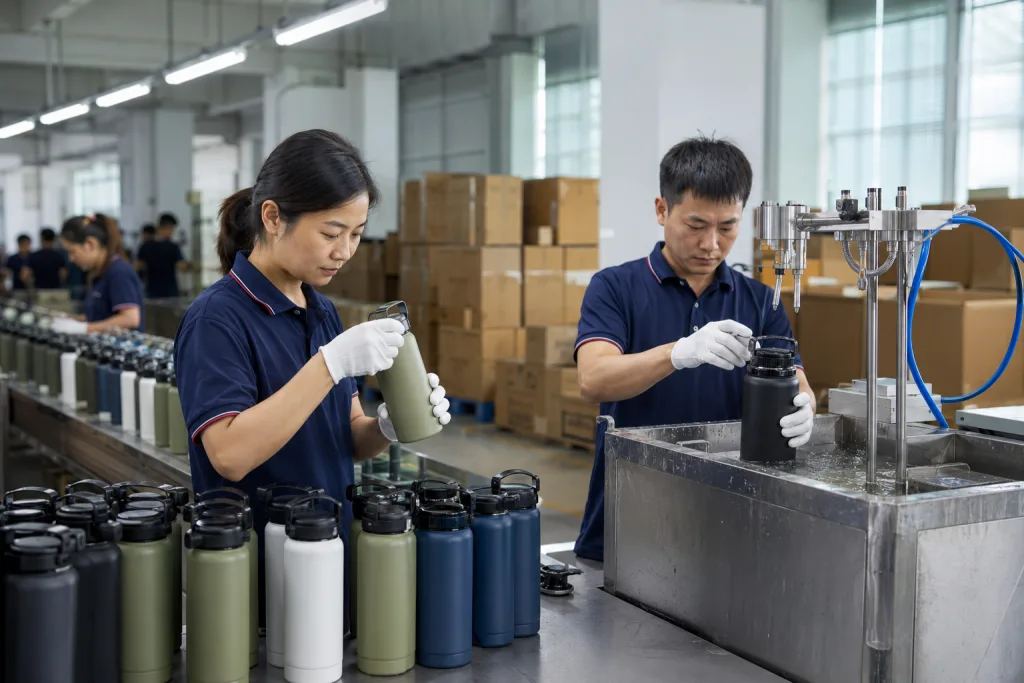
Key Takeaways
- For a 750ml single-wall stainless custom canteen, realistic MOQ is usually 1,000-3,000 units and lead time 25-35 days after sample approval
- Decoration cost can shift unit price by USD 0.18-0.85 depending on silkscreen, laser engraving, powder coating, or wrap print
- Ask for 304 stainless inside and out at 0.4-0.5mm wall thickness unless your market requires 316 interior for salt or acidic use
- Use a pre-shipment inspection at AQL 2.5/4.0 with leak, drop, odor, carton, and logo adhesion checks before paying the final 70%
You have a project brief, a target landed cost, and a customer asking for an outdoor canteen custom made fast. Sounds easy. Then the first sample lands 38 g overweight, the cap starts leaking at 60°C, or QC pulled the sample after one carton drop and the logo was already scuffed. Most of these issues start before production, while the spec is still loose and each canteen manufacturer fills the gaps in their own way.
The better method is the one we run on the factory side in Zhejiang, China: lock the use case first, freeze the drawing to the mm, quote decoration at the real line cost, then inspect against AQL before balance payment. This is the wrong question to ask if the buyer only says, "How fast can you ship?" Speed without a locked spec usually turns into a remake. If you source custom drinkware for retail, events, or distributor canteen programs in Europe or North America, this is the practical path from inquiry to shipment.
Start with the real use case
A buyer sends an RFQ for an outdoor canteen custom made order. The brief says: 750ml, matte green, carry loop, one-color logo, Europe delivery, target FOB under USD 3.20. Good start. Not enough to quote cleanly. Before we price anything on the line, we need the real use case. Last month a buyer wrote “mat green” on the PO, then flagged the sample because they meant Pantone 5605C with a fine powder texture, not standard matte.
Ask four blunt questions first. Who uses it: hikers, school groups, corporate promo buyers, or a retail outdoor chain with a 1.2m shelf-drop test? What goes inside: cold water only, hot tea, or acidic sports drinks below pH 4? How hard will it be used: office commute, campsite, or club-store retail where cartons get thrown around? Which market: EU, UK, US, or Canada? These answers drive material choice, lid structure, test plan, and which canteen customizable options are realistic. This is the wrong question to skip.
- Promotional canteen custom: usually single-wall 18/8 stainless, lower cost, lighter weight, often around 220g to 280g for a 750ml body, and not built for hot retention.
- Retail custom canteen: often vacuum insulated, tighter cosmetic limits, stronger packaging like 5-layer mail-drop cartons, and stricter SKU control on caps, colors, and barcode labels.
- Distributor growler or custom growler programs: thicker body, larger neck, and pressure use must be stated in writing if carbonated filling is mentioned; we have seen buyers assume this and the math doesn’t work.
At BottleForge Industrial, we start with usage because it stops the most common quoting mistake: comparing prices for different builds. One canteen supplier quotes 0.35mm wall thickness; another runs 0.5mm. One price includes powder coating at 60 to 80μm; another is spray paint only. One includes REACH-ready decoration ink, another does not. QC pulled a sample this spring where the lid gasket passed for water but failed after citrus soak. If you are a canteen distributor or distributor drinkware buyer, your job is not to chase the lowest unit price. Your job is to remove ambiguity before the factory prices the wrong bottle.
When the spec is vague, the quote is only a guess with a logo attached.
Build the specification before asking price
After the use case is clear, lock the spec the factory will run on the line. For a typical customized canteen order for Europe, a workable baseline is: 750ml capacity, SUS304 inner and outer, single-wall body, 0.45mm body thickness, screw cap with PP inner and silicone seal, powder-coated exterior, laser logo, individually bagged, egg-crate carton packing. Put it on one sheet. We’ve seen POs come in with “single wall” typed on page 1 and “double wall” on page 3, and then everyone argues after sampling. If your customer wants vacuum insulation, write it plain and add the retention target, for example 12 hours hot and 24 hours cold at room temperature.
What to freeze on the drawing
- Capacity tolerance, for example 750ml plus or minus 3%
- Net weight target, such as 265g to 310g for single-wall stainless
- Body diameter and mouth diameter
- Material grade: 18/8 or 304 stainless, PP grade, silicone grade
- Surface finish: powder coat, spray paint, brushed, electropolish
- Logo method and size in mm
- Packaging detail down to barcode label position
Leave these items open, and the canteen vendor will fill the gaps for you. That is where repeat orders start drifting. QC pulled the sample once on a reorder because the mouth diameter moved by 1.5mm, and the buyer’s old lid stock no longer fit. Buyers ask about 316 stainless all the time. This is the wrong question to ask. Usually no, unless the bottle will hold more aggressive liquids, the brand is selling a premium story, or the customer spec already calls for it. For most outdoor water use, 304 is the sensible cost-performance choice.
Price matters, so ask for it straight after the spec is frozen. A plain 750ml single-wall custom canteen in China often lands around USD 2.10-2.90 FOB Ningbo at 3,000 units with simple one-color print. Add vacuum insulation and you are more likely in the USD 3.80-5.80 range depending on shape and cap. A customized growler at 1.2L to 1.9L is typically higher again because stainless usage goes up, carton size grows, and polishing runs slower on the line. We ship these every month, and the gap is not small. A canteen manufacturer with 300,000 units per month capacity can quote fast, but if they do not ask for wall thickness, logo size in mm, or even carton pack-out, be careful; the math doesn’t work.
Choose decoration that survives handling
Most complaints on canteen promo orders are cosmetic, not structural. The bottle still holds water. The logo scratches, registration shifts by 1-2 mm, or the color batch from run two does not match the approved sample on the line. We have seen QC pull a sample that passed leak test and still got rejected because the buyer flagged the print edge. Decoration needs to be treated like an engineering spec, not just artwork.
For outdoor programs, powder coating plus laser engraving is usually the safe call. It hides small handling marks, feels better in hand, and holds up better than basic silkscreen when 24 units are packed tight in one master carton. We run this combo a lot on 304 stainless. If you need bright spot colors or a large brand block, silkscreen is fine, but ask for adhesion testing and write down what print variation is acceptable. Full-wrap heat transfer looks strong on a customized drinkware retail item, but the math does not work for every project; unit cost is higher, and rejection risk goes up fast if the seam or alignment drifts.
- Silkscreen: adds roughly USD 0.08-0.18 per color, good for simple logos, moderate abrasion resistance.
- Laser engraving: about USD 0.12-0.25, permanent mark, best for powder-coated stainless.
- Powder coating: usually USD 0.28-0.55 depending on color and texture.
- Digital or wrap print: often USD 0.35-0.85, best for retail visuals, more QC points.
If your buyer wants a canteen customized for resale on marketplaces, check barcode handling early. We have had POs delayed over one FNSKU placed across a curve instead of a flat panel. For Amazon FBA projects, carton marks, FNSKU placement, suffocation warning, and carton dimension limits should be signed off before mass production starts. A distributor growler or customizable growler program needs tighter logo placement control too, because the wider body makes a 2 mm registration error easy to spot.
Ask the canteen suppliers for a cross-hatch adhesion test result on painted areas and a rub test on printed logos. This is the right question to ask. Not every canteen factory runs the same internal standard, so put your own acceptance criteria into the PO, with clear pass/fail notes and sample photos if needed. We have even seen a PO typo switch matte black to matt back. You do not need lab drama. You need a finish that still looks acceptable after warehouse handling, carton rub, and one drop test from 80 cm.
Sample approval is where delays start
Most lead time slips do not start on the line. They start in sample approval. For a new canteen custom project from Zhejiang, China, a normal schedule looks like this: 2-4 days for quotation and artwork review, 7-12 days for pre-production sample, 2-5 days for your comments, 25-35 days for mass production after approval, and 3-7 days for inspection and shipping release. QC pulled the sample, the buyer sat on comments for 4 days, and the whole plan moved. That happens a lot. If there is a new mold, add 20-30 days and tool cost that can range from USD 2,000 to 8,000 depending on body complexity and cap design.
Sample review is not a beauty contest. Use a checklist. This is the right question to ask on the first pass, not whether the matte color feels premium under office lights. We ask buyers to review the sample in five passes, and on our side we usually keep a digital caliper and torque tester next to the sample table:
- Dimensional: capacity, weight, height, mouth diameter, thread fit.
- Functional: leak test, cap torque feel, handle strength, hot water pressure change.
- Cosmetic: color match, print position, weld marks, dents, base stability.
- Packing: inner box fit, barcode scan, master carton drop condition.
- Compliance: material declarations, test plan, labeling language.
Do not approve a sample by email with "looks good" only. We have seen this go sideways. Send a signed sample approval sheet. State whether the approved point is color reference, logo position, or complete gold sample standard. One buyer approved a navy bottle, but the PO only said "blue," and production turned into a 1.5 Delta E argument no one could win. This matters later if your canteen vendors say the production is "within normal tolerance." Tolerance is acceptable only when both sides wrote it down.
If you source from multiple canteen manufacturers in China, use one approval form across all factories. We run into the same pushback every season: one supplier says the logo centerline is measured from the shoulder, another measures from the base. A 3 mm difference is enough for the buyer to flag it. Standardizing the form saves time and cuts off that argument early. For repeat distributor canteen business, consistency is worth more than squeezing the last USD 0.05 from the first order. The math doesn't work if the first shipment creates 2 weeks of claims.
Plan compliance and testing early
European and North American buyers usually know they need safe materials, yet a lot of them ask for reports after the PPS sample is approved. We see this on the line. For an outdoor canteen custom made order, the wrong question is not "Do you have tests?" The right question is "Which tests apply to this exact build, decoration, and sales market?" If the bottle body is 304 stainless, the lid has PP, the gasket is silicone, and the logo uses a two-color screen print, those parts do not sit under the same risk check.
For the EU, buyers often need REACH review on coatings and accessories, LFGB-style expectations for food-contact parts based on the customer standard, and packaging compliance. For the US, common requests are FDA-related food-contact expectations for materials, California Proposition 65 review where applicable, and ASTM transit or drop expectations for retail packaging. We ship both markets, and the buyer flagged this more than once: a passed bottle report does not cover the gift box insert if that insert touches the rim during packing. Social compliance like BSCI or Sedex also matters for brand owners, while ISO 9001 is often requested as a system benchmark.
For a standard stainless canteen supplier program, the practical documentation pack is:
- Material declaration for stainless, PP, and silicone
- Food-contact test report for the relevant market or buyer standard
- Coating or ink declaration if decorated
- BSCI or equivalent social audit if required
- Factory QC flow and AQL standard
Be realistic about timing. If you change the cap resin, gasket supplier, or paint system after testing, the old report may not support the exact shipped item. We have seen this go sideways after a 0.8 mm silicone seal was swapped to a new vendor to save cost. Same drawing, different source. That is why serious canteen vendors freeze the bill of materials before sending compliance samples. This matters even more for customized growler and customizable drinkware projects with extra accessories, because every strap, bamboo lid insert, or carry pouch adds one more material check.
Testing does not need to be expensive. It needs to fit the product. A single-wall bottle for cold water should not be treated like a thermal jug, and the math doesn't work if you test every SKU as if it were the highest-risk item. A custom growler sold for beer is a separate case, because buyers may assume pressure performance unless you limit the use clearly on packaging. QC pulled a sample last season where the PO said "beer growler" but the artwork said "for cold drinks only"—that typo alone changed the review point.
Run production with clear QC gates
After you pay the deposit, usually 30% TT, control shifts to process gates. A solid canteen factory runs IQC on incoming parts, IPQC on the line during forming and coating, and FQC before packing. You do not need to stand beside the spray booth with a caliper in hand, but you do need clear hold points the factory cannot skip.
For a 3,000-unit order, we usually set 3 control points. First, approve raw material and color swatches before full coating; one Pantone card and one powder sample panel save rework. Second, ask for inline photos or video after the first 100-200 pieces are assembled and decorated, because this is where QC pulled the sample and the buyer flagged a logo sitting 2 mm low. Third, book a pre-shipment inspection when at least 80% is packed. Use AQL 2.5 for major defects and 4.0 for minor unless your customer contract requires stricter levels. If a supplier says final inspection alone is enough, this is the wrong question to ask.
Typical defect list for a canteen customized order
- Major: leaking cap, wrong capacity, sharp edge, wrong logo, unstable base, broken handle
- Minor: slight color variance, small print pinhole, carton scuff, light weld mark within approved zone
Your inspector needs to do more than look. For insulated models, include vacuum retention verification; on our line, that usually means sample testing after sealing, not just checking appearance. Ask for 100% leak test confirmation from the factory, then add a random hot water leak spot check, barcode scan, carton drop test, and count accuracy. If packaging is retail-ready, check the EAN or UPC against the purchase order. We have seen a single PO typo flip two digits and hold a shipment. If it is FBA, confirm FNSKU and carton labels exactly. Small label mistakes turn into expensive warehouse relabeling later.
A lot of canteen suppliers in China promise replacement for defects, but replacement after arrival does not recover a missed season. We ship outdoor programs where 12 days late means the promo window is gone, and the math doesn't work. That is why pre-shipment inspection matters more than warranty wording. At BottleForge Industrial, our normal MOQ starts at 1,000 units for standard models, and lead time is usually 25-35 days after sample approval. Those numbers hold only if the QC gates are followed. Skip them because the vessel "looks simple," and we have seen this go sideways fast.
Land the order without margin surprises
The last step is commercial, not technical. Make sure landed cost still holds after freight, duty, packaging upgrades, and scrap allowance. New buyers often compare FOB only, then get hit later. The line item that hurts is usually carton space, not the bottle. Serious canteen distributors check delivered margin by carton and by cubic meter, because that is where the math breaks if the packout is wrong.
Ask your canteen manufacturer for carton dimensions, gross weight, and units per master carton before approval. Ask for it before deposit if possible. We run into this all the time: a shape looks sharp in a render, then ships badly once QC stacks the cartons on a 1.2m pallet. Tall narrow bottles waste container space. Oversized gift boxes can cost more in freight than the logo upgrade that sold the program. For a standard 750ml single-wall customized canteen, efficient packing might be 24 units per carton with gross weight around 8.5-10.5kg. Vacuum bottles usually pack fewer units and weigh more. A custom growler is often the worst case per shipped unit because cubic volume eats margin fast.
Payment terms for a first order from China are typically 30% deposit, 70% balance before shipment. That part is normal. If repeat orders are steady and your forecast is clean for 3 to 6 months, some canteen suppliers will talk about better terms. Do not give up inspection rights in exchange for open-account promises. We have seen this go sideways after one clean trial order. Your strongest position is before the 70% balance is released, when QC pulled the sample and the rework list is still on the table.
For distributor canteen and distributor growler programs, ask for spare parts support at the quote stage. Extra caps, straws, gaskets, or replacement loops at 1-2% of order volume protect margin later, and this is not a small detail. The buyer flagged this on one PO after finding the straw lid and chug lid used different silicone rings by 1mm. The cheapest quote often ignored service parts completely. If your program includes several SKUs, consolidate components where possible. Shared caps across 500ml, 750ml, and 1L sizes cut inventory mistakes for you and the canteen vendor.
A good order feels boring when it ships. That is the goal. The drawing is frozen, the carton marks are correct, the AQL report is clean, and the numbers still match the original target. We ship smoother when there are no late edits to barcode position or a typo in the carton mark. That is what you want from a canteen supplier in Zhejiang, China or anywhere else: fewer surprises, less sales talk.
Get your canteen spec reviewed before you place it
Send your target price, volume, market, and artwork. We will review the spec, flag risk points, and suggest a practical China production plan.
Frequently asked questions
What is the normal MOQ for outdoor canteen custom made orders?
For standard models from a canteen factory in China, MOQ is usually 1,000 units per color for single-wall stainless and 1,000-3,000 units for vacuum insulated styles. If you need a custom color box, mixed logo positions, or unusual cap colors, the practical MOQ often moves toward 2,000-3,000 units. A fully new mold is different and can start at 3,000-5,000 units plus tooling. Some canteen manufacturers will accept 500 units for stock shapes with laser logo only, but unit price is higher and decoration choices are limited. If you are a distributor canteen buyer testing a new market, ask for one body style with shared cap components to keep MOQ under control.
How much should I budget per unit for a customized canteen?
A realistic FOB China budget for a 750ml single-wall stainless custom canteen is about USD 2.10-2.90 at 3,000 units with simple powder coat or one-color print. A vacuum insulated version is more often USD 3.80-5.80 depending on body shape, cap complexity, and decoration. Add roughly USD 0.08-0.18 for silkscreen, USD 0.12-0.25 for laser engraving, and USD 0.28-0.55 for powder coating if not already included. Gift box packaging can add another USD 0.35-0.90. If a canteen supplier quotes far below this range, check wall thickness, stainless grade, and packaging assumptions before you compare.
Which tests matter most before shipping to Europe or North America?
Start with food-contact safety documentation for the exact materials used: stainless steel, PP, silicone, paint, and inks if decorated. For Europe, buyers often ask for REACH-related declarations and food-contact support based on their internal standard. For North America, material safety review, labeling, and packaging checks are common. On the product side, run leak testing, odor check, coating adhesion, logo rub test, carton drop test, and capacity verification. For insulated bottles, confirm heat retention with a stated method, such as hot water starting at about 95°C and measured after 6 or 12 hours. If the BOM changes after testing, ask the canteen manufacturers to confirm whether the report still covers the shipped item.
How do I reduce defect risk on a first order from a new canteen manufacturer?
Do three things. First, issue a detailed specification sheet with material grade, wall thickness, finish, logo method, packaging, barcode details, and defect tolerances. Second, approve a signed pre-production sample instead of giving verbal approval. Third, book a pre-shipment inspection at AQL 2.5/4.0 when at least 80% of goods are packed. On a 3,000-unit order, also ask for inline photos after the first 100-200 pieces are coated and printed. The most common first-order problems are wrong color tone, logo position drift, leaking caps, and carton mark errors. A canteen vendor can usually prevent these if you lock the details early and inspect before balance payment.
Can I use the same factory for custom canteen, custom growler, and other custom drinkware lines?
Often yes, but check where the factory is truly strong. Many canteen suppliers handle stainless bottles, tumblers, and flasks well because the processes overlap: drawing, welding, vacuuming, polishing, coating, and printing. A custom growler or customizable growler may need different neck tooling, heavier gauge stainless, and more careful leak or pressure-related communication. If you want one canteen factory to support multiple SKUs, standardize lids, finishes, and packaging formats where possible. That helps control MOQ and spare parts inventory. Ask for monthly capacity by category, such as 300,000 bottle units and 50,000 growler units, not just a vague promise that they can make everything.