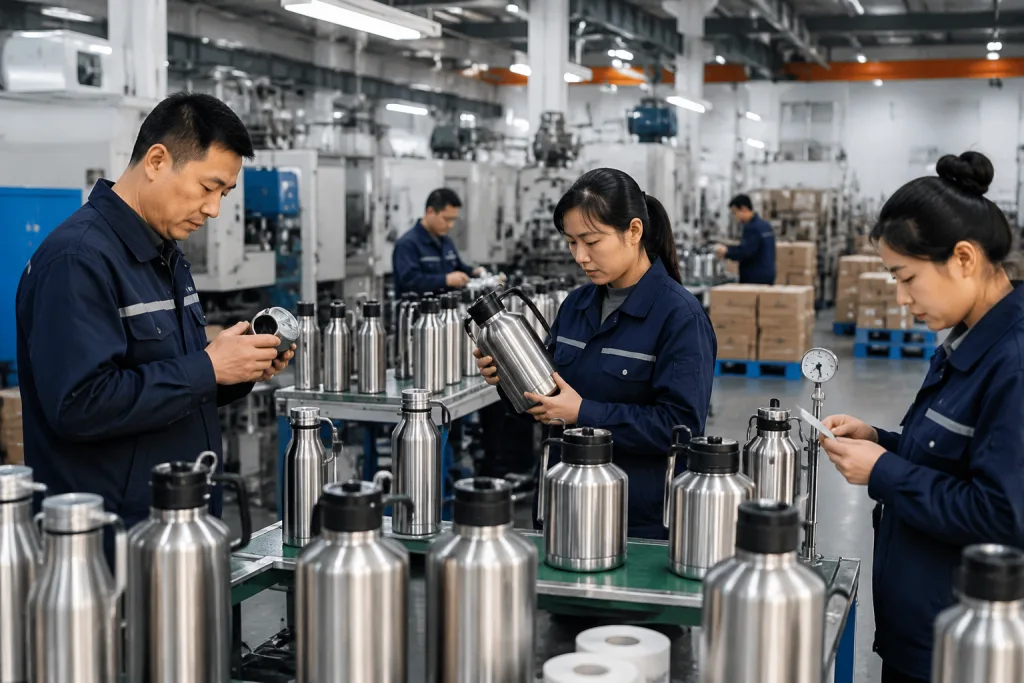
Key Takeaways
- A 304 single-wall canteen at 18/8 and 0.5 mm body thickness typically lands 8-15% higher than 201 steel but cuts rust complaints sharply
- Most outdoor canteen bulk projects start at MOQ 1,000 pcs per color, with custom packaging often pushing practical MOQ to 3,000 pcs
- Powder coating adds about USD 0.28-0.55 per unit and usually improves scratch resistance versus spray paint on field-use bottles
- AQL 2.5/4.0 final inspection and 24-hour leak testing reduce early claim rates more than adding one more logo approval round
You can place an outdoor canteen bulk order with almost any factory in China. That part is easy. The hard part is locking the right spec instead of chasing the lowest quote. Two canteens can look the same on a PDF and still come out 12% apart in unit weight, 20 days apart in lead time, and a full point apart in leak-claim rate after arrival in Europe or North America. We see this on the line all the time: same drawing, different neck tolerance by 0.3 mm, different result in the field.
If you are sourcing from Zhejiang or another China supply base, the spec sheet is where margin gets made or lost. Capacity tolerance, steel grade, mouth diameter, coating system, logo process, and carton drop performance each shift landed cost in a measurable way. This is the wrong question to ask if you start with price first. At BottleForge Industrial in Zhejiang, we tell buyers to slow down at the spec-line level before pushing on price, because QC pulled the sample more than once and found the PO said 304 stainless while the quote sheet was written as “SS” with no grade listed.
Start with body material
The first line on any outdoor canteen bulk spec should be the body material. That decision drives corrosion resistance, unit weight, taste carryover, and how easy the compliance file is to defend. For outdoor programs, the commercial choices are usually 18/8 stainless steel 304, lower-cost 201 stainless, aluminum, and sometimes Tritan on lightweight SKUs. If you sell into Europe or North America, 304 is the default for a wholesale canteen line that will see repeated contact with water, tea, coffee, or diluted sports drinks. On our side, the line usually checks incoming coil with a handheld XRF gun before production starts.
A typical single-wall stainless canteen uses 0.4-0.5 mm body thickness and 0.5-0.6 mm base thickness. Ask for net weight early. If a quote is too cheap, this is the first number we check. A 750 ml 304 single-wall canteen is often around 220-280 g depending on shape. If you see 185 g, the factory is likely shaving wall thickness. The saving is maybe USD 0.12-0.20 per unit, but dent risk climbs, especially on long-neck military-style shapes. We have seen buyers push back after drop-test dents at 76 cm, and the math does not work if returns start.
- 304 stainless: the standard choice for outdoor canteen bulk. Taste stays stable, buyer acceptance is stronger, and QC claims are easier to close.
- 201 stainless: lower cost and workable for some dry-use or promo programs, but corrosion risk is higher in wet storage or salty conditions. We have seen rust spots show up after 48-hour salt exposure.
- Aluminum: lighter and often cheaper, but the inside coating matters more, and denting is easier. QC pulled a sample last month with a 0.08 mm coating miss near the shoulder.
For drinkware wholesale programs sold under your own brand, ask for a mill certificate or at least a supplier declaration for steel grade. Also confirm REACH and LFGB or FDA food-contact compliance for your market. If your range also includes alcohol flask bulk or alcohol flask wholesale items, standardizing on 304 across the line makes material claims cleaner and customer service simpler. This is one place where mixing grades to save a few cents often goes sideways.
Capacity, dimensions, and fill reality
Capacity looks simple until quote sheets start crossing. Buyers often ask for 500 ml, 750 ml, and 1,000 ml canteens, but some factories quote brimful volume, not usable fill. On our line, QC pulled a 500 ml sample that held 536 ml to the rim, while sellable fill was closer to 500 ml once the cap and thread clearance were counted. That gap runs 20-40 ml on a 500 ml bottle and 40-70 ml on a 1,000 ml bottle. If you sell online or need exact labeling, specify both brimful capacity and nominal capacity.
Dimensions drive packing faster than most buyers expect. A 750 ml canteen at 72 mm diameter fits more backpack side pockets than one at 78 mm, and we have seen the buyer flag this after first sample because the bottle would not slide into a Decathlon-style mesh pocket. A loop cap can add 18-25 mm to packed height, which changes carton count and Amazon prep. This is where the math starts to bite. If your carton drops from 24 pcs to 20 pcs because of cap height, freight per unit jumps right away, and the math doesn't work if you are chasing a low FOB price only.
Spec lines worth fixing early
- Mouth diameter: 32 mm, 44 mm, or 50 mm changes cleaning ease and whether standard ice cubes pass without jamming.
- Height tolerance: keep to +/- 2 mm if you need strap lids, boot sleeves, or insert trays to fit across repeat orders.
- Weight tolerance: usually +/- 3% is realistic in mass production; we check this on a digital scale every 30 minutes on the line.
- Capacity tolerance: ask for +/- 3% or define a minimum usable volume, not just brimful overflow.
For a bulk canteen used outdoors, a wider mouth improves refill speed and cleaning. It also raises cap tooling cost and leak risk if the thread design is weak. We have seen this go sideways on 50 mm necks where the thread lead was shallow and torque drifted after 5,000 cycles on the cap tester. If you plan to build a broader bulk drinkware range with best wholesale drink bottle positioning, keep neck finishes shared across 2-3 capacities. Shared caps cut inventory SKUs in China and reduce your replacement-parts load later.
You are not buying milliliters on paper. You are buying a bottle that must fit a user’s hand, backpack pocket, filling line, and shipping carton at the same time.
Insulation and wall construction choices
Not every outdoor canteen bulk order should go to vacuum. Single-wall canteens are still the practical pick for low to mid-price outdoor promotions, scouting programs, workwear channels, and event merchandise. They are lighter, usually cheaper by USD 1.20-2.80 per unit than vacuum bottles in the same size range, and faster on the line. For repeat single-wall orders from Zhejiang, lead time is usually 25-35 days after deposit and artwork approval. On our floor, the spin-forming setup change is simpler, and that cuts waiting time between SKUs.
Vacuum canteens fit projects that need a temperature-retention claim. For a standard 500 ml vacuum body in 304/304 with copper lining, buyers usually ask for 8-12 hours hot and 18-24 hours cold, tested at room temperature around 20-25 degrees C. The cost jump is not just material. Vacuum bodies add extra welding passes, more leak-test points, and more scrap if insulation fails. We have seen QC pulled the sample after a base dimple measured over 0.5 mm, and that lot had to be reworked. That means higher cost and longer lead time, often 35-50 days for custom color orders. Some buyers ask only about temperature hours. This is the wrong question to ask. Ask scrap rate and leak-test method too.
If your assortment also includes growler bulk or wholesale growler products, wall construction matters more because fill volume is larger and buyer complaints come faster. A beer growler bulk item should usually be vacuum insulated if the end use is carrying cold beer outdoors for 3-5 hours. A single-wall growler wholesale program works only when cost is the main driver and the user accepts weak thermal performance. We shipped one single-wall growler program for a festival client, and the buyer flagged condensation on packed samples before launch.
- Single wall: lower unit cost, lighter carry weight, better fit for high-volume canteen wholesale. MOQ pressure is lower too.
- Double wall non-vacuum: uncommon in value sourcing. You add weight and assembly steps, but the thermal gain is small.
- Vacuum insulated: strongest thermal claim, but QA gets tighter. The line needs more leak checks and base inspection.
Ask how the factory tests vacuum retention. A serious drinkware wholesale supplier should not rely on spot checks alone. They should keep vacuum inspection records by batch and a clear reject standard for heat loss and base deformation. We run batch records by date code, and if the bottom plate shifts after vacuuming, QC marks it out before packing. If a factory cannot show that paperwork, the math does not work.
Surface finish and branding durability
Outdoor use wears finishes fast. Office samples don’t tell the full story. Keys, backpack buckles, grit, sunscreen, and repeat washing cut into the coating, and we see this first on the line with corner rub marks near the base ring. On a spec sheet, “matte black” says almost nothing. Write the coating system and the logo process as two separate specs.
For outdoor canteen bulk orders, the common body finishes are spray paint, powder coating, brushed steel, rubberized coating, and special UV print wraps. Powder coating is usually the best value if you care about field durability. On standard colors, it often adds USD 0.28-0.55 per unit over plain spray paint, and in our abrasion test the film build is often 60-80 μm instead of the thinner spray layer. Grip is better too. If you are building a wholesale drinkware line with premium positioning, powder coat is the safer baseline. Frankly, asking only for the cheapest black finish is the wrong question.
Logo choice needs to fit the sales channel and how the canteen gets used. Silkscreen is economical and fine for many bulk canteen projects, but it scratches faster under hard use; QC pulled the sample last month after a buckle-rub test left the white ink broken at the edge. Laser engraving costs more on coated bodies because you need a marked layer or a burn-through effect, yet it lasts longer in the field. Typical custom MOQ is 1,000 pcs per design per color, though some factories in China claim lower. We’ve seen this go sideways. Once you add custom boxes, barcode stickers, and mixed carton labels, the practical MOQ often lands at 2,000-3,000 pcs, and sometimes the buyer flagged a PO typo after labels were already printed.
What to lock before sampling
- Coating adhesion standard and cross-hatch test requirement.
- Salt spray expectation for metal accessories if used outdoors.
- Dishwasher claim: yes, no, or body-only.
- Logo position tolerance, usually +/- 2 mm to 3 mm.
If your product family includes beer tumbler bulk, beer tumbler wholesale, or alcohol flask wholesale bulk items, align branding methods across categories. This saves approval time and keeps the catalog look consistent. A Zhejiang factory running 600,000 units/month can hold that consistency only if the decoration spec is written clearly enough for production and QC to follow without guessing, down to logo height in mm and which Pantone goes on which lid SKU.
Cap system, seals, and leak control
Most field claims on canteen bulk orders come from caps, not bodies. We see this on the line all the time. Buyers will spend 2 hours on shade cards, then skip thread profile, silicone Shore hardness, and handle pull load. That is the wrong question to ask. A cap system needs its own spec sheet, same as a molded part or stamped component.
Start with cap material. PP is the standard run for most outdoor canteen programs because it molds fast and keeps cost under control at MOQ 3,000. Tritan is common for clear windows or transparent lids where the buyer wants to see fill level. Stainless-decor caps look premium on shelf, but they add assembly steps, glue control, and more rework if the sleeve sits 0.5 mm off-center. Then check the gasket. Food-grade silicone is normal, but hardness and groove fit decide whether the seal works after shipping. QC pulled the sample on one order last year and found the gasket channel was too shallow, so the seal rolled during torqueing at 12–14 lbf·in. If the thread start is rough or short, users cross-thread the cap and blame the bottle, and the complaint lands on your side.
A proper outdoor canteen bulk program should include a 24-hour inverted leak test on finished goods, plus torque verification on a defined sample size. On our side, we usually run assembled units through leak check after capping, then recheck after decoration because heat from logo curing has changed seal fit before. For final inspection, AQL 2.5 for major defects and 4.0 for minor defects is a common commercial standard. Leak is a major defect. Odor is often treated as major for food-contact items. If you are buying wholesale canteen or drinkware wholesale for retail packs, ask the factory to test assembled units after logo and after packing vibration, not only before decoration. We have seen this go sideways after a 6-hour carton vibration run where caps passed first inspection, then seeped after inner trays shifted.
- Loop caps should hold at least 10 kg static load for a short hang test. We usually hang the sample for 60 seconds and check for whitening at the hinge root.
- Flip spouts need cycle testing, often 500-1,000 openings for practical review. A simple hand-cycle counter is enough if the factory logs failures by cavity number.
- Straw lids increase complaint risk unless the valve and vent are proven. The buyer flagged this on a U.S. order after 38 pieces showed drips only when tilted at 45°.
This logic also applies to beer growler wholesale bulk and alcohol flask in bulk projects. The closure protects the liquid and your reviews. If your supplier in Zhejiang cannot show cap mold ownership, spare gasket plans, and replacement lead times, you are taking service risk that will not appear in the initial FOB quote. Ask who holds the mold, how many spare gasket sets they keep, and whether a broken cavity means 12 days or 18 days to recover. We ship plenty of repeat orders, and the math does not work if a cheap cap saves $0.06 but creates one retail return batch.
Packing, compliance, and shipment math
The last third of the spec sheet is usually where procurement teams find the extra cost. Inner pack, master carton size, drop resistance, labeling, and test documents move landed price more than a few cents cut from steel. We see this on the line all the time. A standard export setup for canteen wholesale is 1 pc per polybag and white box, then 24 pcs per master carton. Change that to color boxes, FNSKU labels, suffocation warnings, or bilingual manuals, and packing labor can jump by 0.08-0.20 USD per piece. Last month a buyer flagged a PO typo on the barcode panel, and 3,600 boxes had to be re-labeled by hand.
Ask for carton dimensions, gross weight, and loading quantity for both 20GP and 40HQ before you compare quotes. This is the right math. On some 750 ml canteen bulk programs, a better nesting shape can improve 40HQ loading by 8-12%. We’ve seen 12 days vs 18 days on the same lane once the carton count dropped and booking got easier. That can pay back a higher unit price from a better factory in China. If you are also sourcing drinkware bulk lines such as beer tumbler in bulk or beer growler in bulk, keep the carton footprint consistent for pallet handling. Our warehouse usually pushes for the same master carton base size, and the math doesn’t work if one SKU breaks the pallet pattern.
Compliance should be listed by market, not written as a vague “food safe” note. For Europe, REACH and food-contact migration testing are standard checkpoints. For the US, ask for FDA-contact compliance and relevant California Proposition 65 screening where applicable. For kids-oriented products, ASTM and CPSIA can enter the picture, though most outdoor canteen bulk items for adults do not need the same protocol. Larger retailers often require BSCI, and ISO 9001 helps process control, but it does not guarantee a clean product. QC pulled the sample on one project and found the declaration matched 304 stainless, while the accessory spec on the PO still showed an old silicone grade. That sort of mismatch slows shipment fast.
Lead time should be split into sample, pre-production, and mass production stages. Typical numbers from Zhejiang are 7-12 days for pre-production samples, 25-35 days for repeat bulk canteen orders, and 35-50 days for first orders with new packaging. Short sentence. If a supplier offers 15 days for a fully custom wholesale drinkware order in peak season, ask what they are cutting. Usually it is curing time, inspection time, or packaging readiness. We’ve seen this go sideways when the paint line did not get a full bake cycle, or when the outer carton burst test was skipped to save one day.
Send your canteen spec sheet for a fast review
We will mark risk points on material, cap, coating, MOQ, and packaging, then give you a practical FOB quote from Zhejiang production.
Frequently asked questions
What is a realistic MOQ for outdoor canteen bulk with custom logo?
For a standard stainless outdoor canteen bulk order, 1,000 pcs per color per size is a realistic starting MOQ in China. If you choose one stock body, one stock cap, and a one-color silkscreen logo, some factories can support 500 pcs, but pricing will be weaker. Once you add custom powder coat, gift box packaging, barcode labeling, or multiple insert cards, practical MOQ usually rises to 2,000-3,000 pcs. For vacuum bottles or shared accessories across sizes, MOQ can be managed better if you keep the same cap and carton style. Always ask whether MOQ is based on body color, logo artwork, or full SKU, because different factories use the term differently.
Is 304 stainless always necessary for a bulk canteen project?
Not always, but it is usually the safest commercial choice. If your canteen wholesale program targets outdoor, sports, worksite, or retail channels in Europe and North America, 304 stainless reduces corrosion and taste-risk compared with 201. The cost difference on a single-wall canteen can be roughly USD 0.15-0.35 per unit depending on size and steel market movement. For low-price promotions with limited use, 201 may still be quoted, especially in parts of China, but you should expect more scrutiny from buyers and a narrower comfort margin on claims. If your product line includes alcohol flask wholesale or beer tumbler wholesale bulk items, using 304 across the range makes material declarations simpler.
How should we compare quotes from different drinkware wholesale factories?
Compare them line by line, not by total price only. Ask each supplier for steel grade, body thickness, unit net weight, coating type, cap material, gasket material, packaging setup, AQL standard, and lead time. A quote that is USD 0.30 cheaper may be using thinner steel, a lighter cap, or lower-spec cartons. Also compare whether the price is FOB Ningbo, FOB Shanghai, or EXW in Zhejiang, because inland handling changes cost. Request loading quantity per 40HQ and defect policy for leaks and logo issues. If you are buying bulk drinkware across multiple categories such as wholesale growler, beer tumbler bulk, and outdoor canteens, standardizing the quote template will expose differences faster.
What quality checks matter most for outdoor canteen bulk orders?
The most important checks are leak testing, coating adhesion, dimensional accuracy, odor review, and packaging drop resistance. For stainless canteens, require a 24-hour inverted leak test on finished bottles. Use AQL 2.5 for major defects and 4.0 for minor defects as a practical final inspection standard. Check logo position tolerance, thread fit, and cap torque. For coated products, ask for cross-hatch adhesion testing and a basic abrasion check. If the order includes retail boxes, run carton drop tests after full packing, not just on empty boxes. Many first-time buyers focus on appearance only, but field complaints usually come from seal performance and pack damage, not color tone.
Can one supplier handle canteen bulk, growler bulk, and alcohol flask bulk together?
Yes, if the supplier has real category depth rather than just a catalog. The advantage is shared material sourcing, more consistent color matching, and easier packaging coordination. A factory in Zhejiang with in-house decoration and assembly can often run canteen bulk, wholesale growler, beer growler wholesale, and alcohol flask wholesale on related lines if neck finishes, coating processes, and QC standards are managed centrally. The key is to verify production capacity and tooling control. Ask for monthly output, such as 500,000-600,000 units, and confirm whether caps, flasks, and growlers are made in-house or outsourced. Mixed-category sourcing works best when one QA team controls all finished goods before shipment.