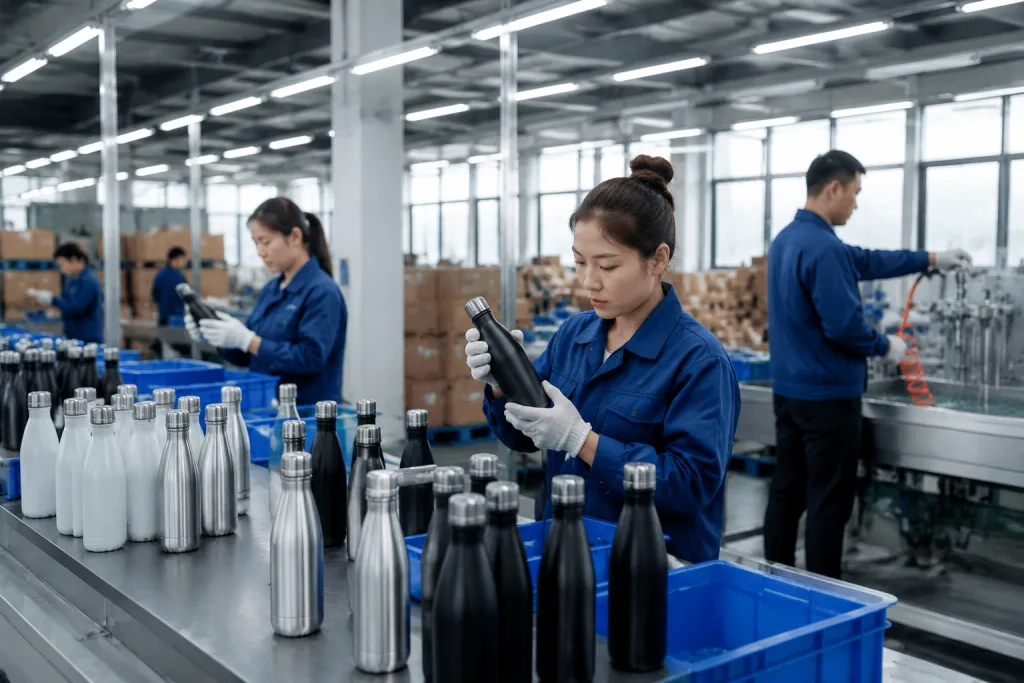
Key Takeaways
- For an 8,000-unit stainless steel order, a practical MOQ is 1,000 units per color, with FOB China pricing often around USD 2.85 to 4.90 depending on size, finish, and packaging.
- Lock the bottle spec early: 18/8 stainless, 0.4-0.5 mm outer wall, 0.3-0.4 mm inner wall, leak standard, logo method, and carton drop requirement.
- Use a three-stage QC plan with AQL 2.5/4.0, pre-production sample approval, in-line checks at 20%, and final inspection before balance payment.
- For Europe and North America, confirm REACH, LFGB or FDA contact safety, and packaging barcodes before mass production to avoid relabeling costs of USD 0.08 to 0.20 per unit.
You need to order water bottles wholesale, but finding a factory is not the hard part. The hard part is freezing the spec before your team signs off artwork, wires the deposit, and then finds the lid leaks at 0.03 MPa, the master carton splits in the drop test, or the logo rubs off after a tape test on the line. This is where first-time buyers lose margin fast. We ship this every week.
Use a real buyer case: a European brand placing 8,000 stainless steel bottles for retail and e-commerce. The factory is in Zhejiang, China, with output of 600,000 units per month and a standard lead time of 35 to 45 days. We will get into what to lock down, what QC should test, and where bulk drinkware orders go wrong. One small warning: asking for the lowest price first is the wrong question. We have seen a PO held up over a 2 mm logo shift and a cap color note typed wrong in the artwork file.
Start with the real order brief
Use a real brief. You are selling mid-range outdoor and office hydration products in Germany, France, and the US, and you need a spring launch order for 8,000 units total, split across 500 ml and 750 ml vacuum bottles. Your target landed cost has to leave distributor margin, so the FOB target from China stays under USD 4.20 for the 500 ml size and under USD 4.80 for the 750 ml size. On our side, the line will first ask one thing: what is the net bottle weight in grams, because 15-20 g swings can move the quote fast.
Buyers often send one photo and one capacity and ask for price. That is the wrong question to ask. Any factory in Zhejiang can throw out a number if the spec is loose, then adjust it later after the sample stage. We have seen this go sideways over a 3 mm base diameter change and over a PO typo that listed 500 ml in the subject line but 530 ml in the attachment. Set the commercial and technical baseline first:
- Material: 18/8 stainless steel, food-contact safe.
- Structure: double-wall vacuum, copper coating optional.
- Wall thickness: outer 0.4 mm, inner 0.3 mm for standard weight; 0.5/0.4 mm if you want a heavier feel.
- Lid: PP inner with silicone seal, leakproof when inverted for 30 minutes.
- Finish: powder coat Pantone-matched, 60-80 gloss if not matte.
- Logo: 1-color silk screen or laser engraving.
- Packaging: individual kraft box, 24 units per export carton.
If you also buy canteen bulk programs, wholesale drinkware sets, or seasonal promotions like beer tumbler wholesale bulk and wholesale growler items, split them into separate RFQs. Do not pack a bulk canteen, bulk growler, and sports bottle into one loose inquiry. Engineering loses time, and pricing mistakes show up fast. We run different tooling, different carton drop-test setups, and sometimes different MOQ logic by SKU family. One supplier can make all of them, sure, but each family should be quoted as its own project.
Your first job is not negotiating price. It is removing ambiguity. QC pulled the sample more than once because the buyer flagged “same as last order,” but the last order had a different lid core. Every missing detail becomes a factory assumption, and assumptions are expensive.
Build a quote you can compare
Once your brief is clear, ask for a quote sheet you can line up side by side. This saves time. Good buyers ask for a price table by quantity break, finish, logo process, and packaging, and we also ask for net weight, carton size, and loading qty because the line cost is only part of the math. For our scenario, a serious supplier in Zhejiang, China should quote something like this for 8,000 units total:
- 500 ml vacuum bottle, powder coat, 1-color print, white box: USD 3.05 to 3.65 FOB Ningbo
- 750 ml vacuum bottle, powder coat, 1-color print, white box: USD 3.55 to 4.25 FOB Ningbo
- Custom kraft gift box upgrade: +USD 0.22 to 0.48
- Laser engraving instead of print: +USD 0.05 to 0.18
- Extra lid color match or carry loop: +USD 0.08 to 0.20
Then ask what is included in that number. Tooling? Sample charges? Barcode labeling? Spare lids? Carton marks? We have seen POs with the carton mark typo carried all the way into mass production, so get the outer carton spec checked line by line. If you sell to Amazon or big-box retail, FNSKU, suffocation warning, carton dimensions, and pallet pattern matter as much as bottle cost. A quote that is USD 0.12 cheaper can turn into USD 0.25 more expensive after relabeling and repacking. The buyer flagged this on one 40HQ order last year, and they were right.
This is where secondary categories help. Ask the same supplier for benchmark pricing on canteen wholesale, drinkware bulk programs, and niche SKUs like alcohol flask bulk or alcohol flask wholesale bulk. Not because you will place 6 POs at once. You are checking factory depth. If they quote a flask, a growler, and a standard vacuum bottle with the same wall thickness and no material breakdown, this is the wrong question to ignore. A real factory should also quote wholesale canteen, growler bulk, beer growler wholesale, and beer tumbler bulk projects with clear MOQ, body weight in grams, and material details such as 304 stainless for inner and outer where applicable. QC pulled the sample on one mixed-line inquiry and found the tumbler lid fit was off by 0.8 mm, which told us that supplier outsourced part of the set.
For this order, a realistic MOQ is 1,000 units per color per size. That is normal. If a supplier offers 300 units with full Pantone coating and custom packaging at the same price level, be careful. The math doesn't work. Usually they are using stock bodies, mixing components from different batches, or cutting process controls on the line. We have seen this go sideways with powder coat color drift and mismatched lids in the same carton.
Approve the sample like a QC engineer
Sampling is where buyers avoid expensive mistakes. You are not signing off a nice-looking photo. You are setting the production standard for the line. For our 8,000-unit order, ask for three sample stages, and get each one measured with a digital caliper before anyone talks about mass production.
1. Blank construction sample
This sample confirms dimensions, weight, mouth diameter, thread fit, and base stability before decoration starts. Ask for actual measurements with tolerance, for example height ±2 mm, diameter ±1 mm, weight ±5%. We usually put the blank bottle on a granite flat table to check wobble, because one unstable base on sample day turns into 300 complaints after shipment.
2. Pre-production sample with finish and logo
This is the approval sample that matters. Check powder adhesion, color variance, logo placement, and lid torque. If your logo is silk screen, run a tape test and 50-rub alcohol wipe test. If laser, check contrast consistency from bottle to bottle, not just one piece. QC pulled a sample last month where the logo sat 3 mm low on one side, and the buyer flagged it right away. Good catch.
3. Packaging sample
Do not skip this step. The bottle can pass, and the box still fails. For a 24-unit master carton, ask for carton board grade, burst strength, and target gross weight. If the carton exceeds 15 kg, your warehouse may reject it or charge more for handling. We have seen this go sideways when a PO said “strong export carton” with no spec, and the supplier packed it in lighter board that crushed at stacking height.
Your sample checklist should include:
- Leak test: upside down 30 minutes, no seepage
- Vacuum test: hot water retention target after 6 hours, for example above 55°C from 95°C fill
- Coating adhesion: cross-hatch or tape test
- Odor check on lid and silicone
- Thread engagement: smooth open/close over 20 cycles
- Drop check of packed sample from 76 cm to 1 m depending on channel
If you also buy canteen bulk or beer growler in bulk, expand the checklist. A wholesale growler or beer growler wholesale bulk order needs cap sealing checks and clear pressure-use marking. Alcohol flask wholesale and alcohol flask in bulk projects need hinge durability, weld finish, and metallic odor control. This is the wrong place to copy one checklist across categories. Different drinkware wholesale items fail for different reasons, and we ship fewer claims when the approval standard matches the actual product.
Set compliance before production starts
For Europe and North America, compliance is not end-stage paperwork. It sits at the start of the sourcing call. Before deposit, ask which standards the factory supports and whether the reports match the exact material set on your quote. For stainless drinkware, buyers usually press on three points: food-contact safety, heavy metals in coating or print, and whether the factory has the audit trail to back the claim. We’ve seen this go sideways when a PO says 304 stainless but the lid insert on the approved sample is not the same as the lid insert on the production spec.
For our scenario, the buyer asks for:
- EU market: REACH screening where applicable, LFGB or migration-related food-contact testing through a recognized lab if required by the customer.
- US market: FDA food-contact basis and California Proposition 65 risk review if selling in California.
- Factory systems: ISO 9001 preferred, BSCI or equivalent social audit if the retailer requires it.
- Inspection standard: AQL major 2.5, minor 4.0, critical 0.
Ask for reports tied to the real bottle build: steel grade, paint system, lid resin, seal material, and decoration method. This is the wrong question to ask: “Do you have a test report?” Ask instead, “Is this report for this BOM?” QC pulled the sample on one order last year and found the factory had swapped a PP lid carrier for a different resin grade after sampling. The old report was valid. The shipment was not.
This gets stricter once the range expands beyond a standard bottle into wholesale drinkware bundles such as canteen wholesale, growler wholesale, or beer tumbler in bulk. A powder-coated tumbler, a wholesale canteen, and a bulk growler may share the same steel shell, but the paint, gasket hardness, or cap liner can change. One gasket at 2.0 mm is not the same risk as another at 2.5 mm. Compliance follows the bill of materials, not the product photo.
Factories in Zhejiang move fast once artwork is approved. We run like that too. But speed only helps if the approved BOM is frozen before the line starts. Put it in the PI: bottle body spec, lid material, seal type, logo method, carton construction, barcode placement, and test requirements. We ship against that sheet. If the BOM changes after testing, ask whether retesting is required. In most cases, yes, if any food-contact part changed. The buyer flagged this on a 10,000-piece order because the PO had a typo on the lid code, and that one line would have forced a retest.
Control production in three checkpoints
For an 8,000-unit order, you do not need a resident inspector on site every day. You do need fixed control points. We usually run three checkpoints and ask the factory to send time-stamped floor photos from the powder-coating line, print station, and packing area in China.
Pre-production meeting
Before mass production starts, lock the golden sample, artwork file, Pantone reference, packaging spec, and shipping marks. Ask the factory to issue a pre-production sheet with signatures from sales, production, and QC. One page is enough if it is complete. We have seen this go sideways over a 2 mm logo shift and one PO typo in the carton mark.
In-line inspection at 20% output
At around 1,600 units finished, check whether the line is stable. This is the cheapest point to catch trouble. After final packing, the math doesn't work. Look for:
- Color drift between batches
- Dent rate after powder coating and assembly
- Print registration and missing logos
- Lid leakage from under-compressed silicone rings
- Carton count accuracy
A normal internal reject rate for stainless bottles may run 2% to 5% depending on finish. If QC pulled the sample and found 8% or more rejects during in-line checks, ask what changed: oven temperature, assembly speed, or incoming body condition. Matte black and dark saturated colors cover small scratches. Light powder coat and metallic finishes show every surface defect fast, and the buyer flagged this more than once on silver SKUs.
Final random inspection
When 100% packed and at least 80% of the order is ready, inspect against AQL 2.5/4.0. For 8,000 units, your inspection sample size will depend on the level used by your QC company, but the method should be fixed in advance. Check quantity, workmanship, leak test, barcode scan, carton drop condition, and assortment ratio. We ship only after this point, not before, and QC should verify outer carton weight against the packing spec to catch short pack cartons.
If your catalog also includes growler bulk, beer tumbler wholesale, or alcohol flask wholesale items, do not inspect them under one generic checklist. This is the wrong question to ask. A beer growler bulk order needs handle security and cap fit checked with the actual filled-weight load. An alcohol flask wholesale bulk order needs hinge pin and weld seam review, and QC should look for sharp edge findings around the neck after polishing. Drinkware bulk is one category for sales. On the line, it is not one category for QC.
Plan shipment, reserves, and repeat orders
After inspection passes, the job is not done. Shipment terms decide whether the goods sell cleanly and whether the next PO lands on time. In this case, the buyer ships FOB Ningbo with a 30% deposit and 70% balance after final inspection approval. Production lead time is 35 to 45 days, plus around 7 to 12 days if custom color boxes are added. On our line, color box approval often stalls at the die-line stage because one barcode digit is off. Sea transit to North Europe may be 30 to 40 days; to the US West Coast often 18 to 28 days, depending on routing.
Before release, confirm these points. Small items. Expensive mistakes.
- Overage/underage tolerance: agree whether shipment can vary by ±3% or must be exact. We have seen buyers reject 288 pcs on a 9,600 pcs order because the PO said exact qty and sales missed that line.
- Spare parts: ask for 0.5% to 1% spare lids or seals packed separately. QC pulled the sample once and found the spare seals were mixed into master cartons, which defeats the point.
- Reserve stock: if your forecast is unstable, ask whether the factory can hold 500 to 1,000 undecorated bodies for 30 days. Check where they sit too; 500 bodies on a dusty top rack near the silk-printing station is not reserve stock.
This is where a solid Zhejiang factory earns its keep. If we run shell stock and hold repeat color control to the approved standard, the second order moves faster with less risk. Repeat orders often drop 5 to 10 days in lead time because sampling is shorter and packaging is already approved. We usually keep the approved Pantone drawdown and a retained sample at the line, and that saves arguments later. Buyers ask about price first. This is the wrong question to ask if your reorder window is tight.
Use post-shipment data on the next PO, not just a complaint email. Track leakage claims, dent complaints, and carton failures by batch. If your returns exceed 1%, review root causes with the supplier. Put the lot code next to each claim. We have seen this go sideways when a buyer says “leaking issue” but cannot separate warehouse damage from lid assembly. Sometimes the fix is the bottle. Often it is packaging, pallet stacking at 1.6 m, or lid torque checked with a torque meter.
If you are building a wider wholesale drinkware line, expand one controlled SKU at a time. We ship plenty of follow-on programs: canteen bulk for school promotions, wholesale growler and beer growler wholesale for brewery merchandise, beer tumbler wholesale bulk for on-premise sales, or alcohol flask in bulk for gift channels. Start with one bottle that runs cleanly at MOQ and passes inspection without drama. Then add canteen wholesale, growler wholesale, and other drinkware wholesale categories under the same control points. The math does not work if you launch 4 shapes at once and none has stable packaging.
Send your bottle spec and get a workable factory quote
Share capacity, target price, packaging, and market. We will review the BOM, MOQ, lead time, and likely QC risks before you place the order.
Frequently asked questions
What is a realistic MOQ when I order water bottles wholesale?
For custom stainless steel bottles from China, a realistic MOQ is usually 500 to 1,000 units per SKU, and 1,000 units per color is common if you want Pantone-matched powder coat and custom packaging. For vacuum bottles with custom logo and a standard white box, 1,000 to 3,000 units total is a workable starting point. If you want multiple sizes, lid colors, and retail boxes, expect the MOQ to rise or pricing to increase by USD 0.15 to 0.40 per unit. Stock-body programs can go lower, but they limit finish and packaging options. Ask whether MOQ is driven by coating batch, print setup, or carton printing so you know where flexibility actually exists.
How do I compare quotes for wholesale drinkware fairly?
Use a quote template and force every supplier to fill the same fields: material grade, wall thickness, unit weight, logo process, package type, MOQ, sample charge, FOB port, lead time, and test support. For example, a 500 ml vacuum bottle quoted at USD 3.10 FOB may exclude custom box, barcode label, and spare lids, while a USD 3.28 quote includes all three. Also check whether the bottle is 0.4/0.3 mm or 0.5/0.4 mm steel, because weight changes cost and feel. For drinkware wholesale categories like canteen bulk, growler bulk, or beer tumbler in bulk, compare like for like on cap type, finish, and carton count. If a quote is much lower, ask for actual bottle weight and packaging spec first.
What tests matter most before mass production?
For a standard stainless steel bottle, focus on five things: leak test, insulation retention, coating adhesion, logo durability, and packaging drop resistance. A practical pre-production sample should pass a 30-minute inverted leak test, show no obvious coating loss after tape testing, and meet your agreed heat retention target, such as above 55°C after 6 hours from a 95°C fill. For e-commerce, ask for packed drop checks at 76 cm to 1 m. If your order includes wholesale growler, beer growler wholesale bulk, or alcohol flask wholesale items, add cap-fit checks, hinge durability, and odor review. The exact test list should match the product structure, not just the category name.
How long does a custom bulk drinkware order usually take?
For a custom order of 5,000 to 10,000 units, plan 35 to 45 days for production after sample approval and deposit. Add 3 to 7 days for pre-production samples if artwork and colors are simple. If you need custom retail boxes, barcodes, and inserts, add roughly 7 to 12 more days. In peak season, especially before summer launches and Q4 gifting, some factories in Zhejiang, China may quote 45 to 60 days. Shipping is separate: sea freight to Europe can take 30 to 40 days, and to North America often 18 to 35 days depending on destination. If you want faster repeats, ask the factory to hold approved packaging artwork and reserve undecorated stock bodies.
Can one supplier handle water bottles, canteens, growlers, tumblers, and flasks?
Sometimes yes, but only if they truly manufacture across those lines or control a stable partner network. Many factories are strongest in one or two groups, such as vacuum bottles and tumblers, while outsourcing bulk growler, wholesale canteen, or alcohol flask bulk items. That is not automatically bad, but you should ask which products are made in-house and which are subcontracted. In-house lines usually give better color control, lead time visibility, and lower defect rates. If you source beer tumbler wholesale, canteen wholesale, wholesale growler, and alcohol flask wholesale bulk from one place, require separate specs and QC points for each family. One master purchase order is fine. One generic quality standard is not.