Key Takeaways
- For most 500 ml stainless vacuum bottles, a realistic MOQ is 1,000 pcs per color, with 35-45 day production after sample approval
- 18/8 stainless steel, 0.4-0.5 mm inner wall, and copper-coated vacuum layers usually improve 12-hour heat retention by 10-15%
- Leak complaints often come from lid gasket design and torque control, not the bottle body; request 100% vacuum and seal checks on final assembly
- FOB Ningbo pricing for standard 500 ml bulk thermos orders often lands around USD 3.20-5.80 depending on steel weight, coating, lid tooling, and logo process
You can buy a stainless thermos from almost any supplier in China. That part is easy. The hard part is buying the right one for your channel, margin, and product claims. Outdoor retail buyers usually ask us for heat retention hours, leak test results, drop performance, and how many pieces fit a master carton without wasted cube; on the line we check that against a 65 mm cup base and carton drop test data before we quote. Promotional buyers push on logo finish, MOQ flexibility, and event-date delivery. We ship plenty of rush orders, and the buyer flagged more than one job because the logo looked fine in artwork but washed out after screen printing on dark powder coat. If you order vacuum bottle wholesale and skip the spec line by line, small misses turn into returns, chargebacks, or dead stock fast.
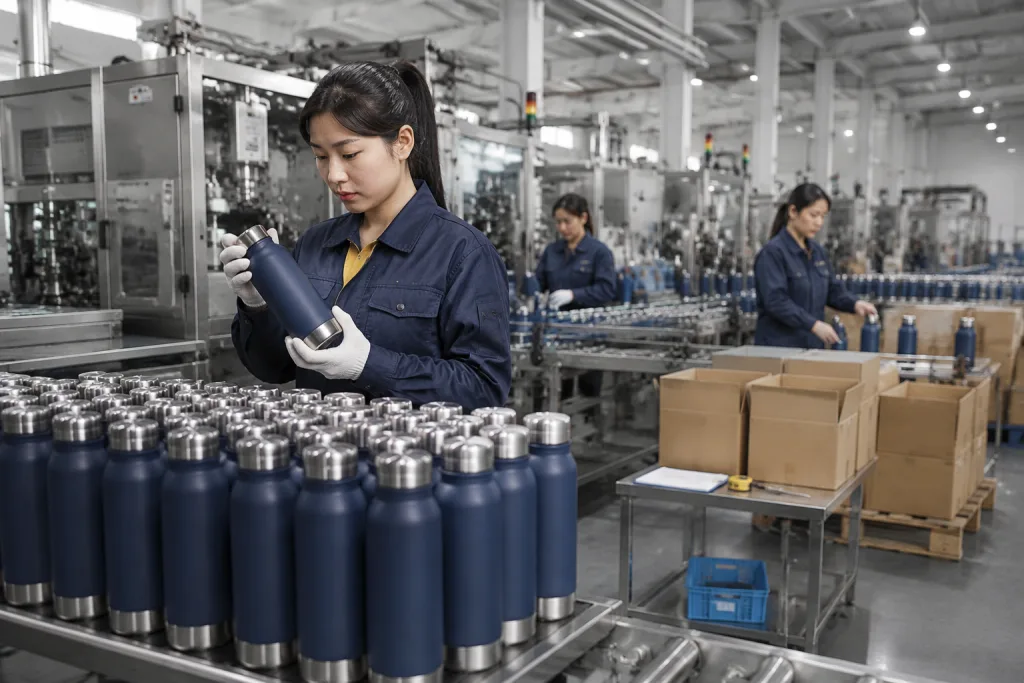
At our Zhejiang factory, we see the same mistake again and again: a buyer asks for a 500 ml custom thermos, then finds out too late that the mouth diameter is 42 mm instead of 55 mm for ice fill, the powder coat fails an abrasion rub test, or the logo process cannot hold the Pantone match they approved on the PO. QC pulled the sample on one run last month because the laser mark looked sharp but came out too silver against a matte navy body. BottleForge Industrial in Hangzhou, Zhejiang builds around 600,000 units per month, with MOQs starting at 1,000 pcs per color for most stainless models, so this is the wrong question to ask: not whether China can make it, but whether the spec fits your sales plan, your carton math, and your claim on shelf.
Start with body material
The first line on a factory thermos spec sheet should say more than “stainless steel.” For outdoor retail and serious promo programs, ask for 18/8 stainless steel or SUS304 on the body spec, especially for the inner wall. That is the standard most buyers in Europe and North America expect for food-contact parts. We still see offers using 201 stainless on the outer wall to shave cost, and some buyers accept that on tight targets. Ask it directly. We have seen this go sideways after 60 days in humid storage near Shenzhen port, where the buyer flagged rust spots on the outer bottom ring.
Wall thickness matters almost as much as steel grade. On a 500 ml thermos, we run 0.4 mm inner and 0.5 mm outer on a lot of repeat orders because it balances cost, weight, and dent resistance. Drop below that and you might save USD 0.10-0.20 per unit, but the math does not work if bottles start picking up dents during container loading. Go heavier and the hand feel improves fast, but freight climbs too, since a 500 ml bottle can jump from 280 g to 360 g. QC pulled the sample on one 0.35 mm body last year, and the sidewall deformation showed up after a 1-carton drop test.
- Good baseline: inner SUS304, outer SUS304 or 201, 0.4/0.5 mm
- Premium outdoor baseline: inner and outer SUS304, 0.5/0.5 mm
- Budget warning: unspecified steel grade usually means you are buying on price only
If you are comparing thermos manufacturers in China, ask for steel mill certificates or at least a written declaration of material grade. For Europe, ask for REACH compliance on coatings and plastic parts like the PP lid and silicone seal. For North America, check whether the factory already ships programs that face retailer food-contact reviews, because this is the wrong question to ask after mass production starts. We ship buyers samples with AQL 2.5 inspection reports attached, and a serious factory will answer this clearly instead of sending a vague one-line PDF.
Vacuum structure and insulation numbers
Too many buyers see the word “vacuum” and stop. That is the wrong question to ask. On a thermos spec sheet, insulation only means something if the test method is written out: fill temperature, ambient temperature, hold time, and pass point. Without that, the number is packaging copy. A workable claim for a 500 ml bulk thermos looks like this: filled with 95°C water, ambient 20°C, after 6 hours above 68°C, after 12 hours above 55°C. Cold retention might be listed as below 10°C after 12 hours with ice water starting at 4°C. On the line, we check fill volume with a graduated cylinder because 480 ml tested as “500 ml” will skew the result fast.
Three build details change insulation numbers in real production:
- Vacuum quality and evacuation consistency from bottle to bottle
- Copper coating or reflective inner treatment between walls
- Lid design, since heat loss often comes through the cap seal and vent path
On distributor thermos projects, copper coating usually adds cost, but in production runs it often improves retention by around 10-15%. That gap shows up in real use. If your sales team wants to print “12 hours hot” on the box, this is the math that decides whether the claim survives buyer spot checks. We have seen QC pull the sample at 12 hours and miss target by 2°C because the cap structure was too loose. Lid choice also matters more than buyers expect. A screw cap with a simple PP inner often beats a flip lid with extra plastic parts, hinge gaps, and vent paths.
You do not buy insulation by catalog claim. You buy it by test condition.
Ask your thermos suppliers for internal test data, then keep one golden sample sealed to the approved standard. We run vacuum retention checks by lot, and on some models we screen 100% for vacuum presence with a vacuum detector or a temperature-drop check. The tool depends on the SKU. For outdoor retail, that is normal factory discipline. For promotional thermos orders tied to an event date, it matters even more, because if 3,000 pcs miss spec, you do not have 12 days to rework what should have shipped in 18 days. If you need a customized thermos with a tea filter, handle lid, or straw structure, assume insulation performance drops against a plain screw-cap bottle. Plan claims conservatively. The buyer flagged this before on a straw-lid PO, and they were right.
Capacity, mouth, and carry profile
Capacity looks simple until returns start. We have seen a 500 ml bottle pass the drawing, then fail in use because it was 268 mm tall and stuck out of a commuter backpack, or because the body was too slim for winter gloves. The spec sheet needs more than nominal volume. Put in body diameter, total height, mouth diameter, and net weight. Those four lines decide shelf fit, carton count, hand feel, and whether ice cubes drop in or a standard brush can reach the bottom.
For outdoor retail, mouth diameter and base diameter usually settle the argument fast. A 44-50 mm mouth is the safe range if the buyer wants easy ice filling and cleaning; QC pulled a sample last month at 41 mm and the buyer flagged it right away. A narrower mouth gives better sip control and sometimes better heat retention, but the use case gets tighter. Base diameter matters if the bottle has to sit in a car cup holder; 70-75 mm is common for 500 ml to 600 ml. For promo brands, total height matters more because a taller body gives more logo area on the silk-screen fixture, but if the profile gets too slender, dent claims go up in transit. We have seen this go sideways.
Typical size logic for order planning
- 350 ml: gift sets, office kits, lower landed cost, often easier to hit MOQ 3,000 pcs by color
- 500 ml: the most balanced custom thermos for retail and promotions, and the size we run most often on the line
- 750 ml: better outdoor position, but freight and carton weight climb fast; one master carton can jump by 2-3 kg
- 1,000 ml: better for camping and distributor thermos channels than impulse promo campaigns; the math does not work for cheap giveaway projects
If you are buying thermos bulk for more than one channel, do not force one shape onto every order. This is the wrong question to ask. A promo bottle for a logo campaign needs a wide printable panel and a lower unit cost. An outdoor dealer wants grip, coating durability, and a mouth that works in the field. We ship both, but not from the same exact setup every time. A better plan is one platform body, then change the lid, color, and graphics by channel. That usually avoids a new mold charge, and it also avoids small mistakes that creep in later, like a PO typo calling for a straw lid on a narrow-mouth body.
Surface finish and logo decisions
A custom thermos sells or stalls on finish quality. Buyers touch the bottle first, then they judge insulation. On our line, QC pulled the sample after the cross-hatch tape test, and bad paint adhesion shows up before any lab report does. Common finishes are spray paint, powder coat, rubber paint, and bare steel with brushed polish. Powder coat is the usual pick for outdoor retail because it gives better grip and holds up better in abrasion testing. On a standard 500 ml thermos factory order, powder coat may add around USD 0.12-0.25 over plain spray depending on color and line speed.
Logo process needs to match the finish and the order volume. This is the wrong question to ask: "Which logo method is best?" The better question is which method fits 1,000 pcs, a matte powder surface, and the artwork you approved on the PO. We usually quote silkscreen, laser engraving, heat transfer, and UV print. Silkscreen runs fast for 1-2 spot colors and works well from 1,000 pcs upward. Laser engraving looks premium and avoids ink wear, but on some painted surfaces the contrast comes out lighter than the buyer expected. Heat transfer gives more color freedom on a customized thermos, but setup cost and positioning control matter. On tapered bodies, we check logo position with a 2 mm fixture, or the buyer flags it.
- Silkscreen: low setup, clean branding, best for simple logos on 1-2 spot colors
- Laser: durable, premium look, no Pantone match, and contrast depends on the coating layer
- Heat transfer: complex graphics, higher process sensitivity, with tighter control needed on placement
- Embossed mold logo: good for long programs, requires tooling, usually makes sense after repeat orders justify the mold cost
If your brand promises Pantone accuracy, ask the thermos vendor to quote tolerance and provide a pre-production color swatch. Do not approve based on a phone photo. We have seen this go sideways when a navy logo looked fine on WeChat but shifted under warehouse light at 6500K. For promotional thermos use, also confirm whether each unit needs an individual polybag, white box, color box, barcode label, or FNSKU sticker. These details affect packing speed and lead time more than 7 out of 10 new buyers expect, and a simple add-on like an FNSKU label can slow one packing line by 12 days vs 18 days if the carton plan was not fixed early.
Most suppliers thermos factories in China can handle custom branding, but not all manage consistency well across reorders. Ask how they control logo position tolerance. A practical answer is within plus or minus 2 mm on standard bodies. We ship repeat programs where the artwork is checked against the first approved golden sample, and the jig on the line is locked before mass print. If the answer is vague, expect trouble when your distributors thermos program repeats six months later. We have seen buyer POs with a typo in the logo code, and that alone can waste 3 days if nobody catches it before printing.
Lid assembly, leakage, and field use
Leakage is one of the top reasons a thermos supplier relationship goes bad. Buyers blame the bottle body first, but on the line we usually find the issue in the lid assembly: gasket hardness at 50-60 Shore A, thread engagement depth, vent structure, or loose torque control at final assembly. Your spec sheet should break the lid into material and function, piece by piece: PP inner, Tritan spout, stainless cap shell, silicone gasket, tea filter mesh, carry loop, push button, and lock clip. QC pulled one sample last month where the PO said “silicon ring” instead of “silicone gasket,” and that small typo created the wrong sourcing call.
For an outdoor-oriented manufacturer thermos, a simple screw lid is still the safest option. We ship more of these for hiking and jobsite use because fewer moving parts means fewer leak complaints after a 80 cm drop. Flip lids and one-hand drink lids sell well for promotions, but this is the wrong question to ask if the buyer only cares about shelf appeal and ignores return rate. You should ask for:
- 100% seal test after final assembly
- Drop test standard, for example 3 drops from 80 cm with no functional leak
- Torque standard for cap tightening
- Spare gasket availability for repeat orders
A good leak test is not just “upside down for 30 minutes.” Ask if the bottle is checked under warm-fill conditions at about 60-70C, because gasket behavior changes once heat builds pressure inside the cup. If the product is for North America school bags, commute, or outdoor use, ask whether the lid plastics meet relevant food-contact requirements and whether the design passed cycle testing on a button press rig. A button lid that works at 500 presses on the bench can fail after 5,000 in the market; we have seen spring pins shift by 0.3 mm and start sticking.
For a distributor thermos order, replacement parts can decide the whole program. A thermos manufacturers partner that supplies spare lids or gaskets at 2-3% of order volume shows they understand after-sales cost, not just FOB price, and the math doesn't work if they refuse this point on a 10,000-piece order. We run into buyer pushback here all the time: they want zero warranty stock, then ask for free replacements six months later. China has many bottle workshops. Fewer thermos suppliers think past shipment day.
Carton math, MOQ, and pricing reality
For vacuum bottle wholesale, carton math moves the landed cost as much as the FOB price. We see this every week on the line. A 500 ml bottle packed 24 pcs per carton usually works for sea shipment, but an oversized gift box can cut container loading hard, and your freight per unit jumps fast. Ask for carton size, gross weight, and loading qty for 20GP, 40GP, and 40HQ, then check the numbers against the actual box drawing. QC pulled a sample last month where the insert was 8 mm too tall, and the buyer flagged the wasted space right away. For reference, a standard 500 ml bulk thermos might load around 10,000-12,000 pcs in a 20GP depending on box style.
MOQ gets misunderstood all the time. This is the wrong question to ask if you only ask for one headline number. A factory may quote MOQ 1,000 pcs, but that usually means per model per color, not split across 10 colors with separate logos. If you want a customizable thermos program with 4 body colors and 2 lid colors, confirm whether the real MOQ becomes 4,000 pcs or whether we can run combined finishes in one production slot. We have had POs marked "assorted colors" with no breakdown, and that goes sideways fast. In Zhejiang and across China, line efficiency decides this more than goodwill.
Realistic FOB Ningbo or Shanghai pricing for a 500 ml custom thermos from established thermos manufacturers often looks like this:
- Basic vacuum bottle: USD 3.20-3.90
- Powder-coated retail version: USD 3.90-4.80
- Complex lid or filter version: USD 4.80-5.80
- Gift box packaging add-on: USD 0.35-0.90
Lead time is usually 7-12 days for pre-production samples, 3-7 days for sample revision, and 35-45 days for mass production after approval and deposit. That is the normal factory rhythm. From August to November, add 7-10 days if your bottle uses uncommon Pantone colors or custom packaging, because we ship peak-season orders in sequence and carton suppliers get tight. If a supplier thermos quote promises 20-day production on a new custom order, ask what they are skipping. We have seen this go sideways. In one inspection, the drop test sample passed, but the barcode label was 3 mm off-center and the outer cartons were still unconfirmed.
Compliance, inspection, and reorder control
The last part of the spec sheet is where experienced buyers protect themselves. This section saves claims. You need three lines in writing: compliance, inspection, and reorder control. For Europe, we usually see REACH declarations and food-contact migration testing based on the retail channel and cup structure. For North America, some retailer programs ask for CPSIA-related declarations on kids' items, California Proposition 65 review, or their own lab protocol sheet with one line changed on the PO. If you are sourcing a stainless thermos for adults, the exact test scope still depends on channel. A serious thermos manufacturer should already know how to prep 3 sets of samples for a third-party lab, seal them, and log the sample weight before shipment.
Inspection belongs in the PO, not in a loose email thread. We have seen this go sideways. AQL 2.5 for major defects and 4.0 for minor defects is a common working standard for drinkware, though some buyers tighten it for premium outdoor lines after QC pulled the sample and found logo print shift at 1.5 mm. Define major defects in plain words: leakage, wrong logo, vacuum failure, sharp edge, coating peel, wrong barcode. If you use a third-party inspection in China, book it after at least 80% packed and 100% produced. Earlier than that, the math doesn't work.
Reorder control matters because the first PO is rarely the hard part. The second one is. That is when color drift, lid swaps, and unit weight changes show up if the factory does not run basic process control. Ask your thermos vendor to retain approved samples, Pantone references, carton marks, and test records. At BottleForge in Zhejiang, we keep master samples and BOM records by item code, and the line checks refill weight and finished weight against the approved sample, so a reorder six months later does not turn into a fresh argument about what “matte navy” meant.
If you are building a long-term thermos custom line, ask practical questions. Can the factory support BSCI audits if your customer requires social compliance? Can they hold spare packaging for call-off shipments? Can they apply FNSKU labels for Amazon prep? This is the right question to ask. We ship projects where the buyer flagged a carton mark typo only after 2,000 units were stacked, and that detail mattered more than the launch photo. You are not just buying bottles from China. You are buying repeatability.
Send your thermos spec for a practical quote
Share capacity, lid type, logo method, target price, and delivery date. We will review the spec line by line and flag the risks before production.
Frequently asked questions
What is a normal MOQ when I order vacuum bottle wholesale?
For a standard 500 ml stainless vacuum bottle, a normal MOQ is 1,000 pcs per color per model from a real thermos factory in China. If you need custom packaging, the MOQ for the bottle may stay at 1,000 pcs, but color boxes often require 1,000-3,000 pcs depending on print complexity. Laser logo can sometimes work at lower volume, while silkscreen usually makes more sense from 1,000 pcs upward. If you want 4 colors with separate logos, assume the practical MOQ is 4,000 pcs unless the supplier can combine runs. For new tooling, lid molds can add USD 2,000-8,000 and may require 3,000-5,000 pcs to justify the project.
How do I compare insulation claims between thermos suppliers?
Ask every thermos supplier to state the exact test condition: fill temperature, ambient temperature, elapsed time, and target remaining temperature. A useful example is 95°C fill, 20°C room, and 55°C or higher after 12 hours. Without that, the number is not comparable. Also ask whether the bottle uses copper coating in the vacuum layer and whether the lid is a plain screw cap or a more complex drinking lid. On similar 500 ml bottles, a copper-coated unit may improve practical heat retention by around 10-15%. Keep one approved golden sample and, if the claim matters for your retail packaging, run a third-party verification before mass shipment.
What FOB price should I expect for a custom thermos order?
For a 500 ml stainless steel vacuum bottle FOB Ningbo or Shanghai, many projects land between USD 3.20 and USD 5.80. The lower end usually means a simple body shape, standard screw lid, basic spray or powder coat, and 1-color logo. The higher end usually includes heavier steel, premium powder coat, copper insulation treatment, a filter or handle lid, and custom box packaging. A gift box can add another USD 0.35-0.90 per unit. If you see a quote well below USD 3.00, check steel grade, wall thickness, coating quality, inspection standard, and whether the supplier included spare cartons, barcode labels, or export packaging.
What quality checks should I require before shipment?
At minimum, require incoming material checks, in-line logo and coating checks, 100% leak testing after final assembly, and lot-based vacuum retention testing. On the final inspection, many buyers use AQL 2.5 for major defects and 4.0 for minor defects. Major defects should include leakage, vacuum failure, wrong print, sharp edges, and carton marking errors if you ship to Amazon or a retailer DC. Ask the factory to inspect after 80% packed and 100% produced if a third-party QC company is involved. For outdoor retail, add a basic drop test, such as 3 drops from 80 cm, and a coating adhesion or abrasion check on powder-coated bottles.
How long does a bulk thermos order usually take from sample to shipment?
A realistic timeline is 7-12 days for the first pre-production sample, 3-7 days for revisions, and 35-45 days for mass production after final approval and deposit. Custom color matching, gift box proofing, and holiday periods in China can extend this by 7-10 days. If your customized thermos uses a new mold, add 20-30 days for tooling and first sample validation. For urgent promotional thermos projects, ask whether stock molds and standard lid parts can shorten the schedule. The fastest path is usually a standard 500 ml bottle, powder coat from an existing color library, 1-color silkscreen, and export carton packing without a custom retail box.