Key Takeaways
- For most wholesale stainless thermos orders, 1,000 pieces per color is a realistic MOQ for custom color and logo work.
- 18/8 stainless steel, 0.4-0.5 mm inner wall thickness, and copper coating usually give the best cost-to-performance balance.
- Laser engraving is durable for outdoor retailers; silkscreen or heat transfer works better for large promotional thermos artwork.
- Use AQL inspection, leak testing, and 6-24 hour temperature checks before shipment, not only after goods arrive.
If you order thermos flask wholesale for an outdoor retail line or promotional campaign, the hard part is not finding another supplier thermos listing. The hard part is locking the build before 3,000 pieces turn into slow-moving stock your sales team has to defend. We have seen this go sideways. A 0.5 mm wall change, a loose flip lid, a thin color coating, or a carton that fails a 1.2 m drop test can move the project from clean shipment to buyer complaint.
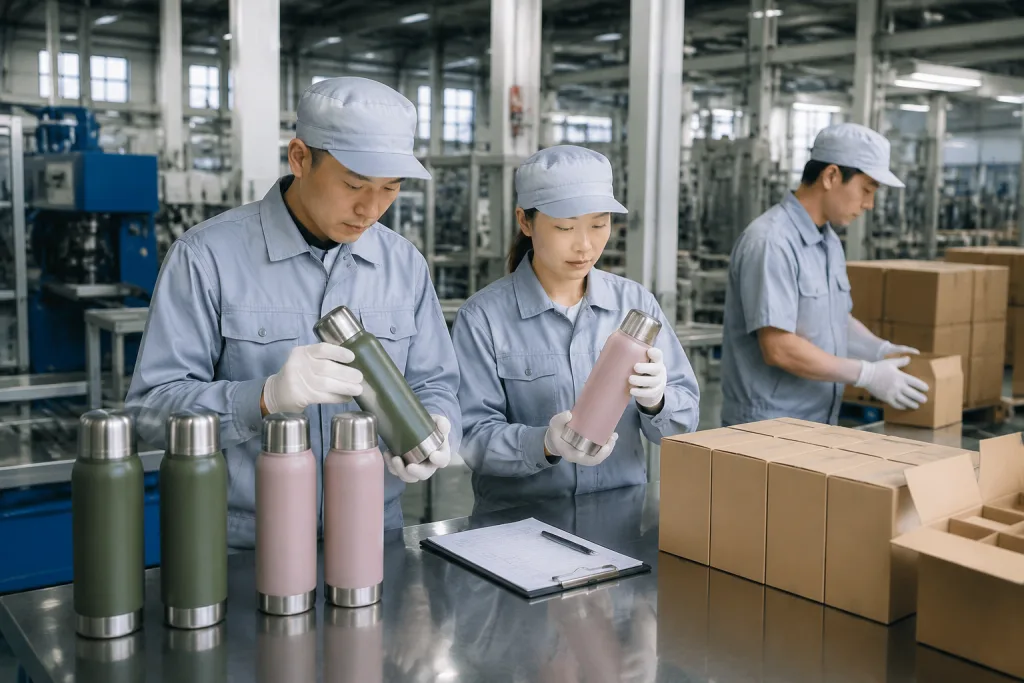
On our factory thermos floor in Zhejiang, China, we run better projects after four decisions are clear: bottle format, insulation target, customization method, and inspection plan. QC pulled one sample last month because the PO said matte black but the approved sample was satin black. Small wording. Real delay. BottleForge Industrial produces up to 450,000 stainless drinkware units per month in Hangzhou, Zhejiang, with typical stainless thermos MOQ from 1,000 pieces per color for OEM orders.
Start With The Use Case
A bulk thermos order should start with the buyer, not the catalog photo. We see this on the line every week. Outdoor retail buyers usually ask for a flask that survives trail packs, truck cup holders at 74-76 mm, cold mornings, and repeat washing. Promo buyers ask for different things: a clean logo area, a gift box that does not crush at 8 kg stack load, and a target price that keeps the campaign alive. Same search term, different job.
For outdoor retail, start with capacity. A 500 ml or 18 oz custom thermos is easy to carry and fits most side pockets. A 750 ml or 25 oz model works better for hiking, fishing, and winter travel. A 1,000 ml bottle gives stronger perceived value, but freight tells a different story; we ship 12 days vs 18 days on some mixed loads once carton volume jumps. If you are building a distributor thermos range, this is the wrong question to ask: not "how many sizes can we show," but "how many SKUs can we restock without dead stock." Two sizes, usually 500 ml and 750 ml, keep inventory cleaner. MOQ stays sane too.
For promotional thermos programs, shape often matters more than capacity. Straight-wall bottles print cleanly, and the line packs them faster in standard dividers. Tapered tumblers look more premium, but logo placement needs more care because artwork can stretch; QC pulled the sample once and the 32 mm logo sat 3 mm off center, and the buyer flagged it right away. Handle lids add utility, but they add parts and failure points. Straw lids sell for cold drinks, but they are the wrong fit for hot liquid claims unless the design has a pressure-safe vent and clear warnings.
The trade-off is simple. Every extra feature makes the item easier to sell and harder to control. A plain screw-cap vacuum flask from a thermos manufacturer is cheaper, more stable, and easier to inspect at AQL 2.5 with fewer moving parts. A multifunction lid, powder coating, custom gift box, and retail barcode can pay off, but only if the channel earns the margin. If not, the math doesn't work. We've seen this go sideways over one small PO typo on barcode artwork.
Choose Steel And Insulation Targets
Most stainless thermos factories in China quote 18/8 stainless steel, also marked SUS304, for the inner tank. That is the baseline we run for food contact, corrosion resistance, and clean taste. Some low-price suppliers quote 201 stainless on the outer wall to shave cost. On paper it looks fine. On the line, we have seen outdoor retail bottles come back with rust spots around the base after salt-spray exposure, so for outdoor programs we usually push 304 outer wall or give the buyer a clear cost break in black and white. If your buyer needs LFGB, REACH, or FDA food-contact documents, confirm the steel grade before sampling, not after the PO typo turns 304 into 204 and everyone loses two days.
Wall thickness gets skipped too often, and this is the wrong question to ask if the buyer only asks for the cheapest bottle. A common build is 0.4 mm inner wall and 0.5 mm outer wall, though the actual spec shifts by model and deep-draw process. We check this with a micrometer after forming. Thinner steel can cut USD 0.15-0.35 per unit on some models, but dent resistance drops fast. The math doesn't work for retail outdoor bottles. For a one-time event giveaway, a lighter build is fine if the campaign is price-driven and the MOQ is 3,000 pcs or above.
Vacuum insulation performance comes from the vacuum process, inner surface finish, copper coating, lid sealing, and bottle shape. All five matter. A practical wholesale target is hot water above 55 C after 12 hours, tested from 95 C starting temperature at 20 C room temperature. Premium builds may stay above 60 C after 12 hours and still read credibly at 24 hours. We ship against test data, not nice wording. QC pulled the sample last month on a 500 ml flask because lid sealing lost 3 C more than spec after 6 hours, and the buyer flagged it before mass production. Cold retention is easier to claim, but it still needs a fixed method and fill volume.
Ask your thermos factory to state the test method, not just the marketing claim. A line like keeps hot for 24 hours is weak unless it shows starting temperature, room temperature, fill level, and pass threshold. We usually ask for 95 C water, 20 C room temperature, 90% fill, then record the reading at 6, 12, and 24 hours with a digital probe. For customized thermos orders going into Europe or North America, vague claims create customer service trouble later. We've seen this go sideways over one carton label and one product page sentence.
Decide The Customization Method
A custom thermos is not custom because the logo is big. It is custom when the decoration method fits the surface finish, target cost, and where the bottle will be used. For outdoor retail, laser engraving on powder coating is still the safest call. We run this on a 20W fiber laser, and QC usually checks the edge line under a 10x loupe. It does not peel. It looks clean on shelf. The trade-off is simple: the engraving exposes the metal or underlayer, so full-color brand artwork is the wrong fit.
Silkscreen printing fits one-color or two-color logos on smooth powder coating. It is the standard option for thermos bulk orders, and the line can print curved bodies if the jig is set right within about 0.5 mm. Expect a setup charge around USD 50-120 per color depending on artwork and factory policy. Heat transfer or water transfer makes more sense for full-wrap graphics, camouflage patterns, or detailed promotional thermos designs, but the math changes fast because unit cost goes up and abrasion testing gets tighter. We have seen buyers flag scratches after a 3M tape test, so this is where QC pulled the sample early.
For a customizable thermos program, split decoration into three levels. Level one is stock color plus logo, often MOQ 500-1,000 pieces depending on model. Level two is custom Pantone powder coating plus logo, usually MOQ 1,000 pieces per color. Level three covers custom mold, custom lid, unique texture, or a retail packaging system. Here MOQ can move to 3,000-5,000 pieces because tooling is real, setup time is real, and we have seen this go sideways when a buyer wants 800 pieces with a new lid and no tooling charge. That math does not work.
Packaging counts too. Outdoor retail often needs hang tags, color boxes, UPC labels, and carton marks by SKU, and we usually confirm carton print size against a 42 x 28 x 25 cm master carton before the first run. Promotional brands sometimes ask for individual mailer boxes or event kits. If you sell through Amazon or a distributor thermos network, confirm FNSKU, suffocation warning, master carton weight, and drop-test expectations before mass production. We ship plenty of orders where the buyer flagged one PO typo in the carton mark, and fixing that after printing wastes 2 days. A good thermos vendor asks these questions before quoting final FOB price.
Read The Price Quote Properly
Wholesale stainless thermos prices from Zhejiang factories are usually quoted FOB Ningbo or FOB Shanghai. For a basic 500 ml double-wall bottle with powder coating and a one-color logo, we usually see USD 3.20-4.80. The spread comes from steel grade, lid structure, finish, packaging spec, and order quantity. A heavier 750 ml customized thermos with copper coating, a handle lid, laser logo, and color box usually lands around USD 5.20-7.50. These are working ranges, not promises. Steel moves, and RMB exchange swings move with it. On the line, even a 12 g weight increase in the lid can push the quote up.
Compare quotes line by line. This is the right question to ask. One thermos supplier may include an individual color box, logo setup, inner carton, and 1.0 mm export carton. Another may quote bulk polybag packing only, then add the rest after the PO is issued. We have seen buyers flag a USD 0.25 gap, then lose it once barcode labels, spare gaskets, and carton upgrades are added back. QC pulled the sample once and found the outer carton spec on the quote did not match the drop-test requirement.
MOQ changes the math more than most buyers expect. At 500 pieces, we still run coating-line setup, silk-printing fixtures, QC paperwork, and carton prep. At 3,000 pieces, those fixed costs spread out across more units. That is why a real thermos manufacturer will usually show a clear step at 1,000, 3,000, and 5,000 pieces, with little movement between 200 and 500 pieces. The math does not work at low volume. Last month, a buyer pushed for the 3,000-piece price on 600 pcs, and the line still needed the same jig change and first-piece approval.
Lead time should be written into the quote, not left in chat history. For BottleForge Industrial in Hangzhou, standard lead time is 25-35 days after deposit and artwork approval for repeat models, and 40-55 days for new customized thermos projects with packaging development. Add 7-10 days for sample approval if your brand team is slow on Pantone or logo sign-off. We have seen this go sideways. One PO even had the logo code typed wrong, so sampling stopped until the buyer confirmed the artwork. If decisions come one week before vessel cutoff, the factory cannot protect your launch date.
Set Inspection Before Production
Quality control for custom thermos orders needs to be locked before the deposit. Once the line starts, your options get tight fast. At minimum, confirm the approved sample, material specification, artwork file, color standard, packaging layout, inspection level, and defect definitions. We usually mark the golden sample with date and signature, then keep it at the line side for checks. For most wholesale orders, AQL General Inspection Level II with critical defects at 0, major at 2.5, and minor at 4.0 is a practical baseline. This is the wrong question to ask if you only ask for a "strict inspection" and leave the details open.
Leak testing should be 100% on the production line. No shortcut here. Vacuum performance testing is usually sampled because one hot-water retention test can take 6 to 8 hours. On our side, we run vacuum check on the blanks with a vacuum meter first, then QC pulled the sample for final heat retention. Ask for the batch size, the sample quantity, and the handling rule for failed pieces. For a 5,000-piece order, checking 32 pcs tells you something; opening three cartons at random and hoping tells you almost nothing. We have seen buyers flag this after shipment, and then the math doesn't work for anyone.
Common defects include coating chips, dust under paint, weak printing adhesion, lid thread roughness, silicone odor, carton crushing, and temperature retention failure. These are standard problems. On the floor, we usually catch dust nibs under coating with a 600 lux light box, and thread roughness shows up fast after 3 to 5 cap turns by hand. Outdoor retailers usually care most about dents and coating wear because shoppers handle the bottle on shelf. Promotional brands watch logo position and Pantone match harder, because a 2 mm logo shift or off-tone red gets noticed right away. The buyer flagged this on one PO last year over a small logo offset, and the rework cost more than the inspection would have.
Third-party inspection is worth considering above USD 10,000 order value or when you are working with a new thermos suppliers network. We ship this way often. In Zhejiang, China, pre-shipment inspection can usually be arranged within 3-5 working days if production is complete and cartons are packed. Inspectors will want packed cartons, shipping marks, and an accessible staging area, not half-finished goods sitting beside the taping machine. Do not wait until the container is booked for the next morning. We've seen this go sideways over one PO typo on the carton mark.
Match Compliance To The Channel
Compliance is not one document. It changes by market and sales channel. For Europe, our buyers usually ask for LFGB food-contact testing on the 304 stainless inner wall, REACH on powder coating and plastic parts, plus BSCI or Sedex status when the order goes into retail chains. For the United States, FDA food-contact expectations, California Proposition 65 screening, and ASTM-related packaging or use checks can apply by product and retailer; last month QC pulled a 500 ml sample because the black coating formula on the lid did not match the lab report.
If you are a distributor thermos buyer, collect documents by SKU and material, not only by factory name. A stainless body test report from last year does not automatically cover a new painted lid, silicone straw, PP handle, or printed coating. For kids bottles, the bar is higher, and the buyer usually asks for CPSIA-related checks for lead, phthalates, tracking labels, and age grading. Do not treat a kids bottle as a smaller adult bottle. We have seen this go sideways when a PO says "adult bottle" but the artwork shows cartoon animals and a 350 ml size.
BSCI helps when selling to European retailers, but it does not prove the bottle is food safe. ISO 9001 shows a quality management system, but it does not replace incoming material checks. The math does not work if you skip the basic pack and hope the retailer will accept factory photos. For a stainless thermos bulk order, we usually prepare the business license, audit report if available, material declaration, food-contact test report, artwork approval sheet, carton specification, and final inspection report; our QC team also checks carton drop marks, barcode size, and inner box weight before release.
The best thermos manufacturers will tell you what they can document and what needs fresh testing. New lab testing adds 7-12 working days and several hundred USD depending on scope. Put that into your launch calendar. Rushing compliance after goods arrive in Rotterdam, Hamburg, Los Angeles, or Toronto costs more than testing before shipment from China; one buyer flagged a missing REACH report at port, and the shipment sat 12 days instead of clearing in 3.
Build A Repeatable Buying Spec
The buyers who run clean programs do not send “best price?” and wait. They send a buying spec. Short is fine. Vague is not. We need the basic points locked before the line can quote: capacity, fixed dimensions if your shelf or cup holder requires them, stainless grade, surface finish, Pantone or sample color, logo method, packaging, carton weight limit, target FOB price, destination market, compliance requirements, and expected annual volume. We have seen POs where “mat black” became three different blacks under the light box, and then the buyer flagged all 500 pcs.
For example: 750 ml vacuum flask, SUS304 inner and outer, powder coating in Pantone 5535 C, laser logo one side, leakproof screw lid with carry loop, hot retention above 55 C after 12 hours, color box, master carton under 15 kg, MOQ 1,000 pieces first order, annual forecast 8,000 pieces, Europe market, LFGB and REACH required. That gives a factory room to quote responsibly. QC can pull the sample, check the coating against the Pantone card, and confirm the carton stays under 15 kg before we ship.
If you are testing a supplier thermos partner, start with one focused order. Do not split 600 pieces across six colors and three lid types on day one. That is the wrong question to ask. Complexity hides problems fast. A clean first order shows whether the factory can hold artwork position within 2 mm, reply clearly on approvals, run sampling on time, control production, pass inspection, and book shipment without drama. Once that run is stable, add more colors, more capacities, or seasonal gift sets.
For outdoor retailers and promotional brands, the job is not finding the cheapest bottle in Zhejiang. It is picking the bottle your customer still uses 6 months later. A durable stainless body, an honest insulation claim, decoration that survives handling, a complete compliance file, and a lead time that is real will protect margin better than pushing for another USD 0.08 after the factory has already cut the buffer. The math does not work. We have seen this go sideways when a buyer forced the price down, then QC found dented bases after the drop test and loose lids at 0.2 N.m torque.
Send your thermos spec for a factory quote
Share capacity, logo method, MOQ, market, and target date. We will quote the practical build, not just the cheapest option.
Frequently asked questions
What MOQ should I expect when I order thermos flask wholesale?
For stainless thermos wholesale, a realistic MOQ is 1,000 pieces per color when you need custom powder coating and logo decoration. Some stock-color models can start at 500 pieces with laser engraving or one-color printing, but the unit price will be higher. For custom lids, new molds, full-wrap artwork, or special packaging, expect 3,000-5,000 pieces. If a thermos supplier offers 100 pieces with full customization at a very low price, check whether it is using stock inventory, trading company consolidation, or a simplified decoration method.
How long does a customized thermos order take from China?
For an existing stainless thermos model from Zhejiang, China, allow 7-10 days for sampling and 25-35 days for mass production after deposit and artwork approval. New packaging, custom color matching, or a new lid design can push production to 40-55 days. Sea freight to North America or Europe then adds roughly 25-45 days depending on port and season. Air freight is possible for urgent promotional thermos orders, but it can add USD 1.50-4.00 per piece on heavier bottles.
Is laser engraving better than printing for a custom thermos?
Laser engraving is usually better for outdoor retail because it is permanent and resists abrasion. It works especially well on powder-coated stainless bottles with simple logos. Printing is better when you need specific brand colors, large artwork, or campaign graphics. Silkscreen is cost-effective for one or two colors, while heat transfer handles detailed designs but needs better adhesion testing. For a 3,000-piece thermos custom order, ask for a decorated pre-production sample and run tape, rub, and dishwasher-related checks if your claim mentions dishwasher safety.
What documents should a thermos manufacturer provide?
A serious thermos manufacturer should provide a material specification, artwork approval, packing specification, and inspection report for every order. For Europe, ask about LFGB food-contact testing, REACH declarations for coating and components, and BSCI or Sedex audit status if your retailer requires social compliance. For the United States, FDA food-contact support and Proposition 65 screening may be needed. Do not accept a generic stainless steel report as proof for every lid, gasket, paint, and printed surface. Each changed material can require separate confirmation.
What is a normal FOB price for bulk thermos orders?
A 500 ml stainless steel vacuum bottle with powder coating and a one-color logo often falls around USD 3.20-4.80 FOB China at wholesale quantities. A 750 ml model with copper coating, handle lid, laser engraving, and retail color box may be around USD 5.20-7.50. Price depends on steel grade, wall thickness, lid complexity, coating quality, packaging, MOQ, and inspection requirements. Always compare quotes line by line. A cheaper thermos suppliers quote may exclude color box, barcode labels, logo setup, or stronger export cartons.