Key Takeaways
- Start with the commercial target: MOQ often runs 1,000-3,000 pcs per SKU, and a 500 ml stainless thermal bottle can vary from about USD 2.80 to USD 5.90 FOB China depending on steel, coating, and lid
- 304 inside is standard for drinkware wholesale; move to 316 only when chloride exposure, sports nutrition, or premium positioning justifies a 12-20% material cost increase
- Vacuum performance, leak rate, coating adhesion, and AQL 2.5 matter more than sample appearance if you are planning bulk drinkware for retail or corporate programs
- A realistic lead time from Zhejiang, China is 35-55 days after sample approval and deposit, with decoration and custom molds pushing the schedule longer
You usually do not lose money on a thermal bottle order because a quote was $0.28 lower. You lose it in the assumptions under that quote: the factory swaps 304 stainless for a cheaper grade, the logo coating starts failing before 200 dishwasher cycles, the master carton is 8 mm too wide and pushes up freight, or the supplier promised 35 days and shipped in 58. We have seen all four on the line. If you need to order thermal bottle wholesale for Europe or North America, cheapest is the wrong question to ask. The better question is which factory can hit your margin target without handing you quality claims 90 days after goods land.
From Zhejiang, China, we see buyers compare thermal bottles, canteen wholesale lines, wholesale growler projects, and beer tumbler bulk programs in one spreadsheet, often across 6 to 10 SKUs. That works only if the early calls are right. Product architecture comes first, then compliance scope, then the landed cost model, then production risk control. Miss one, and the math does not work. Last month a buyer flagged a PO typo on carton drop-test spec, and QC pulled the sample before mass production instead of after shipment.
Decide what you are really buying
When you order thermal bottle wholesale, you are buying a sales job, a margin, and a return risk. Not just a bottle. We see sourcing problems start when those points get mixed on the same RFQ, then the buyer asks for premium finish on a promo budget and the math doesn't work.
Start with four decisions.
- Channel: retail, promo, e-commerce, club, or foodservice. A retail SKU usually needs a stronger gift box, tighter Pantone match, and drop-test packing. A conference giveaway does not. On our line, retail color variation above Delta E 1.0 gets flagged fast.
- Usage: hot coffee commute, gym hydration, outdoor canteen bulk order, or beer growler wholesale. This changes the lid structure, mouth diameter, and heat-retention target. A commuter bottle might run a 45 mm mouth with a one-hand lid, while a growler often needs a wider fill opening and a handle that holds when the unit is full.
- Brand position: entry, mid-market, or premium. Entry product can work with a simpler stopper and single-color print. Premium usually means powder coat, cleaner weld seams, and better pack-out. QC pulled a sample last month because the base weld shadow was visible under matte black coating, and a premium buyer would reject that.
- Reorder logic: are you testing 1,000 pieces or building a 100,000-piece annual program? The factory setup should match that reality. MOQ, tooling amortization, and carton print all shift here; we have seen POs delayed over one carton typo on the item code.
A 500 ml commuter bottle and a 64 oz bulk growler are both stainless vacuum items, but we would not source them the same way. Growler projects usually need heavier body material, stronger handle fixing points, and tighter leak control because people carry them full, knock them around, then reuse them every week. The line checks this with pressure and leak tests, not guesswork. A wholesale canteen may need a wide mouth and a lower unit cost. Your catalog winner might be a simpler 600 ml sports bottle with fewer parts, faster assembly, and less claim risk.
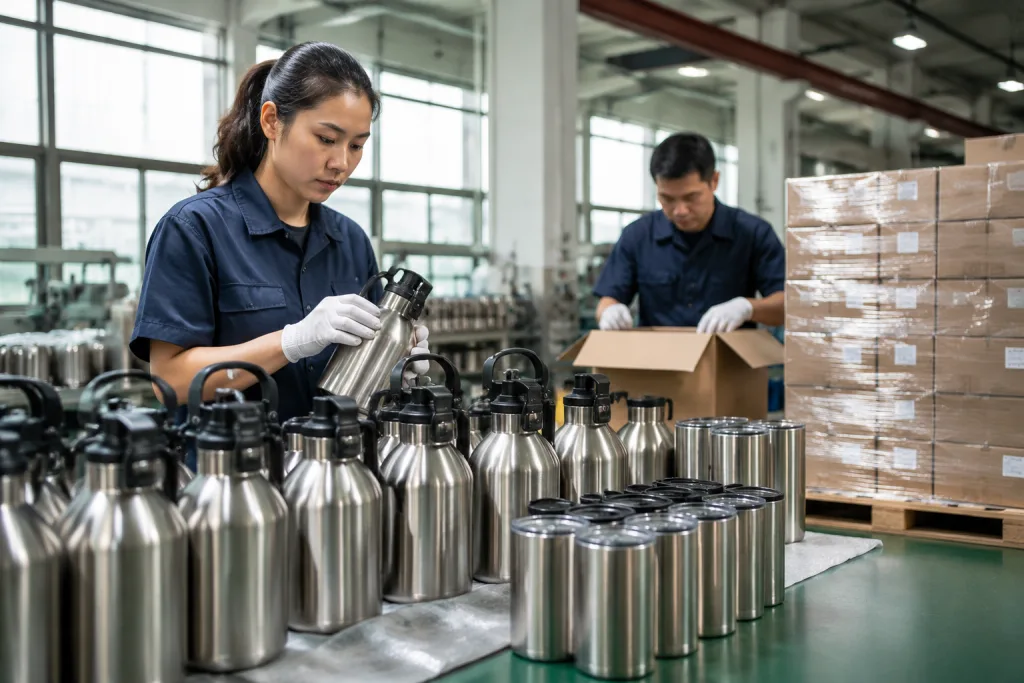
At BottleForge Industrial in Zhejiang, our monthly output is up to 450,000 units across thermal bottles, tumblers, sports bottles, and related bulk drinkware. That matters. Process stability on a plant running one line at 20,000 pieces a month is not the same as a factory running mature welding, vacuum, and powder-coating lines side by side. Before you ask for a price, define the sales scenario and target defect tolerance. This is the right first step. An RFQ with channel, volume, insulation target, print method, and claim limit gives us something we can quote cleanly; a vague price check usually goes sideways.
Choose the bottle architecture carefully
Product architecture drives most of the cost and most of the complaints. New wholesale buyers often spend 2 weeks on bottle shape, then 10 minutes on construction. That is backwards. On our line, QC pulled a good-looking sample last month and found a rough weld bead inside the shoulder with a borescope.
Steel grade and wall structure
For thermal bottles, 18/8 stainless steel, usually called SUS304, is the standard baseline for inside and outside. If the bottle will hold acidic drinks, electrolytes, or salty mixes, SUS316 on the inner wall is a fair upgrade for some programs. It is not automatic. This is the wrong question to ask if you have not first checked weld quality, vacuum rate, and salt spray results. In a lot of wholesale drinkware programs, 304 inside and 201 or 304 on selected external components is enough if corrosion testing passes your standard and the buyer accepts the cosmetic risk on hidden parts.
Typical body thickness for a 500 ml vacuum bottle is around 0.4-0.5 mm outer wall and 0.3-0.4 mm inner wall. Those numbers matter. Drop below that and you might save $0.06 to $0.12 per unit, then lose it back in dent claims and packing upgrades. Go heavier and freight goes up fast; on a 40HQ shipment, an extra 20-30 g per bottle adds up. We have seen buyers push for 0.3 mm outer wall at a 10,000 pcs MOQ, then flag sidewall dents after the first drop test.
Lid system and failure points
The lid causes most end-user complaints. Not the bottle. Thread tolerance, seal material, vent design, and hinge durability are where cheap quotes go sideways. Ask what gasket material is used: food-contact silicone is standard, and shore hardness should match the closure design. If the lid has a flip spout or one-hand button, ask for cycle testing with an actual count, not "passed internal test." A practical benchmark is 3,000-5,000 open-close cycles. We run leak tests upside down for 30 minutes, and QC checks thread engagement with a go/no-go gauge because 0.2 mm drift is enough to start returns.
For screw-top canteen wholesale or wholesale growler products, ask for inverted leak testing and pressure considerations if carbonation is mentioned. Most standard vacuum growlers are not designed as pressure vessels. Say that clearly on the artwork and instruction sheet. We have seen a PO typo where "non-carbonated" became "carbonated," and that small miss cost a full packaging reprint.
Surface finish and decoration
Spray paint is cheaper. Powder coating lasts longer on the shelf and in the hand. For retail drinkware bulk orders, powder coat usually earns its cost, especially on dark colors where edge wear shows fast. Ask for adhesion testing, pencil hardness, and basic abrasion resistance. On the line, we usually cross-hatch the coating and run a tape pull test before mass production approval. If the buyer flagged chips on the bottom edge before, add a rubber boot or widen the base ring; the math does not work if you try to fix a weak finish with nicer photos.
For logos, silk screen is economical for large, simple graphics at 3,000 pcs and up. Laser engraving lasts longer, though the visual effect depends on the finish and base coat. Heat transfer wraps can look sharp on beer tumbler wholesale bulk projects, but registration and dishwasher performance need validation before you sign off. We ship samples with a 1 mm logo position tolerance called out on the spec sheet, because "looks centered" starts arguments fast.
You are not buying stainless steel by itself. You are buying steel, welding, vacuum retention, paint chemistry, seals, and assembly discipline as one system.
Price the total landed cost
A clean FOB quote from China is useful, but it is only the starting point. Procurement teams running bulk canteen, alcohol flask bulk, or beer growler in bulk programs usually compare five cost layers before they sign off. On our side, sales will pull this from the packing spec, BOM sheet, and the latest container loading file. No guesswork.
- Unit FOB cost: bottle, lid, decoration, and standard export carton, with the net weight and steel grade checked against the BOM.
- Tooling and setup: mold charges, screen fees, laser setup, color matching, and packaging sampling; one silkscreen color change can add a separate screen fee.
- Freight efficiency: units per carton, cartons per pallet, and container loading quantity; a 5 mm carton height increase can cut container quantity fast.
- Import and compliance cost: testing, duties, broker fees, and possible relabeling; we have seen buyers miss outer carton marking requirements and pay twice.
- Failure cost: replacements, chargebacks, and customer service burden; QC pulled the sample once for coating rub marks, and that claim cost was larger than the FOB gap.
Example: a 500 ml vacuum bottle at USD 3.20 FOB may look better than one at USD 3.48. The wrong question is FOB only. If the cheaper item packs 24 pcs per master carton with wasted void space and loads 18,000 pcs per 40HQ instead of 22,000, freight per unit moves the other way. Fast. If coating scratch claims add 2% replacements, the savings disappear, and the buyer flagged it later as a packaging issue, not a bottle issue.
MOQ changes the math too. Most thermal bottle factories in Zhejiang, China will quote 1,000 pcs per color per size for existing molds, but custom Pantone matching, individual box printing, or special lids often push the practical MOQ to 2,000-3,000 pcs. We run into this on the line with mixed accessories: one stopper supplier wants 2,000 pcs, the strap supplier wants 3,000, and the printed box plant asks for 5,000 sheets. For alcohol flask wholesale bulk or growler wholesale custom sets, component combinations usually push MOQ higher because parts are bought from separate vendors. We have seen this go sideways over one typo on a PO lid code.
Ask your supplier for this data in one sheet: product weight, carton size, packing quantity, 20GP and 40HQ load quantity, sample charge, mold fee, and ex-factory versus FOB difference. For Amazon or DTC buyers, add barcode application, FNSKU labeling, and drop test performance. Ask for the actual drop height too, such as 76 cm with packed product, not a vague pass statement. A solid factory answers this the same day, often from an ERP export or packing worksheet. If they cannot, the math doesn't work for a stable drinkware wholesale program.
Set compliance before sampling
Set compliance before the PP sample sign-off. If you sell into Europe or North America, the document pack has to match the sales channel, the SKU, and the exact lid set on the PO.
For stainless steel thermal bottles, buyers usually ask for food-contact compliance tied to REACH and LFGB for the EU, plus testing aligned with FDA-related requirements for the US. For children’s ranges, ASTM and CPSIA-related screening may apply based on age grading and small accessory parts like a 12 mm straw bite valve or a carry charm. Packaging also gets checked for heavy metals and label wording. We have seen this go sideways when the bottle passed but the printed color box did not.
Do not ask, “Do you have certificates?” That is the wrong question. Ask what the report covers, which components were tested, and the report date. A test report for one old model does not validate a new lid, new coating, or new printed graphic, and QC pulled the sample on this exact issue last season when a buyer changed the soft-touch paint after approval. The workable method is component-based control:
- Steel material declaration for body and inner wall
- Silicone gasket compliance statement
- Coating or ink test scope tied to the actual finish
- Final product migration or food-contact testing where required
- Factory social audit status such as BSCI if your customer requests it
For wholesale drinkware programs going into chain retail, buyers usually want ISO-style process discipline, incoming material records, and final AQL inspection. AQL 2.5 for major defects and 4.0 for minor defects is a common starting point, though some accounts tighten after the first shipment. We run 100% inline leak testing on sealed products, not sample-only; the line uses an air-pressure fixture, and any pressure drop gets quarantined by lot. Vacuum performance can be sample tested by lot, but the method must be written down: starting water temperature, ambient room condition, and retention target after 6 or 12 hours. No method, no comparison.
Factories in China that ship volume already have routine checks. The job is to tie those checks to your SKU, not some older house model with a similar shape. If you are buying canteen bulk, beer tumbler in bulk, or alcohol flask in bulk with thermal bottles, align the compliance matrix at the start. We have seen buyers approve 3 items, then hold the 4th because one PO line missed the lid material declaration.
Control sampling and production risk
Sampling is where later claims usually start. We see the same pattern on the line: the buyer approves a hand-polished showroom piece, then expects 3,000 pcs to match it one by one. That is the wrong question to ask. A showroom sample and a production sample are not the same job, especially when the logo sits 2 mm from a weld line or the powder coat hides minor steel marks.
- Concept sample: confirms shape, capacity, and the general finish target.
- Pre-production sample: made with actual mass-production materials and decoration from the line, not bench work.
- Packing sample: confirms barcode, insert, carton marks, and the drop-risk points we ship against.
For order thermal bottle wholesale projects, lock the details before deposit release for mass production: Pantone reference, logo size and position tolerance, finish standard, capacity tolerance, net weight tolerance, and packaging spec. Put the tolerance in writing. “Center logo” is too loose; “logo offset within 1.5 mm” is clear. Same for capacity. If the bottle is sold as 500 ml, state whether that means brimful capacity or nominal fill capacity, because QC pulled a sample once that read 512 ml brimful and the buyer flagged it as over spec on a PO that only said “500ML.”
Then control risk with checkpoints, not assumptions. We run it in this order: deposit, material purchase, in-process review, finished goods inspection, then balance payment after inspection pass. If you use a third-party inspector, give them a checklist tied to sales risk, not a generic form. Include leak test, scratch level, print adhesion, vacuum retention, carton drop, assortment count, and barcode scanability. Add actual limits where you can. AQL 2.5 alone does not cover drinkware issues; we have seen cartons pass count check and still fail because the scan gun would not read 2 out of 24 barcodes.
Lead time needs a straight answer. For existing molds with simple one-color print, 35-45 days after approval is normal. If you add powder coating in multiple colors, gift boxes, or mixed containers with wholesale growler, wholesale canteen, and beer tumbler bulk lines, that usually moves to 45-55 days. Before Q4 retail, peak season often adds another 7-15 days because the coating line backs up and carton supply slips. If a supplier promises 20 days for a customized 3,000-piece order from China, ask which step they are cutting: sample approval, paint curing, vacuum test, or packaging print proof. We have seen this go sideways.
The lowest-risk factory is not the one that says yes first. It is the one that tells you the weak points early, shows you the test record, and pushes back before the math doesn't work.
Match supplier fit to your program
Not every factory should get your PO, even if the sample passes. Sample approval is one checkpoint. Supplier fit is a production question. On our floor, the sample room can make 20 nice pieces by hand; the line still has to hold the same finish at 1,000 pcs.
If you run repeat retail or distributor business, pick a factory that controls version changes, holds color from reorder to reorder, and ships fast on repeat SKUs. We usually check color with a Pantone book and keep a signed master sample at the line. If your model is seasonal promo, lower MOQ and mixed SKUs often matter more than full automation. A factory that runs sports bottles all day is not always right for beer growler wholesale bulk. Heavy-handle welding, larger vacuum chambers, and body balance on big formats are different jobs. We have seen buyers miss this point, and then QC pulled the sample because the handle weld line looked rough after powder coat.
Ask direct questions:
- What is your normal MOQ by existing mold and by custom mold?
- What is your monthly capacity by product family?
- Which processes are in-house: welding, vacuuming, powder coating, laser, packaging?
- How do you handle defective rate claims after arrival?
- Can you support retailer compliance, BSCI requests, and private label packaging?
Use the answers to test how the factory actually runs. Ask who does the laser marking in-house, what size powder-coating line they run, and whether packaging is packed on-site or sent outside. This is the wrong question to ask if you only want the lowest quote. You need the real operating setup, not a sales sheet.
For reference, factories in Zhejiang often quote MOQs that look low, then add conditions by color, lid, or box style. We ship against the real MOQ, not the headline MOQ. A fair answer might be 1,000 pcs for blank stock color, 2,000 pcs for custom powder coat, and 3,000 pcs for fully custom gift-box retail pack. That tells you more than a broad promise. We have even seen a PO marked “1,000 mixed colors” while the approved quote was for one body color only. That goes sideways fast.
If you are sourcing a line extension that includes wholesale drinkware, canteen bulk, alcohol flask wholesale, and beer tumbler wholesale, supplier consolidation can cut admin cost. The math does not work if one factory is weak in two of those categories. Flasks need clean weld appearance and steady cap tether assembly. Beer tumbler bulk orders need smooth rim finish and stack-safe packaging; a 1.5 mm divider can decide whether transit damage stays under claim level. Thermal bottles depend on vacuum retention and seal reliability first. On our side, vacuum pieces go through a heat test before packing.
You want controlled predictability, not a cheap opening number. A good supplier gives tolerances, lead times they can hit, and process proof from the line. If the buyer flagged a lid leak last order, the factory should show the fix, not just apologize. That is the partner worth keeping.
Get a sourcing-ready thermal bottle quote
Send your target size, MOQ, market, and decoration plan. We will reply with realistic FOB pricing, lead time, and quality checkpoints from Zhejiang, China.
Frequently asked questions
What MOQ should I expect when I order thermal bottle wholesale from China?
For existing bottle molds, a realistic MOQ is usually 1,000 pcs per size and color. If you want custom Pantone powder coat, printed gift box, or a non-standard lid, the practical MOQ often moves to 2,000-3,000 pcs. Some factories advertise 500 pcs, but that often applies only to stock colors with simple one-color logo decoration. For mixed-category orders like wholesale canteen plus beer tumbler bulk, you may be able to combine container space, but each SKU still needs its own production minimum. Ask for MOQ broken down by bottle body, lid type, decoration, and packaging. That prevents the usual surprise where the bottle MOQ is low but the box or accessory MOQ is much higher.
How much does a thermal bottle cost wholesale FOB China?
A typical 500 ml double-wall vacuum stainless bottle often lands around USD 2.80-3.40 FOB for a straightforward model with a stock lid and one-color print at volume. Add premium powder coating, laser engraving, a more complex leak-proof lid, or retail-ready packaging, and the same size can move to USD 4.20-5.90 FOB. Large 64 oz growler wholesale items can be noticeably higher because of steel weight and handle construction. Unit cost also changes with order size; 1,000 pcs will not price like 10,000 pcs. Do not compare FOB price alone. Check steel grade, wall thickness, carton efficiency, and whether the quote includes spare gaskets, barcode labels, and export carton marks.
What quality tests matter most for thermal bottles and related bulk drinkware?
Four tests matter first: leak testing, vacuum retention, coating adhesion, and final inspection to an agreed AQL. Leak testing should be 100% inline. Vacuum retention should use a defined method, such as starting hot water temperature and checking performance after 6 or 12 hours at room condition. Coating adhesion is important on powder-coated wholesale drinkware and beer tumbler wholesale bulk items because scratch claims are common. For final inspection, many buyers start at AQL 2.5 for major defects and 4.0 for minor defects. Also check capacity tolerance, logo position, rim finish, and carton drop performance. If you are buying alcohol flask wholesale bulk or growler bulk lines too, add cap fit and weld appearance to the checklist.
How long does production usually take after sample approval?
For an existing model with standard lid, simple decoration, and plain inner box, 35-45 days after sample approval and deposit is a realistic lead time from Zhejiang, China. If your order includes custom molds, multiple powder-coat colors, gift boxes, or mixed SKUs such as canteen wholesale, bulk growler, and thermal bottle lines in one shipment, 45-55 days is more realistic. Peak season before holiday retail can add 7-15 days. Sea transit then depends on destination, but buyers should keep production lead time separate from freight time. Ask for a milestone plan covering sample approval, material booking, coating, assembly, inspection, and booking date. That gives you a schedule you can actually manage.
Should I source thermal bottles, growlers, tumblers, and flasks from one factory?
Sometimes yes, but only if the factory has real process depth across those categories. Thermal bottles and wholesale canteen lines rely heavily on vacuum stability and lid sealing. Growler wholesale items often need stronger handles and more robust body construction. Beer tumbler in bulk programs care more about rim quality, nest-safe packing, and decoration consistency. Alcohol flask in bulk needs clean welding and cap fit. Consolidating with one China supplier can reduce admin work, improve container utilization, and simplify compliance follow-up. But if one category is outside the factory’s core line, the hidden quality risk can outweigh the convenience. Ask what they produce in-house, their monthly capacity by product family, and examples of repeat orders by category.