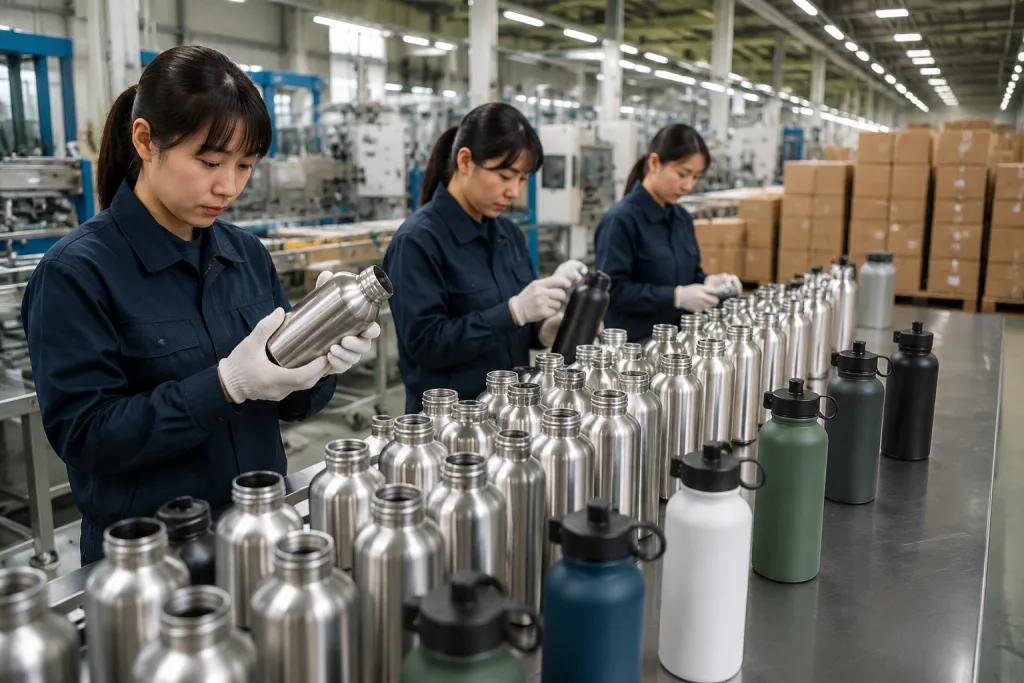
Key Takeaways
- Typical MOQ for a custom stainless sport bottle is 1,000-3,000 pcs per SKU, while stock-color programs can start at 500 pcs
- Normal mass production lead time from Zhejiang, China is 25-40 days after sample approval and 30% deposit
- AQL 2.5/4.0, 24-hour leak testing, and coating adhesion checks reduce the most common claim issues by a measurable margin
- A lid, coating, or gift box change can add USD 0.18-0.90 per unit, which often matters more than a 3% steel price swing
You do not lose margin on a sport bottle order because stainless steel is expensive. You lose it because the quote looked simple and the detail sheet was thin. A 650 ml bottle can move from USD 2.85 to USD 4.10 fast once you add lid tooling, coating, retail box, drop test upgrades, and a second logo position. We run this quote check every week in Hangzhou, and the price often changes after QC pulls the first coated sample and finds 0.3 mm color build-up near the thread. If you plan to order sport bottle wholesale from Zhejiang, China, catch these costs before the PO is signed.
On 7 out of 10 RFQs, the buyer is not sourcing one SKU. They are also checking bulk canteen, wholesale drinkware, beer tumbler bulk, or wholesale growler projects for the same season. The real questions stay simple: what is the MOQ, what can fail inspection, and which specifications change sell-through at retail. Ask for “best price” first and the math doesn't work. We've seen this go sideways when a buyer approved 3,000 pcs, then flagged the carton drop test after the line had already booked powder coating. Use this checklist if you want fewer factory surprises and cleaner landed cost.
What exactly are you buying?
Start with the part buyers usually skip: define the commercial use case before you compare factories. This is the wrong question to ask if you start with “best wholesale drink bottle” and leave the channel open. You will get 3 prices for 3 different products, and the math doesn't work. A gym promo bottle, a retail-ready insulated bottle, and a corporate gift bottle can all be 750 ml stainless, but on the line they run with different lids, paint standards, carton specs, and drop-test targets.
Your RFQ should lock five basics:
- Body material: single-wall 18/8 stainless, double-wall vacuum 18/8, or Tritan.
- Capacity: 500 ml, 650 ml, 750 ml, 1,000 ml.
- Mouth style: narrow mouth, wide mouth, chug lid, straw lid.
- Finish: spray paint, powder coating, silk screen, laser, heat transfer.
- Sales channel: promo, retail, Amazon FBA, club store, team merchandise.
For example, a single-wall 750 ml sports bottle for event giveaway may land at USD 1.85-2.40 FOB Ningbo at 3,000 pcs. A double-wall vacuum bottle with powder coat and logo can be USD 3.20-5.80 FOB depending on lid and packaging. If you also source canteen wholesale, drinkware bulk, or alcohol flask wholesale bulk items, build separate cost sheets. We split them at once. A flask body uses different welding and polishing standards than a sport bottle; a beer growler wholesale bulk item may require heavier wall thickness, often 0.5 mm instead of 0.4 mm, plus pressure-resistant closure parts that buyers usually miss in the first PO.
At BottleForge Industrial in Zhejiang, we usually see buyers cut failure rates just by fixing wall structure and packaging before price discussion. QC pulled the sample more than once where one quote used a 0.4 mm single-wall body and another used a 0.5 mm body with a thicker base, then the buyer flagged the cheaper one as the better deal. It wasn't. We've seen this go sideways, especially when the outer carton spec changes from brown box to color box after approval and nobody updates the FOB sheet.
MOQ, pricing, and where costs move
For an order sport bottle wholesale quote, body price is only one line on the cost sheet. In our Hangzhou quoting room, we run the BOM beside a 0.01 g scale and a lid sample tray; the late increase usually comes from lids, coating, and packaging after the buyer changes the retail pack.
Typical working ranges
- MOQ: 1,000 pcs per color per size for custom coating is common; 3,000 pcs if a new lid mold or uncommon finish is involved. Below that, the coating line spends more time cleaning guns than spraying bottles.
- Stock-color MOQ: 500-1,000 pcs if the factory already runs that color. Ask which Pantone is on the weekly plan, not just which color is in the catalog.
- Sample lead time: 5-10 days for logo sample, 12-20 days if new tooling is needed. A laser logo sample is fast; a new PP lid insert waits for mold trial and fit checking.
- Mass production: 25-40 days in normal season, 40-55 days before Q4 peak. We have seen buyers lose 9 days because the PO said matte black but the artwork file said black gloss.
What usually changes your unit cost?
- Powder coat instead of standard spray: +USD 0.12-0.28
- Second logo position: +USD 0.03-0.10
- Straw lid versus basic screw lid: +USD 0.20-0.65
- Individual color box instead of bulk carton: +USD 0.18-0.55
- SBS gift box with insert: +USD 0.45-0.90
If your program includes wholesale canteen, growler bulk, or beer tumbler wholesale bulk assortments, ask for a mixed-SKU container plan before artwork approval. We ship these together when carton sizes are locked early, for example 24 pcs sport bottles with 12 pcs growlers on one pallet layer. The buyer flagged freight once because air gaps took utilization down to 78%; with carton dimensions planned early, the same mix can hit container utilization above 85%.
Good buyers ask for both the quote and the quote assumptions. If the assumptions are missing, the price is not real.
Ask for three columns on every quote: FOB Ningbo price, mold/setup charge, and packaging cost. Simple table. QC pulled the sample? Then the setup charge should match the actual mold or screen plate on the bench, not a vague “logo cost” line. This is where margin arguments stop.
Which specifications deserve your attention?
Not every spec carries the same weight. New wholesale buyers often stare at steel grade and miss the parts that drive claims: lid fit, coating consistency, and gasket compression. QC pulled a sample last month with a silicone seal 0.6 mm too thin, and that bottle leaked in a simple upside-down test. That is where returns start.
For stainless sport bottles, check these specs line by line:
- Steel grade: 18/8 stainless for inner and outer is standard for export to Europe and North America. We still see POs typed as “304 inside, 201 outside” by mistake, so match the PO to the approved spec sheet.
- Wall thickness: around 0.4 mm for many standard bottles; heavier models may run 0.5 mm. Ask for tolerance. If the line runs 0.35 mm instead of 0.4 mm, dent complaints go up fast.
- Vacuum performance: request a target, such as 12 hours hot and 24 hours cold, and ask how it is tested. Ask for the test method, not just the claim; the math doesn’t work if the sample sits in a 26°C office and the report says “lab result.”
- Lid material: PP, Tritan, silicone gasket; confirm BPA-free declarations if needed. Buyer pushback here is common, especially on odor after sealing for 24 hours.
- Coating: powder coat usually hides scratches better than spray paint and feels more premium. We run cross-hatch adhesion checks on the line because poor coating bond shows up after carton rub, not on day one.
- Base construction: anti-slip pad, dimple, or plain base affects stability and carton rub marks. A plain base saves cost, but on a 32 oz bottle it can wobble if the bottom dome is out by 1 mm.
If you also handle canteen bulk, alcohol flask in bulk, or beer growler in bulk projects, watch the closure first. This is the wrong question to ask if you start with body shape and ignore the cap system. Flasks usually fail at the cap thread or hinge pin. Growlers fail at handle welds, lid sealing, or pressure from warm filling when the end customer uses them the wrong way. A sport bottle with a straw lid has a different drop and leak risk than a classic screw-cap bottle, and we’ve seen this go sideways after a 1.2 m drop test.
Ask the factory for a drawing or spec sheet showing net weight, gross weight, carton count, carton size, and CBM. Good Zhejiang factories run cleaner projects with that sheet locked before sampling round 2. We ship plenty of mixed programs, and if a supplier cannot hold weight within about plus or minus 3%, your freight budget drifts later. One 40HQ plan can move from 12 days to 18 days to rebalance if the master carton weight is off and the buyer flagged the loading plan.
How do you verify compliance and quality?
You do not need a perfect factory. You need a factory with records you can inspect. For Europe and North America, we usually start with REACH, LFGB or food-contact migration standards where relevant, California Proposition 65 risk on coatings, and ASTM/CPSIA if the bottle is sold for children. For social compliance, about 6 of 10 importers who send us RFQs ask for BSCI or an equivalent audit report before they release the PO. QC also checks whether the test report name matches the actual factory name; one buyer once flagged a report where the trading company name was listed instead of the production site.
On quality, ask for the inspection plan, not the promise. A workable sport bottle plan includes:
- AQL standard: commonly AQL 2.5 major / 4.0 minor for final random inspection, with carton count and sampling size written on the QC sheet.
- Leak test: 100% air pressure or inverted leak test for assembled bottles, often 2-24 hours depending on product design; our line uses a pressure jig before packing.
- Vacuum check: sample-based test for insulated models, with temperature drop recorded after the set holding time.
- Coating adhesion: cross-hatch or tape test on painted bodies, usually checked before logo printing starts.
- Drop test: packed drop test from defined height, often 76 cm for standard cartons, after the master carton is sealed with production tape.
- Salt spray: if you need corrosion performance validation on coated parts, especially for caps, handles, or metal clips.
Ask the supplier to separate critical defects from cosmetic defects. This matters. A scratched logo and a leaking lid are not the same problem, and treating them the same is the wrong question to ask during inspection. On bulk drinkware orders, most chargebacks we see come from leaks, odor complaints, wrong barcode application, or mismatched accessories; a 1 mm paint shade difference almost never stops a shipment unless the buyer approved a tight color limit. QC pulled the sample, not the sales team.
If your product mix includes wholesale growler, alcohol flask wholesale, or canteen wholesale, request family-specific checklists. A growler handle weld needs a pull check, and a flask hinge needs open-close cycle testing before packing. A factory with 300,000 units per month capacity may still struggle if it applies one generic QC standard to every drinkware bulk item; we have seen this go sideways when a canteen cap gasket was checked like a normal sport bottle lid.
Printing, packaging, and retail readiness
Brand owners will spend 3 weeks arguing over USD 0.06 on bottle cost, then give us logo files and box artwork on Friday afternoon. Wrong order. Printing and packaging decide whether the bottle looks retail-ready on shelf, and whether Amazon or a chain buyer rejects the shipment when QC scans the carton mark with a Zebra reader.
For logos, choose the method by volume and how the bottle will be used:
- Silk screen: Lowest cost for 1-2 spot colors, clean edges on straight walls, sensible from 1,000 pcs up if the artwork does not wrap too close to the curve.
- Laser engraving: Best for a durable mark on powder-coated stainless. It looks premium, but we run it slower than silk screen, often 12 days vs 8 days for the same 5,000 pcs batch.
- Heat transfer: Use it for multi-color graphics or full-wrap artwork. Ask QC to run a 3M tape pull and a 500-cycle rub test before you approve mass production.
- Digital print/UV: Good for lower volumes or detailed artwork. The weak point is adhesion on some coatings, so test it on the actual bottle, not a flat color chip.
Retail packaging changes freight cost and damage rate. A plain master carton is fine for promo orders; retail buyers usually ask for an individual box, barcode, inner tray, and multilingual labeling. Amazon FBA requires FNSKU labeling when assigned, suffocation warnings on polybags, carton weight limits, and scannable outer marks. We have had a buyer flag a 2 mm barcode shift on a color box proof, and the same issue can hit beer tumbler in bulk, beer growler bulk, or alcohol flask bulk programs.
Ask for a packaging test sample before final approval. We have seen a good bottle fail because the paper insert was 4 mm too loose, so the powder-coated body rubbed against the printed logo during the truck leg to Ningbo port. If your distributor will palletize in Europe, ask for the pallet pattern, carton compression data, and whether the supplier can keep outer cartons below 15 kg or 18 kg per your warehouse rules.
Use a short gate list before production starts: logo method approved with the real fixture, Pantone matched under a D65 light box, barcode placement confirmed, carton marks approved, insert fit tested, and photo sign-off completed. Skip this, and the math does not work when 300 cartons are already packed.
Questions to ask before placing the PO
Procurement managers know they need questions. The hard part is asking the ones that protect the shipment. Use this shortlist before you wire the 30% deposit; we have seen a PO sit for 5 days because the logo file name on the artwork did not match the color sheet.
- Can you hold the quoted price for 30 days? Stainless and carton paper move faster than buyers expect. Put the validity date on the PI, not only in a WeChat message.
- What is the production lead time after sample approval? Ask for normal lead time and peak-season lead time. For a 2,000-unit sport bottle order, 12 days and 18 days are different launch plans.
- Will you provide pre-production sample and production photos? Ask for photos from the coating line and logo station. QC pulled the sample once because the print sat 6 mm lower than the approved mockup.
- What is your rework policy for leakage or logo defects above AQL? Make the remedy clear before production starts. If 37 lids fail the vacuum leak test, the math doesn't work unless rework time and cost are already agreed.
- Can I split shipment dates by SKU? Useful if one color is delayed but the launch date is fixed. We run into this often with matte black, since tiny dust spots show up under the inspection lamp.
- What documents come with shipment? Packing list, commercial invoice, test reports, carton dimensions, barcode files, plus carton mark artwork should be routine. Check the HS code and gross weight before the forwarder books space.
Ask whether the factory can support adjacent categories as well. About 6 out of 10 buyers who start with order sport bottle wholesale later add wholesale canteen, drinkware wholesale, growler wholesale, or alcohol flask wholesale items within the next two seasons. Shared finishes matter here; if the powder coating color card is off by even 1 shade between bottle and growler, the buyer flagged it before retail packing.
The best POs are boring. Good. They spell out SKU code, capacity, color, logo file version, packaging spec, carton marks, AQL standard, ship term, and ex-factory or FOB date. In Zhejiang, China, factories that ship repeat export orders smoothly treat the PO as the control sheet for the line, with the same version taped beside the assembly table and packing bench. This is the right question to ask before you place 2,000 units or 200,000: can the supplier build exactly what the PO says?
Get a factory quote built on real specifications
Send your target capacity, lid type, logo method, and packaging requirement. We will reply with MOQ, FOB pricing, lead time, and QC checkpoints.
Frequently asked questions
What MOQ should I expect when I order sport bottle wholesale?
For a custom stainless sport bottle, a realistic MOQ is 1,000-3,000 pieces per SKU depending on coating, lid, and packaging. If you use a stock bottle shape and stock color, some China suppliers can start at 500-1,000 pieces. New mold development, unusual lids, or gift box packaging usually push MOQ higher. If you want mixed colors, ask whether the MOQ is per model, per color, or per print design. Those are not the same. Also confirm whether the MOQ applies to the bottle only or to each bundled accessory like straws and cleaning brushes. Many buyers miss that point and end up short on accessory packs.
How long does production usually take from China?
For repeat models with approved artwork, 25-40 days is a normal production window after deposit and sample approval. Sampling is usually 5-10 days for standard logo samples and 12-20 days for new tooling or complex packaging. In peak season, especially before Q4, lead time can stretch to 40-55 days. If your order includes several categories such as canteen bulk, beer tumbler wholesale bulk, or wholesale growler items, ask for a production schedule by SKU. One delayed lid component can hold the full shipment. Good factories in Zhejiang will show assembly timing, packaging timing, and cargo-ready date instead of giving one vague ship week.
Which tests matter most for sport bottles and related drinkware bulk orders?
Focus on tests that match actual claim risk. For sport bottles, the essentials are leak testing, vacuum retention checks for insulated models, coating adhesion, and packed drop testing. AQL 2.5 for major defects and 4.0 for minor defects is common for final random inspection. If the item is sold in Europe or North America, ask about food-contact compliance such as REACH-related material controls, and request supporting declarations for plastics and coatings where needed. For kids' bottles, ASTM or CPSIA-related requirements may apply depending on how the product is marketed. If you also buy alcohol flask wholesale or beer growler in bulk items, add closure durability and weld checks to the QC plan.
What Incoterm is best when sourcing wholesale drinkware from China?
Most buyers start with FOB Ningbo or FOB Shanghai because it gives clearer freight control than EXW without forcing the supplier to quote destination charges they do not manage well. FOB works especially well if you already have a forwarder consolidating drinkware wholesale orders from more than one supplier. EXW can look cheaper but often adds local China trucking, export handling, and communication friction. If you are new and want simplicity, ask for both FOB and DDP estimates so you can compare. Just make sure the DDP quote states duties, taxes, and delivery address assumptions clearly. For larger programs above one 40HQ per month, FOB usually gives you the cleanest cost visibility.
How can I reduce risk on a first order with a new supplier?
Keep the first PO controlled. Choose one or two bottle sizes, one lid family, and no more than two decoration methods. Ask for a pre-production sample, packaging sample, and signed specification sheet before mass production. Put AQL level, leak standard, logo placement, carton marks, and ship date in the PO. Use a third-party final inspection if the order value justifies it; on many projects, that small cost is cheaper than one claim. If you are testing several lines such as wholesale canteen, alcohol flask bulk, and beer tumbler in bulk, do not launch all categories at once. Start with the category that has the simplest closure and packaging, then expand after the supplier proves consistency.