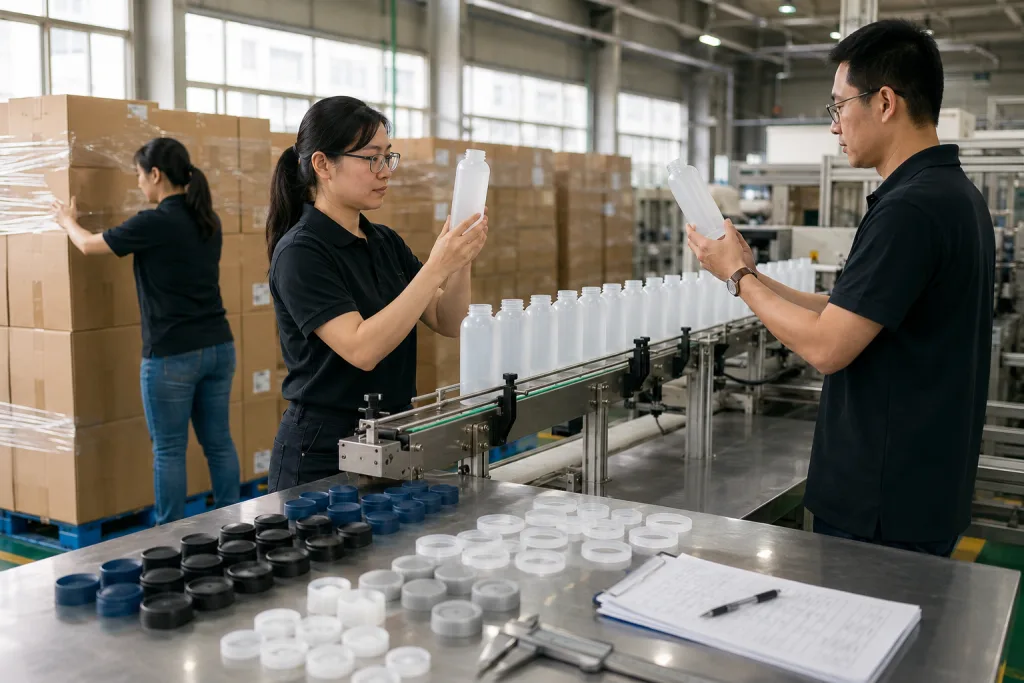
Key Takeaways
- A complete RFQ should define resin grade, capacity tolerance, decoration method, and test standard; this typically cuts sampling revisions from 3 rounds to 1 or 2.
- For order polypropylene bottle wholesale, common MOQ is 3,000-5,000 pcs per color, with sampling in 7-10 days and bulk lead time in 25-40 days.
- Add PO line items for AQL 2.5/4.0, leak testing at 100%, and packaging details down to carton drop standard to avoid chargebacks.
- FOB Ningbo pricing for a basic 600 ml PP bottle often lands around USD 0.78-1.55 depending on mold status, lid complexity, and print count.
You can buy a polypropylene bottle from almost any trading company in China. That part is easy. Getting the right bottle at the right cost, with the right compliance paperwork, is where orders slip. We see the same misses on the factory side: vague RFQs, a PO missing a lid color code, or a decoration note that says “match logo blue” with no Pantone. Then the buyer flags leakage, drop test results, or food-contact testing after sampling, when the line is already booked.
If you need to order polypropylene bottle wholesale for Europe or North America, start with a process that removes guesswork. This is the right question to ask. It matters whether you are buying a simple canteen wholesale program, a drinkware bulk promotion, or adding a lightweight bottle beside a stainless range. In Zhejiang, we see the same pattern every month: clear specs cut delays by 7 to 12 days and reduce rework on mass production. QC pulled the sample on one recent order because the straw OD was off by 0.8 mm, and that single miss would have pushed shipment from 12 days to 18 days. China is efficient when your paperwork is precise.
Start with a usable RFQ
If you want usable pricing, do not send a bottle photo and ask for a “best price.” Send a product definition the factory can actually quote and run on the line. For order polypropylene bottle wholesale, your RFQ should state bottle body material, lid material, capacity, weight target, color standard, decoration method, packaging, compliance market, and target Incoterm. Buyers who send a structured RFQ usually get 2 to 4 comparable quotes within 48 to 72 hours. Buyers who send one JPG get numbers all over the board, and the math doesn’t work. We see this every week. One missed detail like Pantone matching or a 1.8 mm wall target can shift cost fast.
For polypropylene, say clearly if you need virgin PP for food contact and if any recycled content is allowed. For direct-drinking programs in Europe and North America, most orders stay with virgin food-grade PP and silicone seals. QC pulled the sample on one EU order last month because the seal hardness was off by 5 Shore A, so this point is not paperwork only. A practical RFQ list looks like this:
- Capacity: 500 ml, 650 ml, or 750 ml, with tolerance of plus or minus 3%
- Bottle weight: for example 78 g body and 22 g lid
- Wall thickness: 1.8-2.5 mm depending on design stiffness
- Decoration: 1-color silkscreen, heat transfer, IML, or pad print
- Leak requirement: no leakage after 30 minutes inverted and 10 cycles open/close
- Compliance: REACH, LFGB, FDA as needed
- Packaging: bulk pack, egg-crate divider, or individual polybag plus label
If your range also includes wholesale canteen, wholesale drinkware, or a bulk growler line, split them into separate RFQ sheets. A PP bottle quote should not be benchmarked against a beer tumbler wholesale bulk SKU or an alcohol flask wholesale bulk program. Material cost, molding cycle, and freight density are different. We ship these as different jobs, not one bucket. At BottleForge Industrial in Zhejiang, our practical MOQ for standard PP bottle programs is often 3,000 pcs per color, while custom-mold projects usually start higher because tooling amortization has to show up somewhere. One buyer flagged this before, asking why the mold charge was not “free” at 2,000 pcs; we’ve seen that go sideways once sampling starts.
Lock the product spec before sampling
Too many buyers start sampling before the spec is locked. That's backwards. A sample should verify the spec, not create it on the fly. Before you sign off any pre-production sample, the factory should issue a drawing or spec sheet detailed enough that purchasing, QC, and packaging all work from the same file. On our line, QC pulled the sample once because the lid height on the sketch was missing by 2 mm, and packing used the wrong inner tray.
The minimum file set should include a 2D dimensioned drawing, Pantone references, logo position, and an approved bill of materials. Skip that step and the sample might pass your desk while bulk production ships with small changes you never froze and can't claim against later. We've seen this go sideways over a matte finish callout that was written on a chat screenshot, not on the approved spec.
PO line items to add at this stage
- Material: bottle body in food-grade polypropylene, lid in PP or ABS, seal in silicone
- Finish: matte or gloss; surface texture standard if required
- Color: Pantone code or approved physical chip
- Logo artwork: AI or vector file, print size in mm, print location tolerance of plus or minus 1.5 mm
- Unit weight tolerance: usually plus or minus 5%
- Odor requirement: no abnormal odor after 24-hour conditioning
For custom programs in China, sample timing is normally 7 to 10 days for existing molds and 20 to 30 days if a simple modification is needed. New tooling can take 25 to 35 days depending on cavity count. If you are building a canteen bulk or drinkware wholesale program for retail, ask for two sample stages: an engineering sample for fit and function, then a finished sample with final print and packaging. We run both for larger retail accounts. The first sample checks thread match, leak risk, and cap seating. The second checks print color, barcode placement, and carton fit. That extra round often saves one full production cycle, and the math works.
What causes most sample delays? Late artwork, changing lid style after sampling starts, and no decision on packaging method. We also see PO typos on logo size more often than buyers expect.
If your assortment also includes growler wholesale, beer growler in bulk, or alcohol flask in bulk, keep separate approval files by category. This is the wrong question to ask: "Can't one approval form cover all drinkware?" No. Procurement teams try it anyway. Then the buyer flagged it later because closure torque, handle stress, and food-contact declarations were never checked by category. A 32 oz PP bottle and a metal flask do not belong on the same approval sheet.
Read the quote like an engineer
A quote for order polypropylene bottle wholesale is more than a unit price. Read it like a spec sheet. In Zhejiang and across the China supply base, two suppliers can both quote USD 0.96 FOB Ningbo for a 650 ml bottle and still be shipping different bottles. We see this every month. One runs a 1.6 mm wall body at 58 g; another quotes 62 g with the silicone seal included. One line also leaves out the print setup charge, and the buyer only catches it after the PI is issued.
Ask the supplier to break pricing into these blocks:
- Unit price by quantity: 3,000 / 5,000 / 10,000 pcs
- Tooling cost: new mold, mold modification, or no tooling
- Decoration cost: per color, per position, setup charge
- Packaging cost: bulk pack vs gift box vs PDQ
- Testing cost: third-party lab, if requested
- Freight basis: EXW, FOB Ningbo, or DDP estimate
For a standard single-wall PP bottle with screw lid, current factory-level pricing often falls around USD 0.78 to 1.10 FOB for 5,000 pcs. Add a flip-top with a spring pin, a carry strap, two print positions, or a retail box, and the price often moves to USD 1.20 to 1.55. That jump is normal. On the line, extra assembly adds seconds per piece, and retail packing can add 12 to 18 workers on a rush run. The best wholesale drink bottle is not the cheapest one. This is the wrong question to ask. The right one is whether it holds your claim rate under 0.5%, protects margin, and lets you replenish in 12 days instead of 18 days.
This is also where buyers need to compare PP bottles against adjacent categories with clean math. A wholesale growler or beer tumbler bulk item has a different margin structure because stainless steel, vacuum construction, and welding steps raise cost. QC pulled the sample on one tumbler order last month and found a pinhole at the weld, but complaint rates on breakage still ran lower than lightweight plastic in courier channels. A PP bottle wins on weight, freight efficiency, and casual-use pricing. We ship more units per carton cube, and the math works for low landed cost. If your customer wants temperature retention, PP is the wrong material.
Approve samples with test points
Sample approval needs test points you can measure, not a fast visual sign-off. For polypropylene drinkware, the usual failure points on the line are leakage, odor, body deformation, print adhesion, and cap fit after repeat opening and closing. If the sample is approved on looks alone, the bulk order carries the risk. We have seen this go sideways after 5,000 pcs were already packed.
Put a short approval matrix into the PO file and tie each item to a result. QC pulled the sample, filled it at 23°C, and recorded pass or fail. Typical checks include:
- Capacity verification with water at room temperature
- Leak test when inverted for 30 minutes
- Drop test from 80 cm to 100 cm depending on pack type
- Dishwasher suitability claim only if tested; do not assume PP print survives top-rack cycles
- Print adhesion by tape test and rub test
- Odor check after 24 hours in closed condition
For Europe, ask if the factory can provide REACH and LFGB-related food-contact paperwork from resin suppliers or lab partners. For North America, FDA food-contact declarations are standard on a lot of PP bottle programs. If the item is for children, ASTM and CPSIA may also apply depending on age grading and any small accessories. This is where buyers often ask the wrong question. The issue is not whether the factory "has" every report on day one; the issue is whether the material lot, colorant, and final item can be matched back to valid paperwork and external lab testing if needed.
PO line items to add after sample approval: approved sample date, sample code, critical dimensions, accepted color standard, and reference photos. Add lid-color count too if the order runs mixed packs. On one 12,000 pc canteen order, the buyer flagged a PO typo on the blue lid code after assembly started, and 3 lid colors were already sitting beside the capping machine.
At our Zhejiang facility, we usually ask buyers to approve one golden sample kept by both sides before mass production starts. It sounds old-school. It works. We store it in a labeled carton with the sample code and seal date, and the line refers back to it if a distributor later says the bottle shade changed by 1 shade card step. The same control applies whether you buy wholesale drinkware, growler bulk accessories, or beer tumbler in bulk for seasonal promotions.
Write the bulk PO properly
A purchase order is where preventable disputes either die early or get locked in. Most import problems are not fraud; they start with a 2-page PO that leaves room for two different readings. If you want polypropylene bottle wholesale orders to run cleanly, write the PO like a shop-floor document, not an accounting note. We’ve seen this go sideways over a 3 mm logo shift and one PO typo on lid color.
Include these line items clearly:
- SKU description: capacity, color, lid style, logo version
- Quantity split: by color and by packaging type
- Tolerance: quantity tolerance, usually plus or minus 5% unless fixed
- Price term: FOB Ningbo or agreed term in USD
- Lead time: for example 30 days after deposit and artwork approval
- Inspection standard: AQL 2.5 for major defects, 4.0 for minor defects
- Critical defects: leakage, wrong logo, sharp burr, contamination, cracked lid
- Packaging standard: master carton dimensions, gross weight, carton marks, barcode placement
- Labeling: FNSKU, suffocation warning, country of origin, recycling marks if required
- Payment: commonly 30% deposit, 70% before shipment or against copy documents
Do not leave carton details vague. This is the wrong question to ask: “Can you pack it as usual?” Usual for who? Our line may run a 57 x 39 x 41 cm carton for one buyer and a 15 kg cap for another. Carton oversize and overweight trigger chargebacks in Europe and North America warehouses, and the buyer flagged it more than once on Amazon programs. For Amazon-related projects, the packaging spec should state FNSKU placement, carton label format, and outer carton weight cap, often below 15 kg or your warehouse requirement. QC pulled the sample last month because the FNSKU was 20 mm too close to the side seam.
If your sourcing calendar includes drinkware bulk assortments such as wholesale growler, alcohol flask wholesale, or beer growler wholesale bulk, do not pile too many packing standards into one PO unless the supplier already runs a tight packing system. The math doesn’t work if 6 SKUs use 4 insert styles, 3 barcode rules, and 2 carton limits on one line. Complexity creates mistakes faster than volume. A factory producing 500,000 units per month still makes basic shipping errors if your instructions arrive in six separate emails instead of one signed PO package. We ship cleaner when one file controls the order.
Control production and final inspection
Once the PO is placed, the real control work starts. The highest-risk window sits between resin booking and final packing on the line. Ask for a dated production plan with clear checkpoints: material arrival, color matching, first-off approval, printing start, assembly start, packing start, inspection date, and booking date. We usually put this in a one-page sheet, and if the cap mold change is 0.3 mm late, you will see the whole schedule slip fast.
For standard PP bottle orders, bulk lead time is often 25 to 40 days after deposit, depending on quantity and decoration. If the order includes custom boxes, add 5 to 7 days unless the packaging supplier is already aligned. Ask for first article photos and in-line QC records during production, not after the issue shows up in cartons. QC pulled the sample should mean something. At minimum, you want confirmation of:
- Resin lot traceability
- Color matching against approved standard
- 100% leak test if specified
- Print registration checks every 1 to 2 hours
- Carton drop test or stacking validation for export pack
Final inspection should happen when at least 80% of goods are packed. Use AQL sampling, and make sure inspectors work from the same defect glossary as your supplier. This sounds basic, but we have seen this go sideways over one PO typo on barcode digits. Leakage is usually a critical or major defect. Smudged logo may be minor or major depending on visibility. Wrong barcode is major because it causes downstream receiving problems.
China has strong manufacturing depth, but the factory is only half the answer. Your control system has to be as disciplined as the plant. If you source canteen wholesale or drinkware wholesale from Zhejiang and skip in-line records, you are relying on memory and chat screenshots. This is the wrong question to ask. Ask for records, timestamps, and who signed first-off approval.
Book freight early in peak periods. We ship enough high-cube PP bottles to know the math does not forgive delays: a booking that rolls by 10 days can wipe out the ex-factory savings on a low-value item. In one case, a buyer flagged the freight jump after cartons were ready, but by then the vessel space was gone. For PP bottles, freight timing matters almost as much as ex-factory price.
Send your PP bottle RFQ for a workable quote
Share your target capacity, artwork, quantity, and market. We will review the spec, flag risks, and quote MOQ, lead time, and FOB pricing clearly.
Frequently asked questions
What MOQ should I expect when I order polypropylene bottle wholesale?
For a standard existing-mold polypropylene bottle, a realistic MOQ is 3,000 to 5,000 pcs per color, sometimes 1,000 pcs for leftover stock colors but not for a true custom program. If you need custom Pantone matching, special lids, or retail boxes, suppliers in China usually push closer to 5,000 pcs because setup scrap and packaging minimums increase. New mold projects can start at 10,000 pcs total to make tooling economics reasonable. If your range includes canteen wholesale or drinkware bulk mixed SKUs, ask whether components can be shared across sizes. Shared lids can lower your MOQ risk and simplify replenishment.
How long do samples and bulk production usually take?
For existing molds, plain samples usually take 3 to 7 days, and finished logo samples take about 7 to 10 days after artwork approval. If the factory needs a mold modification, expect 15 to 25 days. For bulk production, 25 to 40 days is normal after deposit, approved sample, and confirmed packaging files. Add another 5 to 7 days if you require custom gift boxes or third-party lab testing before shipment. In Zhejiang, lead time is often shorter outside peak gifting seasons, but October to December can tighten capacity fast, especially for drinkware wholesale programs with multiple print variants.
What compliance documents should I ask for on PP bottles?
At minimum, ask for a declaration that the polypropylene resin is food-grade and suitable for the destination market. For Europe, buyers commonly request REACH-related material information and often LFGB-style food-contact testing through a third-party lab. For North America, FDA food-contact declarations are standard. If the bottle is marketed to children or includes parts with child appeal, additional ASTM or CPSIA questions may apply. Also request a packing list, carton spec, and country-of-origin marking confirmation. If a supplier cannot identify the resin source or seal material, that is a warning sign even before testing starts.
Is polypropylene a good choice compared with stainless for wholesale drinkware?
Polypropylene is a good choice when you need low unit cost, low weight, and high freight efficiency. A 600 to 700 ml PP bottle can weigh under 120 g, while a comparable stainless bottle may be 250 to 350 g or more. That matters when you ship 10,000 units. PP is practical for schools, promotions, gyms, and entry-price drinkware bulk programs. It is not the right choice if you need temperature retention, premium hand feel, or a high-ticket wholesale growler or beer tumbler wholesale bulk position. Think about the usage case first, not the material trend.
How do I reduce quality problems on a first order from China?
Use a full RFQ, approve a golden sample, and write tighter PO terms. Specify material, capacity tolerance, print position, leak standard, AQL level, and packaging details in one document. Require in-line photos or first article approval before full production runs. For a first order, many buyers also use a pre-shipment inspection when 80% of goods are packed. Budgeting USD 250 to 400 for inspection is cheaper than dealing with leakage claims or relabeling after arrival. The factories in Zhejiang and broader China respond well to clear operating documents. Most quality problems come from vague instructions, not from a lack of manufacturing ability.