Key Takeaways
- A 304 inner / 201 outer vacuum bottle can cut unit cost by USD 0.18-0.35 versus full 304, but it changes corrosion risk and claim language.
- Typical MOQ for custom bulk drinkware is 1,000-3,000 pcs per SKU; full custom molds usually start around USD 2,500-8,000 and add 20-35 days.
- Lead time is usually 25-45 days after sample approval and deposit, but custom color, third-party testing, and gift box packs can add 7-12 days.
- AQL 2.5/4.0 inspection, carton drop testing, and REACH/LFGB/FDA paperwork matter more than one extra Pantone match when you sell into Europe or North America.
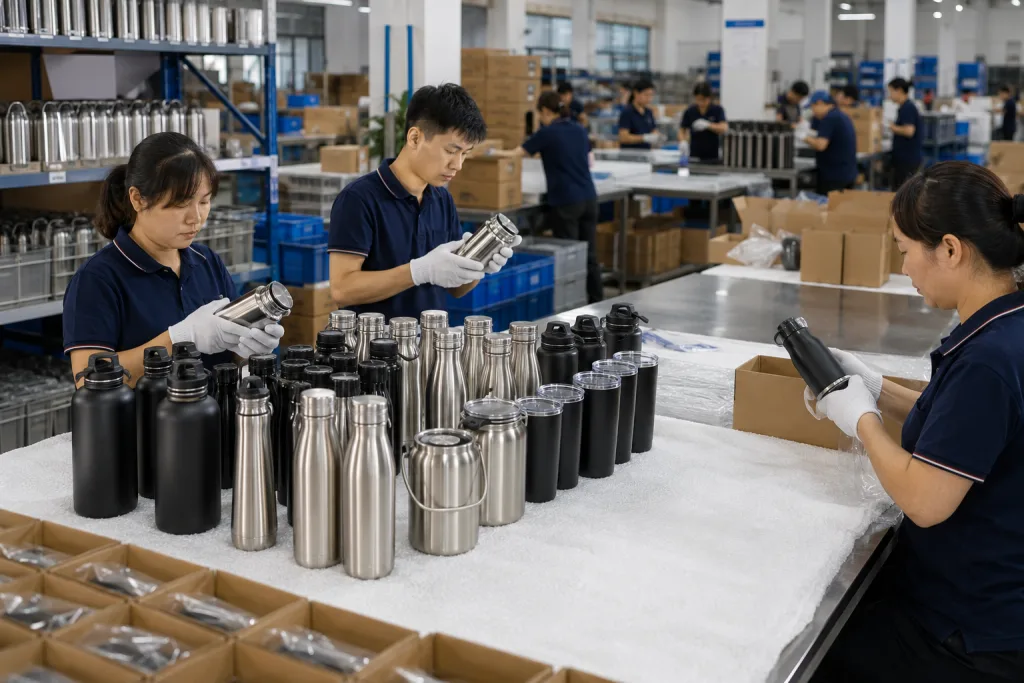
You do not usually lose money on bulk drinkware because of the bottle shape. You lose it in the small spec lines on the quotation: 0.1 mm less steel, a lid resin missing the right food-contact file, a carton that fails a 1.2 m drop test, or a print method approved before anyone checked the dishwasher claim. We see this on the line. QC pulled one tumbler sample last month where the body looked fine in the photo, but the wall gauge read 0.38 mm instead of the quoted 0.48 mm. When you order drinkware in bulk, the drawing matters more than the photo.
Buyers in Europe and North America often arrive in Zhejiang with a target retail price and a mood board, but no full spec sheet. That is where orders drift. At BottleForge Industrial in Hangzhou, Zhejiang, we build around 600,000 units per month, and 7 out of 10 sourcing delays we see start with missing details, not factory capacity. A buyer may ask for "same as sample" while the PO skips lid material, carton burst strength, logo size in mm, and test standard. The math does not work. If you want predictable landed cost, read the spec line by line and understand what each line changes for tooling, QC, packing, and shipment.
Start with product architecture
The first line on your spec sheet should say what you are buying, before anyone talks about Pantone color or logo size. For bulk drinkware, the structure controls tooling, drop test risk, carton count, and what your sales team can honestly claim. A 500 ml single-wall sports bottle usually runs through a simple forming line with a light PP cap. A 32 oz vacuum flask needs inner and outer shells, vacuum sealing, copper coating if specified, and retention testing. A 64 oz bulk growler brings a different neck finish, heavier carton load, and more complaints if the handle weld is weak. Same black finish. Different job.
Write the structure in plain engineering terms:
- Body type: single wall, double wall vacuum, plastic, glass with sleeve, or flask construction, with material grade and wall thickness written on the PO
- Capacity: measured to brim and practical fill volume, because a buyer once flagged a 32 oz bottle that only held 29.8 oz at normal fill height
- Mouth style: narrow mouth 35-45 mm, wide mouth 55-80 mm, growler neck, or tumbler open top, checked with a caliper before cap tooling is confirmed
- Base diameter and height: critical for cup holder fit, shelf pack-out, and FBA carton planning, down to the mm when the bottle must fit a retail tray
- Use case: hot/cold retention, beer growler wholesale, alcohol flask bulk, gym bottle, kids bottle, or gift program, because the line setup changes when leakproof performance matters
Buyer impact is direct. If you need a beer tumbler bulk program for event merchandise, a 0.4 mm inner wall and no leakproof lid may pass the brief. If you need the best wholesale drink bottle for outdoor retail, ask for a stronger shoulder, powder coat abrasion resistance, and a screw cap we run through leak testing upside down for 30 minutes. For canteen wholesale orders, shape also affects decoration area. A curved military-style canteen bulk body gives less straight print area than a standard cylinder, and this is where artwork goes sideways if nobody checks the printable width before sampling.
Factories in China can quote fast from a photo, but photos hide dimensions. Ask for a 2D drawing with tolerance on height, diameter, thread finish, and weight. On stainless items, weight tolerance of plus or minus 3% is normal. QC pulled one sample last year where the thread finish was 1.2 mm off, and the cap from the approved sample would not close after the first pilot run. If a supplier refuses to lock dimensions before sampling, expect trouble later with caps, accessories, or retail packaging. The math does not work when the carton insert is already cut and the bottle grew by 4 mm.
Material grade is not a footnote
Material grade is where new buyers get burned. Stainless steel is not just “stainless.” In 10 RFQs we see, 6 ask for drinkware bulk pricing without naming the inner wall grade. For drinkware bulk, we usually run SS304 inner wall with SS201 or SS304 outer wall. For premium lines, some buyers ask for full 18/8 stainless, meaning 304 both sides. Budget programs may use 201 on the outer shell to save USD 0.10-0.25 per unit depending on size. The catch is simple: if the PO says only “food grade stainless,” the math doesn't work when QC checks the XRF gun reading against the buyer's spec.
The right decision depends on product category:
- Travel bottle and canteen bulk: 304 inner is standard. 316 inner makes sense for high-salt drinks, electrolyte powder, or aggressive beverage use, but the buyer should approve the cost before sampling.
- Beer growler in bulk: use 304 interior, especially when product holds acidic beverages for 12-18 hours instead of a quick table pour.
- Alcohol flask wholesale bulk: 304 gives cleaner claim confidence. Avoid vague “food grade steel” wording, because one distributor already flagged that phrase during artwork review.
- Plastic components: PP for lids is common, Tritan for clear bottles, silicone for seals. Ask for FDA or LFGB declarations and SVHC screening for REACH where needed, with the part name matching the BOM.
Thickness matters too. A common entry-level vacuum bottle uses 0.35 mm inner and 0.45 mm outer walls. A stronger bottle may run 0.4/0.5 mm. Small number. Real difference. That extra 0.05 mm shows up in drop resistance, dent complaints, and carton abuse during sea freight. On our line, QC pulled a 500 ml sample after a 1.2 m drop test and found the outer wall dented beside the bottom weld; same design at 0.5 mm passed with only paint scuffing. For a wholesale growler with carry handle, weak gauge at the neck area creates failure risk during transport.
If you source from Zhejiang or elsewhere in China for the EU, ask specifically for REACH compliance and, if your market requires it, LFGB testing on food-contact parts. For North America, buyers often request FDA food-contact declarations and California Proposition 65 screening, depending on the retail channel. Good factories should give material certs, heat numbers, and test reports, not a verbal promise on WeChat. We've seen this go sideways when a quotation says “304 optional” and the buyer assumes the whole bottle is 304, while the factory priced only the inner liner. Pin down exactly which component uses which grade before deposit.
Insulation, lids, and real performance
A bottle usually gets judged by one line on the box: keeps cold 24 hours, keeps hot 12 hours. Those numbers come from build details on the line, not sales copy. If you order drinkware in bulk, put the retention target and the test method into the spec sheet from day one.
For vacuum products, define:
- Vacuum process: standard vacuum or copper-coated inner wall for better heat retention
- Insulation target: for example, 95°C filled water, measured after 6 and 12 hours at 20°C ambient
- Leak standard: upside-down 30 minutes, no visible leakage
- Lid construction: PP screw cap, Tritan straw lid, stainless lid cap, slider lid, or swing top for growler wholesale
The practical point is simple: the lid drives more complaints than the bottle body. We run retention tests on the vacuum shell, and it can pass clean, then QC pulled the sample and found the silicone ring rolled at 0.8 mm, the spout dribbled, or the handle pin got loose after 500 cycles. We have seen this go sideways. For beer growler wholesale bulk, gasket material matters more because carbonation and repeated opening put extra load on the closure. For alcohol flask in bulk, a cap tether or hinged top cuts cap-loss complaints, but the assembly time goes up and the math does not always work.
Ask for claim language backed by data
If a supplier says a 20 oz tumbler keeps hot for 8 hours, ask for the exact test condition. Start temperature, fill volume, ambient temperature, and pass standard should all be written down. One buyer flagged this after seeing 95°C water in one report and 90°C in another. Without the method, the claim is sales language.
Good sourcing means translating marketing claims into testable numbers before production, not arguing about returns after the container lands.
Also check accessory compatibility early. A straw lid that fits one 63 mm neck may fail on another if the thread pitch shifts by 0.2 mm. We ship line extensions across drinkware wholesale SKUs all the time, and this is the wrong question to ask late in sampling. Standardize neck finish early. That saves tooling cost, cuts spare-part confusion, and keeps dead stock off the shelf.
Decoration specs decide yield and durability
About 6 out of 10 buyers bring up decoration before the bottle spec is fixed, and that is the wrong order. Still, decoration must sit on the core spec sheet because it changes rejection rate, unit cost, and lead time. On bulk drinkware, we run screen printing, heat transfer, laser engraving, UV print, digital wrap, water transfer, and powder coating with logo treatment. One 40 oz tumbler PO last month had the logo 3 mm too close to the handle in the artwork file; QC caught it before mass print, but it cost us half a day on the line.
Each process has trade-offs:
- Silkscreen: lowest cost for 1-2 colors, usually USD 0.05-0.15 per color depending on size and quantity; best on straight walls. We check logo height with a steel ruler before the first 20 pcs go through the screen.
- Laser engraving: durable, clean look, good for stainless bottles and wholesale canteen orders; cost often USD 0.08-0.25 each. On 304 stainless, the buyer usually asks for a darker mark, but deep engraving can slow output.
- Heat transfer or digital print: better for multi-color artwork, but curved shoulders can raise defects. A 360-degree wrap on a tapered bottle needs tighter jig control, usually within 1-2 mm.
- Powder coat: strong premium feel, but ask for adhesion and scratch testing. We normally run cross-hatch tape test and a quick key scratch check before packing approval.
Buyer impact shows up in production yield. A matte powder coat with a 1-color screen print may run smoothly at 97-98% yield. A light Pantone body with full-wrap transfer on a tapered bottle can drop to 92-94%, and the waste cost gets hidden somewhere in the quote. The math does not work if the buyer only compares FOB price and ignores rework. If you need exact Pantone matching, allow a tolerance discussion. Metal and powder do not behave like paper print; our color room uses D65 light, and QC pulled the sample twice on a cream bottle because it looked yellow under warehouse lamps.
Dishwasher claims are another trap. If you tell your sales team the bottle is dishwasher safe, make sure the logo process can survive the claim. About 70% of promotional drinkware wholesale programs we ship are hand-wash only for decoration reasons, even when the steel body itself is fine. Put that into your packaging copy and carton marks to reduce disputes. We have seen this go sideways when a buyer approved body testing but forgot the decal, then the logo peeled after 10 dishwasher cycles.
For North American and EU retailers, ask the factory for a golden sample signed against logo position, print size, and color reference. Keep that sample linked to your PO. In China, avoidable arguments often start because one side approved a rendering and the other side produced to a sample. Use both. Let the approved physical sample win. We usually write the PO number, Pantone code, and logo size in mm on the sample tag so the packing team and final inspector are checking the same thing.
Packaging, cartons, and freight math
Packaging looks boring until the freight quote lands on my desk. On drinkware bulk orders, packaging can move landed cost more than a small raw material change; we have seen a 40HQ quote jump after the buyer changed from white box to window gift box. A gift box, tissue wrap, EPE bag, barcode sticker, insert card, and master carton upgrade may add USD 0.35-1.20 per unit depending on die-cut, paper weight, and hand-packing time on the line.
Write packaging specs with the same discipline as the bottle. QC should be able to check it with a ruler and a carton scale:
- Unit pack: polybag, egg-crate, white box, color box, PDQ tray, or gift box, with paper GSM and finished box size in mm
- Barcode: UPC, EAN, FNSKU, carton label position, plus scan test before sealing the master carton
- Master carton: dimensions, burst strength, K=A or K=K requirement, export marks, and gross weight limit
- Drop test: usually 1A style practical transit testing or your retailer protocol, photographed from all 6 sides
- Palletization: if shipping to a 3PL or club channel, confirm pallet height before the forwarder books space
A 40 oz tumbler in a large display box can ship mostly as air. Bad math. If your program is price-sensitive, ask your supplier to calculate units per carton, cartons per pallet, and units per 40HQ before you sign off. The difference between 24 and 20 units per carton can change ocean freight cost per piece; on one Costco-style PDQ pack, the buyer flagged it only after the carton drawing showed 586 x 392 x 410 mm. For canteen wholesale and wholesale growler orders, handle shape often creates dead space the carton software does not forgive.
Procurement managers should also care about carton failure rate. Heavy beer tumbler wholesale bulk packs and glass bottle orders need stronger dividers and board grade; QC pulled a sample last month where the divider collapsed after the third corner drop. If your supplier only talks about unit cost and avoids carton specs, you may save USD 0.04 and lose USD 0.40 in damaged goods. The math does not work.
At factory level, standard custom MOQ is often 1,000 pcs per color per size for existing molds, while simple white-box packaging can keep MOQ lower because we run it with stock cartons. Bespoke gift packaging usually raises MOQ and adds 7-10 days, sometimes 12 days vs 18 days if foil stamping or a new insert tray is involved. If you buy from Zhejiang, insist on a packaging mockup before mass production, especially if Amazon FBA labels or retail compliance marks are required; one typo on a PO label can stop the packing line for half a shift.
Compliance, inspection, and factory control
The most expensive sentence in sourcing is “we assumed it would be fine.” For wholesale drinkware, compliance and QC belong in the PO, with balance payment held until the report is cleared. We once had QC pull 80 cartons because the barcode on the gift box was one digit off the buyer’s PO. You do not need every lab test on every order, but you need the right test for the market, material, and coating.
Start with the basics:
- Factory systems: ISO 9001 covers the management side; BSCI or Sedex matters when your brand team or retail customer asks for social compliance before shipment booking.
- Product testing: FDA or LFGB food-contact declarations, REACH SVHC review, lead/cadmium checks on coatings when used, plus ASTM tests for the relevant category.
- Inspection standard: AQL 2.5 for major defects and 4.0 for minor defects is common for drinkware wholesale shipments, and it should be written on the PO.
- Functional checks: leak test, vacuum retention, coating adhesion, handle pull test, and salt spray when the order has plated or painted hardware.
Define critical defects before the line starts. Leakage, exposed sharp edge, wrong logo, mold odor, incorrect barcode, or under-vacuum bottles should not be argued about after 200 cartons are packed. On alcohol flask wholesale projects, cap fit and weld finish need closer checking; we run a simple thread-gauge check before polishing. On beer growler bulk items, pressure-related closure integrity and handle pull force should be validated during sampling, not after the buyer flagged a loose handle in inspection photos.
What good pre-shipment control looks like
A working control plan is pilot sample approval, in-line QC at 20-30% production completion, and final random inspection at 80-100% packed status. If your order is 5,000 units, checking 315 pcs under a normal AQL level is standard practice. Not perfect. Still, it beats judging a 5,000-unit shipment from 12 WeChat photos and a clean table in the sample room.
Lead time should include QC reality. For existing models, expect 25-35 days after deposit and artwork approval. More complex custom drinkware wholesale orders can run 35-45 days. If a supplier in China promises 12 days for a fully custom powder-coated, tested, gift-boxed order in peak season, push back; the math does not work once you count coating cure time, carton drop test, and final inspection booking. Capacity is real, and shortcuts are real too.
Commercial terms that protect your margin
After the technical spec is signed off, pin down the commercial terms line by line. We see about 7 out of 10 buyers check only the FOB Ningbo or Shanghai price on the quote sheet. That line matters, but the margin leak usually starts elsewhere: MOQ by color, remake rules, mold ownership, and whether a 1.5 mm logo shift passes inspection. QC pulled one sample last month where the PO said “black lid” and the artwork file said “charcoal”; that kind of small mismatch costs days.
For order planning, ask these questions directly:
- MOQ by SKU: is it 1,000 pcs per color, 1,000 mixed colors, or 3,000 across one style?
- Sample cost and timing: pre-production sample in 7-12 days is common for existing molds; new color matching usually needs a Pantone chip and one extra spray panel
- Tooling: who owns the mold, where is it stored, and can it be transferred after the final 70% payment clears?
- Incoterms: FOB, EXW, or DDP for small replenishment orders; DDP looks clean until the buyer flags the per-carton freight cost
- Payment: typical export terms are 30% deposit, 70% before shipment; larger accounts may negotiate differently after two clean shipments
If you are building a line with bulk canteen, wholesale growler, and beer tumbler in bulk products, ask for a program quote instead of one-SKU pricing. The math changes when we run shared lid parts, the same white inner carton, and one production window across 3 SKUs. You may not cut the FOB price on every item, but you can cut setup scrap, reduce carton changes on the line, and ship 18 pallets instead of 22.
Set the tolerance policy before production. Weight, color shade, and print position need clear pass/fail limits, such as +/-5 g body weight or +/-1 mm print position on a wrap logo. Without that, a small deviation becomes a long email fight. We have seen this go sideways when a buyer approved a lab dip under office lighting, then rejected the same powder coat under a 6500K inspection lamp in Zhejiang.
The final practical point: choose a supplier that can say no. If a factory accepts every custom request, every deadline, and every target price in 10 minutes, that is sales talk, not manufacturing truth. The better partner will tell you a 0.35 mm wall on a 64 oz beer growler wholesale bulk order is too risky, or that your artwork needs a wider logo gap on a curved shoulder because the pad-print fixture cannot hold the angle. That answer can feel slow. It usually saves the order.
Send your spec sheet, not just a reference photo
We will review material, MOQ, lead time, decoration, and compliance points, then quote the practical version you can actually import and sell.
Frequently asked questions
What is the normal MOQ when I order drinkware in bulk?
For existing bottle molds, normal MOQ is usually 1,000-3,000 pcs per SKU, often split by color. A common structure is 1,000 pcs per color per size for stainless bottles, tumblers, or canteen wholesale programs. Simpler stock colors with one-color logo may sometimes go lower, while custom packaging or special finishes can push MOQ up. Full custom shapes usually require a mold investment of about USD 2,500-8,000 and MOQ of 3,000-10,000 pcs depending on complexity. If you need mixed SKUs for a launch, ask whether the factory can combine styles under one container booking. In China, MOQ flexibility is often better on existing lids and standard carton sizes than on custom body tooling.
How do I compare quotes for wholesale drinkware fairly?
Make every supplier quote to the same spec sheet. List steel grade, wall thickness, capacity, finish, lid material, logo method, unit packaging, master carton, testing, and Incoterm. A bottle quoted at USD 2.85 FOB may look cheaper than one at USD 3.05, but the lower quote may use 201 outer steel, thinner walls, no copper coating, weaker cartons, or no third-party compliance cost. Ask for net weight, carton size, units per carton, and estimated 40HQ loading quantity. That lets you compare freight efficiency as well as ex-factory cost. For beer tumbler wholesale or growler bulk orders, closure details and handle strength are often where quote differences hide.
What compliance documents should I ask for in Europe and North America?
For Europe, buyers commonly ask for REACH compliance on relevant materials, and many importers want LFGB food-contact testing for extra assurance, especially on lids, straws, and seals. For North America, request FDA food-contact declarations at minimum, and consider Proposition 65 screening depending on your sales channel and coating type. If the order involves kids products, you may need additional testing aligned with retailer requirements. Also ask for factory credentials such as ISO 9001 and social audit status like BSCI if your brand policy requires it. Compliance is not one certificate for everything. A stainless body, powder coat, silicone seal, and printed box each sit in a different risk area.
How long does production take for bulk drinkware orders from China?
For standard models, expect about 25-35 days after deposit, artwork approval, and pre-production sample signoff. If you add custom Pantone coating, complex gift boxes, or third-party lab testing, lead time often moves to 35-45 days. Full custom molds can add 20-35 days before normal mass production starts. Peak season before Q4 can stretch schedules, especially for travel tumblers and gift sets. A practical schedule from Zhejiang or other China export hubs also needs 3-7 days for internal QC and booking, plus transit time. If you are selling into Amazon or big-box retail, build buffer for FNSKU labeling, carton mark review, and inspection rework if defects exceed your AQL.
Which drinkware categories have the most sourcing risk?
The highest-risk categories are usually large vacuum items with complex lids, glass bottles, and pressure-sensitive closure products. Beer growler in bulk orders carry extra risk because handle strength, gasket quality, and seal performance matter more than on a basic tumbler. Alcohol flask wholesale items look simple but can fail on cap fit, weld finishing, odor, or plating issues. Glass bottles bring obvious breakage and packaging concerns. Kids bottles add compliance sensitivity around small parts and bite valves. By contrast, a straightforward single-wall sports bottle with one-color silkscreen is lower risk. If you are new to wholesale drinkware, start with standard architectures and existing components before moving into heavy customization.