Key Takeaways
- For 8,000 stainless steel bottles, private label usually starts at 1,000-3,000 pcs/SKU, while full OEM tooling often needs USD 1,500-8,000 and 45-70 days
- A clear spec sheet should lock capacity tolerance within ±3%, wall thickness at 0.4-0.5 mm, coating, logo method, and carton pack before sampling
- Use AQL 2.5/4.0 final inspection plus 100% leak and vacuum checks to reduce claim rates below 1.0%
- In Zhejiang, China, a practical production lead time for repeat custom drinkware orders is 25-35 days after deposit and artwork approval
You have a launch date, a target margin, and too many SKUs on the sheet. That is where the OEM vs private label question stops being about branding and turns into a sourcing risk call. Lock specs late, and the bill shows up later: leakage claims, logo drop-off after 50 dishwasher cycles, delayed cartons, or 8,000 bottles that looked clean in a render but weak under warehouse strip lights. We’ve seen this go sideways.
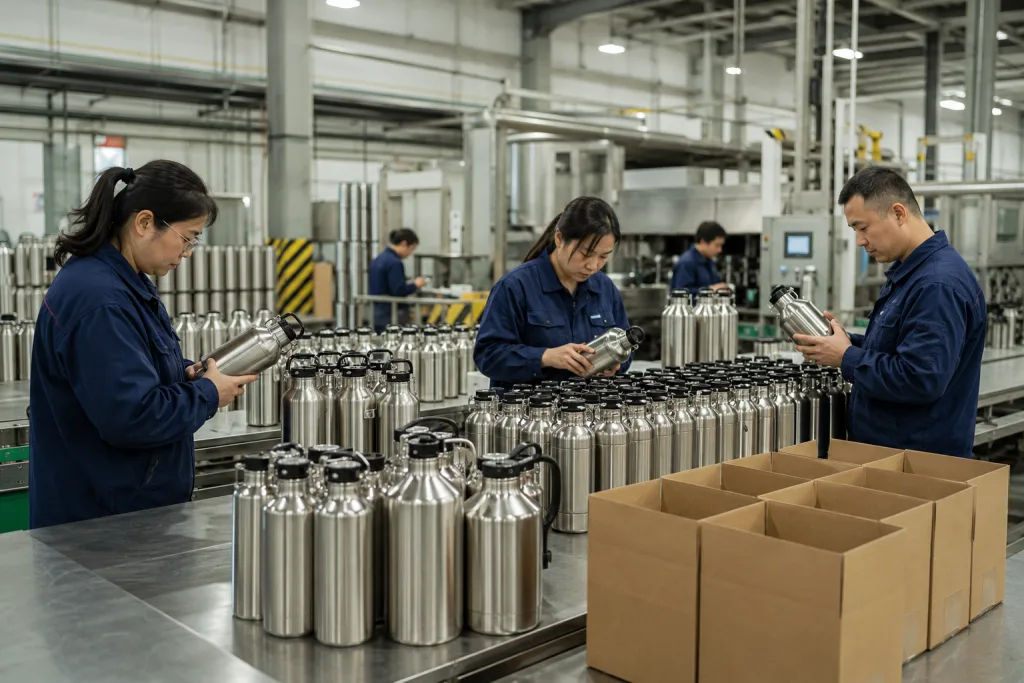
Here is one standard B2B case from first inquiry to final inspection: 8,000 stainless steel bottles for a North American outdoor brand, sourced from a canteen factory in Zhejiang, China. We run through the same checkpoints on the line for distributors, drinkware program managers, and retailers adding a custom growler or customizable canteen range under their own label. One small detail matters early: the buyer flagged a PO typo on cap color, and that 1 line item would have delayed sample approval by 3 days if QC had not pulled it first.
A real order starts with math
The buyer here is not chasing a trendy bottle. The job is simpler and tougher: land 8,000 units at a duty-paid cost that still leaves margin for wholesale. The brief looks clean on paper: 8,000 units, 32 oz insulated bottle, two lid colors, one body shape, outdoor retail channel, launch in 11 weeks. We see this setup often, and the wrong question is usually “Do I need OEM?” The better question is whether the math works before the line even starts. On our side, costing usually gets checked against a 68 mm carton drop test spec and pallet load before we quote.
Here is the first split. Private label means you run an existing mold from a canteen manufacturer or canteen supplier, then change the decoration, color, packaging, barcode labels, and sometimes swap lid combinations already on the shelf. OEM means you change the bottle structure: a new shoulder line, custom cap geometry, a fresh handle, a special base, or a non-standard mouth finish. If your annual forecast is under 50,000 units for one body shape, full OEM is often hard to defend. We have seen buyers push for a new silhouette, then pull back after seeing the mold amortization on a 12-cavity cap tool.
For this order, private label wins. Why?
- Existing 32 oz vacuum bottle mold: no body tooling charge
- MOQ: 1,000 pcs per color, 3,000 pcs total per item family
- Sample time: 5-7 days for color and logo confirmation
- Mass production: 30 days after deposit and pre-production sample approval
- FOB Ningbo estimate from Zhejiang, China: USD 3.85-4.60 depending on coating and lid packout
If you insist on a new handle cap and a custom bottom profile, the whole schedule moves. Lid injection tooling usually runs USD 2,500-6,000, then you add 20-30 days for T1 sampling and corrections. That is 12 days vs 18 days fast on paper, but in real production one failed fit check between cap and neck can eat the gap. QC pulled a sample last month with a 0.4 mm mismatch on a new cap thread, and the buyer flagged wobble right away. For many canteen distributors and canteen vendors, custom structure only pays when the sales edge is real. If it is just cosmetic, the math does not work.
You do not buy OEM because it sounds exclusive. You buy OEM when the sales upside is bigger than the tooling bill, the delay, and the quality risk.
Build the specification before discussing price
Most sourcing mistakes start with a loose RFQ. If a canteen vendor quotes from 3 photos and a rough size, each factory fills in the gaps its own way. We see this every week. One supplier prices a 0.35 mm body with a basic PP lid, another prices 0.45/0.40 mm and a tighter silicone seal, so you get USD 3.40 from one factory and USD 5.20 from another for what looks like the same customized drinkware.
For this order, the spec sheet includes the details below:
- Body: 18/8 stainless steel, inner 304 and outer 304
- Capacity: nominal 32 oz / 950 ml, tolerance ±3%
- Construction: double wall vacuum insulated
- Wall thickness: outer 0.45 mm, inner 0.40 mm
- Mouth diameter: 55 mm standard wide mouth
- Finish: powder coating, 60-80 micron thickness
- Logo: one-color silk screen, 1 side, max 55 x 80 mm
- Lid: PP + silicone seal, BPA free, black and olive green
- Packaging: white box, 12 pcs/master, drop-tested mailer optional
- Compliance: REACH for EU, FDA/LFGB contact safety declarations, CA Prop 65 screening on coating if required
With this sheet, your canteen manufacturers are quoting one product instead of 3 different versions. That matters. QC pulled the sample last month on a project where the PO said only “matte green bottle,” and one factory sent spray paint while another ran powder coat at 70 micron. If you need a custom canteen with an engraved mark instead of silk screen, write it into the spec. If you need a customizable growler with a stainless inner lid, write that too. If your distributor growler program goes to Amazon FBA, call out FNSKU labeling, suffocation warning rules, carton limits, and pallet height. Miss one line item and we've seen this go sideways.
Where buyers over-customize too early
New buyers often ask for 3 logo methods, 4 colors, a custom box insert, and 2 spare seal colors before sales has validated demand. This is the wrong question to ask. It pushes MOQ up, slows approval, and clogs the line with extra changeovers. For a first order, keep the body common and change what sells: color, logo, or retail pack. We run this way for most trial orders at 1,000 pcs MOQ because screen setup, carton split packing, and insert matching all cost money. A good canteen factory in Zhejiang will tell you the same thing, even if the buyer flags it as “less customized” on day one.
Sampling shows what drawings do not
After the specification is locked, sampling should answer shop-floor questions, not produce a clean photo for approval. We ask buyers to sign off these three sample stages, in this order, because the sample room checks each one against a different problem: shape, decoration, then packing.
- Stock sample: 2 days, courier collect. Confirms body shape with caliper check, hand feel after filling with water, and whether the lid starts cleanly on the first thread.
- Pre-production logo sample: 5-7 days. Confirms Pantone match in the light box, logo location from rim and base, and coating texture after the line has sprayed the real finish.
- Packaging sample: 5 days. Confirms barcode placement, carton marks, insert fit, and drop risk after a basic corner-drop check on a packed carton.
This is where you learn whether a canteen customizable idea can survive production, shipping, and retail handling. Nice rendering, bad product. Powder coat can look premium, but we have seen soft-touch finishes pick up grey rub marks after 40 minutes of carton friction. A large wraparound logo looks strong online, but silk screen on a curved shoulder can stretch the letters by 1-2 mm. A customized canteen cap with a carry loop feels good in the hand, but if the torque range is too tight, warehouse staff cross-thread lids during repack. We have seen this go sideways.
For this project, the buyer rejects the first logo sample because the olive green cap is 1.5 shades off the approved PMS under D65 light. Fair call. The bottle sits beside existing branded gear, and the mismatch shows on a shelf. The second issue matters more: QC pulled the sample and the print rub test shows visible abrasion after 30 cycles with a dry cloth. The fix is to shift from standard ink to higher adhesion ink and tighten cure control on the oven. Unit cost goes up by USD 0.06. The math still works because field complaints cost more than that.
A good canteen supplier records these changes in the approved sample file, with photos, date, ink code, and the buyer's signed sticker on the bag. Do not rely on chat history. We run one sealed golden sample at the buyer office and one at the canteen factory, usually stored in a clear PE bag near the QC bench. When mass production starts, both sides inspect against the same physical reference.
The quote only matters when terms are clear
By the time you line up quotes, the sample and spec sheet should have killed most of the guesswork. On an 8,000-unit canteen order, we usually see 3 China suppliers come back with numbers that all look workable on page one. The cheapest quote often loses. We compare landed risk, claim risk, and rework cost, not just FOB.
Typical quote structure looks like this:
- Unit price FOB Ningbo: USD 4.12
- MOQ: 1,000 pcs/color, 8,000 pcs total
- Sample charge: USD 80-150 refundable against order
- Payment: 30% deposit, 70% against inspection approval before shipment
- Lead time: 30-35 days after deposit and artwork confirmation
- Tooling: USD 0 because existing bottle mold is used
Then check what sits behind the number. Is the steel 304/304 or 304/201? Is the lid virgin PP or mixed regrind? Is the master carton 5-layer or 7-layer, and is the wall test 8 kg or 12 kg? Does the price cover desiccant, barcode labels, and export carton marks, or did the buyer flag those after PO release? We have seen a PO with "gift box included" typed on the buyer side while the quote only covered a brown box. QC pulled the sample, and the packing spec did not match. This is where disputes start.
When OEM is still the right answer
If your brand needs a custom growler body with its own lid lock, private label will not protect your margin. A true custom growler shape usually makes sense once annual volume hits 60,000-100,000 pcs and you plan to keep that body for 2-3 years. Ask who owns the mold, who pays maintenance, and what happens if you shift production to another canteen factory later. We have seen this go sideways after T1, when the neck finish was already locked and the tool steel bill was on the table. These points are easier to settle before deposit.
At BottleForge Industrial in Zhejiang, China, our view is blunt: if 80% of your sales forecast depends on decoration, not body geometry, start with private label. We run this math all the time, and the math does not work for full OEM if the customer only notices the print, the color, and maybe a soft-touch finish at 35-45 microns. Save OEM for the parts people can see and will pay for.
Production control is where margins are protected
After deposit, the order moves into the stage about 7 in 10 first-time buyers monitor too lightly. Bottles are not one process. They pass tube cutting, body forming, mouth shaping, welding, vacuuming, polishing, coating, printing, assembly, and packing. If the mouth expander drifts by 0.3 mm, the leak may not show until QC pulls cartons at final inspection.
For this order, the buyer asks for a simple production control plan the line can actually run:
- Incoming material check for steel thickness with micrometer
- Vacuum retention check by batch during production
- 100% leak test after lid assembly
- Color verification against approved sample each shift
- Adhesion and rub test after printing
- Carton drop check on each packaging lot
A solid canteen factory should already run most of these checks. The real question is whether the data is written down and whether your merchandiser can see it before shipment. On a line producing 300,000-500,000 units/month, a clipboard with batch numbers, shift names, and failed samples matters. Undocumented QC is not QC. It is guessing.
For insulated stainless bottles, common defects include pinhole vacuum loss, powder coat fish-eyes, off-center logos, dented rims, silicone odor, and mixed lid components. We see these every month. That is why your PO should define defect standards before bulk starts, not after the buyer flagged 43 crooked logos in a video call. Example:
- Critical defects: 0.0 AQL
- Major defects: AQL 2.5
- Minor defects: AQL 4.0
If you sell through outdoor retail or e-commerce, add use-based limits. A scratch under 8 mm on the base may be acceptable. A scratch on the front logo zone is not. A lid torque below your agreed range, for example 8-12 kgf·cm, is not minor if it creates leakage returns; the math does not work when one bad lid costs more than the factory saved on checking time.
This is where experienced canteen distributors beat beginners. They define pass/fail by channel reality, not by factory convenience, and they do it while the line is still running, not when 1,200 cartons are already taped shut.
Final inspection before the balance payment
At 80% packed, book the pre-shipment inspection. For this order, we run it at the Zhejiang warehouse two days before container loading. The lot is 8,000 units: one SKU family, two colors, mixed lids. QC checks the sealed master cartons against the packing list first, because one missing color sticker on a carton can waste half a day at loading.
The checklist is not fancy. It is disciplined:
- Verify carton count against the final packing list, including inner box quantity per master carton
- Check workmanship under the AQL 2.5/4.0 sampling plan, with photos of scratches, dents, coating dust, and lid fit
- Run leak tests on sampled finished goods, usually inverted for 3 minutes after the lid is tightened by hand
- Spot check vacuum performance with the hot water retention method, using a probe thermometer and timed readings
- Confirm logo location, print edge sharpness, and color against the approved sample or Pantone callout
- Scan barcode and FNSKU labels if needed, because Amazon receiving will not care who made the typo
- Measure carton dimensions and gross weight, then check crushed corners, wet marks, and drop condition
- Confirm assortment accuracy by color and lid combination, carton by carton if the PO has mixed packing
The inspector finds two issues. First, 4 of 200 sampled units show light overspray near the base. Second, one carton batch carries the wrong outer shipping mark. The overspray rate is still below the minor threshold, but the buyer asks for 100% re-sort on the affected lot because the cups are going into specialty retail. Fair call. The carton mark issue gets fixed before loading; distributor canteen programs depend on exact receiving labels, and we have seen one wrong mark hold 36 cartons at the warehouse door.
The buyer releases the 70% balance only after accepting the inspection report. That is the right pressure point. Once goods are on water, arguing about rework value from China takes longer, costs more, and usually ends with a credit note nobody is happy with.
If your order is headed to the EU or North America, keep the shipment file complete: commercial invoice, packing list, test declarations, inspection report, carton photos, and approved sample references. We keep these in one job folder with the PO number, because customs questions and marketplace claims do not disappear just because the container sailed.
What you change on the second order
The first order teaches you more than any catalog. In this case, matte black sold through in 21 days, while olive still had 38% stock left after 45 days. The buyer reordered 12,000 units and changed the program in three places that actually matter on the line.
- Cut the color range from four to two, so slow olive and sand inventory did not tie up the next PO
- Changed the front logo from silk screen to laser engraving after the buyer flagged rub marks on 6 samples from an outdoor field test
- Added a 1.5 mm thicker divider insert after QC pulled cartons with lid scuffing, cutting transit marks by about 35%
This is where a customizable drinkware program starts acting like a sourcing system. Your canteen suppliers already know the approved steel grade, coating tolerance, logo zone, packing style, and inspection rules. Fewer open approvals. Lead time drops from 35 days to 25-30 days because the sample room is not guessing again. MOQ pressure also improves on repeat runs because we run the same body, same tooling, and a familiar packing SOP.
If you later expand into a customizable growler, custom canteen, or customized growler family, use the same discipline. Start with the sales case, not the most creative shape. For a canteen distributor or distributor growler buyer, chasing the most customized canteen is the wrong question to ask. The goal is a product your customer can reorder with stable quality, stable packout, and a landed cost that still works after freight moves by USD 0.18 per unit.
China has thousands of drinkware sources, but not all of them are reliable canteen manufacturers for export programs. Ask direct questions. How many units per month? What is the standard MOQ by body? What defect rate triggers line hold under AQL 2.5? Which tests are in-house, and which go to SGS or Intertek? A Zhejiang factory that answers with numbers, not promises, is easier to work with than one that says yes to every logo, color, and delivery date in one message.
Get your drinkware spec reviewed before you order
Send your target bottle, quantity, logo file, and market requirements. We will suggest whether private label or OEM makes better commercial sense.
Frequently asked questions
How do I decide between OEM or private label for drinkware?
Use private label when the existing bottle shape already fits your market and your real branding value comes from color, logo, and packaging. In practical terms, if your forecast is below 50,000 units per body shape per year, private label is usually the lower-risk choice. MOQ often starts at 1,000 pcs per color or 3,000 pcs per item family, with 25-35 day production. Choose OEM when body geometry, cap function, or unique tooling will clearly improve sales or protect margin. New tooling can cost USD 1,500-8,000, sometimes more for complex lids, and usually adds 20-30 days before production. Ask whether the factory can keep your mold dedicated and what happens if production moves later.
What information should I send a canteen factory for an accurate quote?
Send a proper RFQ pack, not just reference photos. At minimum, include capacity in ml or oz, body material, single or double wall construction, wall thickness target if known, color by Pantone, logo size and method, lid type, packaging style, compliance market, and order quantity per SKU. Also state shipping terms like FOB Ningbo or EXW Zhejiang, China. If you sell into Amazon or large retail, add carton size limits, barcode rules, FNSKU, and drop-test expectations. A useful RFQ is 1-2 pages plus artwork. Without that, one canteen supplier may quote 304/304 steel and another may quote 304/201, creating a false price gap of USD 0.30-0.80 per unit.
What quality checks matter most for custom stainless steel bottles?
For insulated bottles, the critical checks are vacuum performance, leakage, coating quality, logo adhesion, and component matching. You should ask for 100% leak testing after assembly and batch vacuum checks during production. For final inspection, many B2B buyers use AQL 2.5 for major defects and 4.0 for minor defects, with 0 tolerance for critical defects. Confirm wall thickness with micrometer spot checks, verify color against an approved sample, and inspect lid torque consistency. If your program is customized drinkware for the EU or North America, also confirm declarations for REACH, FDA or LFGB contact materials, and any Prop 65 screening needed on coatings. These are not luxury checks; they are return-rate control.
What lead time and MOQ should I expect from canteen manufacturers in China?
For existing molds, many canteen manufacturers in China work on 1,000 pcs per color and 3,000-5,000 pcs per style family, though exact MOQ depends on coating and packaging. Sample lead time is often 5-7 days for logo and color confirmation. Mass production usually runs 25-35 days after deposit, artwork approval, and pre-production sample signoff. Full OEM projects take longer because tooling, T1 sampling, corrections, and validation can add 30-60 days before regular production even starts. During peak season, especially before Q4 export rush, add a 7-10 day buffer. If a canteen vendor promises 15 days for a first-time insulated bottle order with custom packaging, ask very hard questions.
How can I reduce claims and surprises on my first private label order?
Keep the first order controlled. Use one proven bottle shape, two or three colors maximum, and one packaging format. Approve a golden sample and make sure the factory keeps the same reference on site. Put pass/fail standards into the PO: AQL level, logo position tolerance, acceptable scratch zones, leak requirements, and carton specs. Request in-process photos and at least one mid-production update. Before paying the balance, run pre-shipment inspection when 80% or more of goods are packed. On an 8,000-unit order, spending USD 250-400 on inspection is far cheaper than a 3% return rate. Most problems with private label custom drinkware are not dramatic factory fraud; they are small assumptions left unspoken.