Key Takeaways
- Most bottle claims come from 6 repeat failure modes: leakage, insulation loss, coating defects, print variation, odor contamination, and transit damage
- A workable OEM brief should lock down material grade, wall thickness, leak test standard, decoration tolerance, AQL level, and carton spec before sampling
- Typical MOQ is 1,000-3,000 units per SKU, with 7-12 days for pre-production samples and 30-45 days for bulk after deposit
- For Europe and North America, ask for REACH, LFGB or FDA alignment, ASTM where relevant, and an inspection plan such as AQL 2.5/4.0
You usually do not lose money because the bottle sketch looked off. You lose it when the lid starts leaking after a 1.2 m drop test, the powder coat chips after carton vibration, the logo drifts 2 mm on the print jig, or the outer carton crushes on the run from Zhejiang, China to your warehouse. That is where claims start. For a B2B buyer, the risky part is not the design file. It is the gap between an approval sample that passed on the table and mass production on the line that acts differently.
If you are sourcing from an oem manufacturer water bottle partner, think like a quality engineer, not only a merchandiser. This is the right mindset. It applies whether you buy custom drinkware for retail, a custom canteen for events, or a customized growler for a distributor channel. At BottleForge Industrial in Hangzhou, Zhejiang, we run about 600,000 units per month, and QC pulled this pattern again and again: most preventable claims start with vague specs, a loose golden sample, or a PO typo on logo position. The buyer flagged it later. By then, the math doesn't work.
Where bottle projects actually fail
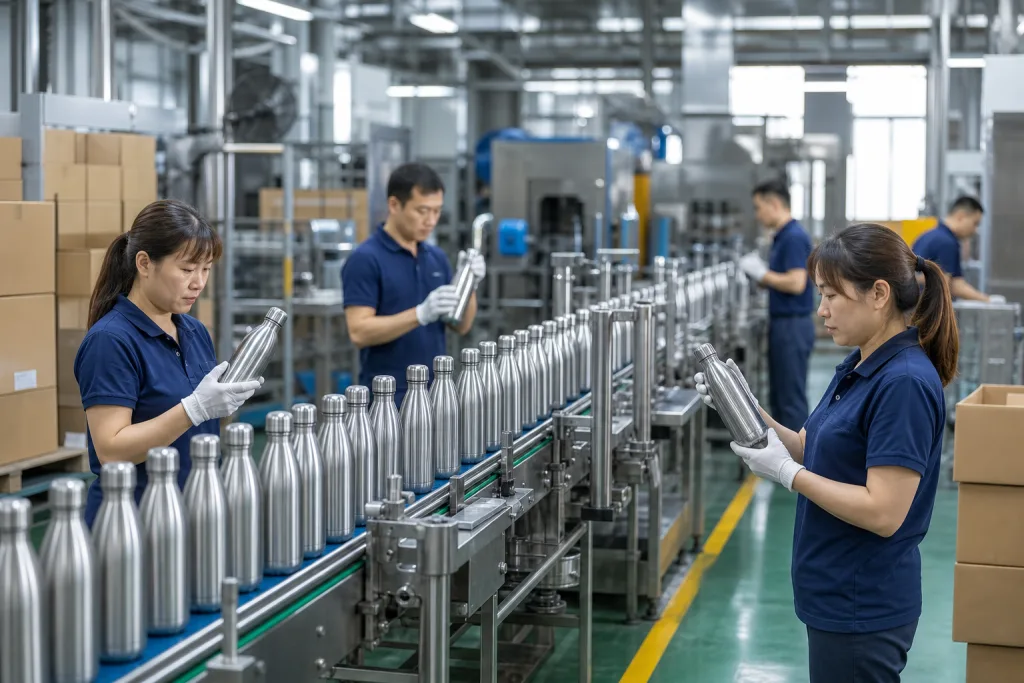
Most buyers start with shape, color, capacity, and logo placement. Fair start. Not enough. The real job starts after sample approval, when the order jumps to 5,000 or 50,000 pieces and the line has to hold the same standard on shift 1 and shift 2. A reliable canteen manufacturer or canteen factory should tell you where defects show up by process step: tube forming, welding, vacuuming, polishing, powder coating, printing, lid assembly, and packing. If they cannot walk you through that chain, this is the wrong question to ask about price first. Ask where scrap spikes. On our floor, QC pulled the sample after neck threading and found a 0.3 mm pitch drift that looked small on paper and turned into cap mismatch fast.
Here is the practical truth: defects cluster. Leakage often comes with thread mismatch or uneven silicone gasket compression. If the coating chips, the pretreatment or curing window is off; we have seen parts pass color check and still fail cross-hatch adhesion after baking. If cartons arrive crushed, the pallet pattern or master carton burst strength was under-specced, sometimes both. One buyer flagged transit damage on a 40HQ, and the issue was not the bottle at all; the outer carton was 5-ply when the load needed 7-ply. “Good quality” is too vague. Ask for measurable controls.
- Material: 18/8 stainless steel, usually SUS304 for body and inner, or SUS316 for premium corrosion resistance.
- Wall: common inner wall 0.35-0.40 mm, outer wall 0.45-0.50 mm for vacuum bottles.
- Leak test: 100% inverted water test for 30 minutes minimum.
- Vacuum: insulation retention checked by hot-fill temperature loss over 6-12 hours.
- Inspection: AQL 2.5 for major, 4.0 for minor is common for export.
Whether you buy a customizable canteen, a custom growler, or a private-label sports bottle, every production risk sits somewhere in that chain. Buyers in Europe and North America often assume the supplier will fill in the blanks. Some suppliers in China will. A lot will not. We have seen this go sideways over simple PO gaps: logo size missing by 2 mm, finish written as “black matte” with no Pantone, lid torque standard not listed, carton drop requirement skipped. Then mass production follows the path of least resistance, not the path in your head. We ship what is signed off, not what was implied.
Leakage starts with bad lid math
The most expensive defect is rarely a scratch. It is a bottle that leaks in a backpack, on a retail shelf, or after Amazon FBA handling. We have seen one leaking lid turn a clean shipment into 240 return claims in 3 weeks. Leakage is not one problem. On the line, QC usually traces it to thread engagement that is 0.3 mm short, gasket hardness that does not match the neck finish, uneven spout welding, weak straw joints, or a lid shape that looks good in the rendering and fails after a 1.0 m drop.
For a canteen custom project, treat the lid as a functional part. Not decor. Write down the resin grade, gasket material, torque range, and test method on the spec sheet. PP and Tritan lids do not behave the same after molding; gate position and shrink rate show up fast on fit. Silicone gaskets at 50-60 Shore A are common, but this is the wrong question to ask if the groove geometry is loose. We check neck finish variation with a go/no-go gauge because even 0.2 mm swing can seal 8 bottles and fail the next 2.
What to lock down before production
- Thread standard and neck drawing with tolerance
- Lid torque range, for example 8-12 lbf·in for screw caps
- 100% leak test after assembly
- Drop test, such as 3 drops from 1.0 m on filled sample bottles
- Straw flow and bite-valve performance if applicable
You do not buy “a leakproof lid.” You buy a lid that passed a defined test on your exact bottle neck.
This is where buyers get squeezed between a canteen supplier and a lid subcontractor. The body factory points at the lid factory, the lid factory points at the neck finish, and the buyer eats the return cost. We have seen this go sideways over a PO typo that mixed two neck drawings with the same bottle artwork. Good OEM factories in Zhejiang manage that interface in-house, and we keep a go/no-go gauge at the line for every active neck size. If you are a canteen distributor or distributor canteen buyer selling into outdoor or corporate channels, ask for retained sealed samples from each production lot for 6-12 months. QC pulled the sample, dated the carton, and the argument usually ends in 10 minutes.
Insulation claims collapse without process control
If your oem manufacturer water bottle is vacuum insulated, the second failure point is thermal performance drift. A sample may hold heat for 12 hours, but mass production lands at 8-9 when vacuum level, copper coating, or weld quality moves off target. We’ve seen QC pulled the sample from one lot and the outside wall hit warm in under 3 hours. Buyers often write “double wall vacuum” on the PO and assume every factory builds the same bottle. They don’t.
Insulated bottles live or die on forming and vacuum process control. The body weld and base weld need a clean seam, the vacuum port has to seal tight, and the internal reflective layer must stay even if the spec calls for it. On our line, a bad laser weld spot shows up fast during thermal screening. Thin walls cut cost. Push too far and the math doesn't work: more dents, more shape variation, weaker vacuum retention. A practical export spec for a 500 ml bottle might be SUS304 inner and outer, 0.4 mm inner, 0.45 mm outer, with hot retention target of at least 45°C after 6 hours starting from 95°C fill at 20°C ambient. Cold retention can be set as under 10°C after 6 hours from ice water start conditions.
Ask your canteen manufacturer or canteen vendors to write the test method into the spec. This is the wrong question to ask: “How many hours hot?” Ask fill temperature, ambient, fill volume, standing time, and whether the bottle is opened during the test. We ship lots where one buyer tests at 90% fill and another at full fill, then argues over a 2°C gap. That is why capable factories in China run line checks by lot, not just one golden sample at the start.
- Vacuum failure sign: bottle sweats externally with cold liquid or feels warm outside after hot fill
- Root cause: micro-leak at weld or vacuum seal point
- Prevention: vacuum inspection per lot, retained sample validation, plus pressure or thermal screening; on some orders we test 5 pcs per lot before packing
If you buy customizable growler or customized growler products, the risk goes up because larger capacities put more load on handles, lids, and base welds. A 64 oz growler can pass bench inspection and still lose vacuum after carton drop or long transit. We’ve seen this go sideways after a buyer flagged handle wobble and base distortion on arrival. Specify insulation as a measurable requirement, not a sales phrase.
Coating and print defects are rarely cosmetic only
Buyers often split appearance defects from performance defects. On the line, they are tied together. If pre-treatment is weak, powder coat adhesion fails. The same rushed setup also shows up as dirty silk screen registration, low laser contrast, or lot-to-lot color drift. We’ve seen QC pull a sample where the logo was only 1 mm off, and the buyer flagged it on the gift-box SKU but accepted it on the gym bottle. You need to define that in advance. This is the right question to ask.
Powder coating on stainless steel should start with the right pre-treatment. If degreasing is incomplete or the oven cure is off by 8-10°C, the finish can look fine at packing and fail after 2 weeks of handling. Typical coating thickness might run 60-80 microns. Too thin, and abrasion shows fast. Too thick, and threads or fit-up areas go out; we’ve measured a neck area build-up that caused cap torque to jump on a go/no-go gauge. For logos, silk screen, heat transfer, water transfer, pad print, and laser engraving all have trade-offs, but don’t leave it at that: ask for the actual MOQ, unit adder, and rub-test result by method. The math doesn’t work if decoration saves $0.03 and drives a 5% complaint rate.
Useful buyer specs
- Color reference by Pantone or approved sprayed panel
- Logo placement tolerance, for example ±1.0 mm
- Coating adhesion test, such as cross-hatch or tape test per agreed method
- Dishwasher disclaimer if finish is hand-wash only
- Approved defect limit samples for scratches, pinholes, and orange peel
For a canteen promotional run at 3,000 units, decoration drives more complaints than the bottle body in a lot of cases. We ship plenty of these, and the common pushback is not leakage; it’s a scuffed print or a shade mismatch against the approved panel. For a premium customized canteen line, laser engraving cuts durability risk, but contrast can drop on matte powder or dark pearl finishes. Ask your canteen suppliers or canteen vendor for decoration compatibility by finish, with photos from actual mass production, not just one sales sample. In Zhejiang, 6 out of 10 factories outsource at least part of the printing. That alone is not a problem. What matters is line-side approval, lot traceability, and who owns the reject stock when an outer carton PO has the right SKU but the print house used the wrong logo film. We’ve seen this go sideways.
Material compliance and odor problems
A bottle can pass visual inspection and still fail after launch because it smells off, leaves taste in water, or opens a compliance issue with your customer. We see odor complaints come from four places on the line: low-grade plastic, poor washing after molding, ink migration risk, or silicone cured at the wrong temperature. QC pulled one lid sample last month with a sharp rubber smell right after the 200°C bake check. Compliance failures usually start with a lazy claim. A supplier says “food grade” but has no report that matches your sales market.
If you import into Europe, ask for REACH and, if the product touches food directly, LFGB-oriented testing. For North America, buyers usually ask for FDA-related material declarations, and some ask for ASTM standards if the item is for children or a defined use case. If the item is a custom canteen for kids, the requirement is tighter than for a plain office tumbler. This is the wrong question to ask: “Do you have a certificate?” Ask which component was tested, by which lab, under which report date. A serious canteen manufacturer should separate a 304 stainless body claim from lid, straw, paint, and ink scope.
Do not skip smell tests. Stainless bodies are usually simple. Lids, straws, seals, and paint systems are where trouble starts. We’ve seen this go sideways: the buyer flagged it after cartons sat 12 days in summer transit, and the smell came from trapped moisture under the seal, not the steel body. A quick deodorizing wash is not a fix if the resin grade is wrong or the post-mold handling is sloppy. Ask for:
- Material list by component: body, lid, gasket, straw, paint, ink
- Third-party reports tied to current materials, not old generic reports
- Incoming QC on silicone and plastic parts
- Pre-pack cleaning standard and drying control to prevent trapped moisture smell
This matters even more for customizable drinkware sold through a distributor drinkware network, where one complaint gets passed through 3 parties and the root cause gets blurred. We ship cases where the PO has the logo code right but the gasket material line is missing, and that is enough to create an argument later. A clean bill of compliance from China is not just paperwork. It is your backup when the customer asks hard questions 90 days after delivery.
Packaging failure turns good bottles into bad deliveries
A lot of teams spend 20 days dialing in the bottle, then lose the shipment on packing. We see the same failures on the line: dents, chipped coating, crushed corners, mixed cartons. Packaging caused them first. A bottle shipping from China to Europe or North America gets hit more than buyers expect—truck to port, container loading, deconsolidation, then parcel sorting if it goes to FBA or direct fulfillment. QC pulled one sample last month with a clean body and a carton corner crushed 38 mm deep. The pack-out has to match that route.
For standard export, a single polybag plus egg-crate divider works for some SKUs. Not all. Matte powder coat scuffs one way; glossy paint rubs off another way, and the buyer flagged both on the same PO because the finish mix was packed under one carton spec. Our safer baseline is simple: individual bag, cell partition, 5-layer export carton, drop-tested master carton, clear carton marking by SKU and color. If you sell through a canteen distributor channel, count accuracy sits right next to damage rate. We have seen a 24 pcs carton packed 12+12 in the wrong size split, and the warehouse spent two extra shifts fixing assortments. That hidden labor cost is real.
Write the carton spec into the PO:
- Master carton board grade and burst strength
- Inner partition type
- Drop test standard, such as 76 cm for export cartons
- Pallet pattern and overhang rule
- Barcode placement, carton labels, and FNSKU if needed
For a customized growler or distributor growler order, test with filled samples, not empty ones. This is the wrong question to skip. Weight changes the result because handles and closures take more force on a drop, especially on 64 oz and 128 oz bodies. We often tell buyers in Zhejiang sourcing programs that cutting USD 0.12 from packaging can turn into USD 1.20 in claim cost later. We have seen this go sideways. It shows up fast: dent claims, relabeling labor, chargebacks, and one case where the PO label had a color-code typo so 600 units had to be re-sorted by hand.
The spec sheet that prevents rework
If you want fewer surprises, lock the project to a hard spec sheet with approval checkpoints. Not a mood board. Not a WeChat chat history. One document pack should cover drawing, BOM, surface finish, decoration, compliance, test standard, inspection plan, and packing method. That is how different canteen manufacturers quote the same bottle instead of three different versions, and how we keep one approved supplier aligned once the line starts.
A usable OEM package from a canteen factory should list the SKU code, capacity, dimensions, net weight tolerance, steel grade, wall thickness, lid material, gasket spec, finish code, artwork file version, packaging method, carton dimensions, and QC criteria. Put the commercial terms in the same set: MOQ, sample fee, tooling lead time, bulk lead time, payment term, and claim window. At BottleForge Industrial, common MOQ is 1,000 units for existing molds and 3,000 units for some custom color-and-print combinations, with sample lead time around 7-12 days and bulk production typically 30-45 days after deposit and approval. We also ask buyers to state key tolerances in mm and g on the sheet, because “same as sample” is the wrong instruction and we’ve seen this go sideways.
Then define checkpoints:
- Pre-production sample: confirms fit, finish, print, and basic testing; QC pulled the sample and checks lid torque, color, and logo position before mass run
- Pilot run approval: first-off units from actual line setup, not hand-built pieces from the sample room
- During production inspection: catches drift before all units are packed; on our floor this is where a print shift of 1.5 mm usually gets flagged
- Pre-shipment inspection: AQL 2.5/4.0 or your agreed level
If you are a canteen supplier, canteen distributors, or a brand buyer managing 6 or 20 SKUs, ask for lot traceability by production date and line. It sounds bureaucratic until one lid lot fails and you need to isolate 2,400 units instead of quarantining 24,000. We ship faster when the records are clean. Good OEM buying is not about trusting less. It is about leaving less to memory.
Send your bottle spec before it becomes a QC problem
Share your target market, capacity, lid type, MOQ, and artwork. We will review the failure points, propose workable specs, and quote realistic lead times.
Frequently asked questions
What MOQ should I expect from an oem manufacturer water bottle supplier?
For existing bottle molds, a realistic MOQ is usually 1,000 units per SKU, sometimes 500-1,000 for plain stock colors with simple logo work. If you want a new mold, special lid, or mixed decoration process, MOQ often moves to 3,000-5,000 units. Some colorways can be split, but not every factory will split efficiently because setup loss affects coating and printing cost. In Zhejiang, China, you should also ask whether MOQ is per capacity, per color, or per logo version. Those are not the same thing. A quote that looks flexible can become expensive if the supplier adds a color setup fee of USD 80-150 or carton redesign charges later.
How long does custom drinkware production usually take?
For a standard stainless steel custom drinkware order, plan 7-12 days for pre-production samples after artwork and spec confirmation. Bulk production is commonly 30-45 days after deposit, sample approval, and final packaging sign-off. New tooling can add 20-35 days depending on complexity. If your project includes a custom canteen lid, molded handle, or a new customizable growler structure, add engineering time and testing time. Peak season can stretch lead time by 7-15 days, especially before Q4 shipping deadlines. Ask the factory to separate sampling, bulk production, and booking lead time. Buyers often hear one number, but ocean booking and inland trucking are separate from the manufacturing calendar.
What quality standard should I put in the PO?
Use a simple but enforceable standard. Many buyers specify AQL 2.5 for major defects and 4.0 for minor defects, with critical defects at zero tolerance. Then define what counts as major or minor for your product. Leakage, wrong capacity, missing gasket, sharp burrs, and failed insulation should be major or critical. Minor cosmetic issues can include slight print variation or tiny surface marks on hidden areas, but only if you have approved limit samples. Include 100% leak testing, agreed thermal retention targets, and carton labeling rules. If the product goes to retail or Amazon, add barcode readability and pack count accuracy. AQL without a defect glossary is too vague to protect you.
How do I compare canteen suppliers beyond unit price?
Compare total landed risk, not just FOB price. Ask each canteen supplier for material grade, wall thickness, monthly capacity, sample lead time, typical on-time shipment rate, compliance documents, in-house versus outsourced decoration, and claim handling procedure. A bottle quoted at USD 3.10 FOB may be more expensive than one at USD 3.28 if it uses thinner steel, weaker packaging, or inconsistent lids. Look at carton spec, not just bottle spec. Also ask whether the supplier can support retained samples, lot traceability, and third-party inspection access. A serious canteen vendor in China should answer these directly. If replies stay vague, expect production to be vague too.
What should I do if I need a custom growler or specialized canteen customized for retail?
Start with the use case, not the artwork. A custom growler for craft beverage retail needs different specs than a canteen promotional giveaway. Define capacity, handle load, lid type, carbonation assumptions if any, target insulation, and shelf appearance. For retail, lock down logo position tolerance, coating quality, and master carton presentation because returns come from appearance as much as function. Expect MOQ around 1,000-3,000 units for existing structures and more for new molds. Ask for drop tests on filled units, not just empty units. If the product will be handled by distributor growler or distributor canteen partners, include carton count checks and barcode verification to reduce warehouse claims.