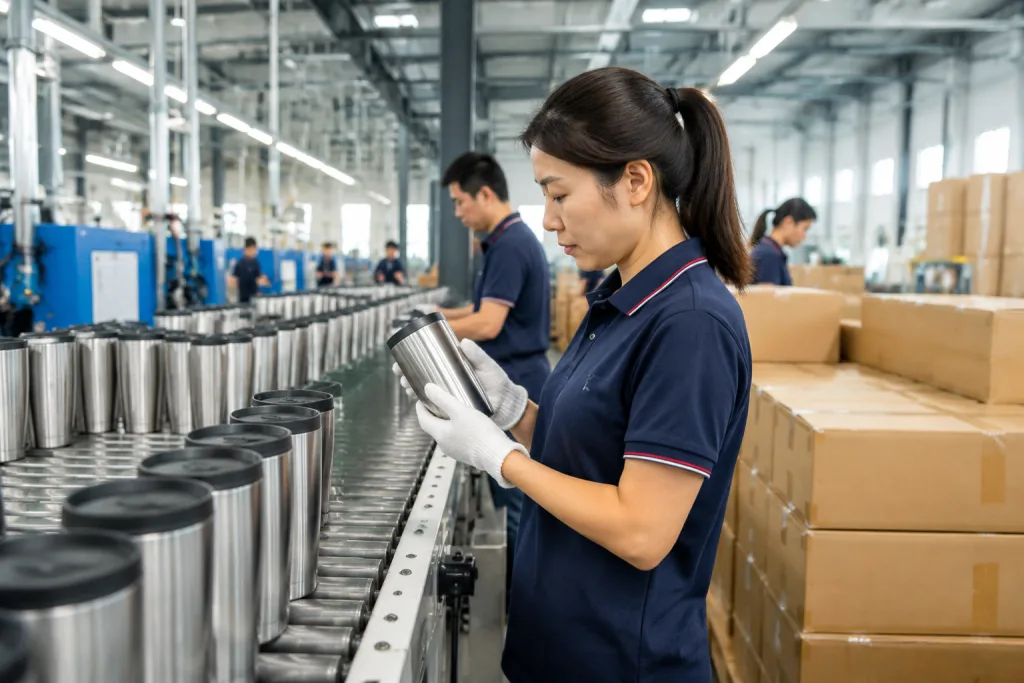
Key Takeaways
- For a 20 oz stainless tumbler, common MOQ is 1,000 pcs per color, while custom color plus logo usually starts at 3,000-5,000 pcs
- Typical FOB Zhejiang, China pricing for a 20 oz 304 SS double-wall tumbler runs about USD 2.80-4.60 depending on lid, coating, and print method
- A realistic production plan is 7-12 days for samples and 25-40 days for bulk after deposit and artwork approval
- Use AQL 2.5/4.0 final inspection and verify heat retention, leak testing, coating adhesion, and barcode/carton accuracy before balance payment
You are not buying a travel tumbler. You are buying 20 small calls that decide whether your margin stays intact or gets shaved away: steel grade, lid fit, print method, carton drop test result, and whether the Zhejiang supplier on the line understands retail packs or gift-box orders. We have seen this go sideways over a 0.3 mm lid tolerance and one PO typo on logo position. Buyers searching for an oem manufacturer travel tumbler usually ask the right question in plain language: what do I need to lock before I place the PO?
Here is one real order flow, from first inquiry to final inspection. Assume you are a coffee brand or a corporate-gift buyer placing 5,000 pieces of a 20 oz travel tumbler with a logo, packed for North America. MOQ matters. So does carton count. The numbers below are not fantasy; they are the figures we run against quoting sheets, sample fees, and AQL pull records after QC pulled the sample at final inspection. Use them to compare a coffee mug manufacturer, a coffee mug factory direct source, or a coffee mug distributor offering imported private-label stock. And frankly, price alone is the wrong question to ask.
Start with the order brief
A workable project starts with a short spec sheet, not a mood board. Send only reference photos, and you’ll get a price spread and soft promises. A solid oem manufacturer travel tumbler inquiry should state capacity, structure, finish, decoration method, packaging, compliance market, and target price. For this case, the buyer wants a 20 oz double-wall vacuum tumbler for a coffee subscription brand and a year-end gifting program. Forecast is 5,000 units now, with repeat potential of 20,000 units across 12 months. On our side, the first thing sales does is mark up the brief against the caliper and lid-sample rack, because missing details turn into delays fast.
Here is the practical brief we would want from you:
- Capacity: 20 oz / 590 ml
- Body: 18/8 stainless steel inner and outer, vacuum insulated
- Wall thickness: inner 0.35 mm, outer 0.45 mm
- Lid: AS or Tritan slider lid, splash resistant, BPA free
- Finish: powder coating, matte black and cream white
- Logo: 1-color silk screen or laser engraving
- Packaging: individual kraft box, 24 pcs/master
- Market: US and EU, REACH and LFGB request, outer carton drop resistance
- Barcode: FNSKU or client SKU on each unit if selling through FBA
Leave those points open, and each supplier will fill the gaps in their own way. That is why one coffee mug supplier quotes USD 2.90 and another quotes USD 4.40 for what appears to be the same bulk coffee tumbler. The cheaper one may be using 201 stainless outer, a thinner gauge, basic spray paint instead of powder coat, or a lid with weak fit. We’ve seen this go sideways: QC pulled the sample and found the slider lid rocked by 1.2 mm, which the buyer flagged right away. Price without structure detail is the wrong question to ask.
At BottleForge Industrial in Zhejiang, China, a travel tumbler line can run around 300,000 units/month in season, but output alone does not save a project. We run faster after the spec is frozen early. For a coffee mug custom made program, the brief is your cost-control tool, not paperwork. If the PO says “cream while” instead of “cream white,” we stop and confirm before printing cartons, because small errors on the line turn into expensive rework.
Choose the structure before the logo
About 7 out of 10 new buyers start with the logo because it is what the boss sees first. Wrong order. The cost risk is inside the body, lid, gasket, and base fit. If you are buying a bulk travel tumbler, lock the body and lid combination before anyone spends half a day arguing over Pantone matching.
For this order, the buyer compares these three structures:
- Economy: double-wall vacuum, straight body, clear AS slider lid, usually checked with a simple go/no-go lid gauge on the line
- Mainstream: tapered body, 18/8 steel, powder coat, Tritan lid with silicone gasket, with QC pulling 20 pcs per carton during fit review
- Retail-upgrade: narrower base for cup holders, threaded leak-resistant lid, electro-polished inner wall, often with a 72-75 mm base confirmed by caliper before mass packing
The economy version may land around USD 2.80-3.20 FOB Ningbo for 5,000 pcs. The mainstream version is more often USD 3.35-4.10. The upgraded version can push USD 4.20-4.60 or more. This is where coffee mug bulk decisions hit after-sales. We have seen a buyer save USD 0.18 on a loose slider lid, then get 43 complaint photos in the first week after delivery. The math does not work.
What matters most in the structure review
Steel grade: ask for SUS304 / 18-8 on food-contact surfaces, and make the grade appear on the PI, not only in a WhatsApp message. If the supplier says “stainless steel” without grade, press harder. Vacuum performance: ask for a test standard, for example 95°C filled water dropping to 55-65°C after 6 hours depending on model; our QC team records this with a probe thermometer and time sheet. Base diameter: if your users drive, 72-75 mm base fit matters, and 78 mm will already fail in some car holders. Lid material: Tritan usually gives a better quality impression than basic AS, especially after the buyer twists the sample lid 30 times at the meeting table.
For corporate gifting, buyers often over-spec the print and under-spec the lid. End users forgive a small logo shift. They do not forgive spills on a laptop bag.
If you source from a coffee mug factory, ask whether the lid is made in-house or purchased. A coffee mug oem manufacturer with in-house lid assembly usually controls fit tolerance better because the line can adjust gasket pressure before packing. If you are buying through coffee mug distributors or a coffee mug supplier directory, ask who owns the mold and where replacement lids come from. That answer affects repeatability more than most first-time buyers expect; we have seen repeat orders go sideways because the second-batch lid came from a different subcontractor.
Price the real landed program
A buyer comparing a coffee mug factory direct quote with a domestic coffee mug distributor often stares at the unit FOB price first. Wrong question. Build the landed cost sheet line by line. In this case, we run 5,000 pcs, 2 body colors, one logo position, individual boxes, and ocean shipment to the US West Coast; our merchandiser will put the carton size in the quote before the PI, because 3 mm extra foam can change the freight math.
A working quote for a mainstream 20 oz tumbler normally reads like this on our side of the desk:
- Unit price: USD 3.62 FOB Zhejiang, China
- Silk screen logo: included for 1 position, 1 color
- Laser engraving upgrade: +USD 0.12-0.18/pc
- Color box instead of kraft box: +USD 0.22-0.38/pc
- Drop-test master carton upgrade: +USD 0.06/pc equivalent
- Tooling for custom lid color or insert: USD 800-2,500 one time depending on complexity
- Sample cost: USD 80-150, usually refundable against bulk order
Then add freight. A 20 oz tumbler with box commonly ships around 16-18 pcs per 0.1 CBM depending on packaging. Ocean freight moves every week, but the math is blunt: a bigger retail box or a 28 g promotional insert can add more landed cost than shaving USD 0.05 off the cup. We have seen buyers argue for 40 minutes over unit price, then approve a box that drops the load from 18 pcs to 16 pcs per 0.1 CBM.
This is where the buyer should decide whether the program is a coffee mug private label line, a coffee mug promotional products campaign, or standard coffee mug in bulk for resale. Private label needs packaging control, barcode accuracy, and the same powder-coat shade on repeat orders; QC checks the color against the signed sample under a D65 light box. Promotional orders usually care more about the event date and logo visibility than 12-month color continuity.
If a supplier gives you a suspiciously low quote for a bulk coffee mug or bulk coffee travel mug, ask for the net weight in kg, gross weight in kg, steel grade on the BOM, and master carton dimensions in cm. Numbers force honesty. Good factories in China expect this, and our sales team would rather answer those points early than fix a PO typo after the buyer flagged the carton CBM during booking.
Approve samples like a buyer, not a fan
Sampling is where a 5,000-piece coffee mug custom order can lose money fast. One buyer asks for a softer beige, then a 2 mm logo move, then a lid color change, and the line date moves from 12 days to 18 days. Separate cosmetic comments from production-critical comments before QC pulls the sample.
For this 5,000-piece order, the normal path is:
- Day 1-3: quote alignment, PI check, and artwork files in AI or PDF format
- Day 4-7: pre-production sample or digital mockup confirmation with Pantone callouts
- Day 8-12: physical sample with coating, logo, lid fit, and actual carton label
- Day 13-15: buyer approval or final revisions before material booking
When the sample arrives, use a checklist. Start with numbers: capacity tolerance, height, rim diameter, base diameter, net weight, and lid fit measured by caliper and scale. Then test use: fill with hot water, invert for 30 seconds, carry it in a bag, and check whether the slider opens too easily. Last, check decoration: Pantone approximation, print registration, engraving depth, and coating texture. We have seen this go sideways when the buyer loved the color but missed a 1.5 mm logo tilt.
For a coffee mug customizable or coffee mug customized program, ask the supplier for a sample approval sheet with the signed-off standard. That document should include body color, logo size in mm, position from rim, packaging photo, and carton mark layout. If your order is split between a coffee brand and a gifting client, write down which side approves final artwork. Too many projects stall because marketing approved the tumbler while procurement rejected the barcode label after we had already printed 5,000 color boxes.
Buyers using Amazon FBA or multi-channel retail should approve scannability too. A clean-looking bulk travel mug can still create a receiving problem if the FNSKU bends over a seam or sits under shrink-wrap glare. Basic issue. Still costly. We run a phone scan and a handheld scanner check on the packed sample, because one unreadable label can turn into chargebacks and relabeling labor. A disciplined coffee mug supplier list review should include whether the factory has handled FBA labeling before.
Lock production details before deposit
After the sample is signed off, ask the factory for the proforma invoice and the production specification. Read both line by line. This is where small spoken promises become big debit notes. In our tumbler line, we normally see 30% deposit, 70% balance before shipment, with 30-35 days production after sample approval. From August to November in Zhejiang, China, plan on 35-45 days; last October one buyer pushed for 30 days, and the powder coating line was already booked 11 days out.
The production spec should confirm:
- Approved sample date and version code
- Material grade for the body, the lid plastic, and the silicone gasket, with 304 stainless stated where required
- Coating type and Pantone reference
- Logo method, size, and position tolerance, for example ±2 mm
- Packaging details including box board thickness and insert style
- Carton size, packing quantity, gross weight limit, and shipping marks
- Testing requirement: LFGB, REACH, FDA contact compliance, if requested
If you need a coffee mug private labeling project with your own packaging claims, check the legal wording before deposit. Factories manufacture. They do not carry your claim risk in Europe or North America. If your color box says “100% leakproof,” your QC standard needs a real leak test, not a sales promise. We run 20 samples upside down for 30 minutes when buyers ask for that claim, and QC pulled two lids last month because the gasket sat 0.6 mm too high.
A serious coffee mug factory or coffee mug manufacturer should talk through in-process control before money moves. Ask for raw material check, welding check, vacuum test, coating adhesion check, print adhesion check, and packing audit. Then ask whether they use AQL for final inspection and what counts as a major defect. Short answer? Push back. If the reply is only “we check quality before shipment,” the math does not work when 8,000 pcs are already packed in export cartons.
By this stage, the buyer should know whether they are dealing with a true coffee mug oem manufacturer or a trading company. A trader is fine if they add control and clear communication. We ship for traders too. The risk starts when nobody owns the failure: the factory says the PO had no logo tolerance, the trader says the buyer approved the artwork, and the buyer flagged the crooked print only after the container reached Hamburg.
Inspect the batch before final payment
The safest money in a tumbler order is the 70% still in your bank. Use it. For a 5,000-piece bulk coffee tumbler order, book pre-shipment inspection after at least 80% is packed, with cartons sealed and carton marks printed. We run this check with a carton scale, caliper, 3M tape, barcode scanner, and the approved PP sample on the QC table. Your own QC team is best; a third-party inspector is acceptable. The supplier’s report is backup only. Factory photos do not catch a lid mix-up in carton 37.
For this order, we would set final inspection around AQL 2.5 major / 4.0 minor. Critical defects get zero tolerance. No debate there. On one 3,000-piece matte black job, QC pulled the sample and found 6 cups sweating after the hot-water hold, so we stopped sealing cartons before the buyer paid the balance. Typical checks include:
- Leak test: invert the random samples, shake for 30 seconds, then check the lid thread and silicone ring
- Heat retention: spot-check against the approved benchmark with 95°C water and a probe thermometer
- Vacuum integrity: reject false vacuum, body sweating, or a base that sounds dull when tapped
- Decoration adhesion: run cross-hatch or 3M tape test where the logo process requires it
- Coating appearance: reject chips, burns, heavy orange peel, or color drift beyond the approved standard
- Dimension and weight: check height, mouth diameter, and unit weight against the agreed tolerance
- Packaging: scan barcode, verify carton mark, count pieces, check drop resistance, and open inner protection
Most bulk coffee mug or bulk travel mug defects are boring. They still cost money. We see logo print 4 mm too low, mixed lids from two assembly bins, weak BOPP carton tape, dented rims because the inner divider board is 1 mm too thin, and handles or logos facing random directions in the box. The buyer flagged that last one on a club-store order because the shelf tray looked messy. Retail-ready means the math and the carton both work.
If your supplier says “all goods are okay” but cannot show inspection records by lot, you do not have QC. You have optimism.
Corporate-gift buyers should check count accuracy before final payment. A 2% shortage on a 5,000-piece program means 100 missing units, and air freight for 100 replacement tumblers can wipe out the margin. We have seen this go sideways when the event date was printed on the PO and nobody noticed the typo in the delivery week. Good coffee mug manufacturers in China usually run a small overage, often 1% to 3%, to cover inspection rejects and packing loss. Ask for that before production starts.
Plan the repeat order now
The first order shows whether the supplier can hold a program, not just pass one shipment. Start the repeat-order plan before the first container leaves Ningbo. If the tumbler sells, the hard part is sameness: same Pantone drawdown, same lid gasket hardness, same 12 pcs inner carton, same FDA or LFGB file. QC should tag one carton from mass production and write the carton size in mm, because buyers flag this later when the shelf tray no longer fits.
For this scenario, ask the factory to keep one approved golden sample, one sealed production sample, coating reference chips, and final packaging files with the date and PO number on the label. We run this in a locked sample cabinet; QC pulled the sample more than once after a buyer said the second batch felt lighter. If there is a custom mold, confirm ownership terms in writing, including who pays for repair after 50,000 shots. If the order is a coffee mug custom seasonal campaign, one production run is enough. If it becomes a permanent coffee mug promotional line or a branded merchandise SKU, repeatability matters more than a USD 0.08 saving.
Compare supply routes early. A coffee mug distributor can give refill stock in 3 days instead of 35 days on a sea shipment, with lower stockout risk, but you give up control over wall thickness, lid structure, and margin. A direct coffee mug manufacturer in Zhejiang or elsewhere in China usually gives stronger customization and long-run cost, but the buyer must plan color powder, carton printing, and inspection booking before the line is full. Neither route wins by default. The wrong question is “who is cheaper”; the better question is “who can keep my SKU unchanged for the next 6 POs?”
If you are building a shortlist from a coffee mug supplier directory or a coffee mug supplier list, score candidates on five items: reply time, spec accuracy, sample result, QC discipline, and repeat-order consistency. Make each item measurable. For example, did the supplier confirm 304 stainless, lid material, carton gross weight, and barcode position on the first PI, or did the buyer flag a typo on the PO after artwork approval? Price belongs on the scorecard, not at the top of it. The right oem manufacturer travel tumbler partner is not the factory that says yes in 10 minutes; it is the one that ships the same tumbler six months later when the replenishment PO has no room for excuses.
Send your tumbler spec, get a workable factory quote
Share capacity, structure, logo, packaging, and target market. We will review feasibility, MOQ, lead time, and FOB pricing before you commit.
Frequently asked questions
What MOQ should I expect for a custom travel tumbler order?
For a standard 20 oz vacuum tumbler with an existing mold, MOQ is often 1,000 pcs per color for basic stock finishes, but 3,000-5,000 pcs is more common when you want custom body color, logo decoration, and individual retail packaging. If you ask for a custom lid color, special coating, or gift box insert, the practical MOQ can move higher because setup waste and packing complexity increase. For corporate-gift programs, some factories in China will accept 500-1,000 pcs on a simple coffee mug custom order, but unit price may rise by 8%-20%. Ask whether MOQ is based on total quantity, per color, or per SKU. Those are not the same thing.
How much does a bulk travel tumbler cost from a China OEM factory?
A realistic FOB range for a 20 oz stainless steel double-wall tumbler is USD 2.80-4.60 per piece at 5,000 pcs, depending on steel grade, wall thickness, lid material, coating, and packaging. Entry-level models with simple AS lids and plain cartons sit near the low end. Powder-coated bodies, Tritan lids, laser engraving, and retail boxes push the price up. If you need third-party testing, barcode labeling, or stricter carton specs, budget those separately. Always compare like-for-like: 304 steel vs mixed grade, 0.35/0.45 mm walls vs thinner gauge, and splash-resistant lid vs threaded lid. A low quote without those details is not a reliable quote.
What tests and compliance documents should I ask for?
For Europe and North America, ask first about food-contact compliance for the exact materials used in the tumbler and lid. Depending on your market, that can include LFGB, REACH, or FDA-related material declarations. For children’s items, requirements become stricter, but for standard travel tumblers the core concern is food-safe materials and migration risk. On the quality side, ask for heat retention data, leak test method, coating adhesion results, and carton drop test if the product is retail packed. If your buyer requires social or quality system audits, BSCI and ISO-style process controls are relevant, but they do not replace product testing. Make sure the reports match the actual SKU materials.
Should I buy factory direct or use a coffee mug distributor?
Factory direct usually gives you better customization, lower long-run cost, and clearer control over the OEM process. That matters if you need coffee mug private label packaging, custom colors, or repeat POs above 3,000-5,000 pcs. A distributor can be the better choice when you need smaller quantities, faster local delivery, or reduced import complexity. The tradeoff is usually less flexibility and a higher unit cost. If you are testing a design, a distributor may lower your risk. If you are building a repeat branded tumbler line, direct sourcing from Zhejiang, China often makes more financial sense once specifications are stable and lead time planning is under control.
How do I avoid defects on a custom tumbler order?
Start by freezing the specification before deposit: steel grade, dimensions, lid version, coating, logo method, packaging, and barcode placement. Then approve a physical sample, not only a rendering. During production, ask for in-line photos or reports covering vacuum testing, coating inspection, and print checks. Before final payment, use a pre-shipment inspection at 80% packed or more, with AQL 2.5/4.0 as a practical baseline for many orders. Focus on leak testing, logo position, rim dents, coating chips, mixed components, and carton count accuracy. Most problems on bulk travel tumbler orders are preventable if the approval standard is written down and the final inspection is done before the goods leave China.