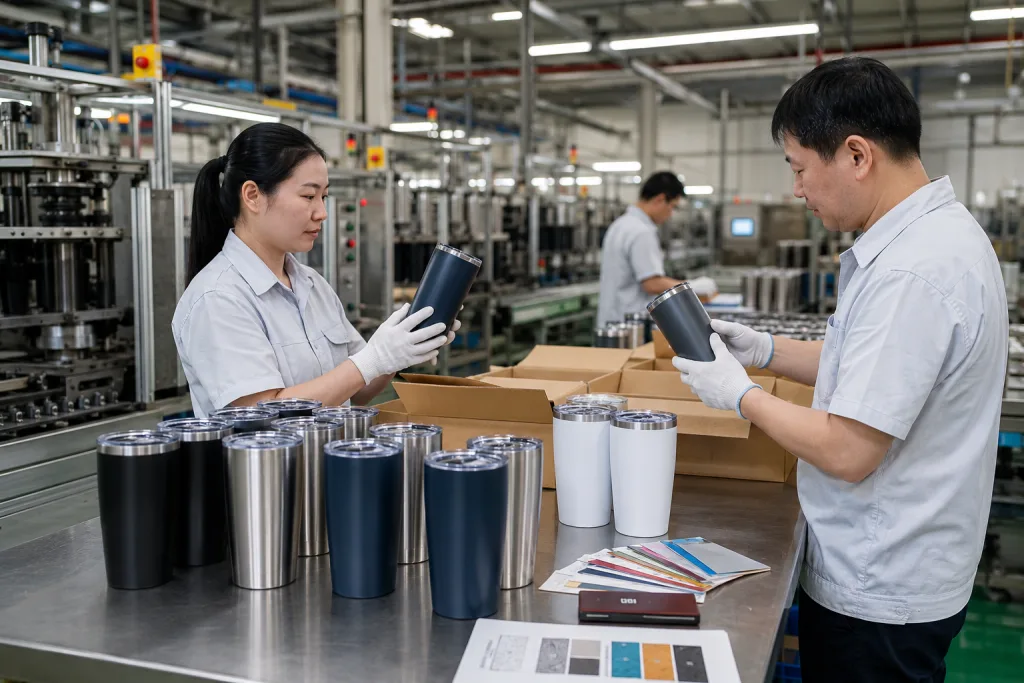
Key Takeaways
- A realistic MOQ for custom travel tumblers is usually 1,000-3,000 pcs per SKU, while fully new lid tooling often starts at USD 3,000-8,000
- Standard lead time for a repeat bulk travel tumbler order is often 25-35 days after sample approval and deposit
- For 18/8 stainless vacuum tumblers, FOB China pricing commonly lands around USD 2.80-6.50 depending on size, coating, and lid complexity
- Use AQL 2.5 for major defects, request REACH and LFGB or FDA documentation, and verify insulation, leak, and coating adhesion before shipment
You can buy a travel tumbler from almost any trading company in China. Finding a name is easy. The hard part is finding an oem manufacturer travel mug partner that can hold lid fit within 0.3 mm, keep powder-coat color close to the approved swatch, pass logo tape tests after curing, and still ship on the agreed date when your order moves from sample to 20,000 units. We have seen launches slip because QC pulled the sample and found the slider lid sitting loose by one fingernail. That matters whether you are a coffee brand building a retail line or a corporate-gift buyer with a fixed event date.
At BottleForge Industrial in Hangzhou, Zhejiang, we hear the same buyer questions about 12 times a week: Which steel grade is enough? What is a realistic MOQ? How do you compare a coffee mug factory direct quote with a coffee mug supplier directory lead? What should be tested before deposit? The wrong question is usually “who is cheapest.” The better question is who can run the line, control the PP sample, and catch the PO typo before 80 cartons get printed with the wrong logo size. If you are sourcing from Zhejiang, China, this is the practical checklist you need.
What counts as a real OEM partner
Buyers search for a coffee mug manufacturer or coffee mug factory, see workshop photos, and assume the supplier controls production. We’ve seen this go sideways. A forklift in front of stacked cartons proves nothing. You still need to separate 3 models: a direct factory, a trading company managing 2–6 plants, and a hybrid exporter that runs final assembly in-house but buys bodies, lids, or straws outside. None of these models is wrong by itself. The wrong question is “Do you have a factory?” The right question is “Which process do you control on the line, and which process is subcontracted?”
If you need a coffee mug private label or coffee mug custom made program, a real OEM partner should answer specific questions fast, without sales fluff or half-answers. On our side, if QC pulled the sample and the wall thickness reads 0.38 mm on the micrometer, we say 0.38 mm, not “about 0.4.”
- What is the body material: 18/8 stainless, 18/0 stainless, or recycled stainless blend?
- What is the outer and inner wall thickness: for example 0.4 mm/0.4 mm or 0.5 mm/0.4 mm?
- Is the vacuum rate checked piece by piece or by batch?
- Which coating line is used: powder coating, spray paint, UV print, or transfer print?
- Can the supplier provide AQL standard, REACH declaration, LFGB or FDA contact test documents, and factory audit status such as BSCI or ISO 9001?
At our Zhejiang, China facility, typical travel tumbler MOQ starts at 1,000 pcs per color for standard bodies, with monthly capacity around 600,000 units across tumblers, bottles, and mugs. That number matters more than a polished website. We run capacity planning by line hours, not by brochure claims. If a supplier cannot tell you normal lead time, such as 12 days for existing color stock versus 18 days for fresh coating, plus defect policy and tooling ownership, you are not talking to a stable coffee mug oem manufacturer.
Checklist for your first call: ask who owns tooling, where lids are molded, whether sealing rings are food-grade silicone, and how many repeat customers reorder the same SKU. Ask for one recent example. The buyer flagged this last month on a PO because the lid supplier changed and torque moved from 0.8 N·m to 1.1 N·m. First shipment looked fine. Second shipment did not. A factory that lives on repeat orders understands why a bulk coffee travel mug program fails when color drifts, lid torque shifts, or logo alignment moves 2 mm off center.
Which tumbler specs actually change cost
Buyers ask for pricing on a bulk coffee tumbler or bulk travel mug before the main cost points are fixed. That gives you quotes that don’t match. We see this every week. For a clean comparison, lock these variables first, or the buyer flagged one spec later and the whole sheet has to be redone.
Body construction
A single-wall mug costs less, but it does not fit premium coffee retail or daily commuter use. Double-wall vacuum 304 stainless is the standard for a bulk travel tumbler sold in Europe or North America. If the inner wall drops from 0.4 mm to 0.3 mm, cost may fall by USD 0.08-0.18 per unit, but dent resistance drops at the same time. On the line, QC pulled the sample after a drop test and the thinner body showed a softer sidewall fast. This is the wrong place to save 8 cents if the product is going into stores.
Capacity and shape
Common sizes are 12 oz, 16 oz, 20 oz, and 30 oz. Shape changes cost more than some buyers expect. Tall narrow bodies fit cup holders better, but they wobble more on the decoration line, especially during full-wrap printing, and we end up slowing the fixture. A shaped body with bottom reduction usually creates more scrap and more handling time than a straight-wall cylinder. We’ve seen this go sideways on a 20 oz body where the base neck-down was only 6 mm, but output still dropped.
Lid system
This is where a lot of low quotes hide risk. A simple press-in slider lid costs less than a threaded leak-resistant lid with a lock feature. Tooling for a custom lid can run USD 3,000-8,000, while a stock lid may avoid tooling entirely. If your corporate-gift buyer needs a true leak-resistant spec for commuting bags, write that on the PO in plain words. We had one order where the buyer typed “spill proof” and later asked for an inverted leak test at 60°C. That is not the same spec. Many "spill resistant" lids are not leakproof when inverted.
Decoration
Coffee mug customizable does not mean every logo process costs the same. One-color silkscreen is the low end. Laser engraving lasts, but the result depends on coating thickness and contrast after the beam hits the surface. Full-wrap heat transfer looks strong on shelf, but registration, color matching, and extra QC time all add cost; if the seam is off by 1.5 mm, the buyer will notice. A textured powder coat usually adds USD 0.20-0.45 over plain spray finish on mid-size orders. The math doesn’t work if you want low MOQ, custom Pantone, and full-wrap graphics on the cheapest base cup.
A practical FOB China reference for a 20 oz double-wall 18/8 tumbler with powder coat and standard slider lid is often USD 3.20-4.80 at 3,000 pcs, depending on decoration and packaging.
When you compare coffee mug bulk offers, ask every supplier to quote the same steel grade, wall thickness, finish, lid style, packaging, and test standard. Ask for the carton spec too. We ship plenty of 24 pcs master cartons, and that alone can change the number if one factory is quoting thicker dividers. If not, the cheapest number is usually just the least complete number.
MOQ, sample timing, and lead time reality
If you are buying coffee mug in bulk for a promotion, launch date matters as much as price. We’ve seen buyers lose 12 days by treating custom orders like stock on a shelf. They are not the same job. On the line, logo films, Pantone matching, and drop-test samples all need their own slot.
For standard bottle and tumbler bodies from a coffee mug factory direct supplier in China, the usual timeline looks like this:
- Existing sample with your logo: 5-7 days
- Pre-production sample with custom color and print: 7-12 days
- New mold development for lid or body part: 20-35 days
- Mass production after sample approval: 25-35 days
- Peak season extension: add 7-15 days from August to November
MOQ depends on how much of the program is custom. For a standard 20 oz travel tumbler with powder coating and one logo, 1,000 pcs per color is normal, and the powder supplier usually wants a full batch mixed for that run. For retail-ready gift box packing plus custom straw, custom lid insert, or mixed-color silicone parts, 2,000-3,000 pcs is more realistic. If you need a fully new body, do not expect a viable MOQ below 3,000-5,000 pcs unless you absorb higher tooling and setup cost. This is the wrong question to ask: “What is your lowest MOQ?” Ask what MOQ keeps unit cost and defect risk under control.
This is where coffee mug distributors and importers get caught. We see it every month. They compare a custom quote against a stock item sold by a coffee mug distributor and assume the factory is inflexible. The real issue is line changeover cost, coating minimums, and carton efficiency. A coating line does not like a 300-pc color run. A print line does not like 12 logo versions spread across 800 pieces. Last season a buyer flagged pricing on four silicone ring colors packed into one order; the math didn’t work once we split setup and QC by color.
Checklist before you book production: confirm carton dimensions, unit net weight, master carton gross weight, barcode position, FNSKU need if you sell online, and whether replacement lids are available. QC pulled a sample once because the barcode on the PO was 8 mm too low for the retail box window, and that small mistake cost a reprint. A good factory in Zhejiang should lock these details before deposit, not after your PO is already in process.
How to audit quality before deposit
A travel mug looks simple. It isn’t. Most failures start at the interfaces: lid threads, gasket fit, vacuum seal, coating adhesion, and base stability. On our line, QC pulls more issues from these points than from the cup body itself. If you are sourcing a coffee mug customized line from China, set the quality plan before you start shaving the last $0.08 off unit price. We’ve seen this go sideways.
Start with documents. Then get on the phone and ask what the report actually covers. Ask for recent test reports for your market: REACH for Europe, FDA or LFGB contact compliance where required, and if the item targets children or specific channels, check whether extra ASTM or CPSIA-related obligations apply. Ask for BSCI or an equivalent social audit if your customer requires it. A factory with ISO 9001 usually runs cleaner paperwork and better traceability, but product-level checks still matter. Last month a buyer sent us a PO with the lid material typed as PP instead of Tritan, and that one typo would have changed the whole test scope.
Minimum sample checks
- Leak test with hot water for 30 minutes at multiple angles
- Insulation retention, for example temperature drop after 6 and 12 hours
- Coating adhesion by cross-hatch or tape test
- Dishwasher statement validation if claimed
- Logo abrasion check with 100-200 rub cycles depending on process
- Thread engagement and open-close cycle test on lids
For bulk orders, agree the inspection standard in writing before deposit. AQL 2.5 for major defects and 4.0 for minor defects is common on drinkware export orders. Define major defects in plain language: leaking lid, unstable base, wrong Pantone outside tolerance, visible dent over 2 mm, poor weld polish, missing logo, or vacuum failure. This is the wrong question to ask late in production. If the buyer flagged a silver speck under the coating during final inspection, the math doesn’t work to argue whether it is major or minor on the warehouse floor.
Do not rely on final random inspection only. Ask for in-line photos or video from first-off production: bare body, after coating, after print, and after assembly. We run these checkpoints at the line because a bad powder batch or loose screen alignment shows up early, not at carton seal. A dependable coffee mug supplier should be able to show process control, not just stacks of finished cartons. That matters even more for coffee mug promotional products, where event dates are fixed and a 12-day rework window can turn into 18 days once lids are repacked and reshipped.
If you are comparing names from a coffee mug supplier directory or building your own coffee mug supplier list, score suppliers on how they answer technical questions during sampling. Ask what Shore hardness they use for the gasket, what torque range they check on screw lids, or how they confirm vacuum on 100% of pieces. Generic replies are a bad sign. In our experience, a supplier who takes 48 hours to answer a lid leak question during sampling will cost you far more during production.
Private label or promotional order choices
Coffee brands and corporate-gift buyers often use the same factory, but they buy in different ways. A retail coffee brand watches repeatability, shelf look, and margin on every reorder. A gift buyer watches ship date, logo size, and landed cost. We see this on the line all the time: one PO asks for barcode position within 3 mm, the next only asks, “Can you catch the event on June 12?” Your sourcing setup should match the job.
For a coffee mug private labeling program, chase consistency first. You might reorder the same 16 oz or 20 oz SKU every quarter, 3,000 to 10,000 pcs at a time. In that case, stay with standard body platforms, stable tooling, and lids that have already passed leak testing on the same neck size. Don’t switch coatings every order unless the brand team has a clear shelf reason; we’ve seen this go sideways when the buyer wants a new matte feel, then QC pulled the sample and gloss came back 8 points off target. Standardization usually saves 3-8% on repeat runs because setup scrap drops and packing specs stay fixed.
For coffee mug promotional campaigns, keep decoration and packing simple. Fast wins matter. A one-color screen print on a stock powder-coated body can save 10-20 days compared with a fully custom gift set, and the math doesn’t work if the tumbler is just a 5,000-piece conference giveaway. A standard tuck box is often enough. For executive gifting, a rigid magnetic box may add USD 1.20-2.50 per set, and freight volume jumps fast; one 40HQ plan can change after box height grows by 18 mm.
Questions you should answer internally before asking for quotes:
- Is the order for retail, gifting, subscription, or employee merch?
- Do you need barcode labeling, warning labels, or multilingual packaging?
- Will the tumbler be sold with coffee beans, coupons, or bundled accessories?
- Do you need replacement lids and after-sales stock?
- Will your next reorder use the same Pantone and same finish?
A lot of buyers search broad terms like coffee mug manufacturers or coffee mug distributors, but this is the wrong question to ask. Ask who can support your exact sales model with the least friction. A factory in Zhejiang, China that ships 30,000 tumblers every week may be the right fit for repeat private label, while a smaller workshop may be fine for a one-off local event. We’ve even had a buyer flag a simple PO typo that changed “black lid” to “blank lid,” so process matters more than catalog size. Pick the supplier around the program, not the product list.
How to compare landed cost honestly
The quote is only one line in the cost sheet. On a bulk coffee mug or bulk coffee travel mug order, landed cost usually moves on five things: product structure, carton density, freight choice, duty rate, and rework risk. Buyers still get stuck on a USD 0.20 unit gap while a master carton is wasting 18% of container space. We’ve seen this go sideways.
Check the quote basis first. Is it EXW, FOB Ningbo, or CIF? Most export factories in Zhejiang quote FOB because we run local trucking, booking, and export handling every week, so those costs are easier to pin down. If one supplier gives EXW and another gives FOB, put them on the same basis before you compare. This is the right first question. Last month a buyer flagged a PO that mixed EXW with FOB on the same style number, and the comparison was useless until we cleaned it up.
Then look at carton efficiency. A 20 oz tumbler packed 24 pcs per master carton often ships better than a premium-shape mug packed 16 pcs per carton, even with a slightly higher unit price. On the line, a 5 mm wider belly can change the carton layout and push ocean freight up 5-12% per unit. The math doesn’t work if the “cheaper” mug loads 180 fewer cartons in a 40HQ. For e-commerce, drop-test-ready inner boxes often earn their keep because return damage costs more than extra corrugate. QC pulled a sample last quarter where the color box corner crushed at 76 cm, and that one packaging fix saved a batch of claims.
Here is a clean buyer checklist for total cost:
- Unit FOB price
- Tooling or mold cost amortized across forecast volume
- Sample and courier charges
- Third-party inspection cost
- Packaging upgrade cost
- Labeling, FNSKU, or palletization fees
- Spare parts or replacement lid allowance
- Expected defect and claim reserve, often 0.5-1.5%
If a supplier looks cheap but pushes back on quality clauses, the discount disappears fast. One leak complaint during a retail launch can cost more than the original price gap, especially if QC finds torque drift on the lid station or a seal ring sitting 1 mm proud. The buyers who do best with a coffee mug custom program usually pick the most predictable supplier, not the lowest first PO number. We ship plenty of repeat programs this way.
Get a practical OEM travel mug quote
Send your target size, lid style, quantity, logo method, and delivery window. We will reply with realistic MOQ, FOB pricing, and lead time options.
Frequently asked questions
What is a normal MOQ for a custom OEM travel mug order?
For a standard stainless travel tumbler using an existing body and lid, a normal MOQ is 1,000 pcs per color and around 3,000 pcs for mixed decoration programs. If you want a new lid mold, custom base, or special gift box, MOQ often moves to 2,000-5,000 pcs because setup waste and tooling cost need to be absorbed. At BottleForge in Zhejiang, China, many repeat private-label travel tumbler projects start at 1,000 pcs for stock tooling and one logo position. If a supplier offers 200 pcs on a fully custom structure, check carefully whether they are a real factory, using stock leftovers, or simply quoting without understanding production economics.
How much should I expect to pay for a bulk coffee travel mug?
A realistic FOB China range for a 16-20 oz double-wall vacuum tumbler in 18/8 stainless is usually USD 2.80-6.50 per unit. At the lower end you get a standard shape, basic powder coat, and common slider lid. At the higher end you may have a threaded leak-resistant lid, premium gift box, laser plus print decoration, or recycled material claims with extra documentation. Single-wall mugs can be below USD 2.00, but they serve a different market. If your quote is far under market, confirm steel grade, wall thickness, lid resin type, and whether tests and export packing are included. Tiny specification gaps can easily explain a 15-25% price difference.
What compliance documents should a European or North American buyer request?
For Europe, ask for REACH-related material declarations and, depending on your channel, LFGB food-contact testing if applicable. For North America, FDA food-contact compliance is a common baseline for drinkware materials. If your customer has social compliance requirements, ask for BSCI or equivalent factory audit documentation. Product testing should cover more than paperwork: request leak testing, coating adhesion, and insulation performance data. If claims include dishwasher safe, that should be validated. For large orders, define inspection using AQL 2.5 major and 4.0 minor. A good China supplier should also confirm carton drop resistance, barcode placement, and if selling online, FNSKU or pallet labeling requirements before production begins.
How long does OEM development usually take from sample to shipment?
If you use existing tooling, logo samples usually take 5-7 days, and a pre-production sample with your color and packaging often takes 7-12 days. Bulk production generally needs 25-35 days after approval and deposit. If you need a new lid mold or structural change, add 20-35 days for development and validation before mass production. Peak season in China, especially from August through November, can add another 7-15 days depending on coating and printing load. You should also budget ocean transit separately. The safest buying plan is to lock artwork, packaging, and compliance checks before deposit instead of trying to solve them during production.
Should I buy from a coffee mug factory direct or from a trading company?
Factory direct usually makes sense when you have stable volume, need better control on technical details, and plan repeat orders. You can discuss wall thickness, gasket hardness, lid tooling, and quality checkpoints directly, which reduces misunderstanding. Trading companies can still be useful if your order includes several product categories or low volumes across mixed SKUs. The key issue is transparency. Ask who manufactures the body, who molds the lids, and who handles final inspection. If the seller cannot name the process owners, risk goes up. For a core travel tumbler program above 3,000 pcs, most serious buyers prefer direct access to a Zhejiang or broader China manufacturing team plus documented QC.