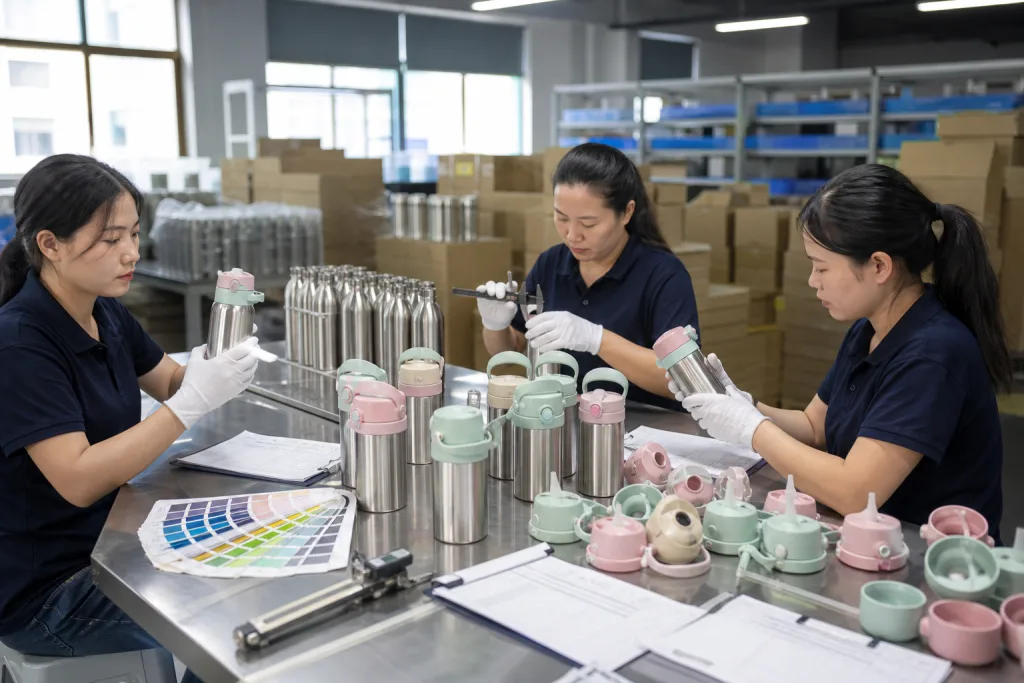
Key Takeaways
- Set measurable specs early: PP straw hardness, silicone Shore A 50-60, and bottle body wall thickness of 0.45-0.60 mm for common stainless toddler bottles
- For new tooling, expect 25-35 days for mold work and 45-60 days total to first bulk shipment from Zhejiang, China after sample approval
- Use AQL 2.5/4.0 at minimum, plus 100% vacuum leak testing for assembled lids before packing
- Realistic MOQ is often 1,000-3,000 pcs per colorway, with FOB prices around USD 2.80-6.50 depending on material, lid complexity, and decoration
The toddler bottle that looks fine in a sales sample is often the one that comes back as a claim 6 months later. We see the same failures on the line: leaks in daycare bags, chipped coating after a 1.2 m drop, odor complaints after hot-fill, broken handles, or a straw that fails migration. QC pulled the sample once on a lid fit issue at 0.3 mm, and the buyer had already approved artwork. These are not random problems. They usually start with a vague RFQ, the wrong resin grade, or a process the factory never locked. If you are buying from an OEM manufacturer toddler bottle supplier in Zhejiang or elsewhere in China, spec the failure points first. Before artwork. Before tooling.
You may also be buying broader custom drinkware: a custom canteen line, a customizable growler, or canteen promotional items for seasonal retail. Same logic. This is the wrong question to ask: “Who has the lowest FOB?” The math doesn’t work if 3% of units leak and the retailer charges back the full shipment. Good buying is about cutting preventable failure modes with measurable requirements: wall thickness in mm, torque range on the cap, AQL, drop height, odor standard, and lead time discipline. We ship smoother when those numbers are written into the PO, not added after the buyer flagged the pre-production sample.
Where toddler bottles usually fail
Most buyer problems land in five places: leaking, breakage, chemical compliance, decoration durability, and pack-out errors. We see this on the line every season: a buyer sends one photo, one target price, and asks a canteen manufacturer or canteen factory in China to “match it.” Bad start. That is how a desk sample passes a 10-minute fill test, then leaks after a child drops it from 90 cm onto tile. Toddler bottles are not mini sports bottles. Adults twist them tight, kids chew the spout, dishwashers run hot, and parents will reject a bottle if the cap smells after one weekend.
At BottleForge Industrial in Zhejiang, we see buyers copy adult custom drinkware specs into kids programs and call it efficient. The math does not work. A custom growler can live with higher closure torque and a tougher coating stack, but a toddler bottle needs a cap a tired parent can open with wet hands, silicone that passes mouth-contact review, and parts that QC can check with a 0.05 mm feeler gauge. A customized canteen for outdoor retail may chase dent resistance and full-wrap logo coverage. A toddler SKU needs easier cleaning, fewer loose parts, and verified material safety on every mouth-contact component.
- Leak path failures: poor gasket compression, flashing on spouts, straw length mismatch, thread wobble.
- Mechanical failures: thin handles, hinge pin wear, brittle copolyester, weak weld points on stainless ears.
- Compliance failures: wrong pigment masterbatch, untested silicone, missing REACH or CPSIA documentation.
- Appearance failures: color drift above Delta E 1.5, uneven powder coat, logo peeling after 50 dishwasher cycles.
- Logistics failures: mixed lids, wrong FNSKU placement, barcode label falloff, carton drop damage.
If you buy as a canteen distributor, distributor drinkware importer, or one of several canteen distributors managing private label programs, ask for the failure list before you ask for the prettiest render. QC pulled samples from a 3,000 pcs pilot run last month because two cartons had mixed lid colors after pack-out. Small miss, big claim. Your supplier should treat these as engineering risks on the BOM, tooling, inspection, and packing table, not customer service problems after shipment.
Leakage starts with bad lid geometry
The top return reason is plain: the bottle leaks when it is tipped, shaken, or packed sideways in a school bag. Buyers often point at the silicone ring first. Most of the time, the problem starts earlier, in the lid stack-up. If thread pitch, cap flatness, gasket groove depth, and straw seat height all drift by 0.2-0.4 mm, the seal has no room left to work. QC pulled one toddler lid sample last year where the gasket groove was 0.35 mm too deep; the buyer had blamed "bad silicone" on the first email.
Your RFQ should put numbers on the closure system. For a straw lid, ask for a compression ratio on the main seal of 15-25%. Ask for thread engagement of at least 1.5 turns on plastic lids and a stable torque window, usually 8-12 kgf-cm for child-operable screw caps depending on diameter. For flip lids, specify hinge cycle testing to 3,000-5,000 cycles and a measured latch retention force, not a finger-feel comment from the sample room. If the bottle is insulated stainless steel, specify neck roundness tolerance and thread concentricity. A clean powder coat cannot fix a mouth that comes off the line oval by 0.3 mm.
What to request from the canteen supplier
- 100% air-pressure or vacuum leak test after final assembly, with the test pressure written on the QC sheet
- Filled-water inversion test for 30 minutes at room temperature, using production caps and production gaskets
- Hot-fill leakage check if you market warm water use, usually at 60-70°C, not boiling
- Dimension report on lid groove depth, gasket cross-section, and straw insertion depth, checked by caliper or height gauge
Do not approve a toddler bottle from a hand-built sample only. Ask for at least 20-50 pcs pilot run from production tooling and production materials.
This matters whether you are buying a customized canteen, a canteen custom program for a retailer, or a broader customizable drinkware range. Leak control comes from repeatable tooling and QC discipline. Design intent is not enough. We have seen this go sideways when a PO said "same as sample" but the pilot run used a revised straw plug with no drawing update. A serious canteen vendor in Zhejiang should show the test method, reject criteria, and daily records instead of saying "no leak" on a chat message.
Material choices that trigger complaints
Toddler bottle buyers often miss how fast a small material shortcut turns into a claim. We see the same 4 complaints: sour smell after the first hot rinse, tea staining on the straw, cracked handles after drop testing, and migration paperwork that does not match the actual resin. For bottle bodies, the normal choices are 18/8 stainless steel, PP, Tritan-type copolyester, or glass with a sleeve. For straws, spouts, and seals, we run food-grade silicone, PP, or PE blends. Cheap is not the real problem. The wrong grade is. QC pulled one 5,000 pc sample lot last year because the spout smelled like rubber after 24 hours sealed in a PE bag.
If you need insulated stainless, specify inner and outer body thickness instead of accepting "standard". A common practical range is 0.35-0.45 mm inner wall and 0.45-0.55 mm outer wall for a 12-14 oz toddler bottle. Too thin and you get denting, weld instability, or thread distortion; our line checks this with a digital thickness gauge before necking. Too thick and the FOB price climbs with little user benefit. For plastic bodies, request resin grade disclosure and compliance documentation before the mold trial, not after the carton is booked. For Europe and North America, that may include REACH SVHC, LFGB depending on market, and CPSIA or FDA food-contact declarations where applicable. We have seen this go sideways when a PO says Tritan-type, but the supplier quotation only says "clear plastic".
Control softer parts tighter than 6 out of 10 canteen suppliers expect. Silicone should have a defined Shore A range, often 50-60 for seals and slightly softer for spouts depending on design; we check it with a Shore A durometer on the incoming table. Ask for odor testing after 24 hours sealed storage and after first wash. If pigments are used for lids or straws, require heavy metal declarations on the color masterbatch. Buyers of customizable canteen and customized drinkware lines often focus on body color, but the mouth-contact parts carry the bigger compliance risk. The buyer flagged it once on a blue straw, not the bottle body.
- Stainless: ask for SUS304 contact parts, weld passivation, and insulation retention test if double-wall; for one toddler program we held 95 C water for 6 hours before packing approval.
- PP: good cost control, but hinge areas need impact validation, especially after 3 drop tests from 1.2 m.
- Copolyester: clear appearance, but verify crack resistance around handles and threads after cap torque testing.
- Glass: premium feel, higher breakage risk; usually a poor first choice for toddler programs unless the sleeve tooling and carton drop test are already proven.
A reliable canteen factory in China should not push back on these requests. They should already have standard test reports on resins, silicone, inks, and coatings, and the file names should match the material codes on the BOM. If the sales reply is only "all food grade", ask again. That answer is too thin for toddler bottles.
Decoration failures are preventable
Brand owners spend 3 weeks arguing over Pantone chips and 10 minutes on decoration durability. That is backwards. On toddler bottles, decoration fails from fingernails, bottle brushes, dishwasher heat, sterilizing water, and abrasion inside export cartons. We have opened a 5-ply carton after a 1.2 m drop test and found logo scuffing before the bottle body had a dent. If you are sourcing custom drinkware, custom canteen, or a customized growler, match the decoration method to real use, not only to the AI file.
For stainless steel bodies, powder coating is common and practical, but the cure window matters. Under-cured coating chips. Over-cured coating shifts color and loses adhesion. We run oven checks with a contact thermometer, and QC pulled one sample last season where the red moved outside Delta E 1.5 after the second cure. Ask for cross-hatch adhesion testing, abrasion test criteria, and a color tolerance such as Delta E under 1.0-1.5 against approved standard. For logos, choose the process based on order volume and the wash claim. Silk screen works on simple artwork at 3,000 pcs MOQ, but laser engraving usually survives heavy washing better. UV printing can look sharp, but the adhesion on coated surfaces needs tape test and rub test proof.
For lids and PP parts, pad print and silk screen are common, but curved surfaces can cause registration drift. Small logo, big curve. We have seen a 28 mm logo walk 2 mm off-center on a toddler flip lid, and the buyer flagged it during pre-shipment inspection. If your program is canteen customizable across many SKUs, build a decoration matrix by body material, lid shape, logo size, and wash claim. One method for every SKU is the wrong question to ask. A canteen manufacturer producing 300,000-500,000 units per month should be able to tell you what process can hold your logo size, placement tolerance, and dishwasher claim.
Minimum decoration spec to write into the PO
- Logo placement tolerance: ±1.5 mm
- Color tolerance: Delta E ≤ 1.5 against signed sample
- Adhesion: cross-hatch 4B or better
- Abrasion: defined rub cycles with dry and wet cloth
- Dishwasher claim: specify exact cycle count and detergent condition, or do not make the claim
If you are a canteen distributor or distributor growler buyer serving retail chains, vague decoration language turns into chargebacks later. We have seen one PO say "dishwasher safe" with no cycle count, then the retail lab ran 50 cycles with alkaline detergent and rejected the lot. The math does not work after rework, air freight, and repacking. Put the test method and pass criteria in writing.
Tooling shortcuts show up after launch
First-time buyers often chase unit price and treat tooling as a small setup charge. That is the wrong question to ask. A weak mold keeps charging you later through rejects, slow assembly, and after-sale claims. On an OEM manufacturer toddler bottle project, we usually see it at T1 or after the first 3,000 pcs: flash on the spout, caps that need two hands to close, sink marks around the handles, threads drifting by 0.2 mm, and parting lines sitting right where a parent grips or a child drinks. QC pulled one lid sample last summer where the silicone straw passed leak test, but the PP cap had a sharp edge near the vent hole.
Ask direct mold questions. How many cavities? What steel grade? Are critical sealing surfaces polished and protected? Is there interchangeable insert design for future cap variants? What is the mold maintenance interval? If a supplier is also a canteen vendor serving broader canteen customized and customizable growler programs, they may try to push one tool concept across several SKUs. The math works only when the seal, bite area, and hand feel are checked again for toddler use. We run different gauges on these parts, including a thread plug gauge and a 0.05 mm feeler check around the cap seat, because “same lid family” does not mean same child-safe fit.
Lead time is where buyers get too hopeful. New tooling commonly needs 25-35 days. Pilot sampling, test correction, and packaging confirmation add another 10-20 days. Bulk production usually needs 20-35 days after final approval, depending on decoration complexity and carton availability. A realistic total from approved drawing to first FOB shipment from Zhejiang, China is often 45-60 days for a straightforward program and 60-75 days if the lid is new. We have seen buyers ask for 30 days door to port on a fresh lid mold; the line can run fast, but steel cutting, EDM texture, leak testing, and color box approval do not compress that way.
- Reasonable MOQ: 1,000 pcs for simple repeat items, 2,000-3,000 pcs for new custom colors or new lids
- Typical tooling cost: USD 1,500-8,000 depending on lid complexity and cavity count
- Pilot run: request 20-50 pcs from production tool before mass PO release
If your supplier refuses a pilot run or cannot provide dimensional data from the mold trial, assume you are paying for their learning curve. Ask for the T1 report, caliper photos, and at least 20 pcs from the production tool before you release the mass PO.
QC plans buyers forget to demand
Inspection should not happen only after production is packed. For toddler bottles, final sorting usually finds the defect after the line has already made 8,000 bad lids. We ask buyers to lock the QC plan before PP sample approval: incoming material check, line checks during molding and assembly, then pre-shipment inspection. AQL alone is not enough. Last season QC pulled a straw-lid sample with silicone flash at 0.4 mm; the final inspector would have caught it, but the mold tech needed to fix the trimming knife on hour one.
A workable baseline is AQL 2.5 for major defects and 4.0 for minor defects, with critical defects at zero tolerance. Define critical in writing. For a toddler bottle, we count accessible sharp edges, detached small parts, failed leak test, missing compliance documents, and any odor or contamination on mouth-contact parts as critical. For in-process control, require first article confirmation at each line start, hourly leak checks on assembled bottles, coating adhesion spot checks with 3M tape, and carton drop verification after pack-out. Short note: if the factory says leak testing only at the end, the math doesn't work.
If you ship to Amazon or large retail, the QC plan also needs labeling and packaging checks. FNSKU placement, suffocation warnings, country-of-origin marking, and carton dimensions sound basic, but we still see canteen suppliers miss them. One buyer flagged a carton at 61 cm when the PO allowed 58 cm max, and the 3PL charged relabel and repack fees before release. That hurts more than a 2-day line delay.
A practical QC checklist
- Incoming resin grade, silicone hardness, and 304 stainless verification against the approved BOM and sealed sample
- 100% visual check on mouth-contact parts for flash over 0.2 mm, black specks near the drinking path, or oil and dust contamination
- 100% leak test on finished assemblies, with the jig pressure and test time written on the QC sheet
- Drop test: commonly 3-5 drops from 80-100 cm depending on age-grade and claim
- Pre-shipment AQL on appearance and function, plus packing, barcode scan, and carton markings against the PO
Any canteen supplier, canteen manufacturers group, or canteen vendors you shortlist in China should accept third-party inspection. If they push back, ask why. We have seen this go sideways when a factory agrees to AQL 2.5 but blocks the inspector from opening inner cartons.
Packaging mistakes that raise landed cost
Packaging failures stay quiet. Margin loss does not. We’ve seen a toddler bottle pass leak, drop, and torque checks, then lose money because the insert scuffed the powder coat, the straw took a set in the carton, or the master carton softened after 18 days on water. Buyers on custom drinkware, canteen promotional orders, and distributor assortments still under-spec this part because they treat packaging like back-office detail. That is the wrong question to ask.
Start with unit protection. For a powder-coated bottle, we run a PE bag or clean tissue wrap that will not shed dust or offset print; QC pulled a sample last month with black logo ink transferred onto a light pink body. If the straw is removable, write it clearly on the PO: assembled or separately bagged. Don’t leave it vague. We’ve seen one typo on a PO turn “packed inside” into “fixed inside,” and 6,000 straws arrived bent at the elbow. For gift boxes, call out board weight, drop resistance, and logo rub protection. Then lock the shipper carton spec: wall strength, carton gross weight, pallet pattern, and pallet overhang rule. Buyers still push for 22-24 kg cartons to cut carton count. The math doesn’t work once damage claims and warehouse complaints start.
Ask your canteen factory for carton compression and drop test records, not a verbal promise. For export from Zhejiang, China to Europe or North America, practical master carton gross weight is often 12-16 kg; on our line, cartons above 18 kg show more corner crush after stacking. Specify barcode quality grade if scanning matters at your DC. If you are one of several canteen distributors feeding e-commerce, define inner pack quantity, spare straw ratio, and replacement-part labeling upfront. One missing label on a replacement straw bag sounds small until the buyer flagged it and the 3PL had to relabel 4,800 units by hand.
- Carton drop test: 6 faces, 3 edges, 1 corner for transit validation
- Barcode: scannable after humidity exposure and carton rub
- Palletization: no overhang, stretch wrap pattern defined
- Spare parts: 1-2% extra straws or seals for service stock on large orders
This is where a capable canteen supplier earns the order beyond factory price. Better packaging design often cuts claims, relabel labor, and replacement shipments faster than squeezing FOB by USD 0.08 per unit. We ship both ways, and we’ve seen this go sideways.
Send your toddler bottle spec for a factory review
We will flag leakage, compliance, tooling, and packaging risks before sampling, with MOQ, FOB pricing, and realistic lead times from Zhejiang, China.
Frequently asked questions
What MOQ should I expect for an OEM manufacturer toddler bottle?
For a repeat model with standard lid colors, MOQ is often 1,000 pcs per item. If you need a new Pantone body, custom packaging, or mixed lid colors, expect 2,000-3,000 pcs per SKU or colorway. A brand-new lid mold can push MOQ higher until the tool is amortized. In China, especially in Zhejiang, factories with larger lines may quote lower MOQ on stock bodies but still require 500-1,000 pcs per print color or packaging style. Ask the supplier to split MOQ by body, lid, decoration, and carton, not just give one total number. That shows you where the real production constraint is.
How much does a custom toddler bottle usually cost FOB China?
A practical FOB range is USD 2.80-4.20 for a single-wall PP or simple stainless toddler bottle with basic print, and USD 4.50-6.50 for a double-wall vacuum stainless version with a more complex straw or flip lid. Premium packaging, laser logo, spare straw sets, or licensed-color matching can add USD 0.20-0.80 per unit. Tooling for a new lid may run USD 1,500-8,000 depending on cavity count and complexity. If a quote is far below the market, check whether they excluded leak testing, used thinner wall stock, downgraded silicone, or priced on generic cartons without retail protection.
Which compliance documents should I ask for on kids drinkware?
At minimum, ask for food-contact declarations for all mouth-contact parts, plus test reports tied to the exact materials used in production. For Europe, REACH and, depending on your market and claim set, LFGB-oriented testing may be relevant. For North America, ask for FDA food-contact compliance declarations and children’s product documentation where applicable. Also request reports for coatings, inks, silicone seals, and color masterbatch, not just the bottle body. Good suppliers in China should provide a BOM-linked document pack. If the factory cannot show which report matches which component and date, treat the paperwork as marketing, not compliance control.
How do I reduce leakage risk before mass production?
Do not approve from a hand-made sample alone. Ask for a pilot run of 20-50 pcs from production tooling, with production silicone, straws, and caps. Require 100% leak testing on the pilot lot and review actual dimensional data for thread fit, gasket groove depth, straw length, and cap flatness. Put test methods into the PO: 30-minute inversion test, vacuum or air-pressure check, and hot-water leakage test at 60-70°C if relevant. Also define closure torque and child-operable force targets. Most leak problems come from tolerance stack-up, not one bad gasket, so process capability matters more than one perfect sample.
What lead time is realistic for a new private label toddler bottle project?
If you are using an existing body and only changing color, logo, and packaging, 30-45 days from approval to FOB shipment is common. If the lid is new or tooling needs modification, budget 45-60 days at minimum, and 60-75 days is safer for first orders. Typical timing is 25-35 days for tool work, 7-10 days for trial samples, 5-10 days for revisions, and 20-35 days for bulk production and packing. Buyers often lose time not in manufacturing but in artwork approval, package edits, and incomplete compliance requests. Lock the BOM, testing scope, and carton spec early.