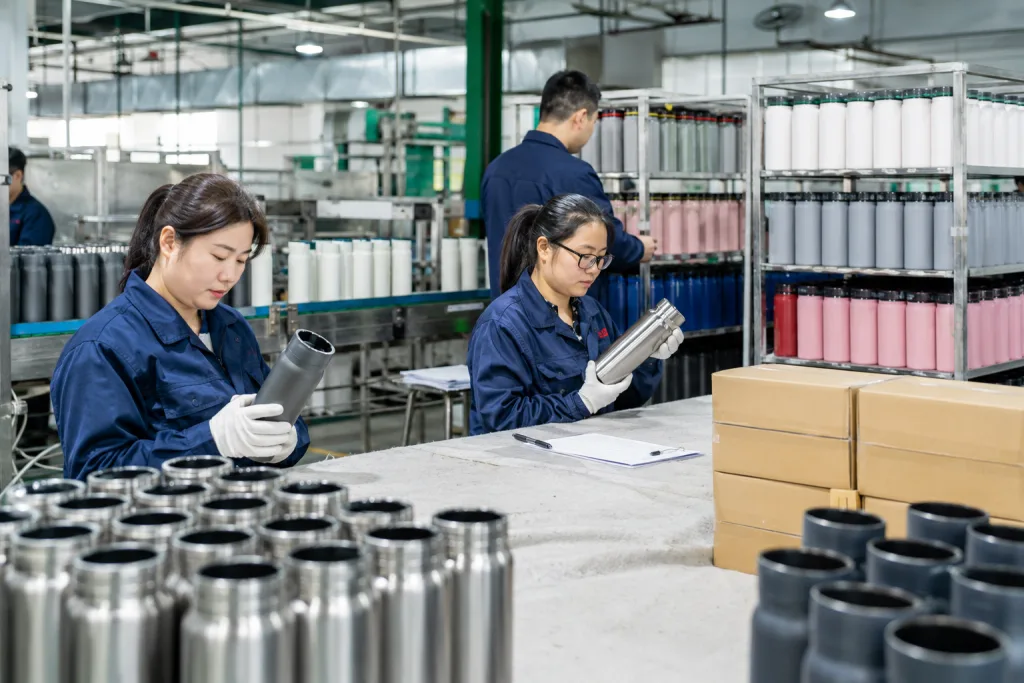
Key Takeaways
- A workable MOQ for a custom stainless thermos is often 1,000-3,000 pcs per color, with sample lead time around 7-12 days and mass production 30-45 days
- For a 500-750 ml double-wall vacuum bottle, 18/8 stainless steel, 0.4-0.5 mm wall thickness, and a 12-24 hour heat retention target are standard buying specs
- Set QC at AQL 2.5 major and 4.0 minor, and test at least 1.0% for leakage, coating adhesion, barcode scan, and carton drop resistance
- A small packaging change can raise container loading efficiency by 8-15%, which matters more than shaving $0.10 off a unit FOB China price
You do not lose money on a stainless bottle order because the quote was $0.18 too high. You lose money because the lid leaks in transit, the powder coat chips after 200 units, or the master carton size pushes freight up by 14%. We have seen all three on the line. The real job with an oem manufacturer thermos factory in Zhejiang, China is simple: turn a desk sample into a production order that survives retail shelves, event use, and warranty claims. A sample can look clean under office lights and still fail a 1.2 m drop test after the first 500 pcs. That is where orders go sideways.
For outdoor retailers and promotional brands, the thermos is only half the buy. The other half is spec control, testing, and production discipline. This is the wrong question to ask: “What is your best price?” Ask for steel grade, insulation result, logo method, packaging drawing, and AQL before deposit. If you are buying bulk thermos or building a custom thermos line, lock down 304 stainless, vacuum hold time, silk screen or laser marking, carton size, and AQL 2.5 before we run mass production. QC pulled the sample last month on a 0.4 mm logo shift, and the buyer flagged it before shipment. Here is what a practical buyer workflow looks like from first RFQ to final shipment.
Start with the actual selling scenario
You’re building a fall hydration line for outdoor retail, or pitching a 5,000-piece holiday program for promos. The target is clear: a 600 ml custom thermos with a carry handle, matte black coating, one-color logo, and carton spec that works for pallet retail distribution or Amazon prep. New buyers often send one product photo and one capacity number, then ask for price. That’s the wrong question to ask. On our side, the line cannot quote cleanly from that. Last month a buyer flagged a handle style in the photo, but the sample they wanted used a different lid thread, and the whole cost sheet had to be redone.
A real RFQ to a manufacturer thermos supplier in China should include the points below:
- Body: 600 ml, double-wall vacuum, food-contact 304 inside and outside, or 316 inner if you sell it as premium outdoor gear
- Wall thickness: 0.4 mm inner, 0.5 mm outer is common for better dent resistance
- Mouth diameter: for example 45 mm if you want easier filling and ice access
- Lid: screw lid with PP inner, silicone seal, fold handle, no straw
- Finish: powder coating, Pantone matched, 60-80 gloss or full matte
- Logo: silk screen, laser engraving, or UV print, with artwork size in mm
- Packaging: individual white box, color box, or PDQ tray; barcode and FNSKU if needed
- Compliance: REACH, LFGB, FDA, California Proposition 65 testing plan if your market requires it
At our Zhejiang facility in China, this type of factory thermos project usually starts at 1,000 pcs for stock molds and 3,000 pcs if you need custom color boxes across multiple SKUs. We run monthly capacity up to 300,000 units across tumblers and vacuum bottles, but the real schedule moves with decoration load and lid assembly complexity. A laser logo run and a silk-screen run do not book the same way. If a supplier thermos quote lands in 24 hours with zero technical questions, be careful. We’ve seen this go sideways. A serious thermos factory will ask about seal structure, branding tolerance, and carton drop expectations before locking price. QC pulled the sample on one recent order because the PO said “full matte” but the approved chip was 70 gloss, and that small mismatch delayed approval by 2 days.
Choose the construction before the decoration
Buyers spend weeks on logo size, then rush the bottle structure. That is the wrong question to ask. On stainless vacuum drinkware, construction drives the defect rate on the line: shallow lid thread, a base diameter that is 3-5 mm too narrow, or powder coat built up around the neck so closing torque jumps and QC pulled the sample.
For most distributor thermos and promotional thermos programs, 18/8 stainless steel, also called SUS304, is the safe commercial spec. It is accepted for food contact, resists corrosion, and the math works at common MOQs. If you sell into angling, hiking, or premium outdoor channels, a 316 inner wall makes sense, but expect FOB cost to rise by roughly $0.35-$0.80 per unit depending on size and steel market conditions. We have seen buyers push for 316 on entry-price SKUs, then cut gift box budget to make up the gap. Usually that goes sideways.
Typical factory spec range
- 350 ml-500 ml office or commuter bottle: FOB China about $2.20-$3.60 at 3,000 pcs
- 600 ml-750 ml outdoor stainless thermos: FOB China about $3.20-$5.20 at 2,000-3,000 pcs
- 1,000 ml large vacuum bottle with handle: FOB China about $4.80-$7.50 at 1,000-2,000 pcs
For heat retention, do not accept soft claims like “keeps hot all day.” Ask for a test statement with numbers: 95°C filled water, ambient 20°C, retained above 60°C after 12 hours. Cold retention should be stated the same way, with iced water, ambient condition, and hold time. Ask whether the factory used its internal procedure or a third-party lab, and ask what thermometer they run. A supplier that knows the product will answer fast, not hide behind marketing copy.
You are not buying a picture. You are buying steel grade, vacuum quality, lid geometry, coating adhesion, and carton efficiency.
If you need a customized thermos for rough outdoor use, write base durability into the spec sheet. A silicone boot helps, but it adds cost and pack volume; on one 750 ml project, carton quantity dropped from 24 pcs to 20 pcs after the boot was added. A wider base gives better stability, but case pack efficiency drops, which matters if we ship pallet programs into Europe or store replenishment orders into North America. The buyer flagged this more than once after seeing the first pallet cube.
Sampling is where hidden cost appears
After the quote stage, sampling is the next control point. This is where cost starts leaking. We’ve seen thermos projects go sideways here because the buyer approved an appearance sample without asking one basic question: was it made on production tooling, with the same spray line settings and logo process planned for mass production? A hand-polished sample from the bench can look clean, then the line runs 5,000 pieces and the defects show up fast.
Ask for three sample stages when the order value justifies it:
- Existing sample: confirms shape, hand feel, and general quality in 2-5 days
- Pre-production logo sample: confirms color, logo position, and coating in 7-12 days
- Golden sample: signed and dated reference kept by you and the thermos vendor before deposit balance production starts
For a standard 600 ml thermos custom project in Zhejiang, sample charges are often $50-$150 for stock bodies with custom print, and $300-$800 if you need a new mold component such as a handle or lid insert. Tooling for a fully new bottle body is much higher, often $4,000-$15,000 depending on complexity, cavity, and whether the base geometry requires special forming steps. On the factory floor, that “small change” usually means a new insert on the mold or a revised core, and the math doesn’t work if your MOQ is only 1,000 pcs.
Use the sample stage to verify more than appearance. This is the wrong question to ask if the only question is “does it look good?” QC pulled the sample, put the caliper on it, and the checks below tell you more than a beauty photo ever will.
- Net weight tolerance, usually within plus or minus 3%
- Bottle height and diameter tolerance, usually within plus or minus 1-2 mm
- Lid closing torque and thread smoothness
- Leak test after upside-down hold for 30 minutes
- Coating adhesion by cross-hatch or tape pull check
- Odor after 24-hour hot water hold
If you are a thermos distributor or one of the larger thermos distributors handling multiple private labels, ask your manufacturer thermos partner to code each sample clearly: body code, lid code, finish code, and logo file version. We ship too many projects at the same time to leave this loose. One buyer flagged a production mismatch after the PO said “final sample approved,” but the approved item was silver laser and the line ran white screen print because both samples were labeled “final sample” in email. A sticker with lid code and artwork version would have stopped that in 10 seconds.
Lock the PO around production reality
After sample approval, the PO needs to match how the line actually runs, not just price and payment terms. If the PO says only “600 ml customized thermos, black, logo,” you’re exposed. That wording leaves too much room between your sales file and our workshop: steel purchasing, Pantone ink mix, jig setup, and carton packing. We’ve seen this go sideways over a 0.3 mm logo shift that the buyer flagged only after mass production started.
A usable PO pack should carry the approved drawing, artwork file, Pantone reference, packaging artwork, carton mark, barcode file, inspection standard, and shipment window. For bottle orders shipping FOB Ningbo or Shanghai from Zhejiang, China, I also suggest adding the target gross carton weight. Keep it under 18 kg if your EU customer has warehouse handling limits; 12-15 kg is easier for event and promo channels. QC pulled cartons last month at 17.6 kg and the customer still asked us to cut weight because their local handler charged extra above 15 kg.
What should be written into the order
- Incoterm: FOB, EXW, or DDP if agreed through a managed channel
- MOQ split: for example 3,000 pcs total, minimum 1,000 pcs per color
- Lead time: 35 days after deposit and artwork approval, not from verbal confirmation
- Defect standard: AQL 2.5 major, 4.0 minor, level II
- Testing: leak, vacuum retention, coating, barcode scan, carton drop
- Spare parts: 0.5%-1.0% extra lids or seals for service claims
For custom thermos and distributor thermos programs, 30% down and 70% against inspection approval before shipment is still the cleanest structure. On orders over $30,000 with custom lids, silicone seals, or a new base mold, ask for milestone approvals tied to packaging sign-off and pre-shipment QC. That is the right question to ask. We run smoother with that setup because arguments get settled while goods are still on the floor, not after the container books.
Watch the container math. A box redesign that increases loading from 8,400 to 9,200 units in a 40HQ cuts freight cost per unit at once. Buyers chase a cheaper thermos supplier quote and miss this. The math doesn’t work. On a bulky 750 ml product, better packout often saves more than a lower body price, especially if the inner box height drops by 8 mm and we ship one more layer per pallet.
QC the order before goods are finished
The costliest QC mistake on a thermos order is waiting for pre-shipment inspection to find the problem. At that point, rework, relabeling, and carton reopening start eating money fast. We prefer one in-line check when 10%-20% of goods are completed, then one final inspection after at least 80% is packed. On our line, QC pulled the sample at 15% output last month and caught a lid thread mismatch before 1,200 pcs went into cartons. That is where you save the order, not at the warehouse door.
For stainless drinkware, these are the checkpoints that matter:
- Raw material verification: confirm 304 or 316 steel with supplier declaration or material cert; we also check the coil heat number against the incoming record
- Vacuum integrity: random heat retention tests on body samples from each lot; on a standard 500ml item, we usually hold hot water and compare the result lot by lot
- Leakage: 100% line check if possible, plus sampling confirmation by the inspector; this is the wrong place to save labor
- Decoration: logo position tolerance, usually within 1.5-2.0 mm; the buyer flagged a 2.3 mm shift once, and we had to rework 600 pcs
- Color consistency: visual comparison under standard light or Delta E control if agreed; we run this under the light box, not by warehouse sunlight
- Packaging: barcode readability, carton count, inner divider fit, export mark accuracy; a single typo on a PO shipping mark can hold customs clearance
For a 5,000-piece thermos customized order, a final inspection sample size under ANSI/ASQ Z1.4 level II is usually enough if the earlier process check was stable. If the in-line report already showed loose lids or print drift, the math doesn't work, and you should raise the sample size or reopen the process. Major defects should include leakage, missing gasket, wrong barcode, vacuum failure, sharp edge, or obvious dent. Minor defects can include small print offset or light rub marks that do not affect saleability, but your cosmetic limit needs to be written down clearly. We have seen this go sideways when a buyer says “no scratches” but gives no photo standard. Outdoor retail buyers usually accept less cosmetic variance than thermos promotional programs, where delivery date and unit cost drive the decision.
If your market is Europe, ask for REACH-related chemical compliance on coatings and accessible plastic parts. If your market is North America and the product is for kids or schools, ASTM-related packaging and labeling checks may also matter depending on the exact use case. BSCI or Sedex audit status should be confirmed early if your customer has social compliance requirements. We ship to both regions, and this question should be settled before mass production, not after 3,400 cartons are taped and stacked in Hangzhou.
Plan for delivery, claims, and repeat orders
An order is not done when the container leaves Ningbo. It is done when your customer opens the cartons and gets sellable units, then your next PO moves faster than the first one. Plan for the problems we see every season: carton crush, missing lids, barcode mismatch, and a small leak claim rate in the field. Last month QC pulled the sample on one repeat order because the outer carton burst strength came in 18% below spec. That is the kind of issue that shows up after port, not before.
For a standard thermos manufacturer shipment from Zhejiang to Europe or North America, plan transit with buffer. Sea freight can swing 7-15 days in peak season, and customs holds are normal. If you need shelf-ready stock by early October, shipping in late September and hoping for the best is the wrong call. Build backward from your warehouse due date. For most outdoor and promo calendars, the safe factory ex-work target is 45-60 days before your required inbound date. We have seen this go sideways over one typo on a PO delivery date.
Ask your thermos manufacturers partner to hold production records for each lot: steel batch, coating batch, decoration date, line supervisor, and carton count. Also keep sealing ring specs, lid assembly records, and torque data from the capping station. If a claim lands 90 days later, traceability is what saves the discussion. We run lot cards by line, and the buyer flagged one case last year where the silicone ring was 0.5 mm off from the approved sample. On repeat business, these records cut troubleshooting time and keep color continuity tighter.
Agree the claim rule before shipment. Put numbers on it. If field leakage stays under 0.3%, ship replacement lids with the next order. If it goes above 1.0% on verified cases, apply credit or remake terms. Put it in writing before deposit, not after the complaint comes in. Promotional brands and distributors thermos buyers skip this because they want to move fast, then the math doesn't work once claims start and nobody defined who pays freight on replacement parts.
The best custom thermos programs in China do not get cheaper because you pushed the FOB price down another $0.08. They get cheaper because the second and third orders run off the same golden sample, the same test limits, the same carton spec, and fewer mistakes on the line. We ship repeat orders faster when the setup stays fixed: same Pantone target, same barcode position at 35 mm from the base, same drop-test standard. That is how a thermos supplier becomes a real long-term manufacturers thermos partner, not just the lowest quote sitting in your inbox.
Send your thermos spec for a factory review
Share capacity, lid type, logo method, target price, and delivery date. We will check MOQ, compliance, and the most likely production risks first.
Frequently asked questions
What MOQ should I expect for a custom stainless thermos order?
For a stock-shape stainless vacuum bottle, the normal MOQ is 1,000 pcs per model and often 500-1,000 pcs per color if the factory already runs that coating line regularly. For a fully custom lid, handle, or mold change, expect 3,000 pcs or more to make the setup economical. In Zhejiang, China, many OEM projects for outdoor retail land at 2,000-3,000 pcs because that balances decoration cost, carton efficiency, and production scheduling. If you only need logo customization on an existing body, some factories will support 500 pcs, but your FOB unit price may rise by 8%-20%. Ask whether MOQ is based on body, color, artwork, or packaging, because suppliers define it differently.
How long does a typical OEM thermos project take from sample to shipment?
If you use an existing bottle mold, a realistic schedule is 2-5 days for stock sample review, 7-12 days for a pre-production logo sample, and 30-45 days for mass production after deposit and artwork approval. Add 5-7 days if you need a custom color box, retail insert, or third-party lab test. A new lid or handle mold usually adds 15-25 days for tooling and sample revision. During busy season in China, especially before August to October outdoor launches, you should book capacity early. Do not count lead time from the day you first approved a photo. Count it from the day the factory has deposit, signed artwork, approved sample, and packaging files.
What tests matter most on a stainless thermos before shipment?
Focus on the failures that create returns. First is leakage: test random units upside down and sideways, ideally 30 minutes minimum each. Second is vacuum retention: for example, fill at 95°C and verify the bottle still holds above your target temperature after 6 or 12 hours. Third is coating adhesion using tape pull or cross-hatch checks. Fourth is odor and taste neutrality after a hot water hold. Fifth is packaging durability, especially barcode scan rate and carton drop resistance. For larger orders, set AQL 2.5 major and 4.0 minor, with vacuum failure, leak, sharp edge, and wrong barcode defined as major. If your market is Europe, also confirm REACH or LFGB-related compliance.
Which logo method is best for promotional and outdoor thermos orders?
It depends on the channel. Silk screen is cost effective for 1-color promotional thermos orders and can be only $0.05-$0.15 per unit depending on size and quantity, but it scratches more easily than engraving. Laser engraving is cleaner, more durable, and preferred by outdoor retailers, usually adding around $0.10-$0.25 per unit on standard bottle bodies. UV print gives full color branding but is less ideal for rough handling. If you sell a premium customized thermos in North America or Europe, laser plus powder coat is the safer choice. If your order is event-driven and price-sensitive, silk screen is usually enough, but ask for an adhesion check before approving the golden sample.
How do I compare quotes from different thermos suppliers fairly?
Standardize the quote request first. Ask every thermos supplier for the same steel grade, wall thickness, lid structure, packaging, logo method, MOQ, and FOB port. Confirm whether the quote includes mold cost, barcode labeling, carton marks, and spare gaskets. One factory may look $0.20 cheaper simply because it quoted 201 outer steel, thinner walls, or an unlined color box. Also compare loading quantity per carton and per 40HQ, because freight per unit can shift by 10% or more. Finally, ask about lead time, AQL standard, and whether the factory has BSCI, ISO, or relevant food-contact compliance records. The cheapest supplier thermos quote is often the most expensive once claims start.