Key Takeaways
- For most private-label orders, MOQ starts at 3,000 pcs per model/color, with 35-45 day lead time after sample approval
- 304 stainless works for mainstream bottles, but 316 inner walls are worth the extra USD 0.35-0.80 for electrolyte or acidic-use programs
- Powder coating at 60-80 microns usually outperforms spray paint in abrasion tests and reduces complaint rates by 1-3%
- AQL 2.5 for major defects and 4.0 for minor defects is a sensible baseline for custom canteen export orders from China
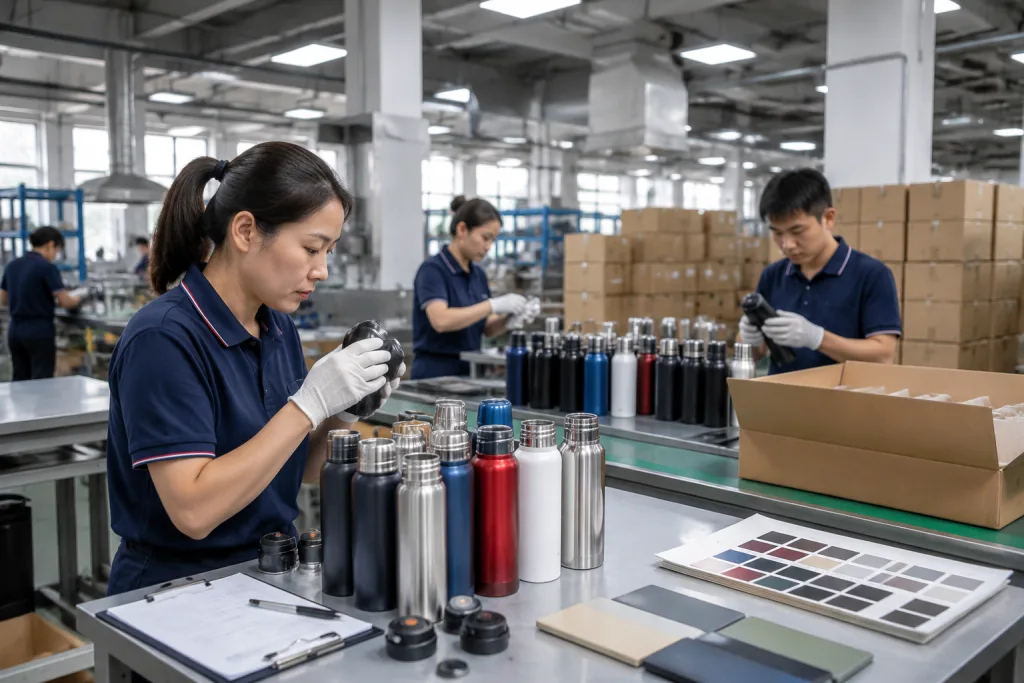
You are not buying a thermal bottle. You are buying a repeatable supply result: insulation that hits spec, decoration that matches the approved swatch, cartons that pass the drop test, and a landed cost your channel can carry. This search gets messy fast. Catalog photos all look close, but the real gaps show up in steel grade, vacuum yield, coating thickness in μm, lid leakage rate, and how the factory handles AQL when QC pulled the sample and found defects on the line.
For buyers in Europe and North America, the practical question is not whether a bottle can hold hot water. That part is easy. The real question is whether a canteen factory in Zhejiang, China can build your custom drinkware to the right spec at 3,000 units, then repeat it at 30,000 without color drift, carton failures, or a lid torque issue at 1.8 N·m. This is the wrong question to ask: “What is your best price?” We have seen projects go sideways over a 0.3 mm fit gap and a PO typo on logo position. Below is a head-to-head buyer guide built around actual factory numbers, use-case fit, and the trade-offs you need to see before you place a PO.
Start with the spec table
Buyers usually start with unit price. That is the wrong question to ask first. Put the build options side by side and make each factory quote the same spec sheet, down to steel grade, finish, lid resin, and packing. We see this on the line all the time: one canteen supplier prices 0.4mm steel, another drops the copper layer, a third swaps PP for a cheaper lid resin and the quote looks clean until QC pulled the sample.
| Build option | Typical spec | FOB China range | Best fit |
|---|---|---|---|
| Entry thermal bottle | 18/8 stainless, double wall vacuum, 500ml, silkscreen logo | USD 2.80-3.60 | Promotional retail, distributor drinkware programs |
| Mid-tier powder coat | 18/8 stainless, copper-coated vacuum, powder coat, laser logo | USD 3.60-4.90 | Corporate gifting, canteen promotional, outdoor shops |
| Premium 316 inner | 316 inner/304 outer, powder coat, leakproof handle lid | USD 4.60-6.80 | Hydration brands, sport and premium e-commerce |
| Custom growler | 64oz, vacuum body, wide mouth, carry handle | USD 6.20-9.50 | Brewery merch, customized growler lines |
Ask every canteen manufacturer to state wall thickness. No shortcuts. Common builds are 0.4mm outer and 0.4mm inner for value lines, then 0.5/0.5mm for a heavier premium feel. Pick up both samples and you will feel it in 3 seconds; dent resistance changes fast once the carton takes a hit at 1.2m drop height. If you are a canteen distributor, or you ship with canteen distributors into 4 or 5 countries, standardizing these specs matters more than arguing over USD 0.08. BottleForge Industrial in Zhejiang, China runs around 600,000 units per month across steel drinkware lines, and we see the same pattern: buyers who lock the table first get fewer claims, fewer surprise substitutions, and fewer emails about a lid that “looked the same” on the PO.
Material choices that change performance
Not all stainless bottles are equal, even if both are marked “food grade.” For most custom drinkware orders, 18/8 stainless steel, also called SUS304, is the standard build because the cost and supply are stable, and the corrosion performance is good enough for daily coffee or water. On our line, the inner tube wall is usually 0.4 mm or 0.5 mm in this setup. If the bottle will carry electrolyte drinks, citrus blends, or sit warm for hours in a car or warehouse, SUS316 on the inner wall cuts complaint risk. We have seen this go sideways with promo programs that chose 304 for sports-drink use just to save a few cents.
Here is the head-to-head view buyers actually need:
- 304 inner + 304 outer: lowest practical cost, widely available, best for volume programs and canteen customizable projects with tight budgets. This is the build we run most for MOQ 3,000 to 10,000 pcs.
- 316 inner + 304 outer: adds roughly USD 0.35-0.80 depending on size, better chemical resistance, stronger premium story for customized drinkware. QC pulled the sample more than once after salt-acid testing, and 316 inner held up better.
- Single wall steel: cheaper by USD 0.70-1.50 but not a thermal product. Fine for gym or event bottles, not for this category. This is the wrong question to ask if you are sourcing an insulated bottle.
Check the plastic contact parts too. Lids are commonly PP on value programs and Tritan on clearer, premium drink-through components, and buyers do flag odor on low-grade resin after hot-fill testing. Silicone gasket grade matters. We ship plenty of Europe orders that ask for REACH and LFGB, plus FDA style food-contact declarations for North America. Ask for a full material declaration pack covering steel, plastic, silicone, and coating. If your canteen vendor cannot send that file set by SKU family within 24 hours, that is a warning sign. Last month one buyer sent a PO with “silicon ring” typed instead of “silicone ring,” and we still matched the correct declaration because the file tree was already sorted.
Steel grade affects warranty rates more than marketing copy does. If your user puts sports drink in the bottle three times a week, 316 inner is not overkill.
Insulation claims versus real-world use
Insulation is one of the first specs factories oversell. The reason is simple: most buyers never lock the test method. “Keeps hot 12 hours” means nothing by itself. You need the fill temperature, room temperature, and the lowest acceptable drink temperature at the end of the test. If you are sourcing an oem manufacturer thermal bottle, get that method written on the quote and PO. We’ve seen this go sideways over one missing line.
A workable benchmark for a 500ml double-wall vacuum bottle looks like this: fill at 95 degrees C, ambient 20 degrees C, after 6 hours not less than 60 degrees C, after 12 hours not less than 45 degrees C. For cold retention, fill with 0-4 degrees C water and report after 6 and 12 hours. Copper coating on the vacuum wall can lift retention, but vacuum depth and seal integrity matter more. On our line, QC pulled the sample after lid torque check because a good vacuum bottle with a bad gasket still fails in actual use.
Use-case fit by channel
- Corporate gifting: 6-8 hour useful heat retention is often enough. Push harder on finish consistency and logo position control, like keeping print offset within 1.5mm. Buyers usually flag paint shade before they complain about hour 10 temperature drop.
- Outdoor retail: buyers expect stronger hold time plus dent resistance. Use 0.5mm walls and powder coat. This is the right place to spend cost; the math doesn’t work if the bottle passes insulation but comes back with shoulder dents after shelf handling.
- Amazon FBA: leakproof performance matters more than top-end lab insulation because reviews punish spills first. We ship plenty of units where the buyer asks for inversion test records before asking for a heat curve.
- Customized growler sales: wide-mouth thermal builds need extra attention on lid thread tolerance and gasket compression. A 0.2mm thread drift is enough to cause trouble, and this is where canteen suppliers get caught if they only test insulation.
Ask for leakage tests and vacuum yield rate. A capable canteen manufacturer should test 100% for vacuum and at least random-sample for inversion leakage after assembly. Serious export lines in Zhejiang usually run 24-hour vacuum hold checks by batch, and the better plants use a vacuum meter plus hot-water spot checks before packing. If the canteen suppliers you are reviewing cannot explain how they catch micro-leaks before carton sealing, assume your returns team will find them later.
Decoration methods in direct comparison
Brand teams usually pick decoration by looks. Purchasing should judge it by complaint rate, carton rub, and whether reorder #2 matches reorder #1. On custom canteen and customizable drinkware POs, this is the comparison that matters. We’ve seen this go sideways after a 1.2 m carton drop test, not on the approval photo.
- Silkscreen: lowest setup cost, clean spot colors, good for 1-2 color logos. Usually adds USD 0.05-0.12 per position. Best for high-volume canteen promotional runs. We run this fast on the line, but mesh count and jig fit decide whether the logo edge stays sharp.
- Laser engraving: durable, premium feel, no ink adhesion issues. Usually USD 0.08-0.20 depending on area and fixture complexity. Good method if the buyer flagged peeling ink on a previous project, though deep curves need a stable fixture or the mark drifts.
- Heat transfer: allows more colors and gradients. Good visual impact, but more vulnerable to scratching if over-varnish is weak. QC pulled the sample once because the varnish failed after 50 rubs with an abrasion block; the artwork looked good, the field result did not.
- Powder coat with logo: coating itself is not decoration, but it changes the whole product value perception and improves grip. This matters on hand feel. On 500 ml and 750 ml bottles, buyers often react to grip before they ask about print.
For Europe and North America, powder coating in the 60-80 micron range is a sensible standard for thermal bottles. Below that, the math doesn’t work. You save a little on coating, then metal edges show after impact and the claim cost comes back later. If your project is canteen customized for outdoor or school use, ask for cross-hatch adhesion and abrasion test reports. We check film build with a coating thickness gauge, not by eye. Color matching should reference Pantone and define tolerance. Approve a golden sample with the exact gloss level, because matte black from one canteen vendor is not the same matte black from another.
For customizable growler projects and large-format custom growler orders, bigger body curves can distort print registration. This is the wrong question to ask: not “can you print it,” but “what is the safe zone in mm around the curve.” Ask for a production mockup and lock the artwork safe zones before mass production. We ship cleaner results when the file already allows for body shape. A disciplined canteen factory will send a decorated pre-production sample before mass run, usually in 7-10 days. Last month a buyer PO even had the logo width typed wrong by 3 mm, and the pre-pro sample caught it before the line started.
MOQ, tooling, and lead time reality
Most B2B buyers ask about MOQ after they lock the shape, lid, and gift box. That is too late. We see this on the line all the time: the buyer signs off a 500ml body with a flip lid and retail box, then finds out the set does not run cleanly at 1,000 units. For an oem manufacturer thermal bottle program, the real minimum comes down to three shop-floor facts: whether the mold already exists, how many body colors you want through the spray line, and whether packaging is stock or custom.
Typical ranges from a canteen manufacturer in Zhejiang look like this:
- Existing bottle + standard lid + 1 logo + white box: MOQ 3,000 pcs per size/color.
- Existing bottle + custom color + custom printed box: MOQ 3,000-5,000 pcs.
- New lid mold or unique base cup: MOQ 5,000-10,000 pcs plus tooling.
- Customizable canteen with retail window box and inserts: expect higher packaging MOQs even if bottle MOQ stays at 3,000.
Tooling for a new plastic lid can range from USD 3,000 to 8,000. A new steel body shape is much more, and this is where buyers often ask the wrong question. The issue is not only mold cost; it is also fit risk, sealing tests, and rework if the first T1 sample fails at the hinge or thread. Lead time for sampling is typically 7-12 days for existing molds, 20-35 days if new mold work is needed. If we cut a new lid tool, QC pulled the sample first for drop and leak checks before we release color chips. Mass production after sample approval usually takes 35-45 days, and can stretch to 50-60 days before peak shipping season.
If you are a canteen distributor managing mixed-market demand, combine colors and packaging where possible. The math does not work on four colors at 750 pcs each if the factory has to wash the coating line between every batch. Two colors at 1,500 pcs each usually run faster and cost less than four colors at 750 pcs each. We have seen buyers flag this only after carton artwork is approved, sometimes because one PO typo split matte black and black into two SKUs. Experienced canteen vendors will tell you this before deposit. Less experienced canteen suppliers take the order first, then start renegotiating when production planning says the batch is too scattered to run cleanly.
Compliance and QC buyers should insist on
If you sell into Europe or North America, skip the factory that talks smoothly about quality. Ask for records. We run into this every month. At minimum, ask your canteen supplier for a written QC plan that covers incoming material, in-process checks on the line, final inspection, and shipment release. The standard baseline for final random inspection is AQL 2.5 for major defects and 4.0 for minor defects. For premium retail, some buyers tighten that to 1.5/2.5. If a supplier cannot show the check sheet, the math doesn't work.
Your checklist should include:
- Material compliance: REACH, LFGB where needed, and food-contact declarations. Ask to match the declaration to the actual 304 stainless and lid resin on your PO, not a generic file from last year.
- Factory systems: ISO 9001 is useful; BSCI or similar social compliance matters if your customers ask. We have seen buyers flag an expired audit during order approval, even though production was already booked.
- Product testing: leakage, insulation retention, coating adhesion, dishwasher statement if claimed, drop test, and barcode scan verification for FNSKU if using Amazon FBA. QC pulled the sample, ran a 1.2m drop test, then found the FNSKU print shifted 3mm off the label box.
- Packaging checks: carton burst strength, carton weight limit, drop test for master cartons. This part gets skipped too often.
For distributor canteen and distributor growler programs, packaging failure is a hidden margin killer. A bottle may pass product inspection and still land dented because the divider board is too light or the master carton is over 16-18kg. We have seen this go sideways. One buyer pushed for a larger pack count to save freight, then the top layer crushed in transit. Ask the canteen factory to confirm carton dimensions, gross weight, and pallet pattern before mass production. Get it before the first carton die-line is locked. We also recommend pre-shipment photo records by pallet.
Good China factories do not fear third-party inspection. They expect it. SGS, TUV, Intertek, your own team, all fine. If your canteen manufacturers resist outside inspection or will not hold cargo for a 48-hour review window, treat that as commercial risk, not just an operational inconvenience. This is the wrong question to soften. Last-minute rework on 2,400 pcs costs less than a rejected container at destination.
Which bottle fits which business model
The right thermal bottle has less to do with trend and more to do with your sales channel. We see buyers over-spec promo orders and cut too much on outdoor or e-commerce SKUs. This is the wrong question to ask: “What bottle is popular?” Better ask what complaint rate you can afford, what shelf price you need, and what spec fits that math. On our line, QC pulled a sample last month with a lid gap over 0.3mm; that kind of miss is minor in bulk gifting and a problem online.
For a canteen distributor serving promotional clients: stay with an existing 500-600ml bottle in 304 steel, powder coat optional, silkscreen logo, MOQ 3,000. Keep FOB near USD 3.00-3.80. Repeat orders matter more than a new mold. We usually steer these buyers to shared lids and stock colors because the line runs faster, and a 3,000-piece reorder ships cleaner than a custom body that saves nobody money.
For a brand owner building custom drinkware for retail: step up to powder coat, laser logo or transfer print, 0.5mm walls if hand feel matters, and push the lid test hard. Do drop test, torque test, and overnight leak test at full fill, not just a bench check. Spending USD 0.40 more at factory can save far more in returns. We’ve seen this go sideways when the buyer flagged a loose carry loop after first production and the carton was already marked for Amazon.
For customized canteen school or youth programs: put leakproof lids first, then easy carry handles, then compliance paperwork. If it moves into kids' categories, ASTM and age-grade issues matter more. We also watch small parts and strap pull strength; a handle pin that shifts 1mm is enough to fail inspection on a school order. Parents complain fast. Schools complain faster.
For customizable growler or custom growler programs: watch thread quality, handle strength, and carton protection with more discipline than usual. Large-format bottles cost more to ship and cost more again when one dent turns into a claim. The penalty for weak packaging is bigger. We run thread gauges on these bodies because a rough neck finish will chew up caps, and a 64oz unit with a crushed corner pad is asking for trouble in long-haul freight.
For distributor growler or distributor drinkware importers: keep the line simple. Fewer shared components and fewer cap types make replenishment easier and cut dead stock risk. Too many finish systems look good on a catalog page and then sit in stock for 8 months. We’ve had POs come in with one cap code typed wrong, and suddenly 2,000 lids don’t match the body. The math doesn't work if your warehouse is sorting avoidable variants.
The best canteen manufacturers in Zhejiang, China are not the factories that say yes to every shape at every MOQ. They are the ones that tell you where the design will fail, where the coating will scratch, and when your target price does not match the spec. We ship plenty of standard bottles, but the useful factory conversation starts earlier, often with one blunt note from engineering after the first CAD review or a coating cross-hatch test on the sample room table. That is the conversation you want before sending a deposit.
Get a thermal bottle spec review before you buy
Send your target price, capacity, market, and artwork method. We will tell you the practical build, MOQ, and lead time that actually fits.
Frequently asked questions
What MOQ should I expect for an OEM thermal bottle order?
For an existing mold bottle with one logo and standard packaging, a realistic MOQ is 3,000 pcs per size and color. If you add a custom printed gift box, special lid color, or mixed accessories, many factories push that to 3,000-5,000 pcs. A new lid mold usually needs 5,000-10,000 pcs plus tooling, often USD 3,000-8,000. Be careful with “low MOQ” offers from China. Some suppliers will accept 1,000 pcs, then substitute stock colors, limit decoration options, or delay production behind larger orders. If you are testing a market, ask whether the factory can support a stock-sample run first, then move to full custom on the second PO.
Is 304 stainless enough, or should I pay more for 316?
For plain water, tea, and coffee, 304 stainless is usually enough and remains the standard for mainstream custom drinkware. If your end users regularly fill the bottle with sports drinks, citrus water, or acidic mixes, 316 inner wall is a safer choice. In most projects, 316 inner adds around USD 0.35-0.80 per unit depending on capacity and wall thickness. That extra cost is easier to justify for retail, premium gifting, and outdoor channels than for price-driven promotional orders. If you sell in Europe or North America, ask the factory to specify inner and outer steel grades separately on the PI and on material declarations.
How long does production usually take from sample approval?
For an existing bottle and lid set, most export factories in Zhejiang, China need 35-45 days from approved pre-production sample and deposit to finished goods. Sample lead time is usually 7-12 days if you are only changing color, logo, or packaging. If you need new tooling, add 20-35 days before the pre-production sample stage. Peak season can stretch production to 50-60 days, especially before August shipping windows and year-end gifting demand. If your order includes custom cartons, inserts, or FNSKU labeling, confirm whether packaging lead time runs in parallel or becomes the bottleneck. The best factories lock a critical path schedule before deposit.
What quality standard should I put in my purchase order?
A sensible baseline is AQL 2.5 for major defects and 4.0 for minor defects, with zero tolerance for safety defects such as sharp edges, exposed burrs, or severe leakage. Your PO should also define functional tests: 100% vacuum check, random leakage test after assembly, logo position tolerance, coating adhesion standard, carton drop test, and approved color reference. If the bottle is sold through e-commerce, add barcode readability and retail-pack inspection. For larger programs, require a sealed golden sample and say that mass production must match it. Good canteen suppliers in China will accept this because it reduces arguments later.
What is the biggest mistake new B2B buyers make with thermal bottles?
They buy from photos and price instead of from a written specification. Two bottles can look identical online while using different steel grades, coating thicknesses, gasket materials, and carton structures. That can shift the real cost by only USD 0.20-0.60 at FOB level but create a much bigger gap in returns and reorder consistency. Another common mistake is splitting a small order into too many colors or gift box variants, which raises scrap risk and slows production. If you are new to custom drinkware sourcing from China, standardize one bottle, one lid family, one coating, and one carton format first. Complexity can wait until the second order.