Key Takeaways
- A practical OEM tea bottle program usually starts at 1,000-3,000 pcs per color, with 25-35 day lead time after sample approval
- 304 stainless is standard, but 316 on the inner wall can add USD 0.35-0.80 per unit and matters mostly for tea, coffee, and high-acid use
- A removable 0.25-0.35 mm stainless tea filter cuts complaint rates versus plastic baskets, but adds assembly time and 3-5% cost
- For Europe and North America, ask for REACH, LFGB or FDA-contact declarations, AQL 2.5 inspection, and carton drop test records before deposit
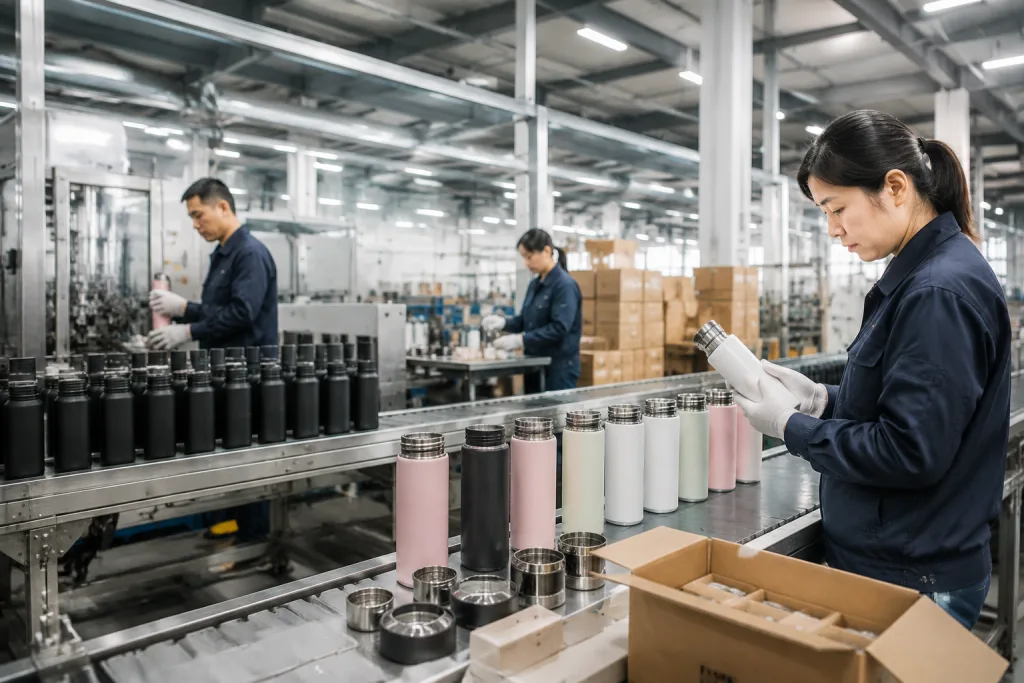
You can buy a tea bottle from almost any canteen manufacturer in China. That part is easy. The hard part is matching the bottle to your sales channel, margin target, and compliance list without paying for features your customer will never notice. We see this on the line every week: a 500ml tea bottle with a fine-hole filter works for a museum gift shop, then fails for Amazon FBA after the drop test and carton limit review. A corporate canteen promo order is a different job, usually starting at 1,000 pcs MOQ with logo cost and unit packing driving the quote.
From Zhejiang, we watch buyers lose 2 to 3 weeks on the same problems: the wrong filter mesh, powder coat that scratches after cross-hatch tape test, FOB pricing that ignores packaging, and MOQs that look low until laser logo, color box, and spare gasket are added. Last month QC pulled the sample and found a lid gap of 0.8mm, while the PO also had a typo on the logo position. If you are comparing an oem manufacturer tea bottle program against a broader custom drinkware or custom canteen range, this is the wrong question to ask if you only start with catalog photos. You need hard specs, cost breakpoints, and a factory answer that holds up after sampling and mass production.
What buyers really compare
When you source an oem manufacturer tea bottle, shape and capacity are the easy part. Buyers on the same 500 ml bottle usually compare 6 cost drivers: material grade, lid structure, filter mesh, decoration yield, carton loading, and defect risk. A clean-looking 500 ml bottle can sit at USD 2.85 FOB Ningbo or USD 5.90 FOB depending on those choices. We see that gap every week in Zhejiang, especially when one factory quotes an existing mold and another adds semi-custom tooling. On the line, a lid with one extra silicone ring and a 0.3 mm tighter thread spec already changes scrap and assembly time. This is the wrong question to ask: “Why is this bottle cheaper?” Ask what got removed.
For most B2B buyers, the shortlist comes down to four formats:
- Single-wall tea bottle: lowest cost, lighter freight, good for spring/summer campaigns. We ship these fast because the structure is simple and carton weight stays easier to control.
- Vacuum insulated tea bottle: mainstream retail choice, better margin, fewer temperature complaints. The line needs stricter weld checks, but returns usually drop.
- Glass tea bottle with sleeve: premium look, fragile logistics, smaller reorder sizes. QC pulled the sample more than once for sleeve fit drifting by 1-2 mm after assembly.
- Wide-mouth hybrid bottle: works as a custom canteen or sports SKU, easier cleaning, broader channel fit. Buyers like the 55 mm mouth because brush access is simple and the complaint rate on trapped tea leaf odor is lower.
If you also sell as a canteen distributor or manage mixed private-label lines, this choice affects sell-through. A tea bottle with a narrow tea chamber looks specialized, but it often hurts reorder speed if the end market wants one SKU for tea, water, fruit infusion, and office gifting. We have seen buyers flag this after launch: the lid looked smart, but users said cleaning took too long. A lot of canteen suppliers keep pushing niche lids because they already paid for the tooling, sometimes with an MOQ of 3,000 pcs per color. That does not mean you should buy it. We’ve seen this go sideways.
The cheapest bottle is often the one with the highest after-sales cost. If the infuser clogs, leaks, or traps odor, your landed cost model is already wrong.
At BottleForge Industrial in Hangzhou, Zhejiang, our practical baseline for a new OEM program is 1,500 pcs per color for an existing mold, 7-10 days for pre-production samples, and 30 days mass production in normal season. Factory output is about 600,000 units/month across vacuum bottles, tumblers, and related custom drinkware. We run sample checks with a torque tester on the lid station, and the buyer pushback we hear most is still lead time, not price. Fair point. But the math doesn't work if a rushed pilot order saves 4 days and creates a leak claim on arrival.
Head-to-head spec table
Below is the comparison buyers ask for before sample booking. We built it around end use, not catalog wording. On our line, QC usually puts all 5 formats side by side and checks actual fill, net weight, and lid fit before we quote.
Tea bottle format comparison
- Single-wall stainless, 500 ml: 18/8 SS body, 0.4 mm wall, strainer under lid. FOB China typically USD 2.10-2.90 at 3,000 pcs. Weight 240-300 g. Best for canteen promotional projects, event giveaways, and price-sensitive programs where landed cost gets watched line by line. Weak point: no insulation, and the body will sweat with cold fill. We’ve had buyers flag this after a 4°C water test because the outer wall got slippery in 12 minutes.
- Double-wall vacuum stainless, 500 ml: inner 304 or 316, outer 304, 0.35/0.45 mm typical gauge. FOB USD 3.60-5.20 at 2,000 pcs. Keeps 55-65°C for 6 hours if correctly vacuumed. Best for retail, corporate gifting, and distributor drinkware channels where shelf feel matters. Weak point: more components and more leak risk if the lid stack is not designed well. QC pulled one sample last month with a silicone ring seated 0.8 mm off, and that was enough to fail the tilt test.
- Double-wall with full-length infuser: same body as above, longer filter basket. FOB USD 4.10-5.80. Good for loose tea users who want better leaf expansion. Weak point: slower filling, more residual tea leaves, harder cleaning. This is where complaints start if the basket hole size is wrong; 0.5 mm perforation works for some blends, but fine-cut tea still clogs.
- Borosilicate glass tea bottle, 450 ml: glass inner or double-glass, steel cap, silicone sleeve optional. FOB USD 3.20-4.90 at 1,000 pcs. Premium appearance. Weak point: breakage risk; carton design and drop test become critical. We usually push a divider carton here because the math doesn’t work if 3 out of 100 units crack in transit.
- Wide-mouth bottle with basket insert: often sold as customizable canteen or sports bottle. FOB USD 3.70-5.40. Best crossover SKU for hydration plus tea, especially for buyers who want one mold to cover office use and outdoor use. Weak point: less refined tea drinking experience, but broader sell-through. A common factory-floor note: if the mouth is over 55 mm, the insert needs tighter tolerance or it will rattle in shipment.
If you are a canteen vendor selling to multiple accounts, the wide-mouth route often wins because one bottle can be pitched as a tea bottle, fruit infuser, office flask, or canteen custom item. That flexibility saves SKU count. If you run a specialty tea brand, a dedicated tea bottle can support a higher shelf price only when the filter design is better in a visible way. This is the wrong question to ask: “Can you make it look premium?” Ask for cross-sections, not only renders. We’ve seen this go sideways when the PO looked fine, but the mesh length was 15 mm shorter than the approved sample.
Use-case fit by sales channel
The right bottle depends less on your team’s taste and more on where it will be sold. Buyers mix up shelf appeal with channel fit all the time. We’ve seen this go sideways: a good-looking sample gets approved, then the shipping math fails at launch.
Retail and e-commerce: A 450-550 ml vacuum tea bottle is the safe middle for most online programs. For Amazon FBA or DTC, keep packed weight under 0.75 kg and stay away from fragile external tea chambers; QC pulled too many cracked chamber samples after a 76 cm drop test. Use a powder-coated body, laser logo, and a simple 3-part lid because the return rate usually starts at the lid. If you want a customized drinkware line with multiple shapes, choose a shared lid diameter such as 58 mm or 65 mm so the line can run one cap set and your spare-part SKUs do not sprawl.
Promotional and corporate orders: A single-wall 400-500 ml bottle is often the smarter buy. You save USD 1.00-2.00 per unit, carton density improves, and decoration options open up. This is the wrong question to ask if the buyer starts with heat retention, because most corporate programs care first about logo size and delivery date. Terms like customized canteen and canteen customizable matter here because the logo has to read clean from 1.5 meters at an event table. Silkscreen on a flat panel or wrapped heat-transfer usually gives the best cost-to-impact ratio, and we often set the art window around 45 x 80 mm to avoid distortion on curved bodies.
Distributor business: If you are a canteen distributor, distributor canteen wholesaler, or one of many canteen distributors serving catalog customers, avoid over-specialized lids. Standard thread systems reorder faster and cut inventory headaches; we ship replacement lids from stock more easily when the neck finish stays common. The same goes for a distributor growler or customizable growler line: too many unique closure systems make replenishment messy. One buyer flagged this after putting 6 lid types on one PO, and the typo was not the problem—the after-sales parts list was.
Tea and wellness brands: Here the infuser matters. Full-length baskets work for blooming tea and fruit slices, while short top-baskets suit leaf tea for office use. Mesh size matters too; 0.35 mm perforation holds fine leaf better than the wider patterns some factories push. If the bottle may expand into a custom growler or broader customizable drinkware collection, keep finish colors and branding methods consistent across the family. Buyers notice when the black powder coat on the bottle is matte and the growler comes out semi-gloss.
For North America, practical packaging details matter more than first-time importers expect. FNSKU label position, barcode scan readability after shrink-wrap, and carton dimensions that stay under common parcel surcharges all need to be checked before mass production, not after the first 500 units are packed. We usually test scan distance on the line with the wrapped sample in hand. In Europe, multilingual care instructions and REACH declarations are a routine ask, not a premium service, and the buyer will often ask for the insert layout before the bottle sample is approved.
Materials, lids, and filter design
Most tea bottle complaints come from the same places: steel grade, lid seal stack, and filter geometry. Buyers still spend hours on Pantone and miss the parts that drive returns. On our line, QC pulled 6 leaking samples out of a 200-piece pre-ship check because the gasket groove was 0.3 mm shallow.
Steel: 18/8 stainless, usually called SUS304, is the standard for mainstream programs. For higher-end tea or coffee use, some buyers ask for SUS316 on the inner wall for better corrosion resistance. The real cost add is usually USD 0.35-0.80 per unit, not the premium some sales teams try to sell. If your end users drink citrus water or strong herbal blends, 316 makes sense. For office water-and-tea use, 304 is enough. We have seen buyers ask for 316 on the full bottle, then cut gift box budget by USD 0.20; the math doesn't work.
Lids: A dependable OEM lid usually uses a PP or Tritan structure, one food-contact silicone gasket, and no decorative cap that backs off during transit. That last part matters. We shipped one order where the buyer flagged loose cap ornaments after a 1.2 m drop test. Flip tops look good on shelf, but leak claims go up fast. For B2B resale, a screw lid with a carry loop is the safer choice. If you want a more premium look, a steel cap shell over a PP core works well and keeps the sealing surface stable.
Filters: This is where good factories and weak ones split. A proper stainless filter should be around 0.25-0.35 mm, with clean rolled edges and hole size matched to the tea type. Fine mesh sounds nice in a meeting room, but it traps flavor, stains fast, and is a pain to clean. Large punched holes let leaves escape. We usually recommend a removable basket with medium perforation instead of a permanent welded screen. It cuts complaint rates and makes QC simpler. We run a burr check by hand on first-off samples because one sharp edge on the rim is enough to kill a program.
- Short basket: lower cost, faster assembly, good for office brewing. Less steeping depth, but for light tea this is usually fine.
- Full-length basket: better extraction and a stronger tea story, with more parts to inspect. On one PO, the buyer typed the basket length wrong by 10 mm, and the carton insert no longer fit.
- Bottom chamber style: looks interesting, but leak risk is higher and filling is less convenient. We have seen this go sideways after repeated twisting on the lower seal.
If your wider line includes a customized growler, custom canteen, or other canteen customized programs, ask the factory whether they share silicone, thread sizes, or cap subcomponents across SKUs. This is the right question. Shared parts usually help MOQ flexibility and spare-part support, and they also cut dead stock when one lid color stops moving.
MOQ, tooling, and true pricing
Most buyers ask for FOB price. The better question is what sits outside that number. We’ve seen a quote look fine, then jump after logo setup, gift box, drop-test carton, and compliance paperwork were added. Last month a buyer’s PO even missed “silkscreen” and wrote “silkprint,” and the line stopped until artwork was reconfirmed.
For an existing mold from a serious canteen factory in China, typical MOQs look like this:
- Stock color, no logo: 500-1,000 pcs
- Custom color with one logo method: 1,000-3,000 pcs per color
- Custom gift box: often adds 1,000 pcs MOQ and 7-10 days
- New lid tooling: USD 3,000-8,000 depending on complexity
- New body mold: USD 6,000-15,000 for common steel formats
Those MOQ bands come from line setup reality, not supplier mood. A custom color means we run paint matching, spray a sample plate, and clean the line before the next job. A gift box sounds small, but if the insert size is off by 2 mm, QC pulled the sample and the whole pack-out plan had to be redone.
Reasonable FOB Ningbo or Shanghai pricing for a 500 ml insulated tea bottle from Zhejiang is usually USD 3.60-5.20 at 2,000 pcs with powder coat and one-color silkscreen. Add about USD 0.12-0.35 for laser engraving, USD 0.25-0.60 for premium box upgrades, and more if your Pantone color needs extra sampling. If a quote is far below that, ask what was cut. This is the wrong question to skip. Usually it is steel thickness, copper coating, filter mesh grade, 5-ply carton instead of stronger spec, or inspection standard. We’ve had buyers flag dented units later, then found the supplier had packed in lighter cartons at 12 kg load.
Lead time also needs plain language. Typical production is 25-35 days after deposit and sample sign-off. In peak season from August to November in China, 35-45 days is more realistic. If a factory offers 15 days for a fully custom order, the math doesn’t work. That time usually gets “saved” by rushing coating cure, booking a later vessel, or skipping buffer time after leak testing on the vacuum line.
This applies whether you buy a tea bottle, a customizable growler, or a broader canteen manufacturer program. Some canteen manufacturers quote low on the hero SKU, then add margin back on packaging revision, spare lids, carton upgrade, or replacement straws. We’ve seen this go sideways after the first PI revision, especially when the buyer asked for one free spare lid per 24 pcs and the supplier priced it in later.
Compliance and quality checkpoints
Europe and North America ask for different files, but both buyers expect a supplier who answers straight. If the factory cannot explain coating compliance, gasket material, or the last leak-test result without checking three people, move on.
For food-contact drinkware, ask for these before mass production:
- Material declarations: FDA or LFGB contact compliance depending on market, matched to the exact inner liner, lid, gasket, and tea filter material on your PO.
- REACH: needed for coatings and printed parts sold into Europe; we have seen buyers flag black powder coating after a third-party lab asked for the pigment detail.
- BSCI or social audit: if your customer requires ethical sourcing checks, confirm the audit holder name matches the factory that will run the line.
- ISO-based process control: 6 out of 10 serious drinkware factories we deal with run under ISO 9001 systems, even when buyers never request the certificate.
- ASTM or CPSIA relevance: check this early if the item moves into kids' drinkware programs, especially small caps, straws, and silicone bite valves.
On product quality, insist on an AQL plan. AQL 2.5 for major defects and 4.0 for minor defects is a common practical starting point for drinkware. Your inspection checklist should cover vacuum retention, inverted leak test for 30 minutes, coating adhesion with 3M tape, logo position tolerance within 1.5 mm, odor check after hot water fill, and carton drop test. For tea bottles, add filter fit and thread smoothness. QC pulled the sample for this twice last quarter; one 304 stainless filter sat 0.8 mm too high and the cap would not close cleanly.
Good factories in Zhejiang and wider China should also provide basic records: welding inspection, vacuum test sampling, and incoming QC for lids and gaskets. If you are buying as a canteen supplier, canteen vendors group, or mixed distributor drinkware portfolio owner, standardizing these checkpoints across SKUs saves real money. We run the same lid torque check on 350 ml, 500 ml, and 750 ml bottles because one loose gasket can turn into 2,000 rejected cartons.
A small but useful detail: ask for a golden sample signed against finish, logo size, and packaging. Without that, you are arguing over photos. We've seen this go sideways after a PO typo changed "matte white" to "milk white" and nobody caught it until pre-shipment inspection. For repeat business, it also helps if your canteen vendor keeps retained samples for each PO for at least 12 months.
How to shortlist the right factory
Do not open twenty supplier chats. Start with five and cut fast. The best canteen suppliers are usually not the ones sending a 200-page catalog. They are the ones who can answer lid thread size, 304 stainless wall thickness, filter mesh spec, and powder coat tolerance without asking the sales manager to "check with engineer" for 3 days.
Use a simple scorecard:
- Core product fit: Do they run tea bottles every month, or is it a side SKU they quote from an old mold list?
- MOQ flexibility: Can they support 1,000-1,500 pcs trials with normal line planning, not hand-packed chaos at 10 p.m.?
- Engineering clarity: Can they provide wall thickness in mm, steel grade, filter drawing, and lid structure before you pay sample cost?
- Quality routine: Can they explain AQL and leak testing without prompting, including vacuum test time and how many pcs QC pulls per carton batch?
- Export readiness: Do they understand pallet labels, FNSKU placement, destination compliance, and the carton mark typo that can hold a container at the buyer's warehouse?
If you need a line that expands from tea bottles into customized drinkware, customizable canteen, or distributor growler formats, choose a factory with shared finishing equipment and tight packing control. One powder coating line, one logo jig setup, one final inspection table. That matters. We have seen this go sideways when the bottle body is sprayed in one workshop, the lid is printed by another vendor, and QC only sees the mismatch after 36 cartons are sealed.
At the sampling stage, ask for two things: one standard sample from existing stock and one pre-production sample in your target finish. Stock samples show mold quality. Pre-production samples show whether the factory can run your real order, including color, logo position, insert card, and barcode label. If you only check stock samples, you are not vetting the OEM process; QC pulled the sample from a finished shelf, not from your line setup.
The right partner in China is not always the lowest FOB offer. This is the wrong question to ask if the price gap is USD 0.08 but the supplier cannot hold repeatability. You need the same lid torque, the same powder coat shade within the approved swatch, carton strength that survives a 22 kg drop test stack, and a lead time window closer to 35 days than 52 days. That is what lets you sell with confidence, whether you are a retailer, importer, or one of the 40-plus canteen distributors managing repeat customer accounts.
Send your target spec and get a realistic quote
Share capacity, material, logo method, packaging, and target market. We will suggest the right tea bottle format, MOQ, and lead time from Zhejiang production.
Frequently asked questions
What MOQ should I expect for an OEM tea bottle order?
For an existing mold, a realistic MOQ is 1,000-3,000 pcs per color depending on finish, logo method, and packaging. Some China factories quote 500 pcs, but that usually means stock color, plain box, and limited customization. If you need Pantone powder coat, laser logo, and a custom gift box, the workable MOQ often moves to 1,500-2,000 pcs. New tooling changes the picture: a custom lid may need USD 3,000-8,000 tooling plus trial shots. In Zhejiang, a practical first order for B2B buyers is often 1,500 pcs across one or two colors so you can test sell-through without forcing the factory into unstable production economics.
Is 304 stainless enough, or should I pay for 316 inner wall?
For most tea bottle programs, 304 stainless is enough. It is the mainstream spec for vacuum drinkware and gives good durability when passivation and welding are done properly. Move to 316 inner wall if your brand positions as premium, if the bottle will see acidic drinks regularly, or if your customer specifically asks for stronger corrosion resistance. The extra cost is usually around USD 0.35-0.80 per unit on a 450-550 ml bottle, not a huge jump but not free either. If your channel is promotional or value retail, that money is often better spent on a better lid seal, cleaner powder coat, or stronger packaging.
What lead time is normal for custom tea bottles from China?
Normal timing is 7-10 days for customized pre-production samples, then 25-35 days for bulk production after sample approval and deposit. In peak season, especially from late summer into Q4, 35-45 days is more realistic. If your order includes a new box, new mold, or multiple logo methods, add another 5-10 days. For repeat orders on stable specs, some factories in Zhejiang can ship in 20-25 days, but only if components are already planned. Always ask whether the lead time includes packaging printing, inspection booking, and export booking. A short quoted lead time that excludes those steps is not a true delivery promise.
Which tests and documents should I ask from a tea bottle supplier?
At minimum, ask for food-contact compliance declarations relevant to your market, such as FDA-contact materials for the US or LFGB-style support for Europe, plus REACH information for coatings and silicones sold into the EU. On quality, require leak testing, vacuum retention checks for insulated bottles, coating adhesion, odor test after hot water fill, and carton drop testing. For production control, an AQL inspection standard such as 2.5 major and 4.0 minor is a practical benchmark. If you sell to larger retailers, social audit status like BSCI may also matter. Good suppliers in China should be able to provide these without treating basic compliance as an expensive add-on.
How do I choose between a dedicated tea bottle and a wider custom canteen style?
Choose a dedicated tea bottle if your brand story depends on tea brewing and you can explain the filter benefit clearly at shelf or online. That format suits specialty tea brands, gift programs, and premium office use. Choose a wider custom canteen or sports-style bottle if you need one SKU to serve water, fruit infusion, tea, and everyday carry. The crossover bottle usually sells better through distributor channels because it has broader appeal and fewer user complaints about cleaning. In cost terms, the wide-mouth format can be similar in FOB price, but it often gives stronger reorder potential because buyers see it as a general hydration product, not a narrow-use accessory.