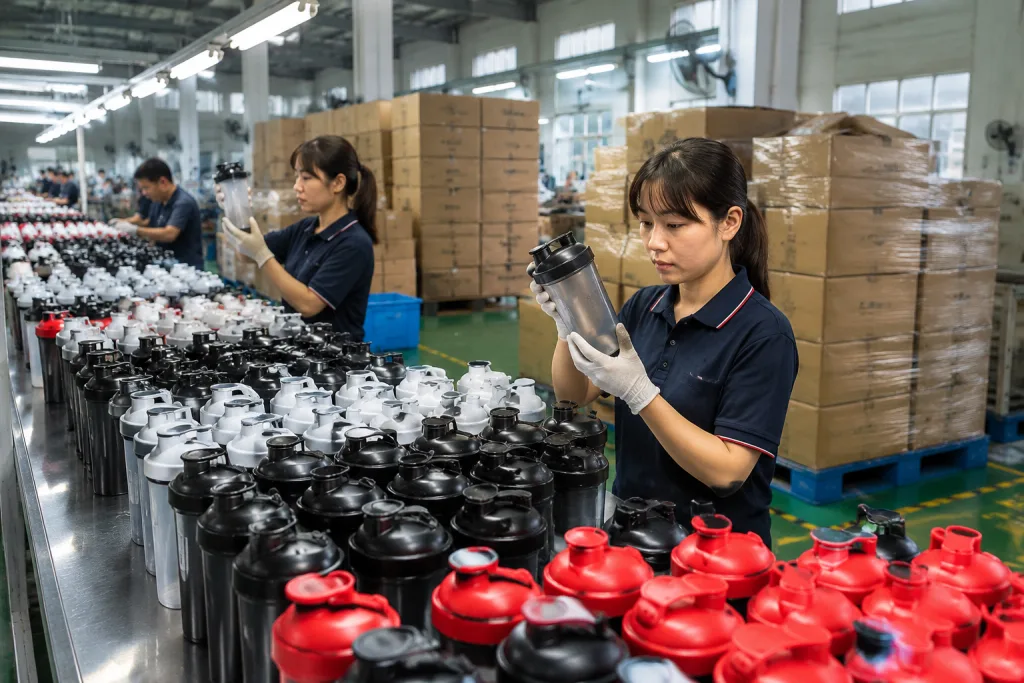
Key Takeaways
- Entry PP shaker bottles usually start around 3,000 pcs/SKU at USD 1.25-1.95 FOB Zhejiang, China
- The practical sweet spot for gym chains is 600-700 ml with 0.8-1.2 mm PP wall thickness and leak rate under 0.3%
- Silkscreen works for 1-2 color logos; dishwasher-resistant laser or in-mold branding costs 12-35% more
- A realistic lead time is 7-12 days for pre-production samples and 25-40 days for mass production after approval
You are not buying a bottle. You are buying return rate, repeat orders, carton efficiency, and a logo that gets carried into the gym 5 times a week. That is why sourcing an oem manufacturer shaker bottle is harder than picking a standard item from a catalog. The renderings look the same. The samples do not. We see lid leaks at 45° tilt tests, odor retention after protein use, weak wire mixer balls, and print drop-off in the tape test after the PO is placed and the launch date is already on the artwork file.
For fitness brands and gym chains in Europe and North America, the right answer depends on sales channel and actual use. A bulk shaker bottle for club onboarding needs a different spec from a premium retail launch. At BottleForge Industrial in Zhejiang, China, we see buyers pay for features they will never sell, then miss the details that drive returns. This is the wrong question to ask if the discussion stays on style only. The useful comparison is material grade, wall thickness in mm, cap thread design, mixing method, print process, carton yield, test standard, and real MOQ. Last month the buyer flagged a 10,000 pcs quote that looked cheap, but the math didn't work once the carton count dropped.
Where shaker bottle buyers get burned
Most sourcing failures start with the wrong comparison: piece price instead of landed performance. A custom shaker bottle quoted at USD 1.38 FOB can cost more than a USD 1.62 option if the cheaper unit uses a softer lid hinge, a lighter seal ring, or a 0.2 mm thinner wall that distorts after hot wash cycles. We have seen QC pull samples that looked fine at packing and came back warped after 20 dishwasher runs. For gym chains, that turns into front-desk complaints. For retail brands, it turns into reviews about resin smell, leaks in a bag, or powder clumps stuck under the shoulder.
The next burn point is channel mix-up. If you need a bulk fitness water bottle for a 50-location chain, pallet density, repeat POs in 12 days instead of 18 days, and a clean one-color logo matter more than fancy packaging. If you need a custom logo shaker bottle for e-commerce, shelf image, color match, and low visible defect rate matter more. We run both types on the line, and the spec sheet should not look the same. A distributor may want one bottle platform with interchangeable lids across a bulk sports water bottle range. A brand launching premium protein accessories may want Tritan, stainless steel trim, and custom mold ownership. Same category, different math.
In Zhejiang, China, factories often quote the same bottle in five price bands by changing parts buyers do not see in photos: gasket hardness, mixer wire gauge, cap pin diameter, print ink, and carton drop protection. This is the wrong question to ask: “Why is your price higher?” Ask what changed. We have had buyers flag leakage, and the root cause was a 1 mm smaller cap pin, not the body. A serious supplier should state AQL level, leak test method, material declaration, and decoration durability straight. If the sales rep avoids that or the PO even has a lid spec typo, treat the quote as incomplete.
You do not need the cheapest shaker bottle. You need the lowest complaint cost per 10,000 units sold.
Head-to-head spec table that actually matters
Below is the comparison format we use to vet an oem manufacturer shaker bottle for fitness brands, gym chains, and distributors. We built it around actual use on the line and after shipment, not brochure copy. One fast factory check: if the sample wall spec is missing by 0.1 mm, QC pulled the sample before quote review.
Buyer comparison grid
- Economy PP shaker, 600 ml: PP body + PE/PP lid, wire whisk or plastic grid; wall 0.8-0.9 mm; MOQ 3,000 pcs/color; FOB USD 1.25-1.55; lead time 25-30 days. This fits bulk gym water bottle promos, membership kits, and club rollouts where the buyer usually says, "I need the price under control." We’ve seen this go sideways when the lid snap is too soft after drop test.
- Standard PP shaker, 700 ml: PP body with thicker hinge and TPR seal; wall 1.0-1.2 mm; MOQ 2,000-3,000 pcs; FOB USD 1.55-2.10; lead time 28-35 days. Best all-round pick for a custom gym water bottle program that expects repeat POs. We run this size often because the 1.0-1.2 mm wall gives fewer leak complaints than 0.8-0.9 mm on shaker use.
- Tritan shaker, 700 ml: BPA-free copolyester body, PP lid, stainless whisk; wall 0.9-1.1 mm; MOQ 2,000 pcs; FOB USD 2.35-3.20; lead time 30-40 days. Better for premium custom fitness water bottle retail that wants a clear, glass-like look on shelf. Buyer pushback is common here: "Why is Tritan higher than PP?" Because scrap rate on clear bodies is less forgiving, and swirl marks get flagged fast under 6000K light inspection.
- Insulated stainless shaker, 700 ml: 18/8 SS double wall, agitator or whisk; body 0.4/0.4 mm; MOQ 1,000-2,000 pcs; FOB USD 4.80-7.50; lead time 35-45 days. Best for higher-ticket customized sports water bottle launches and gift sets. This is the wrong item to ask to hit PP pricing. The math doesn’t work once you add vacuum, copper coating, and weld cleanup.
- Blender-style shaker with storage: PP or Tritan body with bottom compartment; MOQ 3,000-5,000 pcs; FOB USD 2.10-3.90; lead time 35-45 days. Good for specialty retail and bundle offers. Less ideal for chain operations because there are more parts to count, fit, and inspect; on one PO, the buyer flagged a compartment thread mismatch after assembly sampling.
For most buyers, the standard PP 700 ml model is the safe center. It handles protein, pre-workout, and hydration without driving cost up too far. If you are a distributor shaker bottle supplier, this also makes stock planning cleaner: one core body, 4-6 lid colors, and separate logo runs. We ship this format more than the others because it balances complaint rate, margin, and reorder speed.
Match the bottle to the channel
Use-case fit should decide the spec. For gym chains, skip the sample-shelf question. The right question is whether store staff can issue 500 pieces per location without mix-ups, missing parts, or cap leaks on day one. A customized gym water bottle for chain rollout should use a plain screw cap, molded volume marks, and one mixer option that the line can run without rework. We usually recommend a fixed whisk or one standard insert, not three lid styles on one PO. Avoid extra detachable parts. QC pulled one onboarding sample last month with a loose carry loop pin, and that single small part would have turned into claims fast.
For fitness brands selling online, the bottle has to photograph clean and survive delivery. A customizable shaker bottle with translucent color, matte print, and a cap tone matched within one Pantone step can support a higher MSRP if it still looks good after a bag drop test at 1.2 m. Here, Tritan often wins because its clarity holds better than commodity PP after repeated washing. We’ve seen buyers push for PP to save $0.18, then flag haze on the first production photos. For Amazon FBA or DTC, barcode position, inner bagging, and carton marks need to match your warehouse rules before mass production. If you ship to North America, ask whether the factory applies FNSKU labels and packs by color ratio, like 40/40/20, not just mixed cartons.
If you serve as a distributor fitness water bottle partner or one of several distributors shaker bottle in your market, flexibility matters. You need one bottle family that covers a bulk sports water bottle order for a race organizer, a custom sports water bottle request from a supplement brand, and a lower MOQ refill order from regional gyms. The wrong question is whether one mold can do everything. It can’t. What works is common threads, stable mold sets, and decoration methods the factory repeats month after month without color drift or logo position creep. We run this best on shared 63 mm neck finishes with two body sizes, so lids stay common and refill orders move faster.
At our Zhejiang facility, monthly capacity across sports bottles and tumblers is 450,000 units, but that figure means nothing if the model does not match your reorder rhythm. We ship plenty of repeat programs where the cap color MOQ is the real limit, not the bottle body. A bottle that needs a 5,000-piece color MOQ is a bad fit for a buyer reordering 800 units per branch each quarter. The math doesn't work. We’ve even had a PO typo turn 800 black lids into 8,000, and that stock sat for two cycles.
Materials, mixing parts, and leak control
This is where buyer complaints usually start. For a custom made shaker bottle, body material has to fit the shelf price and the way people wash it. PP is the standard pick for large bulk shaker bottle programs: light, low-cost, and easy to run on the line. Tritan gives cleaner clarity and a better hand feel; buyers notice that fast when QC puts a PP sample next to Tritan under a 6500K light box. Stainless makes sense if insulation or odor resistance is the sales point, but freight goes up fast. A 700ml bottle that gains 120–180g per unit changes the carton math.
The mixing system is not decoration. Wire whisk balls usually handle protein powder better, but wire gauge decides whether the part survives shipment. We have seen 0.8mm wire come back bent after drop testing, while 1.0mm holds shape better and rattles less. Plastic grids cost less and stay quieter in use, but buyers often flag clumping on thicker formulas; this is the wrong place to save $0.03 if your channel is gym retail. Agitator inserts can work, though they add mold cost and assembly steps. Ask how the mixer is packed. If the wire ball runs loose inside the bottle, it will scuff the inner wall unless it is packed in a separate PE bag.
Leak control comes down to four boring points: thread tolerance, gasket hardness, hinge life, and spout closing force. Boring matters. You want a factory that runs vacuum or upside-down leak checks, not a quick visual pass. We usually tell buyers to ask for a 100% water leak test on first mass production for any custom logo shaker bottle order over 5,000 pcs. The added cost is small next to one shipment claim; we have seen 12 days spent sorting a leak issue versus 18 days waiting on a replacement batch. A solid baseline for PP shaker lids is a TPR or silicone ring that still seals after 500 open-close cycles, plus a hinge pin design that does not whiten under stress. QC pulled one sample last month with hinge whitening at 420 cycles, and that lot did not ship.
- Best value: PP body + PP lid + TPR gasket
- Best premium look: Tritan body + color-matched lid + stainless whisk
- Best temperature retention: 18/8 stainless double wall
- Lowest complaint risk for chains: simple screw lid with fewer detachable parts
If your end market is Europe, ask for REACH conformity and food-contact declarations. For North America, ask for FDA-contact compliance and the ASTM or CPSIA checks that apply if youth-focused graphics are involved. We have seen this go sideways over small details, like ink migration on a bright lid print or a PO typo that changed the age grading.
Decoration choices and what survives the gym
Branding is where expectations hit physics. A customized shaker bottle goes to the gym, gets dropped into a locker, then sees daily wash cycles, so decoration takes abuse fast. If you need a low-cost bulk gym water bottle for events or club promos, 1-color silkscreen is usually the right call. We run this every week. It looks clean and the add-on cost stays around USD 0.05-0.12 per piece depending on logo size and color count. The tradeoff is wear: on textured PP, QC pulled samples with edge scratching after 80-100 rubs, so if the buyer expects retail durability at promo cost, the math doesn't work.
Heat transfer gives you better gradients and photo-style artwork on a customizable sports water bottle, and it fits tapered bodies better than straight silkscreen, but registration needs tight control on the line. A 1.5 mm shift is enough for the buyer to flag it. Unit cost is higher too. Laser marking fits coated stainless and some special-effect finishes; it does not fit standard translucent PP, and this is the wrong question to ask if the bottle body is plain injection PP. In-mold labeling can look sharp on big programs, but the MOQ and tooling setup only make sense when annual volume is there. For chain programs and brand rollouts, we usually ship silkscreen on PP, then move to UV print or wrapped graphics for premium retail packs.
Ask for abrasion test data, not just a nice mockup. A supplier should explain the tape test, dishwasher limits, and the color shift you will get between Pantone target and actual resin. We usually check this under a light box before sample signoff. On translucent bottles, the logo can shift once the bottle is filled, especially with white ink over blue-tint PP. We've seen this go sideways. If your custom fitness water bottle has strict brand guidelines, check print location against the grip area too. A logo sitting inside a 45 mm hand-contact band will wear faster, no matter how good the first sample looks.
For buyers in China sourcing multiple SKUs, standardizing the artwork zone across your customizable gym water bottle and customizable fitness water bottle families cuts setup mistakes and trims sample cycles by 2-4 days per project. We prefer to lock one print window, such as 60 x 80 mm, across the family. Sounds basic. It saves rework. Last month we caught a PO typo that swapped a front logo from 70 mm to 90 mm, and that kind of mismatch is exactly what slows approvals on multi-SKU orders.
MOQ, lead time, and compliance reality
MOQ is negotiable, but not without a limit. On a standard shaker bottle using existing molds, the real MOQ usually comes from masterbatch color, silk-screen setup, and carton count per case, not the bottle body. For a stock-color PP shaker, 2,000-3,000 pcs per SKU is common. For fully custom body color plus lid color plus logo, 3,000-5,000 pcs is more realistic. We run into this every week on the line. A distributor sports water bottle buyer placing mixed-color orders can often get a lower MOQ if they keep standard body colors and customize print only. One buyer pushed for 1,000 pcs across 4 colors last month; the math didn't work once we split resin and print screens.
The development flow is simple on paper. Artwork review takes 1-2 days, pre-production sample 7-12 days, final approval, then 25-40 days for mass production. Stainless and bottles with more parts usually take longer because welding, polishing, and leak testing add steps. Before summer promotion season, add 7-10 days. We've shipped orders in 32 days off-season and 41 days in peak. If your project includes mold changes for grip texture or a storage compartment, set aside 20-35 days for tooling trial on top. The first T1 sample often comes back with a 0.3 mm texture depth issue or lid fit too tight, and then you lose another round.
Compliance is not an optional line item. Ask for BSCI audit status, ISO process controls, food-contact test reports, and AQL inspection level. For a routine bulk fitness water bottle or bulk sports water bottle order, many buyers work with AQL 2.5 for major defects and 4.0 for minor defects. If you supply a national gym chain, tighten it. This is the wrong question to ask: "Do you have tests?" Ask which lab issued the report, which material grade was tested, and whether the report matches the current lid and mixer ball. QC pulled the sample on one order after a silicone seal substitution, and the buyer flagged the report date. Also ask who pays for failed third-party tests if a material substitution occurs. That answer tells you fast how the supplier handles risk.
A factory in Zhejiang or anywhere else in China without a clear packaging spec is a risk. Carton size, units per carton, gross weight, drop protection, and pallet loading change freight cost and warehouse handling more than most buyers expect. We have seen this go sideways over a small detail, like a 5-ply carton replaced with a lighter one or a PO typo showing 48 pcs per carton instead of 36. That one mistake can push a carton over 18 kg and create problems at the warehouse.
What to ask before you place the PO
Once you cut the list to 2 factories, stop with broad questions. Ask line-level questions. For an oem manufacturer shaker bottle, get the exact resin grade, wall thickness range in mm, gasket material, whisk spec, leak-test method, and standard carton pack. Ask what torque they run on the cap tester and whether QC records the pass rate by batch. If the supplier sells both a customized fitness water bottle and a customized gym water bottle from the same mold family, confirm lid interchangeability and ask if you can buy replacement lids, seals, and mixers as separate SKUs. We have seen this go sideways over a 1 mm thread difference.
- Ask for the complaint history: What defects showed up most on this model in the last 12 months? Ask for actual counts, not “low rate.” QC pulled the sample on one job here and found 3 leak complaints came from a seal sitting proud after assembly.
- Ask about color consistency: How do they control Pantone tolerance on repeat runs? Ask who signs the first-off sample and whether they check under D65 light box conditions.
- Ask about spare rate: Will the factory include 1-2% extra lids or mixers for chain distribution? This is the right question, because the math does not work if one branch loses 40 lids and you need to remake 3,000 pcs.
- Ask about logistics: Can cartons be labeled by branch, region, or FNSKU? We ship this way often, and the buyer flagged it once because the PO had a typo in one branch code.
- Ask about sampling: Is sample cost refundable against a 3,000+ pc PO? Also ask sample lead time in days and whether logo setup is charged again on bulk.
If you are one of several distributors fitness water bottle or distributors gym water bottle partners in your region, settle channel protection early. Chinese factories are not all the same on this. Some run clean account rules. Some will quote the same decorated bottle to another importer next month unless mold control, artwork release, or territory terms are written into the PI and stamped. This is the wrong question to leave for later.
The best outcome is boring. The bottle feels solid, the lid closes every time, and the print survives gym abuse after tape test and dishwasher checks. A Zhejiang supplier who gives straight numbers on MOQ, QC, and lead time is worth more than a flashy quote sheet. That is how you buy a custom sports water bottle line that reorders.
Get a shaker bottle spec review before you order
Send your target price, capacity, logo file, and order quantity. We will recommend the right bottle structure, MOQ, and production plan for your channel.
Frequently asked questions
What is a realistic MOQ for a custom shaker bottle order?
For an existing mold in PP, a realistic MOQ is usually 2,000-3,000 pcs per SKU if you use standard bottle colors and simple 1-color print. If you want a fully custom body color, lid color, and logo placement, expect 3,000-5,000 pcs. Tritan models often start at 2,000 pcs because the material cost is higher, but factories may be flexible on standard clear bodies. Stainless insulated shakers can start at 1,000-2,000 pcs depending on finish. In China, low MOQ quotes below 1,000 pcs are usually based on stock bottles with limited branding choices. Ask whether MOQ is driven by resin batching, print setup, or carton quantity so you know what can actually be negotiated.
Which material is best for a gym chain: PP, Tritan, or stainless?
For most gym chains, PP is the practical choice. It is light, durable enough for front-desk distribution, and usually lands around USD 1.25-2.10 FOB for mainstream shaker sizes. Tritan looks more premium and gives better clarity, so it suits retail resale or membership kits with higher perceived value, but you will usually pay 30-70% more. Stainless is best when insulation or odor resistance matters, not for low-cost onboarding programs. It is heavier and normally starts around USD 4.80 FOB. If your chain is issuing thousands of units a quarter, a 600-700 ml PP bottle with 1.0-1.2 mm wall thickness and a reliable TPR seal is usually the right balance.
How do I reduce leak complaints on a bulk shaker bottle order?
Start with the lid design, not the body. Ask for thread tolerance data, gasket material specs, and hinge cycle testing. A better seal ring and tighter spout closure usually matter more than changing the bottle shape. For first production, require a 100% leak test with water, especially on orders above 5,000 pcs. Set an AQL standard in the PO, such as 2.5 major and 4.0 minor, and define leaks as a major defect. Also review carton protection. Shaker lids can deform in transit if packed too tightly or stacked under high pressure. Finally, ask the factory to include 1% spare lids or mixers. That small buffer can save a lot of service time for gym chains and distributors.
What branding method lasts longest on a custom logo shaker bottle?
For standard PP shakers, 1-color silkscreen is still the most cost-effective option, usually adding about USD 0.05-0.12 per piece. It looks clean but will wear faster than premium methods if the bottle is scrubbed hard or carried loose in a bag. UV print can deliver stronger graphics, though cost rises. On stainless products, powder coat plus laser marking is the most durable option, but that does not apply to most translucent shaker bottles. For large annual volumes, in-mold labeling can be excellent, but setup is not justified for small or mid-size orders. The right question is not just what lasts longest. It is what lasts long enough for your channel at a sensible unit cost.
How long should I plan for samples and production from China?
For a standard OEM shaker bottle using an existing mold, plan 7-12 days for pre-production samples after artwork and color are confirmed. Mass production usually takes 25-40 days from sample approval and deposit, depending on material, quantity, and decoration complexity. PP models with simple silkscreen are faster. Tritan, stainless, or storage-compartment designs often need longer assembly and testing time. Before summer and year-end promotional peaks, add another 7-10 days. If the bottle needs mold modification or a new lid component, tooling trial can add 20-35 days. Ask your supplier in Zhejiang, China for a day-by-day schedule, including sample, approval, production, inspection, and booking.