Key Takeaways
- A realistic MOQ for a custom canteen is 1,000-3,000 pcs per color, with new mold development usually taking 25-35 days
- For 18/8 stainless military canteens, common FOB China pricing is about USD 2.80-6.50 depending on capacity, coating, cap set, and packaging
- Ask for AQL 2.5/4.0 inspection, 24-hour leak testing, coating cross-hatch adhesion, and REACH or LFGB documentation before mass production
- A capable Zhejiang canteen factory should quote sample lead time at 7-12 days and bulk lead time at 30-45 days after deposit and artwork approval
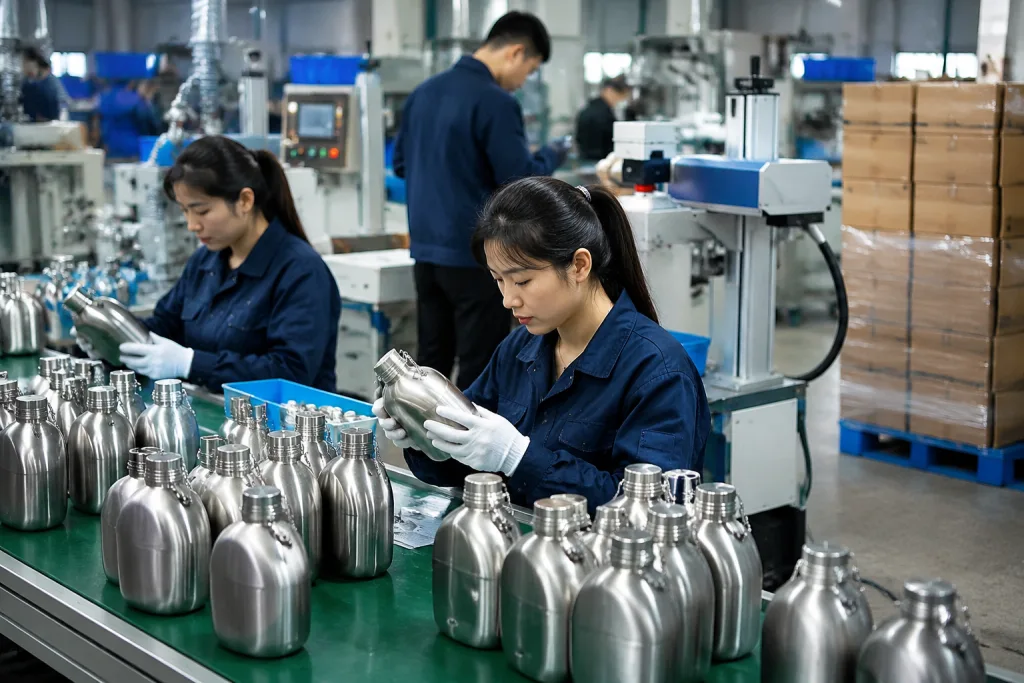
You are not buying a lifestyle bottle. You are buying a field-use canteen that needs to survive a 1.2 m drop test, webbing abrasion, summer-to-winter temperature swings, and rough carton handling without leaks or liner taste. That is the right starting point for judging an oem manufacturer military canteen. A lot of buyers begin with silhouette and logo panel size, then the line finds the real cost drivers later: cap thread tolerance at 0.2 mm, coating adhesion after cross-hatch tape test, and whether the master carton passes a six-face drop.
If you source from Zhejiang, China or other China clusters, you will get 20 factories sending near-identical photos by the second email. The gap shows up on the bench, not in the image: steel grade, wall thickness, AQL discipline, mold ownership, and repeat-order finish control. QC pulled samples last quarter where the buyer flagged color drift between PO-24117 and the reorder, and this is where projects go sideways. This guide is for procurement managers who want straight answers from the factory floor, not showroom talk.
What exactly are you buying?
Start with the use case, not the catalog photo. That sounds basic, but we see POs marked custom canteen that refer to 4 different builds on the same day: a single-wall stainless military flask, a vacuum bottle, an aluminum canteen with cup, or a polymer body with fabric cover. The wrong question is “what’s your best price?” First lock the spec sheet, then compare any canteen manufacturer.
A workable RFQ needs hard points: capacity, material, target weight, finish, cap build, and accessory set. Example: 1.0L single-wall 18/8 stainless body, 0.5 mm wall thickness checked with a micrometer on the line, wide mouth, leakproof PP cap with silicone gasket, matte powder coat in Pantone Black C, laser logo 35 x 35 mm, packed in brown box. If you need a canteen customized for outdoor retail, add strap pull test strength, abrasion result, and dishwasher statement. If you need a canteen promotional item, set the price ceiling first. We’ve seen this go sideways when the buyer flagged durability after approving a gift-grade budget.
Serious buyers define compliance early. For Europe, ask about REACH and LFGB if you will make food-contact claims. For North America, ask for FDA contact-safe materials and the ASTM transit tests tied to the packed carton. If you sell into government or tactical channels, ask whether the canteen factory can trace material by lot number back to the coil or resin batch. QC pulled a sample last month where the PO said “304” and the vendor packing note said “430.” Small typo, big problem.
- Capacity range: common military canteen sizes are 500 ml, 750 ml, and 1,000 ml
- Material choices: 18/8 stainless, aluminum, Tritan, or recycled plastics depending on project and MOQ
- Packaging: bulk pack, white box, kraft gift box, or PDQ for distributor drinkware programs
- Decoration: laser engraving, silk screen, heat transfer, or embossed mold logo
If your spec sheet is vague, each canteen supplier will quote a different item and call it equivalent. Then the math doesn’t work. A quote based on 0.4 mm stock, bulk pack, and single-color print is not the same as 0.5 mm, gift box, and deep laser mark. Cheap quotes turn into expensive orders fast.
How do you qualify the factory?
Do not stop at Incoterms and sample photos. First ask what you are buying from: a real canteen factory, a mixed-product workshop, or a trading company. None is automatically a problem. You just need to price the risk correctly. A real plant should answer technical questions in 10 minutes, not 2 days: steel grade, wall gauge in mm, lid resin, gasket hardness, welding process, coating thickness, and test standards. If the reply stays generic, push harder. We’ve seen this go sideways after deposit, usually when the buyer flagged a leak issue and the supplier still could not name the gasket material.
At BottleForge Industrial in Hangzhou, Zhejiang, we tell buyers to audit capacity and process match first. Total output is the wrong question to ask. A plant making 500,000 units per month of tumblers may still be weak on military canteen neck tooling or strap assembly, because the line, fixtures, and go/no-go gauges are different. Ask for monthly output by category, not one big factory number. A useful benchmark for a mid-size China plant is 150,000-300,000 canteens per month, MOQ 1,000 pcs for standard shapes, and 35-45 days bulk lead time in peak season. We also ask what press tonnage they run and whether neck forming is done in-house or sent out.
Factory checklist buyers should use
- Can the factory show BSCI, ISO 9001, or equivalent management documents?
- Do they own in-house tooling coordination for a customizable canteen, or outsource mold work?
- Can they run leak test, salt spray, coating adhesion, and carton drop tests?
- Do they support AQL inspection and third-party QC before shipment?
- Can they provide packing photos, pallet standards, and container load plans?
A canteen vendor that cannot tell you neck tolerance or gasket material is not ready for a repeat B2B program.
For canteen distributors and brand owners, repeatability matters more than first-order enthusiasm. Ask to see three POs of the same item produced over six months. Check whether color delta stayed controlled, logo placement held within 1.5 mm, and net weight stayed consistent lot to lot. QC pulled the sample once on a repeat order because the PO had a strap color typo, and the supplier caught nothing. That tells you more than a polished showroom in China.
Which materials make sense?
Material choice hits three things fast: cost, abuse on the line, and complaint rate after shipment. For a rugged customized canteen, 18/8 stainless steel is usually the cleanest B2B option. It takes drops better than glass, avoids the liner taste issue we still see on cheap aluminum, and it works well with powder coating, laser marking, and vacuum insulation if required. A typical single-wall body uses 0.4-0.5 mm stainless. Vacuum models often use 0.4 mm inner and 0.5 mm outer walls. Ask for the actual gauge and the steel spec, not just “food grade steel.” We’ve seen this go sideways.
Aluminum still fits some military-style canteens, mostly where the buyer wants lower weight and a lower FOB. That said, the key issue is not the shell. It is the inner liner. Ask what coating chemistry they run, how they test adhesion, and whether they have flavor migration data. Last year a buyer flagged a metallic aftertaste on a 5,000-piece order after hot-fill testing, and QC pulled the retain sample to confirm the liner batch was the problem. Returns come fast on bad aluminum. Tritan or PP bodies can work for value programs and some distributor canteen deals, but they usually look less tactical and scratch faster in abrasion tests.
If your broader line also includes customized drinkware or a customized growler, try to align materials across SKUs. Using the same cap resin, the same gasket supplier, or the same coating family cuts compliance work and makes spare-part planning easier. This is one area buyers skip, then the PO ends up with three lid specs and two gasket durometers for products sold under one brand. The math doesn’t work.
- 18/8 stainless: strong balance of durability, corrosion resistance, and a premium hand feel; we commonly run it on field-use bottles
- 304 stainless naming: often used interchangeably with 18/8, but verify the mill certificate when needed
- Aluminum: lighter and often cheaper, but liner quality decides whether the program holds up
- Tritan or PP: budget-friendly for customizable drinkware programs, less “field gear” positioning and less scratch resistance
For Europe, ask whether pigments, coatings, and gasket materials support REACH expectations. For North America, ask for BPA-free declarations where applicable. Good canteen suppliers will tell you the silicone gasket grade, shore hardness, and contact-use statement, not just write “safe material” on the spec sheet.
What should your RFQ include?
A weak RFQ burns two weeks. A solid one gets you clean, comparable offers from canteen vendors and shows fast who actually runs OEM projects. If you need a canteen custom project, write the RFQ like a short engineering brief. We see this on the line all the time: one missing neck diameter, and three factories quote three different cap structures.
List the core dimensions, target capacity tolerance, surface finish, accessories, packaging, compliance market, and forecast volume. If you need a cup set or pouch set, say clearly if one factory must source and assemble the full kit. This is the wrong question to leave open. A lot of canteen suppliers can form the bottle body but send the textile cover outside, and then your lead time slips to 18 days instead of 12. Last month a buyer flagged a pouch color mismatch because the fabric vendor worked off an old Pantone chip.
RFQ checklist
- SKU description with drawing or reference photos
- Material: 18/8 stainless, aluminum, Tritan, or mixed set
- Wall thickness target: for example 0.5 mm body and 1.2 mm cup
- Decoration method and Pantone codes
- Packaging: bulk, white box, color box, FNSKU label, master carton limits
- Compliance documents needed: REACH, LFGB, FDA, CPSIA if relevant for kids lines
- Trade term: FOB Ningbo, FOB Shanghai, or DDP if you really need landed quotes
- Forecast: trial order 2,000 pcs, annual demand 30,000 pcs
For a canteen customizable mold, ask four direct questions: who pays for tooling, who owns tooling, what is the mold life, and what modification costs apply after T1 sample approval. Ask in writing. We have seen this go sideways after T1 when the PO was approved but tool ownership was never stated, and then the factory charged again for a neck-tool correction of 0.3 mm.
If you are also buying custom growler or other custom drinkware in the same season, combine print approval with packaging approval. One clean approval matrix saves 3-5 days per SKU. We ship faster when files are locked. In Zhejiang and across China, factories move fast once approvals are complete, but they stall hard when buyers keep sending revised logo files. QC pulled one sample last quarter where the PO typo said matte black, while the AI file was gloss navy.
How are samples, pricing, and MOQ handled?
Buyers ask why one canteen supplier quotes USD 3.10 and another quotes USD 5.40 for “the same” military canteen. It is rarely the same canteen. We run the shell weight on a 0.1 g scale, check 304 stainless thickness with a digital caliper, then cost the cap, gasket, finish, strap, cup set, and carton one line at a time. A 1.0L single-wall 18/8 canteen with simple laser logo and brown box may land around USD 2.80-3.80 FOB China at 3,000 pcs. Add a custom cap, powder coat, woven strap, cup set, and color box, and the same capacity can move to USD 4.80-6.50 FOB. The cheap quote usually skipped something.
MOQ follows the customization, not the buyer’s target price. For stock-body logo orders, 500-1,000 pcs per color is normal if we already have the body on the line. For a fully customizable growler or canteen shape with new tooling, 2,000-5,000 pcs is more realistic because the mold shop, trimming fixture, and leak-test jig all need setup time. We have seen buyers ask for 300 pcs with a new cap thread; the math does not work. Sample timing should also be split clearly:
- Existing mold pre-production sample: 7-12 days
- New mold T1 sample: 20-35 days
- Bulk production: 30-45 days after sample sign-off and deposit
Ask if sample fees are refundable against the bulk order. In our market, 6 out of 10 China factories will credit part or all of the sample fee when the PO reaches MOQ, but the credit should be written on the PI, not agreed only in a WeChat message. Also confirm whether packaging samples are included. For a canteen distributor, carton and insert design errors are not small mistakes; QC once pulled a color box because the PO said “desert tan” and the artwork file said “sand khaki,” which delayed booking by 3 days and triggered a buyer complaint.
If you import to Amazon or 3PL channels, require FNSKU placement rules, carton marks, and pallet limits in the quotation stage. Put the label size, scan position, max carton weight, and pallet height in the RFQ; 15 kg cartons and 1.6 m pallets are common limits we see from US warehouses. A factory that also handles distributor growler or distributor drinkware accounts will understand this immediately. If they do not, expect 4-6 extra emails later, and we have seen this go sideways when a 3PL rejects mixed-SKU cartons at receiving.
What testing prevents expensive surprises?
Testing is where experienced buyers protect margin. A good-looking customized canteen can still fail on the first field issue: gasket seat off by 0.3 mm, strap rivet pulling loose at 8 kg, or powder coating that did not cure long enough on the line. We run these checks before the cartons leave Hangzhou, because arguing about leaks after delivery eats more money than the test ever costs. Your quality plan needs factory testing, third-party inspection, and clear shipment release criteria.
At minimum, ask for a 24-hour upside-down leak test on finished goods and vacuum retention testing if the canteen is insulated. Add coating cross-hatch adhesion testing, odor or taste checks after a 95°C hot water fill, and carton drop testing matched to your shipping channel. For one military-style canteen order, QC pulled 32 pcs from packed cartons and found 2 caps with thread drag after the liner was installed. Small issue. Big delay if found at the warehouse. If the product will be sold in Europe, push for material declarations that support REACH expectations. If it is a children’s line extension under customizable drinkware, verify whether extra ASTM or CPSIA work is needed.
Practical QC checklist
- AQL: 2.5 major / 4.0 minor is a common shipment inspection standard; use tighter limits for first orders or new molds
- Leak test: 100% in-line or batch-tested, 24 hours preferred for new SKUs; 2 hours is not enough for a new cap structure
- Coating: cross-hatch adhesion plus color Delta E control if exact matching matters; check the shoulder area, not only the flat body
- Dimensions: mouth diameter and cap thread fit checked by go/no-go gauges; record the mm range on the inspection sheet
- Packaging: barcode scan, carton weight tolerance, drop test, pallet photo approval; the buyer once flagged a PO typo because the carton mark showed 750 ml while the item was 800 ml
The cheapest canteen vendor becomes the most expensive one if 4% of lids leak after the goods reach your warehouse.
Use pre-production samples as the control sample, then sign them physically or lock them by photo record. No vague approval. The factory and inspector should compare final goods against that sample during final inspection, including cap torque, coating feel, logo position, and carton mark. Reliable canteen suppliers in Zhejiang usually accept this discipline because we ship against details, not memory. The ones who resist it are telling you something, and we have seen this go sideways.
What makes repeat ordering easier?
The first PO gets the meetings, but the margin is in PO 2, PO 3, and the reorder after your dealer sells through. If you plan to build a military line plus adjacent customized growler and sports items, lock common parts early: one cap thread, one silicone gasket size, one 5-layer export carton spec at 7 kg gross where it fits. We run fewer spare bins that way, and the canteen manufacturer can forecast caps, gaskets, and cartons without guessing every month.
After the first shipment, build a supplier scorecard that fits on one page: on-time delivery, defect rate, response speed, carton accuracy, and claim handling. Use numbers. Target on-time shipment 95%, final inspection pass rate above 98%, claim closure within 10 working days. We would also track PO revision mistakes, because one buyer flagged a wrong matte black Pantone note after our merchandiser copied the old line sheet. Serious canteen distributors and brand owners should review this every PO, not once a year.
Agree on change control in writing. If the factory wants to change gasket supplier, powder supplier, or carton board grade, that needs buyer approval before the line starts. We have seen this go sideways: a canteen vendor saved RMB 0.08 per unit by swapping a small gasket, then QC pulled the sample after a 24-hour leak test found seepage around the cap. In China, this is preventable when your PO, spec sheet, and QC standard are linked to the same revision date.
Do not think in one SKU. That is the wrong question to ask. If your supplier can support customizable canteen, travel mugs, and a customizable growler under one compliance workflow, your sourcing cost drops across the program. The math often beats squeezing the last USD 0.12 out of one canteen order, especially when one FDA file, one LFGB file, and one AQL 2.5 inspection template cover the family. Buyers who manage the relationship as a controlled manufacturing program usually get 12-day repeat sampling instead of 18 days, steadier pricing, and cleaner service from Zhejiang factories.
Send your military canteen spec for a technical quote
Share drawings, target price, compliance market, and forecast. We will review MOQ, tooling, lead time, and QC risks before you place the PO.
Frequently asked questions
What is a normal MOQ for an OEM military canteen order?
For a stock shape with custom logo, a normal MOQ is 500-1,000 pcs per color. For a more serious custom canteen with powder coating, custom cap color, and dedicated packaging, expect 1,000-3,000 pcs. If you want a fully new body shape or exclusive cup set, MOQ often moves to 2,000-5,000 pcs because tooling and setup costs must be spread across the run. In China, some factories will accept a lower trial order if you use standard components and simple brown-box packing. Ask whether sample fees or mold fees can be credited back once you hit annual volume, such as 10,000 or 20,000 pcs.
How much should I budget for a custom military canteen?
A realistic FOB China range for a 500 ml to 1,000 ml military canteen is USD 2.80-6.50 per unit. The low end usually means a single-wall stainless body, standard cap, one-color logo, and basic export carton. The high end usually includes powder coating, custom strap, cup set, color box, and tighter finishing requirements. New molds can add USD 1,500-6,000 depending on body complexity and whether cap tooling is also new. If you are a canteen distributor or brand owner, ask for a line-item quote showing body, lid, decoration, packaging, and tooling separately. That makes later cost-down work much easier.
What compliance documents should I request from a canteen manufacturer?
For Europe, buyers commonly request REACH-related material information and may also ask for LFGB support for food-contact positioning. For North America, FDA food-contact declarations are common for drinkware materials, and channel-specific testing may apply. If the product is sold into retail, ask for packaging test records, barcode controls, and carton drop results. If you need social compliance, BSCI is commonly requested from China suppliers. For factory systems, ISO 9001 is a useful sign of process control. Also ask for gasket material declaration, coating information, and any stainless steel grade confirmation if your customer specification names 18/8 or 304.
How long does production usually take after sample approval?
For an existing shape, pre-production samples usually take 7-12 days after artwork and Pantone confirmation. Once the sample is approved and deposit is paid, normal bulk lead time is 30-45 days. Peak season or mixed orders with several customized drinkware SKUs can push that to 50-60 days. A new mold project is different: T1 samples often need 20-35 days, then another 7-10 days for revisions if the first sample is not approved. If your order includes custom packaging, add 5-7 days unless the factory is printing plain kraft boxes. Always ask whether the lead time starts from deposit, sample approval, or packaging approval.
What are the most common quality failures on military canteens?
The most common failures are leaks, coating damage, inconsistent color, denting in transit, and off-center logos. On insulated models, weak vacuum performance can also become a problem. Most of these issues are preventable with clear controls: 100% or batch leak testing, AQL 2.5/4.0 final inspection, cross-hatch adhesion tests for coating, and approved golden samples for color and artwork. For threaded caps, ask for go/no-go gauge checks on the neck finish. For export cartons, request drop testing and pallet photos before shipment. If a canteen supplier cannot describe these controls with numbers, treat that as a warning sign.