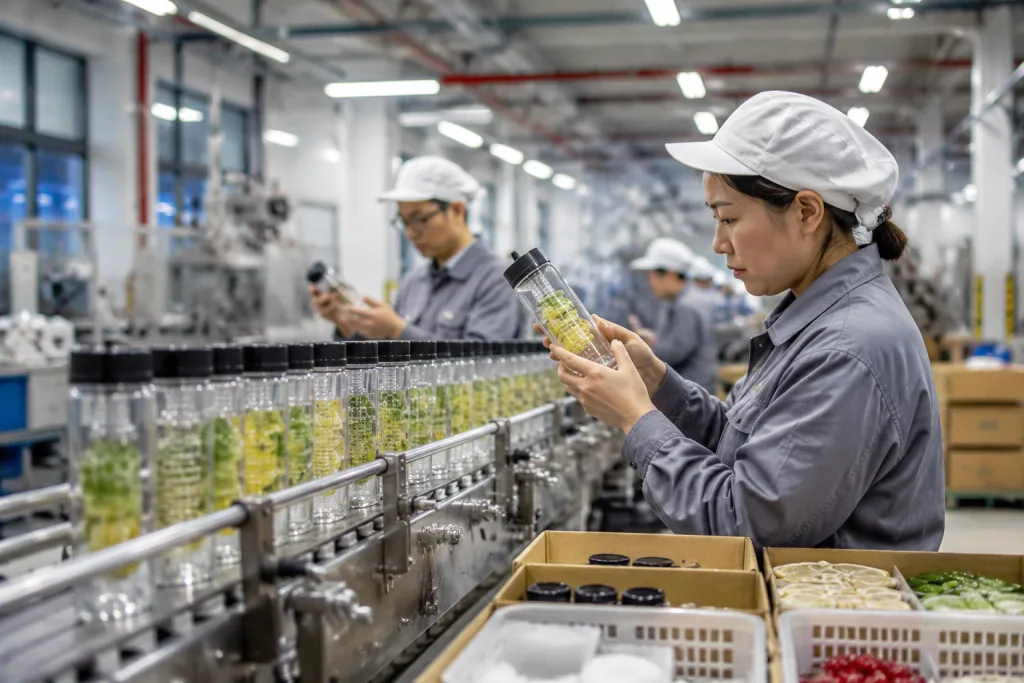
Key Takeaways
- A standard factory direct infuser bottle in Tritan usually lands at USD 2.10-3.80 FOB China at 1,000-3,000 units
- New-tooling custom made infuser bottle projects often add USD 1,500-6,000 in mold cost and 25-40 extra days
- Silkscreen logo printing is usually USD 0.05-0.18 per color, while laser marking on stainless parts is often USD 0.08-0.20
- Typical production lead time is 20-35 days after sample approval and deposit, with AQL inspection before shipment
You have a bottle concept, a target retail price, and a launch date that is already breathing down your neck. The part that slows most wellness brands and hydration startups is not the idea. It is the cost stack behind a real oem manufacturer infuser bottle program: mold fee, logo process, leak test, carton spec, and freight. We’ve seen this go sideways between a hand sample on the sales desk and mass production on the line, especially after QC pulled the sample and found a 0.8 mm lid gap the buyer never saw in photos.
If you are buying a custom infuser bottle, bulk fruit infuser bottle, or bulk tea infuser bottle from China, vague promises are useless. You need working numbers. In Zhejiang, unit cost and lead time usually move on four things: body material, infuser structure, decoration process, and MOQ. Buyers often push on the wrong question to ask—price first, spec later—and the math doesn’t work. At BottleForge Industrial in Hangzhou, Zhejiang, our typical MOQ starts at 1,000 units and monthly output reaches 300,000 pieces, so the ranges below come from orders we run and ship under real factory conditions.
What sets the real bottle cost
Most buyers ask the same thing first: what is the unit price? Fair enough. For an oem manufacturer infuser bottle, that is the wrong question to ask by itself, because the real number usually sits in four cost layers. First is the bottle body material. On our line, wall thickness and resin grade change cost fast. A single-wall Tritan body of 0.8-1.0 mm wall thickness is usually the most cost-efficient option for a wellness launch. A 650 ml Tritan bulk infuser bottle with a standard PP lid and removable strainer generally sits around USD 2.10-2.90 FOB China at 3,000 units. Shift to borosilicate glass with a silicone sleeve and stainless tea basket, and you are closer to USD 2.80-4.60. A double-wall stainless custom tea infuser bottle in 18/8 steel can run USD 4.20-7.50 depending on copper coating, powder coat, and basket assembly.
Second is the infuser itself. This part looks small, but the math doesn’t work if you treat every basket like the same part. Fruit cages are simpler than fine-mesh tea filters. A basic PP fruit core may add only USD 0.20-0.35. A 304 stainless micro-perforated tea basket with a threaded cap can add USD 0.45-1.10. We have seen buyers push back on a USD 0.30 basket increase, then QC pulled the sample and found burrs on the cheaper mesh rim. Third is decoration. A one-color silkscreen print on a custom logo infuser bottle is cheap and fast. Full-wrap heat transfer, UV print, embossed mold logos, or custom color matching to Pantone will all push cost higher. Fourth is compliance and packaging. If you sell into Europe, you may require REACH-related material declarations and LFGB or food-contact testing on components. North American retail often adds ASTM or CPSIA checks for youth-oriented hydration lines, especially if the SKU could be marketed near kids' categories.
Do not ignore carton economics. We’ve seen this go sideways. A bottle that looks cheaper ex-works can become more expensive after shipping if the structure wastes carton space. We often see a supposedly low-cost factory fruit infuser bottle become 8-12% more expensive per landed unit simply because it packs at 24 pieces per carton with too much dead space instead of 36 pieces in a well-designed shipper. Our carton drop test usually shows the problem early, and the fix is often simple: reduce headspace by 12 mm or change the insert, then we ship more units in the same outer carton.
MOQ tiers that change your quote
MOQ is not some random factory rule. It is the break point where raw material buying, masterbatch color mixing, carton packing, and line time start to make sense. For a standard factory direct infuser bottle on an existing mold, a workable opening MOQ in Zhejiang and most of China is 1,000 units per model per color. Below that, the math doesn't work. We still need to run resin, set the pad printer, and book people on the line, and those fixed costs get spread over too few bottles.
Here is a realistic range for a 700 ml Tritan customizable infuser bottle with one-color logo and white box packaging:
- 1,000 units: about USD 2.70-3.80 FOB
- 3,000 units: about USD 2.10-2.95 FOB
- 5,000 units: about USD 1.95-2.70 FOB
- 10,000 units: about USD 1.75-2.45 FOB
Those gaps are normal. At 1,000 units, we are often buying standard stock resin and running a short print setup that wastes 30-50 trial pieces before the logo is clean. At 5,000 units, carton count fills better, labor is steadier, and the unit cost drops fast. One buyer flagged a 12-cent price gap as too big on a PO last month, but once we showed the setup scrap and box ratio, they moved from 1,200 to 3,000 units.
Glass changes the MOQ conversation. Breakage allowance has to be built in, and the sleeve has to match the bottle OD within about 1-2 mm or it looks loose on shelf. A customized fruit infuser bottle in borosilicate glass with silicone sleeve is often best quoted at 2,000 units and above. Stainless steel also pushes MOQ up if you want a special powder coat, vacuum insulation, or a custom lid, because the line needs separate coating samples and oven test pieces before we ship mass goods.
When custom molds start to make sense
If you need a truly custom made infuser bottle instead of an existing platform with your branding, the tooling charge has to be carried by enough volume. For a new lid, fruit core, or handle part, tooling may cost USD 1,500-3,500. A full body-and-lid set can move toward USD 4,000-6,000 or more. Below 5,000 total units, most startups should stay off fresh tooling unless the bottle shape is the brand. We've seen this go sideways: buyer approves a new handle, then sales stalls at 2,000 pieces and the mold cost sits there.
A common mistake is asking for three colors at 500 units each. Most factories in China would rather quote 1,500 units in one color than split three tiny runs, because scrap and setup rates rise sharply.
If you are building a distributor infuser bottle program or pitching to distributors tea infuser bottle channels, ask for MOQ by color, by print artwork, and by package type separately. This is the right question. Hidden minimums usually sit in those three places. QC pulled a sample set on one order where the bottle MOQ was met, but the gift box supplier still wanted 2,000 pcs per artwork, and the buyer had missed that line in the quote.
How decoration affects margin and speed
Decoration is where margin disappears fast. Startups ask for a premium-looking customized infuser bottle and send a budget that treats every logo method the same; the math doesn't work. On a standard bottle from Zhejiang, a one-color silkscreen print usually adds USD 0.05-0.18 depending on print size and order volume. Two colors often land around USD 0.10-0.30, and registration on a curved body needs tighter setup on the jig. Laser engraving on a stainless cap or base can be USD 0.08-0.20. Heat transfer or full-wrap graphic application may add USD 0.25-0.60. Individual name personalization is another category entirely, and at 3,000 pcs MOQ we usually tell buyers to split it off because the line slows down too much.
For a custom fruit infuser bottle sold into gym, wellness, and hydration subscriptions, simple decoration usually runs better on the line. Screen print is durable enough for many use cases, especially if you define an abrasion standard before production; QC pulled the sample once and found the buyer had never specified rub count at all. If you need dishwasher-oriented claims, discuss ink system and test method upfront. Some buyers ask for UV print because the sample looks sharp, then find production scrap rates are 3-5% higher on curved bottles. We have seen this go sideways after pilot run, with bottle rotation shifting 1.5-2 mm and the buyer flagging logo tilt on arrival.
Packaging needs the same discipline. A plain white box with barcode sticker may cost USD 0.12-0.22. A custom color box with foam or pulp insert often sits at USD 0.35-0.90, and the box drop test is where weak ideas show up fast. Add instruction sheets, QR inserts, FNSKU labels for Amazon FBA, or retail windows, and packaging can overtake logo cost before the first shipment leaves Ningbo. For a customizable tea infuser bottle, a premium unboxing experience may be justified if your retail price is USD 24.99 and above. If your target is a promotional or distributor channel, that same packaging can kill margin; we shipped one PO where a label typo forced 8,000 box stickers to be reworked by hand.
Our advice is blunt: put the first budget into a reliable leakproof lid, a clean strainer fit, and a repeatable print position. Ask the line supervisor to check cap torque and logo centering, not just carton count. Fancy packaging is easy to add later. Refunds from leakage or crooked logos cost more than a basic carton.
Lead-time from sketch to shipment
Lead time starts with one question: are you picking an existing platform or asking us to build a new one? For an existing factory infuser bottle with a standard color and one-color logo, the schedule is usually clean. Artwork check takes 1-2 days. Pre-production sample takes 5-7 days. After approval and deposit, mass production usually takes 20-30 days. If the order is 10,000 pieces and uses custom retail packaging, 30-35 days is the safer quote. On our line in Hangzhou, Zhejiang, we normally quote 25 days for standard bottle projects outside holiday peaks. One small detail buyers miss: if the logo file comes in with hairlines under 0.2 mm, our screen-print tech will kick it back the same day.
A new custom tea infuser bottle program moves slower. Product drawing confirmation may take 3-7 days, and that assumes the PO is clean; last month a buyer typed the wrong lid code and we lost 2 days fixing it. Tooling for lid or body components can take 15-25 days for simple plastic parts, and more time if steel bottle parts or complex silicone seals are involved. Trial samples and corrections often add another 7-12 days. Realistically, a new mold project needs 45-65 days before first shipment, even when everyone replies fast. Buyers like to ask for the shortest tooling lead time. This is the wrong question to ask. The better question is how many sample loops the project will need after T0.
Typical timeline ranges
- Existing model + stock colors: 20-25 days production
- Existing model + custom Pantone + color box: 25-35 days
- Existing model + third-party testing: add 5-10 days
- New lid or infuser tooling: 40-55 days total
- Full custom bottle development: 45-65 days total
If you are launching to Amazon or seasonal retail, add buffer from day one. Chinese New Year can add 2-3 weeks around shutdown and restart, and we have seen this go sideways when buyers book cartons too late. Sea freight from China to the U.S. West Coast is often 18-28 days port to port, but door delivery can still run past 40 days once drayage and customs are included. Europe changes by route, but most buyers should budget 30-45 days door to door by sea. QC pulled the sample once on a rush order because the insert tray was 3 mm too shallow, and that single packaging fix cost 4 extra days.
A bulk tea infuser bottle order does not ship earlier because the salesperson promised it. We ship earlier only when artwork is approved fast, deposit is paid, raw materials are booked, and packaging details stop changing. If the buyer flagged the logo size on Monday, changed the barcode on Wednesday, and asked for a new warning label on Friday, the math doesn't work.
Quality checkpoints buyers should insist on
If you are new to sourcing in China, write QC into the PO before deposit. Do not wait for defects to show up on the table. For a customizable fruit infuser bottle or customized tea infuser bottle, we usually see 6 failure points on the line: lid leakage, body scratches, logo offset, handle pull-out, odor retention, and infuser misfit. This is where buyers get burned. Set the inspection standard before mass production starts, and put it in writing with photos, Pantone callouts, and a gasket hardness spec if needed. A lot of importers run AQL 2.5 for major defects and AQL 4.0 for minor defects. For drinkware, that baseline works.
Ask for a pre-production sample made with the actual resin, steel, decoration, and seal structure, not a showroom lookalike. We have seen this go sideways when the sample used one lid mold and bulk used another with a 0.3 mm thread difference. If the bottle uses Tritan, confirm the resin grade on the material sheet. If it uses stainless steel, specify 18/8 or 304 where appropriate. If silicone parts touch liquid, ask for food-grade declarations. A factory in Zhejiang that runs export business every week should be able to discuss BSCI social compliance, ISO-oriented process control, and migration testing routes for Europe or North America without dodging the details.
- Leak test: filled bottle inverted for 30 minutes, then shaken; QC pulled the sample and checks the lid seat, thread start, and gasket compression after the test
- Drop test: packaged drop or bottle drop from agreed height, often 80-100 cm depending on format; if the buyer flagged handle breakage before, we add a focused drop on that weak point
- Salt spray or coating adhesion: if metal decoration is used; cross-hatch tape test is common on painted caps and plated rings
- Barcode scan check: if retail or FBA labels apply; one wrong EAN print or a blurred FNSKU can stop receiving
- Assembly fit check: infuser threads, basket seating, gasket compression; this is the wrong question to skip because a loose basket by 1 mm becomes a leak claim later
For a distributor fruit infuser bottle program, carton mark accuracy matters as much as the bottle itself. We ship cartons that pass product inspection and still get held because the outer mark shows PO1187 while the buyer order says PO1817. That sounds small. It is not. Wrong labels create warehouse charges that often cost more than light cosmetic issues. Our standard advice is simple: approve a production sample, run in-line QC during the first 10%, then book a final random inspection before balance payment. It adds 1-2 days. The math still works, because fixing claims after the container lands costs more.
Where startups overspend without noticing
The fastest way to kill margin on a bulk infuser bottle project is piling on upgrades your customer will not pay for. We see it on the line with hydration startups every month, usually in runs of 3,000-5,000 pcs. The buyer wants a new lid profile, custom mold logo, metallic spray, gift box, and two infuser styles packed together, then sets retail under USD 19.99. The math doesn't work.
Three cost leaks show up first. Start with tooling. On a first run, a proven bottle body with custom Pantone color, silk print, and a 0.5 mm logo adjustment usually gives enough brand feel for market testing without opening a new mold. Next is accessories. A spare straw, cleaning brush, and carry pouch look good on a pitch deck, but we’ve seen this go sideways after packing: USD 0.40-1.20 per set, plus hand-pack labor, plus a bigger master carton. Last is packaging. For ecommerce, build for drop resistance and carton efficiency, not shelf drama. We ship plenty of Amazon orders in tighter boxes because the oversized gift-style pack gets buyer pushback fast.
For a customizable infuser bottle sold online, your landed cost target should usually sit around 20-30% of intended retail if you want room for freight, duties, platform fees, returns, and marketing. Short version: protect margin early. If retail is USD 24.99, many founders should aim for a landed cost of roughly USD 5.00-7.50. In practice, that usually means an existing Tritan platform or entry stainless item from our standard book, not a luxury build with extra steel weight and custom inserts.
Factory choice matters too. A true factory tea infuser bottle supplier in Zhejiang with in-house assembly and printing usually controls timing better than a trader splitting work across 3 workshops. Ask direct questions. What is your monthly capacity? What is your actual MOQ by SKU? Can you handle FNSKU and pallet labeling? Do you run leak tests 100% or by sampling? QC pulled the sample last week on a lid fit issue at 1.2 mm thread tolerance, so this is the right question to ask. We answer these every week because a low quote without process control is rarely the low-cost option at the end.
If you are pitching distributors infuser bottle or building a distributors fruit infuser bottle line, consistency matters more than chasing the lowest ex-works number. We've seen buyers fight for USD 0.12 savings, then lose the launch on returns and replacement freight. One failed launch can cost more than that gap.
Get a real infuser bottle quote, not a guess
Send your target size, material, logo method, MOQ, and deadline. We will reply with practical FOB pricing, testing options, and lead-time ranges.
Frequently asked questions
What is a realistic starting MOQ for a custom logo infuser bottle?
For an existing mold, most factories in China will quote 1,000 units per model and color as the practical starting point. Some will advertise 500 units, but the price usually jumps 15-30% and color or packaging options shrink. For a custom logo infuser bottle in Tritan with one-color silkscreen and standard white box, expect roughly USD 2.70-3.80 FOB at 1,000 units. Glass bottles often work better at 2,000 units because sleeve matching and breakage allowance complicate small runs. If you want a custom box, FNSKU labels, or multiple print versions, ask whether those have separate MOQs. Many buyers miss that detail and then find their actual minimum is 1,000 per artwork, not 1,000 total.
How long does a custom infuser bottle order usually take?
If you select an existing bottle platform, approve artwork quickly, and do not change packaging halfway through, production typically takes 20-35 days after deposit and sample approval. A simple custom infuser bottle with stock colors can be done in about 20-25 days. Add custom Pantone matching, retail color boxes, or third-party testing and you should budget 25-35 days. If you need a new lid, a new fruit core, or a fully customized tea infuser bottle body, total development and production commonly runs 45-65 days. Shipping is separate. Sea freight from China to North America can add roughly 25-40 days door to door, while Europe often needs 30-45 days depending on route and customs handling.
What price should I expect for a bulk fruit infuser bottle?
For a standard 650-750 ml Tritan bulk fruit infuser bottle using an existing mold, a useful FOB China range is USD 2.10-2.95 at 3,000 units and USD 1.75-2.45 at 10,000 units. At 1,000 units, the same bottle may sit around USD 2.70-3.80. The main variables are body material, infuser complexity, lid design, and packaging. A simple PP fruit core costs much less than a stainless micro-mesh tea basket. A plain white box may add USD 0.12-0.22, while a custom retail box can add USD 0.35-0.90. If your quote looks far below these ranges, check whether the supplier included logo cost, barcode labels, gasket quality, and carton specification. Missing details are common.
Do I need third-party testing for Europe or North America?
If you sell into Europe or North America, testing is often worth the money, especially for a new supplier or new material combination. For food-contact drinkware, buyers commonly ask for material declarations and migration-related testing aligned with market requirements such as REACH-related documentation, LFGB-oriented needs in Europe, or other food-contact standards in North America. If the bottle might be marketed around youth segments, extra checks can apply. Budget roughly USD 300-800 for focused testing depending on component count and lab scope. That cost is small compared with a recall or customs problem. At minimum, confirm resin grade, stainless specification such as 304 or 18/8, silicone compliance statements, and leakage test records before shipment.
Is it better to use an existing model or develop a custom made infuser bottle?
For most startups, an existing model is the safer first move. You can still create a strong custom made infuser bottle look with Pantone colors, a custom logo, retail packaging, and small component changes without paying full tooling cost. Existing molds usually keep MOQ around 1,000 units and production around 20-35 days. A fully new bottle shape or lid can add USD 1,500-6,000 in tooling and push timing to 45-65 days before shipment. Full custom only makes sense if shape is central to your brand story, you need patent separation, or you already have repeat volume lined up through retail, ecommerce, or distributor tea infuser bottle channels. Otherwise, prove demand first and customize deeper on the second order.