Key Takeaways
- Set the flask body first: 18/8 stainless steel, 0.45-0.55 mm wall thickness, and 12-24 hour insulation targets are common starting points.
- A realistic OEM MOQ is usually 1,000-3,000 pieces per color for standard molds and 5,000+ pieces for private caps or new tooling.
- Logo method changes both cost and risk: laser engraving is stable for 1-color metal branding, while full-wrap print needs stricter artwork control.
- Plan 35-55 days production after sample approval, plus 3-7 days for pre-shipment inspection and document checks.
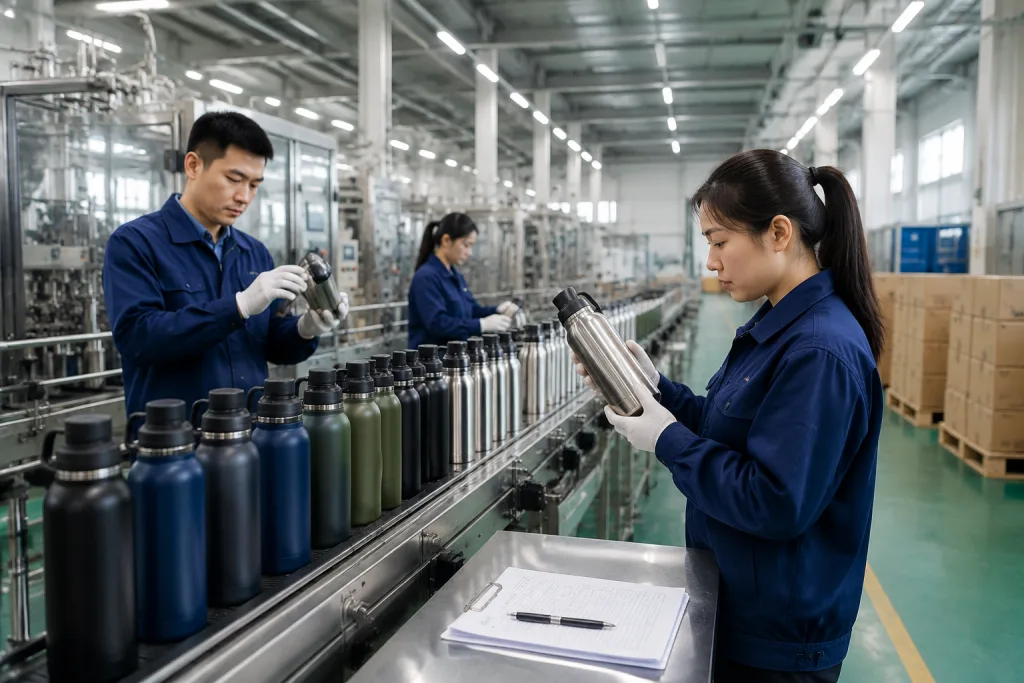
Buying from an oem manufacturer hydration flask partner is not picking a bottle shape and dropping a logo on it. You are fixing steel grade, insulation result, cap tooling, carton burst strength, compliance files, and the factory habits you will deal with across the next 3 to 5 reorders. We run into this on the sample bench: one 750 ml flask passed the 6-hour heat test, then QC pulled the cap and found the silicone ring sitting 0.4 mm proud.
For B2B buyers in Europe and North America, the real decision is where to put control. A Hangzhou, Zhejiang supplier can ship solid custom drinkware at scale, but the spec must be tight enough for quoting, sampling, inspection, and repeat orders. Vague briefs get expensive. Last month a buyer flagged one PO because it said “matte black” while the approved sample was Pantone Black 6 C powder coating, and that small typo held 3,000 pcs off the line.
Start With Four Buying Decisions
Before you ask a canteen supplier for a price on an oem manufacturer hydration flask, lock four points first: product platform, decoration method, compliance level, and delivery model. Otherwise you will get 6 quotes for 6 different bottles. We see this every week in Hangzhou: one RFQ says “sports flask,” the buyer wants 304 stainless, and the cheapest quote is actually 201 outer wall with a thin cap gasket. The price looks nice. The math doesn't work.
Product platform means the real flask construction on the line. For a stainless hydration flask, that usually means 18/8 or 304 stainless steel inner wall, 201 or 304 outer wall, vacuum insulation, copper lining if you need stronger heat retention, and a PP or Tritan cap. A 500 ml bottle and a 1,000 ml custom growler are not the same job. Bigger sizes need thicker body control, stronger handle pull testing, and carton drop checks from 80 cm, because QC pulled samples with shoulder dents after a 6-side drop test.
Decoration method decides how the brand looks after packing, shipping, and daily use. Laser engraving is steady for a premium custom canteen look, especially when the logo line is at least 0.2 mm. Silk screen works for simple one-color logos and lower MOQs. Powder coating with print sells well on the shelf, but we run cross-hatch tape tests and color checks against the Pantone chip before mass packing. A canteen promotional order for an event can live with a simpler finish; a retail customized drinkware line with 12 months of reorder demand cannot afford 8% logo rejects.
Compliance level depends on the sales market, not on what the factory has sitting in a folder. For the EU, ask for LFGB or EU food-contact testing, REACH screening for coatings, and packaging declarations where required. For the US, FDA food-contact material statements and California Proposition 65 review may matter. If children are involved, ASTM and CPSIA questions enter the brief. We have seen buyers lose 12 days because the PO listed “FDA only” while the shipping mark said Germany, and the lab had to rerun coating migration on the powder-coated body.
Delivery model decides packaging, labeling, and logistics before the first carton is printed. A distributor canteen order to your warehouse is simpler than Amazon FBA with FNSKU labeling, carton weight limits, and barcode accuracy. Tell the supplier whether you ship master cartons, color boxes, PDQ trays, or mailer boxes; a 24 pcs carton at 18 kg is a different packing plan from a 12 pcs carton under 15 kg. Put these four decisions into the first RFQ and your quote comparison becomes much harder to game.
Choose The Flask Platform First
A canteen factory may show you 200 shapes in the showroom, but the OEM programs that make money usually start from 8-15 proven platforms we already run on the line. Standard molds reduce tooling risk, cut first sampling to about 12 days vs 18 days for a new drawing, and let you judge canteen manufacturers by welding, polishing, coating, and packing control. For most distributors, the working range is 350 ml, 500 ml, 750 ml, 1,000 ml, and 1.9 L. The 1.9 L size is closer to a custom growler or distributor growler product; QC checks the handle pull and lid sealing before anyone worries about pocket-friendly dimensions.
For stainless vacuum flasks, ask for the exact steel grade and wall thickness, then ask the factory to confirm it with a micrometer on a cut body. A practical benchmark is 0.45-0.55 mm for many bottle bodies, with thicker material on large-capacity customized growler formats. Thinner walls can cut FOB cost by USD 0.20-0.45 per piece, but the math doesn't work if 3% of cartons arrive with dents or the buyer flags the bottle as cheap in shelf review. If your retail channel pushes returns hard, do not chase the thinnest body.
Insulation claims need test data, not sales copy. We run a common check by filling with 95 C water, closing the cap, and measuring after 6, 12, and 24 hours at 20 C ambient temperature with a probe thermometer. For cold retention, ice-water tests should state initial temperature, room temperature, and whether ice remains. Do not accept marketing words such as “keeps hot all day” as a specification; we have seen that line go sideways during buyer inspection.
For caps, decide whether you need a straw lid, chug lid, screw cap, carry loop, or carabiner handle, then count every plastic part and silicone seal. Cap tooling is where many canteen customized projects become expensive. A private cap may require USD 2,000-8,000 tooling and 5,000-10,000 pieces MOQ, depending on parts and silicone seals. If speed matters, use an existing cap and customize color, logo, and packaging first; last month a buyer lost 9 days because the PO said black PP lid while the approved sample was dark gray.
Branding Methods Change The Risk
Customizable drinkware sells well in photos, but branding is where we see orders fail AQL 2.5 visual checks. Match the process to the sales channel. A corporate canteen promotional order usually needs a clean 35 mm logo, carton labels that match the PO, and a delivery date the buyer can trust. A retail customized canteen program is stricter: coating adhesion, repeat Pantone color, and the same logo position across lot 1 and lot 2. QC pulled samples last month because the logo drifted 4 mm toward the shoulder. Small shift. Big argument.
Laser engraving is the lowest-risk choice on powder-coated or stainless bodies. It adds no ink migration issue, and it stands up to abrasion testing better than most prints, even though most vacuum flasks are still sold as hand-wash items. We run a fiber laser on 304 stainless and usually set a positioning jig before mass production, because hand alignment gets messy after 3,000 pieces. The trade-off is simple: engraving gives an exposed-metal or tonal mark, not full-color shelf impact. If the buyer wants a red mascot, engraving is the wrong question to ask.
Silk screen printing works well for one or two colors on flat panels or gentle curves. For a 1-color logo, the added cost may be around USD 0.08-0.18 per piece, depending on size and order quantity. Full-wrap printing, heat transfer, and water transfer can look stronger at retail, but they need locked artwork files, extra setup days, and tape plus scratch testing before the line starts. We use 3M tape for pull tests, and the buyer flagged one batch because the white ink lifted at the bottle seam. If a canteen vendor says every process has the same durability, ask for test photos.
Powder coating gives a premium hand feel and a workable color range. Specify Pantone target, gloss level, and acceptable Delta E if you need tight matching. For many B2B orders, a practical tolerance is Delta E under 2.0-3.0, but only if the factory and coating supplier agree before production. We check panels under a D65 light box before approving the coating batch, not after 20,000 bodies are sprayed. Glossy coatings show scratches faster; matte coatings can show fingerprints and oil marks. We have seen matte black go sideways when the buyer expected a clean retail look after repeated handling.
For a canteen customizable range with multiple SKUs, keep the branding system tight. Use one logo size grid, one approved placement drawing, and one packaging artwork standard with version numbers, because a typo on a PO can travel straight into carton marks. We ship hydration flask, custom canteen, sports bottle, and customizable growler lines from the same artwork folder when the program is organized. When it is not, the math does not work: two extra artwork corrections can cost 12 days vs 18 days on the production schedule.
Price The Whole Landed Program
FOB unit price is one line on the cost sheet. A low quote from canteen vendors can turn ugly after tooling, PPS samples, color-card matching, retail box printing, AQL 2.5 inspection, Yiwu-to-Ningbo trucking, duties, and 2% spare lids. Price the landed program, not the first FOB Ningbo or FOB Shanghai number. We had one buyer flag a USD 0.18 cheaper flask, then the math failed when the supplier added USD 0.42 for a 350 g carton and inner divider.
For standard stainless hydration flasks from China, a realistic FOB range might sit around USD 3.20-6.80 for common 500-1,000 ml vacuum bottles, depending on steel grade, coating, lid, packaging, and quantity. A larger customized growler can move above USD 8.00-14.00. These are sanity-check bands, not offers. If one canteen manufacturer is 25% below the market, ask what changed: 201 instead of 304 stainless, thinner 0.4 mm outer wall, cheaper powder, skipped leak test, or a single-wall gift box. QC pulled the sample once and the coating passed photos but failed the 3M tape test.
MOQ is a trade-off. At our Zhejiang production base, a typical standard-color OEM MOQ is 1,000 pieces per SKU, while custom powder coating normally starts around 2,000-3,000 pieces per color. Monthly output capacity for stainless drinkware is about 300,000 units when standard molds and regular finishes are used. New tooling, complex gift boxes, or special lids can push the schedule and MOQ higher. On the line, one new flip lid can mean a 12-day mold adjustment instead of an 18-day clean production start if the hinge pin drawing is approved the first time.
Packaging costs catch buyers. A white box may be USD 0.12-0.25. A color box can be USD 0.25-0.60. Molded pulp, EVA inserts, retail sleeves, instruction sheets, and barcode labels all add cost and lead time. For distributor drinkware, stronger export cartons matter because damaged outer cartons create warehouse claims even when the flask survives. We run a 5-ply K=A carton for heavier 1,000 ml bottles; a 14 kg master carton with soft corners will get written up before anyone checks the bottle inside.
Payment terms belong in the landed-cost calculation. Most China factories work on 30% deposit and 70% balance before shipment, and we still see POs with the balance line typed as “after arrival,” which is not the same deal. If you require credit terms, expect the supplier to price the risk into the order or ask for trade insurance, especially for first cooperation. This is the wrong place to chase a tiny unit-price win.
Audit Quality Before Mass Production
A good OEM result is fixed before mass production starts. We make the golden sample cover body color, logo position, cap set, silicone parts, retail box, barcode, and carton mark, then QC signs it with a caliper reading and color chip number. Approving a blank bottle is weak buying. For customized drinkware, that sample is the contract you can hold in your hand.
Ask your canteen supplier for an inspection plan based on AQL before the line opens. A common setup is AQL 2.5 for major defects and 4.0 for minor defects, with critical defects set at 0. Critical defects include leakage, unsafe sharp edges, wrong material, serious contamination, or non-compliant food-contact components. Major defects include visible dents, poor logo placement, coating peel, incorrect capacity, and failed vacuum performance. Minor defects should be tied to an agreed viewing distance, such as 30 cm under normal factory light, because one buyer once flagged 2 mm specks as defects after the cartons were sealed.
Leak testing needs a written method. For screw lids, we run filled bottles upside down for a fixed time, then QC checks the tissue under the cap for seepage. Ten minutes is different from two hours. For straw lids and sport caps, the test must match real use because vented lids are not built to be fully leakproof. If your sales page says leakproof, the cap has to support that claim, or the math does not work after Amazon returns start.
Vacuum failure is harder to catch by eye. Good canteen manufacturers run hot-water or temperature tests during production and again before packing, often with a probe thermometer and a timed reading sheet at the line. For large orders, ask for batch records instead of a final verbal statement. Salt spray or cross-hatch coating tests also make sense when you sell into outdoor or promotional channels, especially on powder coating where QC pulled samples can show edge peel near the base ring.
Factory audits should be checked early. BSCI, ISO 9001, Sedex, or customer-specific audits may be required by retailers. A smaller canteen factory may ship acceptable goods but lack audit documentation. That is not automatically a problem for a distributor canteen order, but we have seen this go sideways when a retailer asked for social compliance documents 14 days before shipment and the PO had the factory name typed wrong.
Match The Supplier To Your Channel
A canteen manufacturer is not automatically fit for every sales channel. We have seen this go sideways. A factory that runs clean event giveaway orders may struggle with a national retail program that needs carton drop tests, shelf-ready packaging, and barcode version control. A stainless flask line also does not prove glass bottle or kids bottle compliance. Match the supplier to your route to market first, then talk price.
For promotional buyers, speed and artwork control decide the order. You may need 5,000 canteen promotional pieces in 40 days with one logo, one box, and one delivery address. In that case, use an existing mold, existing cap, and a standard coating color already on the line. Our pad-printing operator checks logo position with a 0.5 mm film ruler before mass production. New tooling usually wastes money unless the client has 3 or 4 campaigns booked ahead.
For brand owners, repeatability matters more than a low first quote. Your first order of 3,000 pieces only has value if the second and third order match it. Ask canteen suppliers how they control coating batch numbers, silicone color chips, lid fit torque, spare parts, and packaging version changes. Keep a signed control sample in China and one in your office. QC pulled one reorder sample for us last year where the buyer flagged a softer lid seal after six months; the control sample ended the argument in 10 minutes.
For distributors, SKU logic matters. A good distributor drinkware range might use the same lid family across 500 ml, 750 ml, and 1,000 ml bottles, with one gasket size and one spare lid carton. That cuts after-sales confusion. For a distributor growler range, test the lid and handle against the channel: club stores crush cartons on pallets, outdoor retailers check grip feel, and e-commerce parcel networks punish weak 5-ply cartons. We run a 1.2 m drop test before we trust the carton.
A trading company works when you buy 8 or 10 categories and need consolidation under one shipment. A direct canteen factory is usually better when your volume is stable, technical requirements are clear, and you need engineering answers within 24 hours, not after a message chain through three offices. In Zhejiang and the wider China drinkware supply chain, both models exist. The wrong question is “factory or trader?” The better question is whether the partner can show the cost, lead time, MOQ, and risk in numbers.
Lock The Timeline And Documents
A normal OEM hydration flask timeline is straightforward, but the line only stays on schedule if both sides lock approvals early. For a standard mold with custom logo and packaging, expect 5-10 days for digital artwork and pre-production sample, 7-12 days if physical color matching is required, and 35-55 days for mass production after deposit and sample approval. Peak season before summer and Q4 can add 10-20 days if you book late. We usually see one lost week from a small miss: the buyer flagged a Pantone note on the PO, or QC pulled the sample and found the logo 2 mm low.
Tooling changes the schedule fast. A new lid, new body mold, or special handle can add 20-45 days before mass production even begins. Tooling samples often need at least one revision. We have seen new lid projects slip 12 days on a single hinge fit issue at the assembly jig, so this is the wrong place to force the calendar. If your launch date is fixed, build the first season around existing molds and reserve private tooling for the second order.
Documentation needs to be requested with the purchase order, not after the vessel leaves port. For EU buyers, ask for food-contact test reports, REACH-related coating declarations when relevant, packing list, commercial invoice, and material declarations. For US buyers, request FDA-related food-contact statements, Proposition 65 assessment if needed, and carton details for customs and warehousing. If you sell online, add FNSKU labels, suffocation warnings for polybags where applicable, and carton barcode rules. We ship smoother when the document list is attached to the PO on day 1; last year one buyer sent a carton mark typo after print approval, and 4,800 boxes had to be relabeled.
Pre-shipment inspection should happen when goods are 100% produced and at least 80% packed. That gives the inspector access to finished goods while still allowing correction. If you inspect too early, packaging errors get missed. If you inspect after container loading, the math doesn't work. At that point, your only options are hold the shipment, rework at the warehouse, or accept the risk. We run most final checks against AQL 2.5, and carton drop issues usually show up only after sealing.
For a first order with a new canteen vendor, do not compress every step. Spend the extra week on sample approval, packaging proof, and inspection. Four extra days in review is cheaper than one wrong production run. We have seen this go sideways with 3,000 wrong lids and with off-color customized canteen stock that passed photo approval but failed under the light box. Slow down the first PO, then speed up from the second.
Send your flask specification before you request price
Share capacity, coating, logo method, MOQ, market, and delivery model. We will return a practical China OEM quote with clear trade-offs.
Frequently asked questions
What MOQ should I expect for an OEM manufacturer hydration flask order?
For standard molds, a realistic MOQ is usually 1,000 pieces per model per color. If you need custom powder coating, expect 2,000-3,000 pieces per color because the coating line has setup loss and minimum paint usage. A fully private cap or body mold can push MOQ to 5,000-10,000 pieces. Some canteen vendors quote 500 pieces, but the unit price, color choice, and packaging options are usually limited. For a first order, 1,000-3,000 pieces is often the best balance between factory attention, freight efficiency, and inventory risk.
How long does production take after I approve the sample?
For a standard stainless hydration flask with logo and retail box, plan 35-55 days after sample approval and deposit. Add 5-10 days for pre-production sampling, or 7-12 days if you need physical Pantone matching. New tooling can add 20-45 days before production starts. China holidays also matter: before Chinese New Year, capacity tightens and plating, coating, and carton suppliers slow down. For Europe or North America ocean freight, add roughly 25-45 days depending on port pair and service level.
Which logo method is best for customized drinkware?
For most B2B hydration flask orders, laser engraving is the most stable choice because it has low setup risk and strong durability. Silk screen is better when you need a simple color logo at low cost, usually around USD 0.08-0.18 per piece for a basic one-color mark. Heat transfer or full-wrap printing is best for retail graphics but needs more testing, especially scratch, tape, and adhesion checks. If your customized drinkware will be sold as premium retail stock, approve both a visual sample and a durability test before mass production.
Can one canteen supplier handle flasks, growlers, and sports bottles?
Some canteen suppliers can handle all three, but you should verify where they are genuinely strong. Stainless vacuum flasks require welding, vacuum testing, polishing, and coating control. A custom growler adds larger body forming, stronger handles, and tougher carton requirements. Sports bottles may involve Tritan, PP, silicone, or squeeze materials, which bring different molds and compliance questions. Ask for recent production photos, test reports, and monthly capacity by product type. A factory making 300,000 stainless units per month may still outsource plastic lids or glass bodies.
What quality standard should I put in the purchase order?
Use a written specification plus AQL inspection terms. A common standard is AQL 2.5 for major defects, AQL 4.0 for minor defects, and 0 tolerance for critical defects. Define critical defects as leakage, unsafe sharp edges, wrong food-contact material, contamination, or serious function failure. Include capacity tolerance, coating color tolerance, logo position tolerance, carton drop expectations, and insulation test method. For an oem manufacturer hydration flask order, the PO should also name the approved sample date and version, because that sample becomes the practical reference for production.