Key Takeaways
- A practical MOQ for OEM hip flask production is usually 1,000-3,000 units per finish and logo method
- 304 stainless steel at 0.45-0.55 mm wall thickness is a common export-grade starting point
- Pre-production samples normally take 7-12 days after artwork and deposit are confirmed
- Use AQL 2.5 for major defects and 4.0 for minor defects on finished flask inspection
You have a retail program, corporate gifting tender, or distributor drinkware catalog slot that needs a metal flask. The drawing says “6 oz flask,” the buyer wants a 1-color logo, and the quote sheet from China shows three prices for what looks like the same item. Usually it is not the same item. Wall thickness, cap fit, welding polish, and gift box paper all change the cost; we have seen a PO typo turn “matte black” into “mirror black” after 3,000 pcs were already on the line.
As an oem manufacturer hip flask supplier in Zhejiang, we see this 6 or 7 times a month: buyers ask for custom drinkware, but the spec is too loose to protect cost, quality, or delivery. This is the wrong question to ask: “What is your best price?” Ask what the price includes. A flask is small, but it still needs 304 stainless material control, leak testing at the cap, surface inspection under a light box, packaging checks, and lead time planning that matches logo approval and carton drop-test timing. QC pulled one 8 oz sample last month because the mouth thread was off by 0.3 mm. Small gap. Big claim risk.
Start With The Actual Buyer Brief
Assume you are buying 5,000 pieces for a European distributor canteen and giftware program. The sales sheet says “6 oz stainless hip flask, black finish, logo printed, individual box.” We cannot quote that cleanly. It leaves open the steel grade, cap structure, body thickness, finish durability, logo tolerance, carton strength, and compliance paperwork. Last month QC pulled a black powder-coated sample after 48 hours in the cross-hatch tape test because the logo edge lifted 0.3 mm.
A usable OEM brief should start with the market and channel. A canteen distributor selling into outdoor shops usually pushes us on abrasion resistance and hangtag presentation; one buyer flagged scuffed corners after a 12 kg carton drop test. A corporate promotional buyer watches unit price and logo sharpness. A spirits gift pack supplier asks for tighter color matching and retail carton print, often with a Pantone callout on the PO. Same flask shape. Different job.
For a standard hip flask, we ask you to confirm capacity, usually 5 oz, 6 oz, 7 oz, or 8 oz; steel grade, usually 201 or 304 stainless steel; body thickness, commonly 0.4-0.55 mm; cap type, captive arm or screw cap; finish such as mirror, brushed, matte powder coat, or PU leather wrap; and logo method with artwork size in mm. For Zhejiang production, the same body tooling can often run several finishes, but MOQ is still counted by finish and decoration. This is where the math goes wrong: 1,000 brushed, 1,000 black, and 1,000 PU wrap is not one 3,000 piece production run on the line.
If you also source canteen custom items, custom growler SKUs, or a customizable canteen range, keep the style rules together. Your distributor drinkware catalog looks stronger when the flask, customized canteen, and customized growler share the same color references, logo placement logic, and carton language. We ship cleaner catalogs when the buyer gives one style sheet with Pantone numbers, logo position in mm, and carton wording before sampling.
Lock The Material Before Price
Most price confusion starts with stainless steel. A low quote often means 201 stainless steel, 0.38 mm walls, and a thin polish that looks fine under office lights. That works for some canteen promotional orders, say 3,000 pcs for a one-week event, but the buyer should know the tradeoff. For North America and Europe, 304 stainless steel is the safer default for a flask that touches alcohol or other beverages. We have had buyers ask, "Can you just write 304 on the PI?" No. QC can check it with an XRF gun, and the paperwork has to match the goods.
For a typical OEM hip flask, we would specify inner and outer body material as 304 stainless steel, 0.45-0.55 mm wall thickness, food-contact silicone washer, and a threaded cap with controlled fit. The cap arm matters. If it is under 1.2 mm, it can bend during carton drop testing or after a few weeks in a retail bin. If the washer is loose, the flask passes visual inspection but fails leakage after two weeks in a warehouse. QC pulled this exact sample last year: 6 pcs leaked after standing upside down for 24 hours. Small metal products fail in small details.
Ask the canteen manufacturer to quote two versions: commercial 201 stainless steel for price-sensitive promotional orders, and 304 stainless steel for retail or longer-life programs. Do not let different canteen suppliers quote different materials under the same description. The math does not work. You cannot compare FOB Ningbo USD 1.28 with FOB Shanghai USD 1.62 unless the steel grade, thickness, cap, finish, and packing are the same. We run quote sheets with separate columns for steel grade and wall thickness because one missing digit on a PO can change the whole shipment.
For powder coating, request coating thickness around 60-80 microns and a basic cross-hatch adhesion test with 3M tape. For mirror polish, define acceptable hairline scratches and require protective film or sleeve packaging. One scratch on the front face is enough for an Amazon buyer to flag the lot. For leather-wrap flasks, check adhesive smell and edge lifting after 24 hours at 40°C. These tests cost less than a rejected shipment.
Price The Order Like A Factory
A factory quote for an oem manufacturer hip flask starts with body cost, cap cost, surface treatment, logo process, packaging, inspection handling, and export terms. Ask only for “best price” and the math goes bad fast. For a 5,000-piece order, common FOB China ranges might be USD 1.20-1.60 for a simple 6 oz 201 stainless flask with one-color silkscreen, and USD 1.65-2.40 for a 304 stainless version with powder coating and laser engraving. On our costing sheet, a gift box with 350 gsm paper and a small funnel can add more than the buyer expected, and QC pulled one sample last season because the funnel scratched the inner tray during carton drop testing.
MOQ depends on process. Plain brushed steel may start at 1,000 pieces. Powder-coated colors often need 2,000-3,000 pieces per color because the coating line loses material during setup and color change. A customized canteen or customizable growler may have higher MOQ because larger bodies use more steel and carton space, but the same rule applies: finish and decoration set the production threshold. We run color chips against the approved sample under a D65 light box, and this is where buyers sometimes flag a “black” that is actually 2 shades off from their retail set.
At BottleForge Industrial in Hangzhou, Zhejiang, a normal stainless drinkware line can plan about 300,000 units per month across flasks, bottles, tumblers, and related custom drinkware. That capacity is not a shipping promise. Sampling takes 7-12 days after artwork approval. Bulk production usually takes 25-40 days after deposit and approved pre-production sample. Add 3-5 days for final inspection booking and export paperwork. We have seen orders sit 4 extra days because the PO said matte silver, the artwork file said brushed silver, and the line would not release the pre-production sample until the buyer confirmed the finish code.
For payment, 8 out of 10 China canteen vendors we deal with still ask for 30% deposit and 70% balance before shipment. For repeat distributor growler or distributor canteen programs, staged payments are possible, but new buyers need to prove forecast discipline, clean artwork, and on-time approvals first. Factories price risk, even when it is not printed on the quote sheet. The buyer may call it strict; from our side, one late balance payment can block a 20-foot container and leave finished cartons stacked beside the loading bay.
Choose Decoration That Survives Use
Logo method has to match the finish and the sales channel. Silkscreen works for simple one- or two-color logos on brushed or painted bodies, usually when the logo is under 50 x 60 mm and the order is a promo run. Laser engraving is the safer choice for stainless steel or powder coat when the flask will sit in pockets, glove boxes, and bar kits. We run a 3M tape test after printing; if the ink lifts near the shoulder radius, the buyer will flag it later.
For a canteen promotional order, a one-color silkscreen logo at 35 x 45 mm may be enough. For retail customized drinkware, laser engraving at 0.15-0.25 mm depth on powder coat gives a cleaner result and holds up better after 500 hand rubs with a dry cotton cloth. If you are building a canteen customizable range for 8 or 12 corporate clients, limit the standard imprint area and keep artwork in vector format. Do this early. One PO typo in a logo file name can cost 3 days on sample approval.
Always request a digital proof with exact logo size, Pantone number if printed, placement from bottom edge, and orientation relative to the cap. Then require one physical pre-production sample. A photo helps, but it does not show hand feel, cap torque, coating texture, or whether the logo sits straight on the curved surface. QC pulled one flask sample last year because the logo leaned 2 mm toward the cap side; on a curved body, the eye catches that fast.
For mixed programs including custom canteen, custom growler, and hip flask items, keep decoration standards consistent. A buyer should not receive one item with glossy black print and another with matte dark gray engraving unless that was approved on the spec sheet. The wrong question is, "Can you print our logo on all items?" Ask whether the line can hold the same logo scale, color target, and inspection rule across 3 product shapes. Good canteen manufacturers lock this in a decoration spec sheet before mass production starts.
QC Starts Before The Carton
Inspection should not start after 5,000 finished flasks are sealed in export cartons. Too late. At that point, the factory can sort, touch up, repack, or argue over who pays. For an OEM flask order, we run three checkpoints: incoming material check, line check during production, and final random inspection. This is the wrong question to ask if the buyer only says, “Can you inspect before shipment?” A flask looks simple on the packing table, but one loose washer or 0.2 mm thinner sheet can turn into a claim.
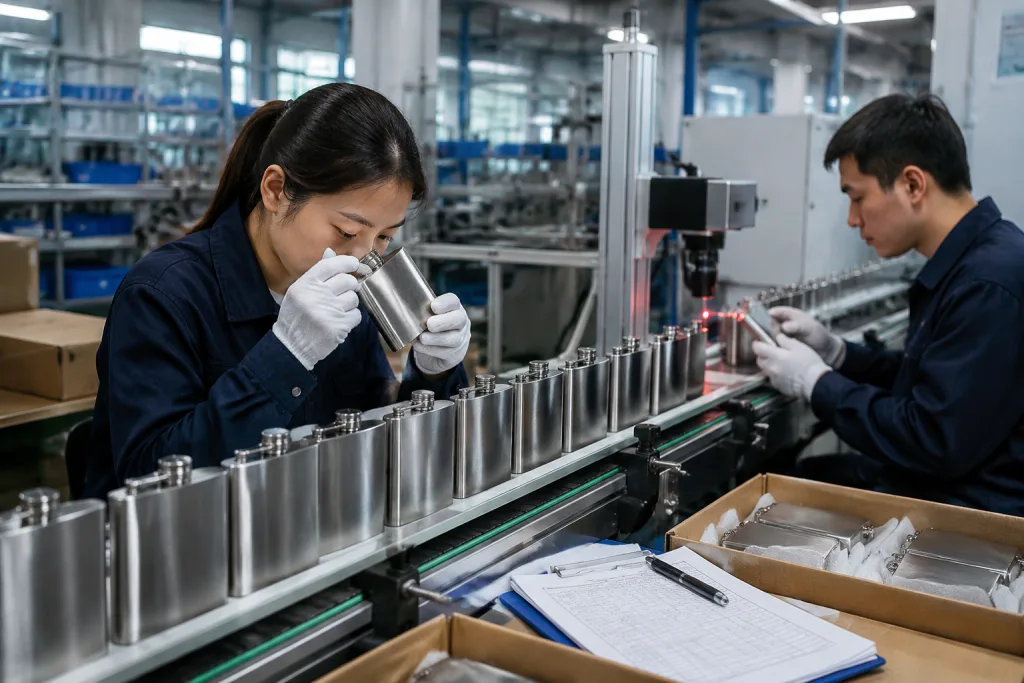
Incoming checks should confirm steel grade documentation, sheet thickness, cap parts, washer fit, and coating sample color. Our QC usually checks sheet thickness with a digital caliper before stamping, then matches the coating chip against the approved sample under the same light. During production, line workers should run leak tests. A common method is filling with water, closing the cap, inverting for 10 minutes, and checking for seepage around the cap and seam. For higher-risk orders, we add pressure or vacuum testing on a sample basis, usually after the first 200 pcs come off the line.
Final inspection should use an agreed AQL plan. For most B2B drinkware buyers, AQL 2.5 for major defects and AQL 4.0 for minor defects is a workable baseline. Major defects include leakage, sharp edges, wrong logo, serious coating peel, dented body, broken cap, odor, or incorrect capacity. Minor defects include small scratches, tiny dust points in coating, slight carton rub marks, or minor print specks within the approved limit sample. We have seen this go sideways when the PO says “matte black” but the approved sample is closer to gunmetal; QC pulled the sample, and the buyer flagged it only after cartons were stacked.
Ask the canteen factory for inspection photos by defect type, not only clean beauty shots. You need cap threads, inside body, bottom stamp, logo close-up, carton mark, barcode or FNSKU label if used, and packed carton weight. For one 6 oz flask order, the carton weight was 13.6 kg on the packing list but 12.9 kg on our scale, so we opened three cartons and found missing funnels. A canteen supplier that resists basic QC documentation is giving you a warning before the goods leave China.
Pack For Your Sales Channel
Packaging is decided before mass production, not after the flask is polished. It changes damage rate, warehouse handling, retail shelf look, and whether customs can read the carton without opening it. For a low-cost event giveaway, we may run 500 pcs bulk packed with each hip flask in a clear OPP bag. Retail is different. The buyer usually needs one white box or one printed color box, plus barcode size checked at 30 mm x 20 mm before artwork approval. If the order ships to Amazon FBA or a 3PL, confirm carton labels, FNSKU position, and master carton size before the line starts packing.
A typical 6 oz flask might pack one piece in a polybag and white box, then 100 pieces per master carton. That sounds simple until QC weighs the loaded carton and finds 16.8 kg instead of the planned 14 kg because the buyer added a funnel and gift sleeve. For export, we normally use 5-layer cartons for heavier drinkware, and we run carton drop testing when the sales channel has strict damage claims. Saving USD 0.03 on carton board is the wrong question to ask if your distributor drinkware customer charges back USD 8 per damaged retail unit.
Compliance starts with packing, too. For Europe, buyers may ask for LFGB, REACH, and food-contact declarations, and the carton mark must match the PO country wording. We once had a shipment held because the PO said “Germany” but the side mark typo said “Germnay.” For the United States, FDA food-contact expectations and California Proposition 65 review may apply depending on material and decoration. If the flask is part of a kids set or outdoor set, ASTM or extra market rules may be added to the brief, so your canteen vendors need the destination market before quoting.
Shipping terms change the math. FOB Ningbo is common for Zhejiang factories; some buyers ask for FOB Shanghai or EXW because their forwarder is consolidating orders from 3 suppliers. If you are combining hip flasks with canteen customized bottles, customizable drinkware, or larger growlers, ask for carton CBM early and check the packing list against the forwarder booking. We ship enough mixed drinkware orders to say this plainly: freight can move landed cost more than the logo method.
Approve The Order Without Guesswork
Before deposit, lock the order file down on paper: signed quotation, artwork proof, material spec, packing method, compliance requirement, production lead time, payment terms, and inspection standard. This is basic stuff. Still, we see orders go sideways because one point sat in WeChat and never made it into the PI. Last month QC pulled a sample against the wrong logo size because the PO said “front logo” but the approved PDF showed a 40 x 35 mm position. A serious canteen supplier puts all of this into the proforma invoice or product spec sheet.
For this buyer case, a clean approval package might read: 5,000 pieces of 6 oz 304 stainless steel hip flask, 0.5 mm body wall, matte black powder coat, laser logo 40 x 35 mm on front center, captive screw cap, silicone washer, one funnel included, individual printed box, 50 pieces per export carton, FOB Ningbo, 35-day production after approved sample, AQL 2.5/4.0 final inspection, BSCI factory audit available, REACH and food-contact test reports required. That is the level the line needs. If the buyer flagged carton drop risk, we would also add carton size and gross weight, because 50 pcs per carton means nothing if the carton lands at 18.6 kg and your warehouse cap is 16 kg.
This detail protects both sides. Your sourcing team can compare 3 suppliers on the same basis, finance sees why one offer is $0.18 higher, and we can book 304 coil, powder, and gift box stock without rework. We’ve seen one typo on a PO change “silicon washer” to “without washer,” and that small miss turned into a leak complaint after shipment. If your catalog later expands into custom canteen, customizable canteen, customized growler, or other distributor drinkware lines, use the same approval method. The product changes; the control points do not.
Good OEM work is not about squeezing every cent from a canteen manufacturer. This is the wrong question to ask. The job is to remove unclear decisions before tube cutting, deep drawing, welding, coating, logo marking, packing, and container loading start. Once metal is cut on the press line, the math doesn’t work if you need to remake 5,000 bodies over a missing cap spec. In China export manufacturing, the cheapest mistake is the one caught on paper before sampling starts.
Send Your Flask Spec For Factory Review
Share quantity, finish, logo artwork, market, and packing needs. We will return a practical OEM quote with MOQ, lead time, and QC notes.
Frequently asked questions
What MOQ should I expect for an OEM hip flask order?
For a standard stainless steel hip flask, expect 1,000 pieces for a plain brushed finish and 2,000-3,000 pieces per color for powder coating or custom printing. If you add a molded cap, special box, or private-label accessory set, MOQ can move to 5,000 pieces. A Zhejiang factory may accept a lower trial quantity, but the unit price and setup cost will be higher. For mixed custom drinkware programs, do not assume you can combine flask, custom canteen, and custom growler quantities into one MOQ. Factories usually calculate MOQ by body type, finish, and decoration process.
Is 201 stainless steel acceptable for hip flasks?
201 stainless steel can work for low-cost canteen promotional programs where price matters more than long-term corrosion resistance. For Europe and North America, 304 stainless steel is usually the better choice for retail or distributor drinkware orders. It costs more, often USD 0.25-0.50 per flask depending on thickness and finish, but it gives a stronger food-contact position and better resistance to staining. If a canteen vendor quotes a very low price, ask whether the body, cap, and weld area are all 201 or 304. Mixed-material products can create inspection and compliance problems.
How long does sampling and production take?
A normal OEM flask sample takes 7-12 days after vector artwork, color reference, and deposit or sample fee are confirmed. Bulk production usually needs 25-40 days after sample approval for 3,000-10,000 pieces. Add more time for custom color matching, gift boxes, compliance testing, or peak-season factory loading before major holidays in China. If you are combining hip flasks with customized canteen or customizable growler items, plan the schedule around the slowest SKU, not the fastest. Final inspection and booking can add another 3-7 days before shipment.
Which logo method is best for a flask?
Laser engraving is the most durable option for powder-coated or stainless steel flasks, and it is a good fit for retail, corporate gifting, and distributor canteen programs. Silkscreen is cheaper and works well for simple one-color logos, but it needs abrasion testing and clear Pantone control. Heat transfer handles more complex artwork, although curved flask bodies require careful setup. For a 5,000-piece order, ask for one physical pre-production sample and a tape or rub test before approval. The best method depends on finish, logo size, target price, and how the buyer will use the product.
What should I inspect before shipment?
Inspect leakage, cap threading, washer fit, body dents, sharp edges, coating adhesion, logo position, capacity, odor, carton marks, and barcode labels. Use AQL 2.5 for major defects and 4.0 for minor defects unless your customer requires stricter limits. For Amazon FBA or retail distribution, also verify FNSKU placement, carton weight, carton dimensions, and master carton strength. Ask your canteen factory for defect photos and measurement photos, not only packed-goods photos. If the order ships from China without a clear inspection report, you carry the risk after the container leaves port.