Key Takeaways
- A 64 oz stainless custom growler should usually specify 0.5 mm inner and 0.6 mm outer wall thickness, not just “18/8 stainless steel.”
- For new decorated SKUs, practical MOQ is often 1,000-3,000 units per color, with 35-45 day lead time after sample approval.
- Leak and pressure issues usually come from thread tolerance, silicone hardness, and cap design; ask for 100% vacuum and leak testing plus 1.0 AQL on critical defects.
- EU and North America programs need SKU-specific REACH, LFGB or FDA contact testing, plus transit validation such as 1A drop checks and carton edge compression.
You do not lose money on a custom growler because stainless steel is expensive. You lose it after the PO is placed, when small misses stack up on the line: threads bind after 3 cap cycles on the torque tester, powder coat chips at the carton edge drop test, logos drift 2 mm off center, silicone seals hold hot water but leak under carbonation, or the lab report covers the wrong SKU. That last one happens more than buyers expect. If you are buying from an oem manufacturer growler program in China, choosing the shape is the easy part. The real job is writing failure out of the spec.
At BottleForge Industrial in Hangzhou, Zhejiang, we see this with buyers in Europe and North America every month. A project starts as a simple custom growler or custom canteen request, then turns into a claim because the brief was loose and QC pulled the sample too late. Zhejiang factories can build reliable products at scale, but the spec has to be tight before sampling moves to mass production: wall thickness in mm, finish standard, test method, artwork tolerance, and AQL. If those points are missing, we have seen this go sideways fast—the buyer flagged a color mismatch once, but the real issue was a typo on the PO and the wrong Pantone was signed off.
Where growler projects usually fail
A buyer asking for an oem manufacturer growler usually starts with capacity, finish, and logo position. Normal start. Not enough. The failures show up between teams: engineering builds around still liquid, sales quotes a glossy coating that gets hairline scratches after 18 days at sea, and QC signs off appearance but skips cap-torque recheck after coating buildup of 0.08 mm on the neck.
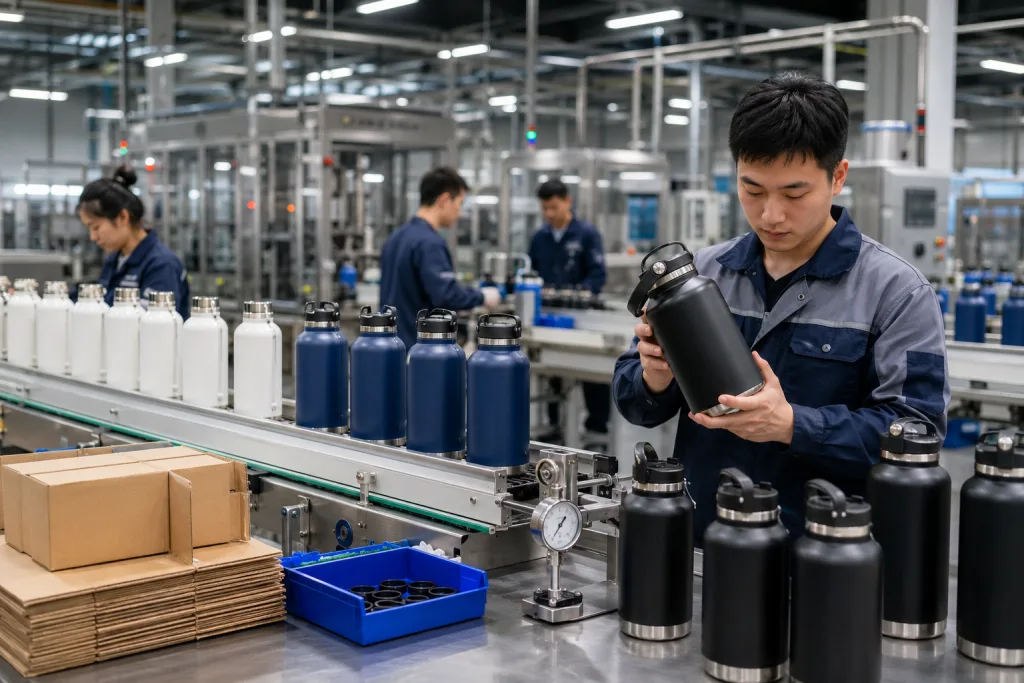
If you source from a canteen factory or canteen manufacturer in Zhejiang or elsewhere in China, treat the growler as a full assembly, not a bottle. We run body, neck, thread, cap, gasket, paint, decoration, inner electropolish, carton divider, and labeling as linked points on the line. A customized growler with a swing top carries different risk from a screw-cap customizable growler; the wire bail, hinge fit, and gasket compression give you more places to lose seal. A custom canteen for cold brew coffee behaves differently from a beer growler. Pressure is different. Cleaning chemistry is harsher. Refill frequency is higher. This is the wrong question to ask if the buyer only wants to compare bottle shape and FOB price.
Most B2B claims trace back to six weak specs: material grade, dimensional tolerance, seal performance, coating adhesion, decoration durability, and packaging protection. We have seen all six go sideways. One PO even said “304 inner / 201 outer” by typo, and the buyer flagged rust risk after pilot samples were already made. Documentation is another failure point buyers miss. A test report from an older cup does not prove your new customized drinkware SKU if the lid, paint, or silicone changed. Customs, marketplaces, and retail compliance teams check the exact build that ships, and QC pulled the sample more than once because the lid gasket hardness shifted from 50 to 60 Shore A without the file being updated.
As a practical baseline, programs in China often run with MOQ 1,000 units for plain stock colors and 3,000 units for a new body mold or special cap, with production capacity above 300,000 units per month for mixed drinkware lines. Good reference numbers. They do not protect your order. The protection comes from a spec sheet tied to sample sign-off, in-process checks, and final AQL 2.5. We ship plenty of projects at those volumes, but the math doesn't work if the carton drop test fails at 76 cm because the divider board is 1 mm too thin.
Leakage starts at the neck finish
The costliest failure is still the simplest one: the growler leaks after filling, after a delivery route, or after sitting in a consumer car for two days. Buyers usually blame the silicone ring first. We’ve seen that go sideways. On the line, the root cause is often stack-up in the neck finish and cap fit, not the ring itself. QC pulled the sample on one 5,000-piece run and found the thread start drifting by 0.3 mm, which was enough to break the seal under transport vibration.
What to specify
- Thread standard and tolerance: define major diameter, pitch, start point, and allowable variance in mm. If this line is vague on the PO, the math doesn’t work.
- Gasket material: food-grade silicone, usually 50-60 Shore A hardness for screw-cap growlers. We also check gasket flash at the cutting edge before assembly.
- Torque range: require a practical closing torque window, for example 1.8-2.5 N·m. We run this with a digital torque meter, not by hand feel.
- Leak test method: upside-down water test for 30 minutes and pressure or vacuum verification where applicable. Sampling is not enough for seal defects.
For a custom growler, ask what the cap structure actually is: injection molded PP, stainless wrapped over plastic, or full stainless with internal polymer components. Buyers flag “all metal” caps all the time, then get upset when they see a plastic core. The core is often the reason the cap seals better over 20,000 cycles. That is fine if it is declared, tested, and matched to the neck finish. Repeatability is the real target.
If your market includes carbonated beverage use, say it at RFQ stage. This is the wrong question to ask after tooling approval. A lot of generic insulated growlers hold still liquids without trouble and then fail under pressure pulses during truck transport. We ship samples with pressure checks for this reason. You need a cap and neck built for that job, not a nicer-looking version of a standard customizable drinkware body. Ask the canteen supplier for burst or pressure simulation data. Verbal reassurance is cheap.
A leak is a critical defect. Treat it with 100% testing, not sampling only.
At final inspection, critical defects such as leakage should be checked at 100%, while cosmetic and minor dimensional points can run to AQL 2.5 or 4.0 depending on the program. For premium retail, many buyers set AQL 1.0 major and 2.5 minor. For promotional volume, the threshold may be looser, but not on seal performance. We had one buyer push back on 100% leak testing for a 12,000-piece order because it added 1 day to packing. Then wet cartons showed up in a pilot shipment, and the freight claim cost more than the test. A distributor growler program gets expensive fast once returns start with moldy inserts and stained master cartons.
Insulation claims that collapse in transit
Buyers see “double-wall” on a 64 oz growler and think the insulation issue is closed. It isn’t. We’ve seen vacuum retention fail from uneven wall thickness, a weak getter bake, a bottom hit that shifts the vacuum point, and test standards that were never defined on the PO. QC pulled the sample on one lot last spring, and three units had a 0.08 mm wall spread from body to shoulder.
For a typical 64 oz stainless customized canteen or growler, a solid baseline is 304 stainless steel inside and outside, with about 0.5 mm inner wall and 0.6 mm outer wall. Go thinner and the math doesn’t work for most retail channels. You save a few cents, then the line starts showing dents after vacuuming or orange-peel marks after powder coating. If you sell into outdoor retail, ask for carton drop tests and product drop tests with filled samples at the packed weight, not empty bodies. We run 76 cm and 1 m drop checks on master cartons for this reason.
Insulation claims need a test method written down. Example: fill with 95°C water, ambient 20°C, then record temperature at 6 and 12 hours; or fill with 4°C water and record at 12 and 24 hours. Without that, you can’t compare one canteen manufacturer or canteen vendors quote to another. This is the wrong question to ask: “How many hours does it hold?” Ask how they tested it, with what sample count, and what fail point they accept. Same problem with no-sweat claims. Condensation shows up when vacuum is weak or a hidden weld defect starts transferring heat. We’ve seen this go sideways after a base weld pinhole passed visual check but failed after ice-water fill.
Ask the canteen supplier or distributor drinkware partner for these production controls:
- 100% vacuum inspection before coating
- Random thermal retention verification every lot
- Bottom dent resistance check after packaging validation
- Traceability by date code or laser lot mark
Zhejiang factories with stable lines usually run these checks already, but get them into the QC standard in writing. AQL 2.5 alone is not enough here. We ship plenty of Amazon FBA and private-label retail orders, and one bad lot hurts fast: removals, replacement freight, review damage, and account pressure. The buyer flagged this exact issue on a 3,000-piece order after transit dents broke vacuum on less than 2% of units. That loss was bigger than the USD 0.20-0.50 saved by thinning the body or cutting inspection.
Coating and logo defects are predictable
Decoration failures are usually traceable. We see four causes on the line: weak surface prep, the wrong print process for the finish, cure shortened to hit ETD, or artwork pushed onto a curved panel that never had enough flat area. A buyer will lock in Pantone and miss abrasion. That is where canteen custom and canteen promotional orders get into trouble. Last month QC pulled a sample with a clean color match and the logo started scuffing after 30 rubs.
For powder coating on a growler body, check adhesion, film build, and edge coverage. We usually measure with a dry film gauge, and a practical target is a uniform film around 60-80 microns, with cross-hatch adhesion testing and solvent rub checks. If the bottle has a narrow shoulder or a deep base groove, the coating gets thin on the edge first, then chips after carton vibration. We have seen this on a 1.2 mm groove radius. Matte black hides the problem. Light colors and metallic finishes show it fast.
The decoration method matters just as much. Silk screen works on big runs and keeps unit cost down, but laser engraving lasts better on stainless or powder-coated surfaces. UV print looks sharp and handles gradients, but only if the varnish and cure profile are matched; we have seen gloss logos sink after a 65°C oven pass that was too short. If you want a premium customizable canteen or customized drinkware line for retail, do not stop at a visual approval sample. Ask for an abrasion test standard. This is the wrong question to skip.
- Logo position tolerance: typically ±1.5 mm to ±2.0 mm
- Color tolerance: approved against Pantone under controlled lighting
- Dishwasher warning: if not tested, do not imply dishwasher safe
- Cure validation: request tape and rub tests after full cure, not just same-day print appearance
A serious canteen distributor or canteen distributors network asks what the bottle looks like after 20 shipping cartons are stacked in a container for 28 days. That is the right question. We ship samples through a carton compression check for this reason, and the buyer flagged edge wear on a pale beige bottle before mass production. Cosmetic quality is not how it looks under factory lights. It is what the customer sees after freight, warehousing, and shelf handling.
Compliance paperwork that does not hold up
One of the easiest mistakes in B2B custom drinkware sourcing is taking generic compliance files at face value. The buyer gets FDA, LFGB, or REACH papers, saves the PDF, and assumes the SKU is covered. Then the retailer or customs broker asks a simple question: was the exact cap, gasket, coating, and logo decoration on the shipped item tested? QC pulled the sample, checked the report, and the part code did not match. Silence after that usually costs 7 to 10 days.
If you buy from canteen manufacturers or a canteen vendor in China, ask for SKU-level document matching. This is the right question. The report should show the same contact materials used on the line, down to the silicone gasket hardness, the PP cap insert, and the outside coating if there is any migration risk. For Europe, common checkpoints include REACH SVHC screening and, depending on the market, LFGB-related food contact expectations. For North America, FDA food-contact alignment is the baseline. If the item is sold to kids, children’s-product review may also be triggered under CPSIA. We have seen buyers send one report for a wide-mouth bottle and use it for a growler with a different lid set; the math doesn't work.
Social and quality audits matter to plenty of brand owners too. BSCI, Sedex, and ISO-style systems do not guarantee a good product. They only show whether the factory runs with some control. On our floor, that means material incoming logs, torque checks on the capping fixture, and AQL 2.5 records that actually match the shipment date. Tie the paperwork to real controls. If the factory says 304 stainless, ask for mill certs or XRF spot verification; our handheld XRF gun gives an answer in under 30 seconds. If a coating is called “eco-friendly,” ask which standard supports that claim. We have seen this go sideways after a buyer flagged packaging copy that sales had approved too loosely.
For imported customized canteen and growler programs, your purchase order should list:
- Applicable food-contact test standard and responsible lab
- Exact bill of materials for body, cap, gasket, straw if any
- Country-of-origin marking requirement
- Retail packaging claims allowed and prohibited
- Barcode, FNSKU, and carton label format if going to Amazon FBA
A solid distributor canteen or canteen suppliers relationship is built on this level of detail. Zhejiang factories shipping to the EU and US know the drill, but do not assume anything. We ship plenty of repeat programs, and we still check exact-match records before deposit release and again before balance payment. One typo on a PO—black lid instead of black-coated lid—can break the whole paper trail.
Packaging failures erase factory quality
A bottle can pass every in-house test and still land as a claim. This is where first-time buyers miss the spec. They ask for an egg-crate divider or a white box, then assume standard export packing will cover the risk. Sometimes yes. On 64 oz and 128 oz growlers, often no. Handles catch, bamboo trim rubs, swing tops shift, and QC pulled samples last month with scuffing before the cartons even reached the drop-test table.
For a heavy customized growler, ask your canteen factory to validate the full shipper, not just the bottle. We run packed drop tests, carton compression checks, and fit checks to see whether the handle or lid touches the next unit. A 64 oz bottle with a metal handle can punch through the side wall of the next carton if the partition board is soft or the cavity runs loose by 4-5 mm. Buyers sometimes push back on insert cost. The math doesn't work once one broken unit turns into a full claim file.
Good export specs usually include:
- Individual polybag or recycled wrap to prevent rub marks
- Partition board or molded insert sized to the exact body diameter
- 5-layer export carton, or stronger if total carton weight exceeds your target
- Carton gross weight held to a manageable range, often under 18 kg
- Carton markings with PO, SKU, quantity, made-in-China mark, and destination code
If your channel is e-commerce, ask for ISTA-minded packing logic even when full certified testing is not required. Parcel-direct and palletized wholesale do not use the same carton setup. This is the wrong question to ask: “Can you pack it the same way as retail export?” No. A distributor growler item going through parcel handling needs tighter void control, stronger corner protection, and tape spec checked on the line at 48 mm width, not the basic setup used for a master carton stacked on a pallet. This is where canteen suppliers and canteen vendors look close on price but split fast on claim rate.
Do not skip palletization. Stretch-wrap tension, carton overhang, and box orientation decide how the load survives a wet port and inland trucking. We’ve seen this go sideways on North American shipments where the buyer flagged a “coating issue,” but the real cause was carton collapse after moisture pickup. One PO even had the destination code printed wrong, so the pallets were rehandled twice. The bottle left Zhejiang in good condition. The carton system did not hold the route.
How to write a PO that prevents surprises
If you want fewer surprises from an oem manufacturer growler, write your purchase order like a control document, not a sales summary. Good buyers are not the ones who push hardest on price. They are the ones who state pass/fail points, chargeback terms, and approval ownership in plain language. On our line, one missing note on logo position can turn into a 3 mm shift that QC pulled at final inspection.
Your PO package should include a signed golden sample, artwork file, specification sheet, packaging drawing, barcode instruction, test plan, and inspection standard. If you are buying a customizable growler, custom canteen, or broader customizable drinkware line, tie each SKU and each part version to a revision number. Put it on the PO, the spec sheet, and the carton mark file. We have seen this go sideways when the factory ran body version B with cap version A because both were marked “approved” in email, and the PO had no rev code at all.
A practical control sequence looks like this:
- Pre-production sample: confirm dimensions, finish, and branding
- PPS approval: freeze BOM, color, logo location, and packaging
- In-line inspection: monitor thread quality, weld appearance, coating adhesion, print alignment
- Final inspection: AQL by defect class, 100% leak and vacuum checks
- Pre-shipment file review: packing list, carton photos, test reports, labeling records
For many programs, lead time after PPS is 35-45 days. If you need a new mold, a special cap, or a custom gift box, expect more time; a new cap tool can add 12 days, and a gift box with foam insert often moves packing approval from 3 days to 8. MOQ may start at 1,000 units, but the math often changes once decoration and packing get complex. Mixed colors, private packaging, and two logo processes on one body can push the efficient order quantity to 2,000 or 3,000 units because the line loses time on changeovers. Ask your canteen supplier or canteen manufacturer where the process becomes stable. This is the better question. “What is your lowest MOQ?” usually gets a sales answer, not a production answer.
The right factory in China is not the one that says yes to every request. It is the one that comes back and says the tolerance is too loose, the barcode size is missing, or the retail box claim needs test data first. We ship smoother projects when the factory pushes back early. Last month a buyer flagged a condensation claim on a PO, but there was no test method listed, so we stopped the artwork before 5,000 boxes were printed. That is how reliable customized drinkware programs are built.
Send your growler spec before the problems start
Share your target market, capacity, decoration, and packaging needs. We will review the risk points, MOQ, lead time, and QC plan before you place the PO.
Frequently asked questions
What MOQ should I expect for a custom growler order from China?
For a standard stainless steel OEM growler using an existing body and cap, MOQ is often 1,000 units per color or logo version. If you need a new lid structure, custom handle, or unique mold, practical MOQ usually moves to 2,000-3,000 units, sometimes higher if tooling amortization is included in unit cost. For plain samples, many factories can provide 1-3 pieces quickly, but decorated pre-production samples normally take 7-12 days after artwork confirmation. In Zhejiang, a stable export factory may quote 35-45 days for mass production after PPS approval and deposit. If you split too many colors below MOQ, decoration consistency and carton efficiency usually get worse.
How do I know whether a growler is suitable for carbonated beverages?
Do not assume every insulated growler can handle carbonation. Ask the factory to state the intended use in writing and provide cap structure details, gasket material, and pressure-related test data. A screw-cap growler for still liquids may leak or vent under pressure spikes during transport. You should request neck and cap dimensions, silicone hardness around 50-60 Shore A, and a defined leak or pressure test protocol. If the product will be used for beer or sparkling beverages, say so before sampling. That lets the canteen manufacturer choose the correct closure design. Generic leak tests with plain water are not enough for carbonated applications.
Which QC standard is reasonable for custom drinkware orders?
For B2B drinkware, many buyers use ANSI/ASQ Z1.4 sampling with AQL 2.5 for major defects and 4.0 for minor defects. For premium retail programs, AQL 1.0 major and 2.5 minor is common. Critical defects, especially leakage, vacuum loss, sharp edges, wrong barcode, or food-contact nonconformity, should be set at zero acceptance and often checked at 100%. You should define defect classes before production starts. For a customized growler, include standards for logo position tolerance, coating adhesion, dent allowance, carton marking, and functionality. If your supplier only promises “good quality” without a written AQL and test plan, expect arguments at shipment time.
What compliance documents should I ask for when importing growlers to Europe or North America?
Ask for SKU-specific food-contact documentation tied to the exact body, cap, gasket, coating, and decoration you are buying. For Europe, buyers commonly request REACH-related declarations and, depending on channel expectations, LFGB-oriented food-contact support. For North America, FDA food-contact alignment is usually the starting point. If the item is for children, review additional requirements before making packaging claims. Also request material declarations, country-of-origin marking confirmation, and test records that match current production, not an older model. If the factory in China changed silicone, paint, or cap supplier, old reports may no longer be enough for your importer or retail compliance team.
What price range is realistic for a stainless steel OEM manufacturer growler?
For a common 64 oz double-wall stainless growler with standard powder coating and one-color logo, FOB China pricing often lands around USD 5.50-8.50 depending on steel gauge, cap construction, order volume, and packaging. Simpler single-wall versions can be lower, while premium lids, handle assemblies, gift boxes, or laser branding can push pricing above that range. Very low quotes usually hide thinner walls, weaker packaging, or less testing. Ask the canteen supplier to break out costs for bottle, cap, decoration, packaging, and any tooling. That makes it easier to compare offers from different Zhejiang or China factories on an equal technical basis.