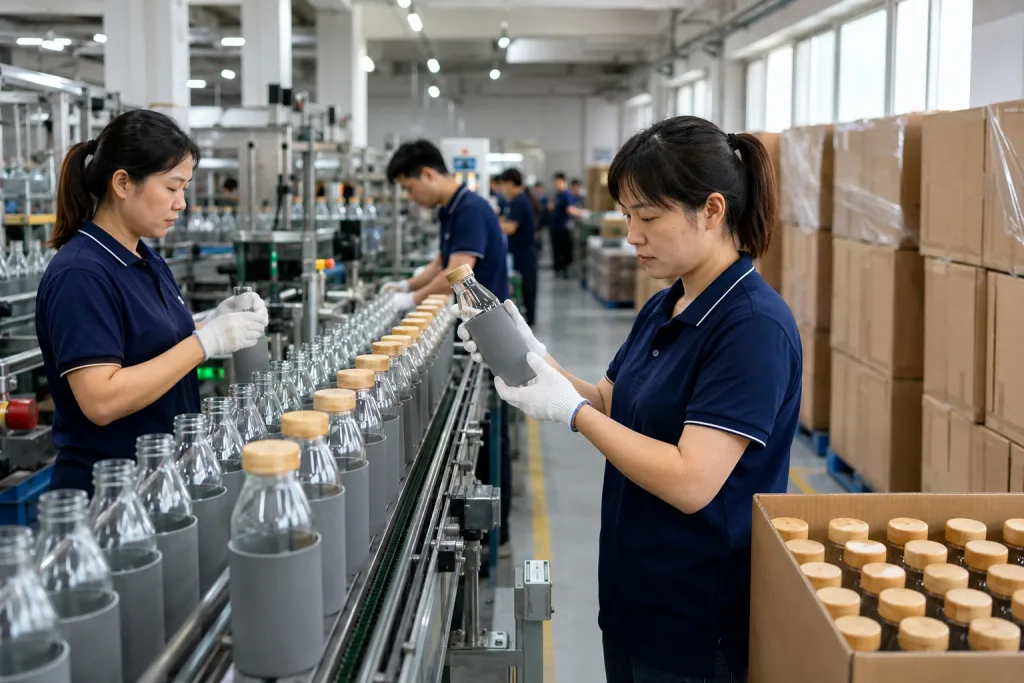
Key Takeaways
- For a 550 ml borosilicate bottle, practical MOQ is usually 3,000-5,000 pcs per design, with sample time 7-12 days and mass production 30-45 days
- FOB China pricing for a decorated 550 ml glass bottle commonly lands around USD 1.65-2.80 depending on glass type, sleeve, lid, and print method
- QC should include leak test at 0.03-0.05 MPa, thermal shock checks, carton drop test, and AQL 2.5 for major defects before balance payment
- If you need FBA or distributor drinkware fulfillment, confirm FNSKU labeling, master carton limits under 15 kg, and barcode placement before packaging approval
You need a glass bottle that looks right on shelf, survives transit, passes compliance, and still lands at a workable FOB price. Sounds simple. Then a supplier quotes from a hand sketch, swaps the cap after sampling, or ships a bottle that leaks at 0.03 MPa on the air-pressure tester. Buyers in Europe and North America hit the same wall: 12 suppliers on the shortlist, not enough engineering detail, and too much sales talk.
We’ll run this like a real factory order, not a catalog pick. You are buying from an OEM manufacturer glass bottle source in Zhejiang, China, so the job is to define the bottle, lock the decoration, control risk, and inspect what we ship. On the line, even a 1.5 mm logo shift or a typo on the PO can turn into a claim later. If you also buy custom canteen or customizable drinkware programs from a canteen factory, the flow is close, but glass gives you less room for vague specs. This is the wrong question to ask: “What’s your best price?” Ask what drawing, closure, and test standard the quote is based on.
Start with the order brief
A buyer sends an RFQ for 20,000 units of a 550 ml customized drinkware program: clear glass bottle, bamboo lid, silicone sleeve, one-color logo, retail box, launch date in 65 days. That gives us a starting point. It does not give us a quote we can stand behind. On our side, sales will open the spec sheet, and the line will ask the first hard question within 10 minutes: is 550 ml the real fill or the brimful?
For an OEM manufacturer glass bottle project, you need to lock six items before the first useful price appears: capacity, glass type, mouth finish, lid construction, decoration method, and packaging standard. Leave one open and the math doesn't work. A supplier in Zhejiang, China will either quote high to cover risk or quote low and add cost later through changes, and we have seen this go sideways over a 2 mm mouth mismatch on the PO.
- Capacity: 350 ml, 500 ml, 550 ml, 750 ml and 1,000 ml are common. Real fill capacity and brimful capacity must be stated separately.
- Glass: soda-lime is cheaper; high borosilicate handles better thermal shock and usually looks cleaner for premium custom drinkware.
- Wall thickness: typical single-wall bottles run about 2.2-3.0 mm depending on shape and capacity.
- Lid: PP inner with bamboo outer cap is common. If the bamboo touches water directly, mold risk goes up.
- Decoration: silkscreen, decal, heat transfer, laser on bamboo lid, or sleeve deboss.
- Packout: bulk pack, white box, color box, PDQ, or e-commerce drop-tested mailer.
For this scenario, the buyer chooses a 550 ml high borosilicate body, 63 mm mouth, 2.5 mm nominal wall, food-grade LFGB silicone sleeve, bamboo-look screw lid with PP inner, and one-color silkscreen logo. MOQ is 5,000 pcs per colorway. That is a workable brief, and QC can pull the sample standard from it. A capable canteen manufacturer may try to cross-sell a matching stainless custom canteen line, but this is the wrong question to ask at this stage. We run glass and steel as separate engineering projects even if one canteen vendor offers both, because the tooling, leak test, and defect points on the line are not the same.
What the first quote should include
A real quote from a canteen supplier or glass bottle factory should read like a short spec sheet, not a flyer with a nice rendering. If the supplier sends only a unit price and a mockup, ask them to revise it. You are buying output from the line: yield rate, print consistency, leak performance, and whether the bottle survives a 1.2 m drop test in export packing.
For our scenario, a reasonable first FOB quote from Zhejiang, China might look like this:
- 550 ml high borosilicate glass bottle body: USD 0.78
- Bamboo-look screw lid with PP inner and silicone seal: USD 0.32
- Silicone sleeve, custom Pantone: USD 0.24
- 1-color silkscreen on body: USD 0.08
- Laser logo on lid: USD 0.05
- White box with barcode label: USD 0.11
- Assembly, leak test, export carton: USD 0.14
Total FOB Ningbo or Shanghai: USD 1.72 at 20,000 pcs. At this volume, the math works. Drop the MOQ to 3,000 pcs and add a four-color wrap decal plus a retail color box with insert, and the same bottle may move above USD 2.20. We see buyers push back on that jump, but setup loss is real on small runs. If the glass shape is fully new, mold cost could be USD 1,200-3,500 depending on complexity and cavity count; an 8-cavity tool is not priced like a simple stock silhouette.
Ask the supplier to state:
- Whether the quote is FOB, EXW, or DDP
- Lead time for pre-production sample and mass production
- Carton quantity, carton size, and gross weight
- Compliance basis: REACH, LFGB, FDA, Prop 65 where relevant
- Whether bamboo, silicone, paint, and inks are tested separately or only as assembled goods
Also ask for the numbers behind the quote. We ship faster when this is clear on day 1: pre-production sample in 7 days vs 12 days, mass production in 18 days vs 30 days, carton pack at 24 pcs or 36 pcs, gross weight at 14.5 kg or 18.2 kg. QC pulled the sample once because the PO typed "silicon sleeve" instead of "silicone sleeve," and the supplier matched the wrong material note. Small error, expensive delay.
If you work with canteen distributors or a distributor growler channel, ask for landed cost modeling early. This is the right question. A glass bottle can look competitive at FOB, then go soft after 3% breakage allowance, heavier freight, and retail packaging are added. We have seen this go sideways when the buyer flagged only bottle cost and ignored carton drop performance.
Sampling is where problems surface
The first sample round saves weeks if you use it properly. Do not sign off because the shape looks close on a video call. Use a sign-off form and mark every deviation line by line. In this scenario, the factory sends samples in 9 days. Visual quality is good, but three defects show up fast: logo position is 4 mm low, the bamboo grain is darker than approved, and one lid weeps after being inverted for 30 minutes. QC pulled the sample and tagged each issue on the bench card.
That part is normal. The real test is the factory response. A solid supplier sends corrective action with dates, root cause, and the next check point on the line, not a long excuse email. We have seen this go sideways when the sales side says “approved style” and production never got the revised drawing.
What to check on the sample
- Capacity: verify brimful and usable fill. A claimed 550 ml bottle may hold 575 ml brimful and 540 ml practical fill.
- Weight range: for this size, body weight often lands around 320-420 g. Ask for tolerance, for example ±15 g.
- Thread fit: lid should start smoothly with no cross-threading. We usually check this by hand on 10 consecutive turns, and the buyer flagged one cap last month that bit on turn two.
- Leak performance: invert filled bottle for 2 hours, then test under 0.03 MPa air pressure if the factory has the fixture.
- Print adhesion: cross-hatch or tape test where suitable, plus 50 dishwasher cycles only if the print method is rated for it.
- Odor: silicone sleeve and seal should not carry strong chemical smell after 24 hours airing.
Buyers new to customized canteen or customizable canteen sourcing often approve a “golden sample” and skip the tolerance sheet. That is the wrong question to ask. You do not need one perfect piece; you need a sample that matches what mass production can hold day after day. Ask for the final approved sample plus written tolerances. If your business includes canteen promotional orders, color accuracy needs tighter control, so define Pantone tolerance and acceptable print registration shift in writing on the PO. For glass, ±1.5 mm logo placement is a realistic control point. Asking for zero shift on every bottle at scale does not work, and any factory that says yes without pushback is telling you what you want to hear.
When a factory says “same as sample,” ask what process controls make it the same. Good factories answer with jigs, inspection points, and rework limits.
Compliance and packaging before deposit
Before you release the deposit, lock the compliance file and packaging artwork. Do it early. This is where a lot of canteen vendors look fine on the quote sheet, then stall once sourcing, QA, graphics, and shipping all touch the same PO. We’ve seen this go sideways over a 2 mm barcode shift and one missing declaration. Don’t wait until mass production is finished to ask for test reports.
For a glass bottle going to the EU and North America, typical document requests include REACH SVHC, LFGB or FDA food-contact declaration depending on market, and if children are targeted, relevant ASTM or CPSIA checks for the finished product and accessible coatings. Ask for the reports against the finished SKU, not just raw material statements; this is the wrong question to ask if you only want a supplier self-declaration. If you market the bottle as temperature-safe, ask for thermal shock test parameters in writing, with the actual hot-cold range and hold time. If the bamboo is marketed as natural, verify the coating system and mold prevention treatment. QC pulled one sample last season where the bamboo lid looked clean but the clear coat was not the one listed on the spec sheet.
Packaging needs engineering, not just artwork. In our scenario, the buyer wants Amazon-ready and retail-ready packaging because some units go to a distributor canteen channel and some go to FBA. We run these as two packing standards under one item family, or the line gets messy fast. That means:
- Individual box with barcode and country of origin
- FNSKU placement area reserved on one panel
- Master carton under 15 kg gross where possible
- Drop test target appropriate to shipping model, often ISTA-style internal validation even if not formally certified
- Carton marks matching PO, SKU, color, and quantity exactly
A bottle factory in China may have monthly capacity of 300,000-500,000 units across standard models, but the packout line is usually the real bottleneck. That’s the part buyers miss. If each unit needs sleeve fitting, logo alignment, lid laser, barcode label, and color box insertion, output can drop 20-30% because the line keeps stopping for recheck and hand placement. The math doesn’t work if you quote packing like it’s a standard brown box job. This is why the quoted lead time of 35 days sometimes becomes 42 days. A disciplined canteen manufacturer should say that upfront.
If you are also sourcing custom growler or customizable growler programs from the same supplier, keep packaging specs separate. Don’t merge them on one pack sheet. Growlers carry different weight and drop-test stress, and carton dividers that work for a 550 ml bottle often fail on 1.2 L formats. We ship these with different partition thickness after a buyer flagged bottom impact cracks during internal drop check.
Mass production needs control points
After the deposit lands and the sample is signed off, sales should pass the file to engineering and QA with the full pack: artwork, BOM, packaging spec, and route card. This handoff shows you who is a real Zhejiang factory and who is just forwarding messages on WeChat. Ask for the production route card with station notes, not a sales promise typed at 11:48 pm.
For our 20,000-piece order, a sensible production plan looks like this:
- Day 1-3: raw material booking, decoration film confirmation, packaging material release
- Day 4-12: glass body production and annealing
- Day 10-18: lid and sleeve incoming inspection
- Day 16-24: printing, laser, and curing
- Day 22-28: assembly and in-line leak test
- Day 29-32: final inspection and carton drop test
- Day 33-35: booking and loading
Do not just ask for updates. Ask for control points. The standard three are pre-production meeting, DUPRO at 20-30% completion, and final random inspection before balance payment. Use AQL. For this type of drinkware, buyers often run AQL 2.5 major / 4.0 minor. Critical defects should be zero tolerance. Put the definitions in writing on the PO, because we have seen buyers write “barcode as sample” and then QC pulled the sample and found the EAN code had one digit transposed.
- Critical: broken rim, leaking lid, wrong barcode, contamination inside bottle
- Major: obvious print smear, sleeve split, unstable standing base, wrong component color
- Minor: small dot in bamboo coating, slight seam visibility, tiny carton mark offset
If you buy from 2 or 3 canteen manufacturers, standardize the defect list across all of them. If not, each vendor will read “acceptable” in their own way, and the line will drift by shipment two. We have seen this go sideways with base wobble limits of 1 mm at one factory and 3 mm at another. The same applies if you run a custom growler or customized growler range and need consistency across SKUs.
One practical note: make the factory record internal breakage during assembly and packing as a separate line on the production report. For single-wall glass bottles, an in-factory breakage allowance of 1-3% is not unusual. Count it early. If your PO says 20,000 shipped units, the math does not work if they only ran 20,200 and 2.5% broke at packing.
Final inspection before the container moves
Final inspection is not a formality. This is the point where you decide if the balance gets released. For this order, we book inspection only after 100% packing is done and at least 80% of cartons are sealed in Hangzhou, Zhejiang. QC pulled the sample at random, counted units, checked inner packs and master cartons, then ran product checks with a torque gauge and leak setup on the line.
A final inspection plan for an OEM manufacturer glass bottle order should cover:
- Workmanship: chips, bubbles, scratches, sharp edges, print clarity, sleeve fit
- Function: leak test on sampled units, lid torque consistency, standing stability
- Measurements: height, diameter, mouth size, logo position
- Packaging: barcode scan, carton quantity, carton dimensions, gross weight
- On-site testing: drop test on packed sample cartons, odor check, limited hot-water exposure if specified
In this case, QC found 3 leaking units in the sample because the silicone seal was not seated flat in the cap groove. That is enough to push the lot toward rejection under the agreed standard. We have seen this go sideways fast. The factory sorted and reworked 100% of the affected cartons in 2 days, then booked reinspection and passed. Do not skip final inspection because the pre-production sample looked clean; that is the wrong question to ask.
If you sell to canteen distributors, growler accounts, or retailers with compliance systems, paperwork carries the same weight as physical quality. Make sure the shipment file includes commercial invoice, packing list, test reports, inspection report, and, if required, BSCI or current factory audit status for the customer file. One buyer flagged a PO last month because the carton mark showed “GLASS BOTLE” instead of “GLASS BOTTLE.” Small typo, real delay. Buyers in Europe now ask for this as standard from China suppliers.
After approval, watch loading. For glass, the loading pattern changes the damage rate. Palletized cargo cuts handling damage but uses more container space; floor loading saves freight, but the math does not work if breakage claims start stacking up. We ship both ways. If your claim rate target is under 0.5%, decide this before the truck arrives, not after 1 container is half loaded.
What repeat orders should improve
The first order shows two things fast: what the factory runs well, and where your spec had holes. Good buyers turn that into a repeat-order file. If your first PO was 20,000 pcs, the second order should move in 12 days instead of 18 because fewer variables stay open, not because someone chased the line harder.
For repeat business, ask the canteen manufacturer to lock these items into a controlled BOM and SOP. We usually put the final version on one signed sheet at the packing table, next to the torque tester:
- Approved suppliers for glass body, sleeve, seal, and lid
- Exact Pantone references and print mesh details
- Torque range for lid closing
- Leak-test method and frequency
- Carton board grade, divider design, and tape method
- Photo standard for acceptable and unacceptable defects
This matters if you run mixed categories such as custom drinkware, customized canteen, canteen custom accessories, and custom growler lines under one brand. Buyers often assume one supplier can scale all of it smoothly. We have seen this go sideways. One Zhejiang plant may run stainless steel bottles with stable welds and clean powder coat, then struggle on glass packout because the divider fit is off by 3 mm and transit breakage climbs. Use actual KPI data, not a thick catalog, to decide allocation. This is the wrong question to ask: “Can you make it?” Ask, “What did you ship last quarter, and what failed?”
Track factory performance with numbers: on-time delivery rate, defect rate at destination, breakage claims, response time for corrective action, and quotation accuracy. QC pulled the sample on one repeat order because the PO typo changed 3-ply carton to 5-ply, and that single line item saved a claim later. If a canteen supplier quotes USD 1.68 and invoices constant add-ons later, that is not a pricing advantage. The math does not work. If another canteen vendor quotes USD 1.79 and holds spec, lead time, and QC discipline, that is usually the better long-term result.
For most B2B buyers, the right OEM manufacturer glass bottle partner is not the cheapest or the biggest. It is the factory that can turn your product idea into measurable controls, then repeat them order after order from China without drama. We ship smoother when the standards are written, signed, and checked at AQL 2.5 before loading.
Send your glass bottle spec for a real factory review
Share capacity, artwork, packaging target, and market. We will reply with practical MOQ, FOB pricing, compliance notes, and lead time from Zhejiang, China.
Frequently asked questions
What MOQ should I expect from an OEM manufacturer glass bottle factory?
For a standard 500-550 ml glass bottle using an existing mold, MOQ is commonly 3,000 to 5,000 pcs per design or colorway. If you add a custom silicone sleeve, laser logo on the lid, and retail color box, many factories in China will push for 5,000 pcs because setup loss and packaging labor increase. A fully new bottle shape usually needs a mold charge of about USD 1,200-3,500 and may require 10,000 pcs to get efficient pricing. If you are buying through a canteen supplier that combines glass with stainless items, confirm the MOQ by SKU, not just total PO quantity.
How long does a custom glass bottle order usually take?
A realistic timeline is 7-12 days for pre-production samples and 30-45 days for mass production after sample approval and deposit. If your order includes custom packaging, third-party lab testing, or Amazon FBA labeling, add 5-10 days. Peak season before Q4 can stretch lead time by another 7 days, especially if the packout line is busy. At BottleForge scale, buyers usually work backward from vessel cutoff, not factory completion date. If your launch window is fixed, reserve artwork approval and inspection slots early. In Zhejiang, the best factories will tell you where the bottleneck sits instead of promising 25 days and missing it.
What quality tests matter most for customized drinkware glass bottles?
Focus on leak performance, dimensional consistency, print adhesion, and packaging strength. For most projects, we recommend leak testing sampled units at 0.03-0.05 MPa, 100% visual inspection for chips and sharp edges, logo position checks within about ±1.5 mm, and carton drop testing before shipment. If you specify borosilicate glass, add a thermal shock check based on the actual use claim. Use AQL 2.5 for major defects and 4.0 for minor unless your channel requires tighter control. If the bottle goes into retail, scan every barcode type during inspection. If it goes to FBA, confirm FNSKU placement and master carton weights too.
Is borosilicate worth the higher cost compared with soda-lime glass?
Usually yes, if your brand position is mid to premium or the bottle may see warm liquids. High borosilicate costs more, but the difference on a 550 ml bottle is often only USD 0.15-0.35 FOB versus soda-lime, depending on shape and thickness. In return, you generally get better thermal shock resistance and a cleaner premium look. For low-cost canteen promotional programs, soda-lime can still work if the use case is cold beverages and the packaging is robust. The decision should match channel, claim, and return-risk tolerance. Paying less for the body and then absorbing breakage or complaint cost is not a savings.
Can one canteen manufacturer handle glass bottles, custom canteen, and growlers together?
Sometimes, but do not assume broad catalog means equal capability. Many canteen manufacturers in China can source stainless, plastic, and glass, yet only one or two categories are truly controlled in-house. Ask which components are made internally, what monthly capacity is available by category, and whether QC standards are shared across lines. For example, a supplier may do 400,000 stainless units per month but only assemble glass through a partner workshop. That is not automatically bad, but you need transparency. If you buy custom growler, customized canteen, and glass bottle SKUs together, set separate BOMs, QC plans, and packaging specs for each.