Key Takeaways
- A practical OEM MOQ starts at 1,000 pcs per color for most stainless travel tumbler projects
- 304 stainless steel at 0.45-0.55 mm wall thickness is the normal baseline for mid-market tumblers
- Plan 7-10 days for sampling and 30-45 days for mass production after deposit and artwork approval
- Use AQL 2.5/4.0 inspection plus leak, vacuum, adhesion, and carton drop tests before shipment
You are not just buying a cup. You are buying a branded item that has to fit a 72 mm car holder, pass a dishwasher cycle, hold heat through a 45-minute commute, and show your logo without rubbing off after 500 hand turns on the test jig. Small details kill bulk coffee travel mug orders. Lid tolerance at 0.3 mm too loose, powder coating chips on the rim, MOQ written as 3,000 pcs on the quote but 5,000 pcs on the PI, or a carton size that adds 12% to sea freight. We have seen this go sideways.
At our Zhejiang coffee mug factory, we run these oem manufacturer coffee tumbler projects for coffee chains, Amazon sellers, and corporate-gift buyers. Before sampling, buyers usually ask 6 hard questions: which steel grade, which lid structure, what logo process, what packing, what test standard, and what lead time. QC pulled one sample last month because the silicone gasket smelled after boiling-water testing; that kind of finding matters more than a nice catalog photo. The practical answers are below: what to specify, what to test, and where factory-direct China sourcing saves money or creates risk.
What should you specify first?
The first mistake is asking a coffee mug manufacturer for “a good 20 oz tumbler” without a technical brief. You will get 6 nice photos and 6 price levels, and none of them are comparable. We see this every month in Hangzhou: the buyer sends one line on WeChat, then QC pulls the sample and the lid gasket is not what their retail channel needs. For a corporate-gift buyer or coffee brand, specify the use case before the shape.
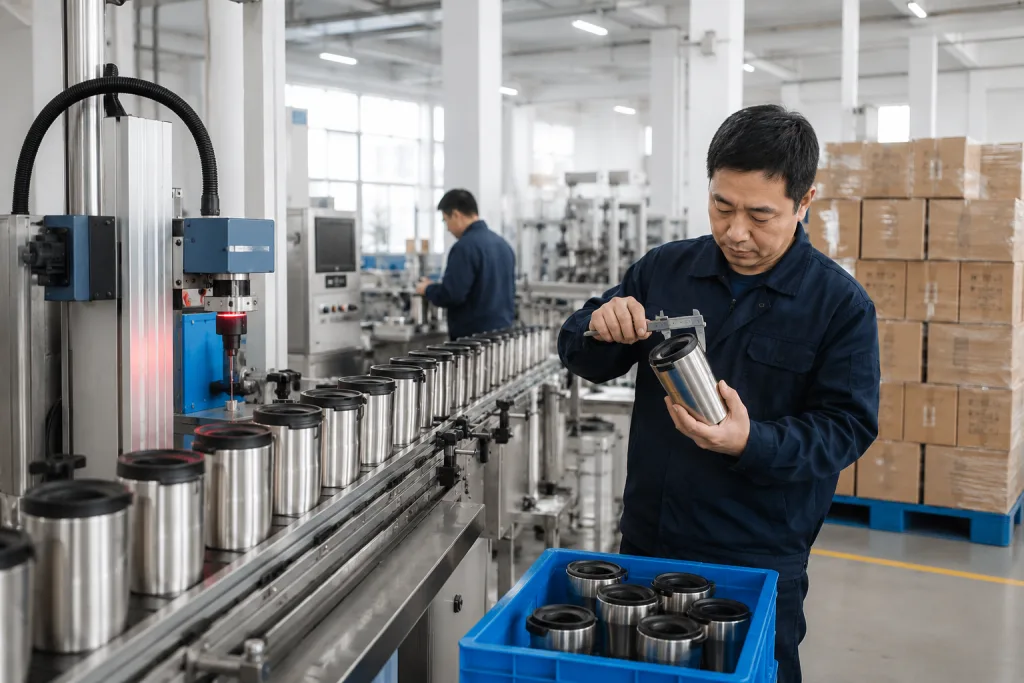
Start with capacity, drinking style, lid type, and retail channel. A 12 oz coffee mug custom made for espresso bars needs a different lid, hand feel, and carton pack than a 30 oz bulk travel tumbler for field sales teams. If your buyer expects the tumbler to fit US car cup holders, keep the bottom diameter around 68-73 mm. If you need a slim European commuter profile, 65-68 mm is safer. We run calipers on the first 10 pcs from the line because 2 mm at the base can turn into a buyer complaint. For hot coffee, double-wall vacuum insulation is standard; single-wall stainless looks cheaper on the quote sheet, but it sweats with cold drinks and feels thin in the hand.
Checklist before asking for price:
- Capacity: 12 oz, 16 oz, 20 oz, or 30 oz, with the target fill line confirmed on the sample
- Material: inner 304 stainless steel, outer 201 or 304 stainless steel, depending on price point and market claim
- Wall thickness: commonly 0.45-0.55 mm for durable retail-grade items
- Lid: push-on, slide, flip, straw, or leak-resistant screw lid, with gasket color shown on the PI
- Finish: powder coating, spray paint, brushed steel, or ceramic-look coating, matched against a Pantone chip when color matters
- Logo: laser engraving, silkscreen, heat transfer, UV print, or full-wrap decal, with artwork size in mm
- Packaging: white box, kraft box, color box, or gift tube, packed to the carton drop-test requirement
For coffee mug private label work, do not treat packaging as an afterthought. A better tumbler in a weak box still looks like a cheap promotional product. We have seen this go sideways when a buyer approved the cup but missed a typo on the PO for the color box barcode. For gift channels, 300-350 gsm paperboard is a cleaner starting point than thin white tuck boxes, and the math does not work if the box crushes before it reaches the shelf.
How does OEM pricing really work?
Factory pricing for an oem manufacturer coffee tumbler starts with steel grade and wall thickness, then moves into lid tooling, coating, logo work, packing, labor, reject allowance, and export handling. We run cost sheets down to the 0.1 mm body tolerance and carton CBM, because small gaps become real money at 3,000 pcs. Buyers often send three quotes from a coffee mug supplier list and think they are comparing the same tumbler. They are not. One quote uses 201 stainless on the outside, one uses 304 inside and outside, and the cheap one may leave out logo setup or inner carton cost.
For reference, a normal 20 oz double-wall stainless bulk coffee tumbler from China may sit around USD 3.20-5.80 FOB Ningbo or Shanghai at 3,000 pcs, depending on lid complexity and finish. A simple laser logo can add USD 0.12-0.35 per piece. Full-wrap heat transfer may add USD 0.45-0.90. A custom color box can add USD 0.18-0.55, depending on paper weight and print coverage. Last month QC pulled a 20 oz sample where the matte powder coat passed the tape test, but the lid gasket sat 0.6 mm high, so the quote was useless until the lid spec was fixed.
Questions to ask before accepting a quote:
- Is the price FOB, EXW, DDP, or CIF?
- Does it include logo setup and sample remake fees?
- Is the inner wall 304 stainless steel?
- What is the lid material: PP, Tritan, silicone, or mixed parts?
- How many pieces per export carton and what is the gross weight?
- What AQL level is included before shipment?
Ask these before the PO. We have seen a buyer flag a USD 0.28 price gap after artwork was approved, then find the lower quote packed 24 pcs per carton with no inner box and a 16.5 kg gross weight. The math does not work if the carton fails drop testing or the warehouse rejects the pack size.
A coffee mug factory direct quote is useful only when the scope is locked. BottleForge Industrial in Zhejiang runs stainless drinkware lines at about 450,000 units/month, with a practical MOQ of 1,000 pcs per color for many travel tumbler styles. Below that, the unit price jumps because the coating booth still needs cleaning, the pad-print fixture still needs setup, and the line changeover still eats about 2-3 hours.
Which logo method fits your channel?
Pick the logo method from the sales channel first. A coffee brand selling a tumbler next to beans needs shelf appeal; an HR buyer ordering coffee mug promotional products for an annual meeting usually wants a clean mark and no complaints from staff. Same cup, different risk. On one 5,000 pc PO last year, the buyer wrote “matte black” in the item line and “gloss black” in the artwork file, and our pre-production sample stopped the mistake before coating.
Laser engraving is our default for powder-coated stainless steel when the artwork is simple. The laser burns off the coating and shows the metal below, so the mark will not peel like ink. It holds up well in normal dishwasher use, and it is the right call for one-color logos. Full-color artwork is the wrong question to ask here. On a 20 oz tumbler, we usually check logo height in mm on the curved body before running the fixture, because a 2 mm shift can make the mark look crooked.
Silkscreen printing suits simple 1-2 color logos on flat panels or soft curves. It keeps cost down for coffee mug in bulk orders, but coating adhesion and oven curing decide whether the print survives handling. UV printing gives a wider color range and sharper small text, yet rough carton rubbing can mark it. Heat transfer and water transfer are better for big graphics or wrap designs; QC pulled the sample on one batch after the 3M tape test lifted an edge near the seam.
Use this quick match:
- Corporate gift, one-color logo: laser engraving
- Cafe retail, clean brand mark: laser or silkscreen after coating sample approval
- Seasonal artwork: heat transfer or UV print with abrasion test
- Photo-style design: full-wrap transfer
- Premium private label: debossed lid detail plus laser body logo
If you need coffee mug customizable programs with 80 names, 12 departments, or staff codes, tell the factory before sampling. We run variable personalization, but packing and inspection slow down. A 3,000 pc coffee mug customized order with 120 individual names is not the same job as one logo on all units; the line needs name sheets, carton marks, and one-by-one QC matching.
What tests protect your purchase?
A travel tumbler can pass under sample-room lights and still fail once 3,000 pcs sit in a Hamburg warehouse. Good QC is boring: same jig, same timer, same report sheet. For Europe and North America, ask the coffee mug oem manufacturer how the line checks food-contact materials, coating adhesion, insulation, leakage, and carton strength before mass goods leave Hangzhou.
For stainless steel items, the usual baseline is food-grade 304 stainless for the inner wall, and QC should confirm it against the material cert and incoming coil label. For the EU, ask about LFGB or relevant food-contact migration testing where required, plus REACH for coatings and components. For the US, FDA food-contact expectations apply, and some buyers also request ASTM-related checks depending on channel. If your retailer has its own protocol, send it before quotation. The factory cannot price testing properly from a vague PO note like “meet all EU standards.” We have seen that go sideways.
Inspection checklist worth paying for:
- AQL: 2.5 for major defects, 4.0 for minor defects
- Leak test: filled and inverted for 30-60 minutes, depending on lid claim
- Vacuum test: hot water temperature drop measured after 6 hours
- Coating adhesion: cross-hatch tape test on printed and coated areas
- Drop test: export carton drop from 60-80 cm on edges and corners
- Logo rub test: dry and wet rub on printed artwork
Use exact wording. “Leakproof” belongs only on lids that earn it in testing, not on every push-slide cap. In our factory, 7 out of 10 slider lids we run are splash-resistant, not leakproof, and QC pulled samples after buyers filled them, tossed them sideways in a backpack, then flagged wet cartons. If you print “leakproof” on a retail box and the lid is only splash-resistant, complaints will follow. A practical coffee mug supplier should push back before production starts.
How should sampling and timing run?
A clean OEM schedule is simple, but someone has to hold the dates. For a standard bulk coffee mug or bulk travel mug using existing molds, we run 7-10 days for a logo sample after artwork confirmation. If the buyer asks for a custom lid, custom body mold, or a coating outside our normal powder line, sampling runs 15-25 days because the mold shop, spray booth, and QC check all need their own slot. Mass production usually takes 30-45 days after deposit, sample approval, and packaging file approval.
Here is the working order we recommend for coffee brands and corporate-gift buyers. First, confirm the body model and lid, including capacity tolerance in ml and whether the lid passes a basic leak test. Second, confirm surface finish and Pantone target; QC pulled the sample last month because the black coating was 1 shade off under the light box. Third, approve the logo method with vector artwork in AI, PDF, or EPS format. Fourth, approve packaging dieline and barcode placement. Fifth, freeze the specification sheet before deposit. Changing color, lid, or carton pack after production starts causes delay and sometimes scrap cost. We have seen this go sideways.
For Amazon, retail, or distributor work, label planning matters. FNSKU labels, suffocation warnings on polybags, master carton marks, and mixed-SKU packing should be documented before the carton is printed. A coffee mug distributor may also need country-of-origin marking, batch number, or customer PO number on every carton. Small details. Big trouble. One buyer once sent a PO with the carton mark typed as 12pcs instead of 24pcs, and the warehouse flagged every pallet at receiving.
In Zhejiang, China, we normally ship from Ningbo or Shanghai. Sea freight to the US West Coast may take about 18-28 days port-to-port in stable periods, while Europe often needs 30-40 days depending on destination. Air freight is faster, but for stainless tumblers the math often does not work: 500 kg by air can eat the margin on a mid-price corporate order unless the launch date is fixed or the goods are high value.
When is custom tooling worth it?
Custom tooling sounds attractive because it gives you a protected shape and keeps the tumbler from looking like the same cup on 40 Alibaba pages. It is also where buyers burn budget fast. We run plenty of coffee mug private labeling projects on existing molds: change the powder coating, upgrade the lid, tighten the logo print, and build a better color box. That is often enough. Full custom body tooling makes sense only when your yearly volume, shelf price, or exclusivity problem pays for the mold. Ask the hard question first: will this shape sell more units, or are we just making the PO heavier?
For a new stainless travel tumbler body, tooling cost can range from USD 1,500 to USD 8,000 or more, depending on shape, lid structure, handle, slider parts, and mold complexity. A custom plastic lid tool can surprise buyers because it may need PP body parts, silicone seals, transparent Tritan components, and 2 or 3 test revisions before the gasket sits right. Tooling adds time too. We usually tell buyers to allow 25-45 days before the first usable trial sample, and QC still checks the first sample with calipers at the mouth diameter, lid thread, and bottom wobble point.
Custom tooling is worth discussing when:
- You expect 20,000+ pcs per year on one platform, not just one trial order
- Your retail price needs a distinct shape or lid feature that an open mold cannot support
- You need exclusive dimensions for a subscription box or gift set, down to carton fit and insert height
- Your current supplier’s open mold is used by too many coffee mug distributors, and the buyer flagged the same body in another brand’s catalog
- You can wait 60-90 days before the first production shipment, including trial mold adjustment and pre-production sample approval
If your first order is 1,000-3,000 pcs, use a proven open mold and put the budget into coating, logo, packaging, and inspection. The math is usually better. We have seen this go sideways when a buyer spends USD 5,000 on a custom body, then cuts the carton, coating thickness, and AQL 2.5 inspection to protect margin. For a coffee mug factory, open molds also lower fit risk because the lid, gasket, and body have already been produced at scale, and the line knows where the leak points show up.
What makes a supplier credible?
A coffee mug supplier directory is fine for building a shortlist, but it will not tell you who can actually run the order. Photos are the easy part. The better test is whether the supplier can explain the trade-offs, quote every cost line, and show that the same tumbler has passed the line 8 or 10 times without late artwork, loose lids, or coating scratches. We usually ask to see a past PI and QC photos, because one nice render means nothing when the caliper reads 0.42 mm on a wall that was quoted as 0.50 mm.
Ask for a specification sheet, not only a catalog page. A credible coffee mug manufacturer should state material grade, capacity tolerance, product weight, carton size, logo method, packaging, MOQ, sample time, production lead time, and payment terms. For social compliance, BSCI or Sedex matters if you sell through larger retailers. For quality systems, ISO 9001 helps, though it does not replace shipment inspection. On our floor, QC pulled a 40 oz sample last month because the lid straw slot was 1.8 mm off-center; that kind of detail belongs in the spec, not in a complaint after shipment.
For China sourcing, fast replies are not enough. You need a supplier who pushes back when the request does not match factory reality. If you ask for a matte white powder-coated bulk coffee travel mug with a full-color wrap, dishwasher-safe claim, 500 pc MOQ, and a very low price, a serious factory should explain the conflict. The math doesn't work. We ship powder coating and UV print orders every month, and the buyer flagged it more than once when a low-price quote skipped the dishwasher test or used a thinner carton to save USD 0.06.
Before placing a coffee mug factory direct order, check three things with proof: a pre-production sample that matches the final spec, a written QC plan with AQL 2.5 or your required level, and carton data for freight quoting. If the supplier cannot give carton dimensions before deposit, your landed cost estimate is incomplete. We have seen a USD 0.20 unit saving disappear because a 24 pc carton jumped from 13.5 kg to 15.2 kg after the insert tray changed, and the forwarder billed the buyer on volume weight.
Send your tumbler spec and target landed cost
We will check the model, MOQ, logo process, packaging, and FOB price before you commit to sampling.
Frequently asked questions
What is a realistic MOQ for an OEM coffee tumbler order?
For most stainless travel tumblers, 1,000 pcs per color is a realistic factory MOQ in China when using an existing mold. Some simple coffee mug promotional orders can start at 500 pcs, but the unit price is usually weaker and color options may be limited. For custom powder coating, custom packaging, or coffee mug private label work, 1,000-3,000 pcs is a healthier starting range. If you need a new mold or exclusive lid, plan for 5,000-10,000 pcs per run and a yearly volume commitment.
Can I order several colors under one MOQ?
Sometimes, but do not assume it. A 1,000 pc MOQ normally means 1,000 pcs per coating color because the spray line needs setup, powder change, curing control, and QC separation. For example, splitting 1,000 pcs into 250 black, 250 white, 250 green, and 250 red often creates extra setup fees or a higher unit price. If you need a bulk coffee tumbler program with multiple colors, ask for a price ladder at 1,000, 3,000, and 5,000 pcs, then decide whether the assortment is worth the cost.
What files do you need for coffee mug custom artwork?
For most coffee mug custom projects, send vector artwork in AI, EPS, or editable PDF format. PNG or JPG files are useful for reference, but they are not enough for clean laser engraving, silkscreen, or print separations. Include Pantone colors, logo size in millimeters, placement from the top or bottom edge, and any rules for clear space. For packaging, send dieline artwork with barcode, origin mark, warning text, and distributor address if required. Approving artwork by screenshot is risky; approve a measured proof instead.
How do I compare two coffee mug supplier quotes fairly?
Put both quotes into the same structure: capacity, steel grade, product weight, lid material, coating, logo method, packaging, MOQ, lead time, incoterm, carton size, and testing. A USD 3.70 FOB quote may be more expensive than a USD 3.95 quote if it uses thinner steel, excludes logo, or packs fewer pieces per carton. Also check whether the supplier includes pre-shipment inspection support and replacement terms for major defects. A fair comparison needs landed cost and risk, not only unit price.
Are stainless coffee tumblers safe for EU and US markets?
They can be, if materials and testing are controlled. For EU buyers, ask for food-contact compliance such as LFGB where applicable, plus REACH for coatings, plastic parts, and silicone seals. For US buyers, request documentation aligned with FDA food-contact expectations and any retailer-specific protocol. The inner wall should normally be 304 stainless steel, and plastic lids should use food-grade PP or Tritan with silicone seals. Do not rely only on old test reports from a different model; reports should match the material and construction of your order.