Key Takeaways
- A 20 oz 304 stainless travel tumbler typically lands at USD 2.85-4.60 FOB China at 3,000-10,000 pcs depending on lid, coating, and print method
- For a new coffee mug custom made project, keep MOQ realistic: 1,000 pcs per color for stock molds, 3,000-5,000 pcs for new tooling
- Standard lead time is usually 7-12 days for pre-production sampling and 30-45 days for mass production after deposit and artwork approval
- Use written QC points for leak test, coating adhesion, vacuum hold time, carton drop, and AQL 2.5/4.0 instead of relying on a general inspection
You are not buying a mug. You are buying lead time, defect rate, landed cost, and a brand touchpoint that has to hold up after 500 opens and closes on the lid test bench. This is where projects go sideways. The buyer asks for a price first, before steel grade, lid leak standard, decoration method, carton drop performance, and test-plan ownership are written down. We’ve seen this go sideways with one typo on a PO: 304 body confirmed, 201 quoted on the accessory ring, and the claim came six weeks later. The wrong question to ask is “what’s your best price?” before the spec is locked.
At BottleForge Industrial in Hangzhou, Zhejiang, China, we see the same pattern from coffee brands and corporate-gift buyers every month. A buyer searches for an oem manufacturer coffee mug, collects 10 quotes, and still has no clean way to compare them. One supplier priced to 0.4 mm wall thickness, another built in a 1,000 pcs MOQ for spray color, and another left out the leak test fixture charge. That is why quote sheets look close but are not close. The practical fix is simple: walk one order from brief to shipment, with real numbers, line-side checkpoints, and the trade-offs that matter when we ship from Zhejiang, China.
A buyer brief that actually works
Use a real buying case. Say you run a coffee brand in Europe, or you source promo mugs for a North American campaign. You need 5,000 pieces of a 20 oz insulated tumbler for a September launch, and the PO typo already says “sliver lid” instead of “slider lid.” You search for a coffee mug manufacturer, a coffee mug supplier directory, or a coffee mug supplier list and get 20 names back: factories, traders, coffee mug distributors. Most will throw out a low price fast. Maybe 6 can turn your concept into a spec the line can actually run.
Your first job is to write a brief that cuts out guesswork. This is the wrong question to ask: “What’s your best price?” A usable RFQ for an oem manufacturer coffee mug should include:
- Capacity: 20 oz / 590 ml usable volume
- Body: double-wall vacuum stainless steel, inner 304, outer 304 or 201 depending on target price
- Wall thickness: 0.4 mm inner / 0.5 mm outer is common for a mid-range bulk coffee tumbler
- Lid: AS or Tritan slider lid, spill-resistant or leak-resistant standard clearly stated
- Finish: powder coating, Pantone reference, gloss or matte
- Branding: 1-color silk screen, laser engraving, or wrap print
- Packaging: white box, color box, PDQ tray, or e-commerce mailer
- Compliance: REACH for EU, FDA/LFGB as required, and any retailer protocol
If you only ask for a bulk travel tumbler quote, each supplier will price a different job. One quotes 201 outer steel, one quotes Tritan, one packs in a white box at 32 ECT, another uses a thin mailer that fails drop test. Then your comparison is useless. If you want coffee mug factory direct pricing, lock the spec first so every quote covers the same build. We’ve seen this go sideways after sampling, when QC pulled the sample and found the lid weight was 18 g lighter than the approved version.
For corporate-gift orders, state names, QR codes, and regional language versions up front. Personalization can push lead time from 35 days to 45 days and may add USD 0.18-0.60 per unit depending on method. The buyer flagged this on one 8,400-piece order because each name list had to be matched carton by carton. That matters before your sales team promises a delivery date you can’t ship.
What the quotation should reveal
A usable quote from a coffee mug oem manufacturer should show more than unit price. If the sheet only gives one FOB number, ask them to reissue it with assumptions listed line by line. We see buyers lose margin on bulk coffee mug projects for one simple reason: packaging, test fees, and decoration setup were buried or skipped. QC pulled a sample last month where the PO said “indvidual box” instead of “individual box,” and the supplier quoted the mug only. That kind of miss turns into a cost fight later.
For a stock-mold 20 oz tumbler order of 5,000 pieces from Zhejiang, China, a practical FOB range looks like this:
- Basic powder-coated tumbler + slider lid: USD 3.10-3.80
- Better leak-resistant lid or screw lid: add USD 0.25-0.65
- Laser logo: USD 0.05-0.12
- 1-color silk screen: USD 0.06-0.15
- Full wrap print or heat transfer: USD 0.22-0.55
- Individual white box: USD 0.10-0.18
- Retail color box: USD 0.22-0.45
Below 1,000 pieces, price climbs fast because the coating line and print line are not running at their sweet spot. The math doesn't work on short runs once you spread setup over a small qty. MOQ for many stock shapes is 1,000 pieces per color, but if you want a coffee mug customized lid color, body color, and gift box combination, factories often ask for 2,000-3,000 pieces. On our line, a Pantone change means fresh powder feed, screen cleaning, and a first article check, sometimes 30-40 minutes before the next batch even starts.
Ask the coffee mug factory for these five lines in writing:
- Mold status: stock mold or new tooling
- MOQ per SKU and per Pantone color
- Sample cost and refund rule after order
- Lead time for sample, production, and inspection booking
- Trade term: EXW, FOB Ningbo, or FOB Shanghai
This is the right checklist, but buyers often stop one question too early. Ask for the details in writing, not in WeChat voice notes. We ship against PO, artwork, and final quote, so if “MOQ per SKU” is missing, the buyer flagged it later and nobody wins. One more factory-floor detail to pin down: sample lead time should mean actual finished sample, not a 3D mockup or an unprinted cup pulled from shelf stock.
BottleForge Industrial, for example, runs travel tumbler production with capacity up to 300,000 units per month on mixed models, but the real scheduling issue is not headline capacity. It is whether your exact lid, finish, and packaging line slot are open in the week you need. We’ve seen this go sideways when a buyer hears “300,000 per month” and assumes a 12-day ship date, while the screw-lid assembly station is already booked for 18 days. A serious coffee mug supplier will tell you that early instead of promising dates the line cannot hit.
Locking the product before sampling
Most disputes start before the first sample gets signed off. The buyer writes “coffee mug custom” on the PO, and the factory reads it as “run the standard body.” Then the cup arrives technically right and useless for the sales plan. We’ve seen this go sideways. Lock the build sheet before sampling, down to lid style, steel grade, finish code, and logo size in mm.
For a travel tumbler, the points that matter are basic. They decide the result. On our line, QC pulled a sample last month because the body diameter was 0.8 mm over spec, and that alone changed the fit in the gift box.
Steel and insulation
If you sell premium coffee, specify 18/8 stainless steel, which is 304 grade. Inner 304 is standard. Outer 201 cuts cost, but if you want a premium claim or more corrosion margin, use 304 outside too. This is the wrong question to ask: “What is your best price?” Ask what steel is inside, what steel is outside, and what retention result is being promised. Set insulation in measurable terms, such as hot above 55°C after 6 hours from 95°C fill, or cold below 10°C after 8 hours from 0-4°C fill. Without a test condition, “good insulation” means nothing. We test with a digital probe, and a 0.5 mm vacuum gap issue will show up fast.
Lid performance
Buyers mix up splash resistance with leak resistance all the time. A slider lid is rarely fully leakproof. If your sales listing says “bag safe,” call for a screw lid with silicone seal and define the test: no visible leakage after inversion for 30 seconds and side lay for 10 minutes. That one sentence saves after-sales trouble. Last quarter, one buyer flagged 600 pcs because their Amazon page said leakproof while the approved sample had a push lid. The math doesn’t work. Put the seal material, thread type, and test method on the sheet.
Finish and decoration
Powder coat is the mainstream finish for a bulk travel mug because it hides handling marks better than spray paint. We run this finish every week, and it holds up better during carton packing. If you want a soft-touch feel or metallic look, ask whether that finish affects dishwasher claims or logo adhesion. For coffee mug private label projects, laser engraving is durable and clean. Silk screen gives tighter color matching, especially when the buyer sends a Pantone callout and then changes one digit on the PO by mistake. If the tumbler is for coffee mug promotional products at events, a 1-color print is usually enough. If it goes to retail, shelf impact might justify a wrap graphic, but check the seam line first and confirm the artwork safe area in mm.
Write one approval standard for color, one for logo position, and one for leak performance. Do not approve a sample with the phrase “close enough.” Production will copy your tolerance.
For a coffee mug customizable program with multiple SKUs, make one master specification sheet with photos, dimensions, net weight, and carton details. Add carton marks, barcode location, and MOQ by color if you have 6 or 12 variants. We ship repeat orders faster when this file is clean. A missing net weight or an unclear logo position sounds small, but that is how a reorder turns into 12 days vs 18 days.
Sample stage and pre-production checks
At this point the buyer brief has to survive the bench, not the PDF. For China OEM tumbler orders, we normally run three sample checks when the project is under control: stock reference sample, branded pre-production sample, and sometimes a packaging confirmation sample with the real color box and carton mark. Skip one and you might save 4 days, then lose 4 weeks when QC pulls a crooked logo or a loose lid after coating.
A normal schedule for a stock-shape coffee mug custom made order looks like this:
- Day 1-3: confirm artwork, Pantone code, quote revision, and the latest PO file name so the line is not working from V2 while the buyer approved V3
- Day 4-9: stock reference sample or digital mockup, plus a similar finished sample checked with calipers for height, mouth diameter, and lid fit
- Day 10-15: branded pre-production sample with actual coating and print, then tape test, rub test, and a quick smell check on the silicone ring
- Day 16-18: packaging approval and carton mark confirmation, including barcode scan, carton size, gross weight, and shipping mark spelling
What should you measure on the sample? Not just appearance. Check net weight against agreed tolerance, thread smoothness, lid fit, silicone odor, and whether the cup sits flat on a glass table. We use a digital scale, calipers, and a simple water retention test before we call the sample approved. Ask the coffee mug factory direct partner for a dimension report and basic retention test result. For Amazon or e-commerce, also ask for packed unit weight and carton size because freight can move the margin more than a USD 0.08 unit-price difference. The math does not work if the carton grows by 20 mm after the insert tray is added.
If you need FNSKU labeling, suffocation warning, or bilingual packaging, do not bury it in the purchase order notes. Put it on approved artwork. We have seen a buyer flag “Made in China” missing from the color box after 3,000 boxes were printed, and nobody enjoyed that call. Many coffee mug manufacturers are strong at bottle making and only average at retail packaging control. Clear files matter.
For North American corporate gifting, watch logo alignment on tapered bodies. A logo that looks centered on a flat template can sit high or look rotated on the actual tumbler once it is clamped in the screen-print jig. Ask for photo approval from three angles before mass print starts. If you work with coffee mug distributors, have them sign off too. Settle artwork approval before 5,000 pieces are coated. After that, the buyer’s “just move it 3 mm lower” request gets expensive fast.
Mass production without surprises
Once the sample is signed, small misses start costing real money. A clean PO for a bulk coffee tumbler or coffee mug bulk order needs to spell out the approved model code, Pantone or factory color code, print file version, packaging version, carton quantity, barcode side, and inspection standard. We have seen a buyer send “same as sample” on the PO, then flag a 6 mm logo shift after packing 86 cartons. The line cannot work from memory.
Typical payment terms from a coffee mug manufacturer in Zhejiang, China are 30% deposit and 70% balance before shipment against final inspection approval. For 3,000-10,000 pieces on stock tooling, lead time is usually 30-45 days after deposit and artwork lock. New mold development can add 20-35 days for tooling and validation, so a 30-day launch plan becomes 55-80 days in real factory time. The math does not work if retail delivery is already fixed.
Production control matters more than capacity bragging. Ask these questions:
- Will coating and printing be done in-house or outsourced?
- How is color consistency checked between batches?
- What is the in-line leak test frequency?
- What is the carton drop standard?
- Can the factory segregate by PO, color, and destination label?
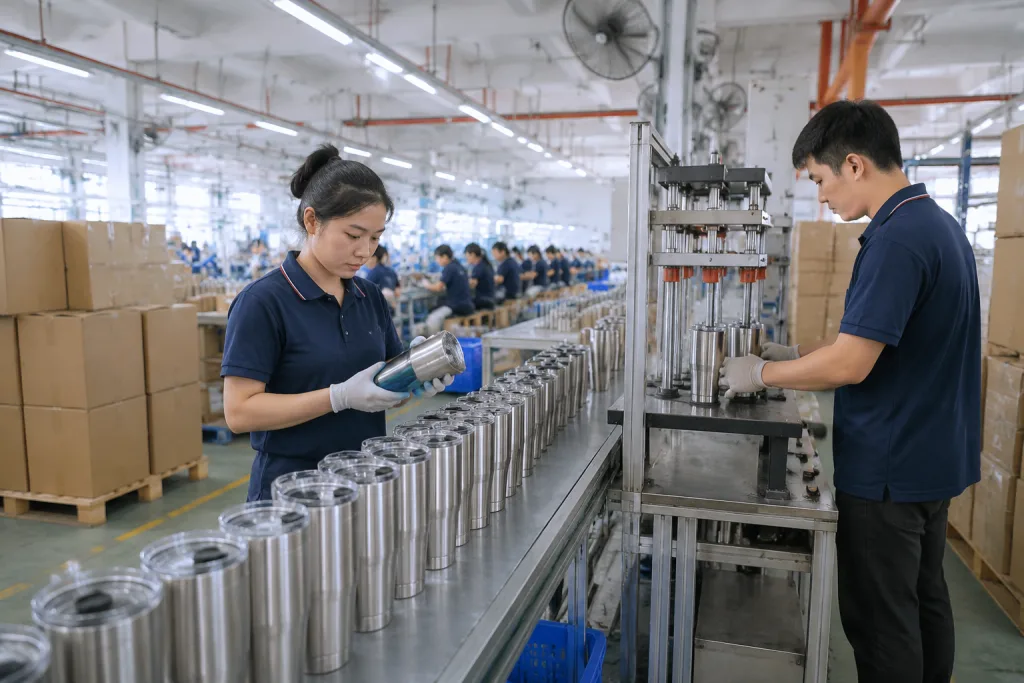
A good coffee mug factory runs in-process checks before final inspection day. For example, every vacuumed cup may go through vacuum integrity screening, while finished goods are leak-tested by sampling, not one by one. Coating adhesion should be checked with cross-hatch tape test. Logo position should be checked with a jig or visual standard board. Cartons should pass drop tests matched to packed weight, often 1A-style retailer expectations even when not formally certified. QC pulled the sample for us once because the lid thread felt rough after 300 cycles on the torque check.
If you run a coffee mug private labeling program, ask the factory to hold back 1-2 sealed master cartons as golden samples. Mark them with PO number, production date, color code, and carton weight in kg. Those cartons become your reference for repeat orders and claim review. Simple step. It can prevent 3 or 4 arguments six months later when the second shipment looks different from the first and nobody remembers which sample was approved.
How to inspect a tumbler order
Final inspection is where new buyers often go too quiet. If you hire a third-party inspector in China, do not write “appearance and quantity check” on the booking form. For travel tumblers, we run inspection against the way the cup will be used: leak test, lid fit, rim feel, logo position, barcode scan, carton strength. Last month QC pulled a sample from line 3 with a lid gasket seated 1 mm high; it looked fine on the table but leaked after a 10-minute side-lay test. A generic report would have missed it.
A practical inspection plan for a coffee mug in bulk shipment should include AQL 2.5 for major defects and 4.0 for minor defects, unless your retailer sets tighter limits. Define the defects before inspection day. Do it in writing. We have seen this go sideways when the PO says matte black, the approved sample is soft-touch black, and the inspector only checks “black color” with no Pantone or finish note.
Common major defects
- Leakage during agreed inversion or side-lay test
- Wrong capacity by more than agreed tolerance
- Sharp edge on rim or lid contact area
- Wrong logo, wrong Pantone family, or missing legal mark
- Vacuum failure causing condensation or poor heat retention
Common minor defects
- Small dust point under coating
- Light scratch under 5 mm not visible at 40 cm
- Slight print position shift within approved tolerance
- Carton scuffing that does not affect product
Ask for these on the report: quantity produced, packed quantity, pass/fail by defect type, leak test sample size, drop test result, barcode scan result, carton dimensions, and clear photos of the worst accepted defect. If the order is for coffee mug promotional products, gift box presentation carries more weight than a plain wholesale order, so add checks for corner dents, glue marks, color rub, and tray fit. On one 3,000-piece gift order, the buyer flagged 47 boxes because the white insert showed grey fingerprints from the packing bench. If the order ships to Amazon, inspect FNSKU placement and carton labels one by one at sample level and by count at lot level.
For a 5,000-piece shipment, buyers usually inspect 200-315 units depending on AQL level and carton count. That is normal. Approving the report without comparing it against the approved sample and PO is not. The math does not work: a 2-hour inspection cannot fix a loose standard that production never received. Before we ship, we put the golden sample, signed color chip, PO, and packing spec on the QC table so the line has one standard, not four opinions.
Landed cost and repeat-order planning
The first order is usually the most expensive one you will ever buy, because you are paying for learning. We see it on the line: the buyer changes the logo size after the first silkscreen plate is made, or QC pulls a sample because the lid fit is 0.4 mm tighter than the approved piece. The sharp buyer turns those lessons into a repeat-order system. For a coffee mug distributor, brand owner, or corporate gifting team, margin comes from repeat orders with fewer corrections.
When you calculate landed cost, do not stop at FOB price from the coffee mug supplier. Add sample cost, test fees if required, inspection, freight, duty, local transport, and warehouse handling. A tumbler quoted at USD 3.25 FOB can land above USD 5.00 depending on season and destination. We have seen 20 cartons pass price review at the factory, then the buyer flagged the CBM after booking because the gift box added 8 mm to each side. During peak freight months, carton size becomes a commercial issue. A taller tumbler with elegant packaging may cost less at factory and more in total because it ships fewer units per cubic meter. The math does not work if you only chase unit price.
Once the first PO is complete, build a repeat-order file with:
- Approved BOM and artwork version numbers, including coating code, lid material, and the final AI or PDF print file name
- Accepted tolerance for color, weight, and print position, such as 1-2 mm print shift agreed before mass production
- Final inspection reports and corrective actions, with AQL 2.5 notes if your buyer requires that level
- Master carton photos and packing data, including gross weight, carton size, and units per carton
- Spare-part policy for lids and straws if applicable, with MOQ and mixed-color rules written into the file
This file turns a one-time coffee mug custom project into a stable coffee mug private label program. It also saves time when you add line extensions such as a 12 oz commuter cup and a 30 oz bulk travel tumbler using the same brand language. We run this through a shared production folder, because one typo on a repeat PO can send the wrong Pantone number to the coating room.
If you are choosing between several coffee mug manufacturers in China, the winner should not just be the lowest unit price. This is the wrong question to ask. Choose the team that can answer technical questions clearly, revise documents quickly, and hold quality from sample to shipment. We ship better repeat orders when the spec sheet, pre-production sample, and carton mark all match before the first carton is sealed. That is what protects your launch date and your brand.
Get your tumbler spec reviewed before you place the PO
Send your target price, volume, and artwork. We will review feasibility, MOQ, lead time, and likely quality risks for your custom travel tumbler order.
Frequently asked questions
What MOQ should I expect for a custom travel tumbler order?
For a stock mold, expect 1,000 pieces per color as a practical MOQ from many factories in Zhejiang, China. Some will quote 500 pieces, but usually with fewer color options, simplified packaging, or a higher unit price. If you want a new lid, new body tooling, or complex coffee mug customized packaging, MOQ often moves to 3,000-5,000 pieces. For laser logo on an existing model, MOQ can stay lower than for wrap print because setup is simpler. If you are buying bulk coffee travel mug units for a corporate event and need a fast program, choose a stock shape, standard lid, 1-color print, and white box. That combination gives the best chance of hitting both MOQ and delivery targets.
How long does production take from sample approval to shipment?
A normal schedule for a stock-model order is 7-12 days for a branded pre-production sample and 30-45 days for mass production after deposit and final artwork approval. Inspection booking usually needs 2-4 days before ex-factory. If you add a new mold, allow another 20-35 days for tooling, validation, and revised samples. During peak season from August to November, coating and packaging lines in China get tight, so add a 7-10 day buffer. If your order includes multiple colors, personalized names, or retail gift boxes, lead time can increase because printing and packing become the bottleneck, not steel forming.
What is a fair FOB price for a 20 oz stainless travel tumbler?
For 3,000-10,000 pieces, a fair FOB China price for a 20 oz double-wall 304 stainless tumbler is often USD 2.85-4.60, depending on lid structure, finish, and decoration. Basic slider-lid models with powder coating and 1-color logo sit around USD 3.10-3.80. Better lids, premium coating, or retail-ready packaging push the number up. New buyers often compare a low ex-factory quote against a complete FOB quote and think one supplier is much cheaper. Check whether the price includes individual box, export carton, logo setup, and standard testing. For coffee mug factory direct buying, details matter more than the headline number.
How should I test whether the tumbler is really leakproof?
First, define leakproof. A slider lid is usually splash-resistant, not bag-safe. If you need true leak resistance, specify a screw lid with silicone seal and set a written test. A useful standard is no visible leakage after inversion for 30 seconds and side lay for 10 minutes at room temperature with water filled to the marked line. For higher confidence, test 10-20 random units from the sample lot and again during final inspection. Also check whether the lid performance changes after repeated opening and closing. If your product claims travel use, ask the factory to confirm the same test in the final inspection report, not only on the first sample.
What quality documents should I ask from a coffee mug manufacturer?
At minimum, ask for the final approved specification sheet, sample approval record, carton mark confirmation, and inspection report with AQL result. For regulated markets, request material declarations and any test reports relevant to your market, such as REACH-related declarations for EU programs or FDA/LFGB-aligned food-contact documentation where applicable. If the factory has BSCI or ISO management documentation, that may matter for your vendor onboarding, but it does not replace product testing. For a stainless travel tumbler, the most useful operational documents are leak test record, vacuum performance record, logo approval, and packaging approval. Those documents are what help you solve claims later.