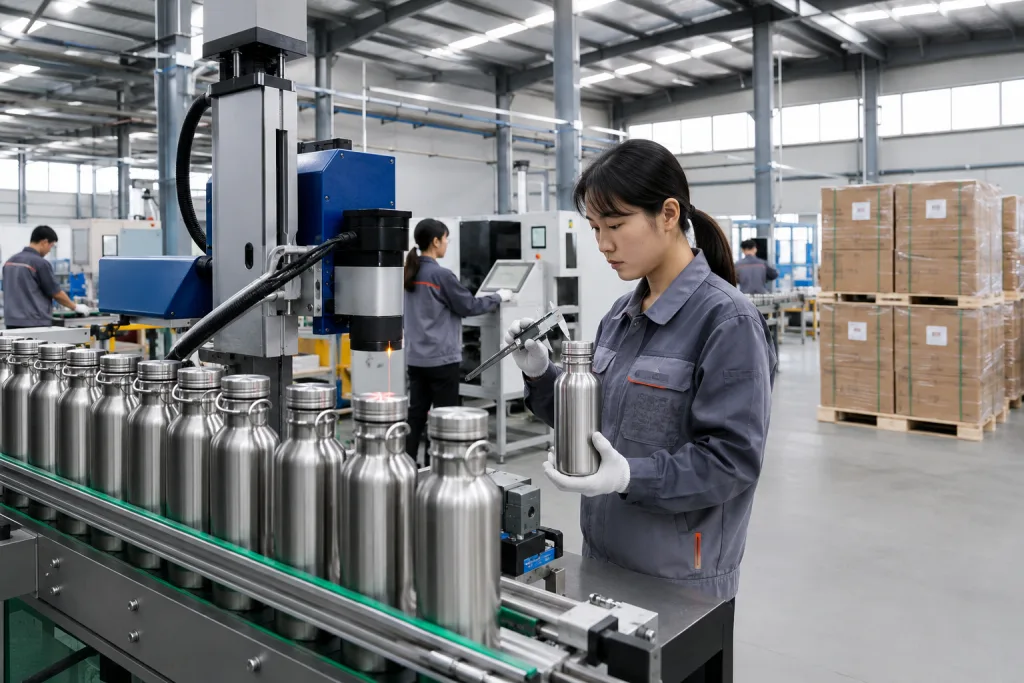
Key Takeaways
- For a standard 500-750ml stainless steel custom canteen, realistic MOQ is usually 1,000-3,000 pcs per color, with 25-40 day production after sample approval
- Typical FOB China pricing for double-wall 18/8 stainless canteens runs about USD 3.20-6.80 depending on size, coating, lid style, and decoration
- AQL 2.5/4.0 inspection, REACH testing, and carton drop tests at 76cm should be agreed before deposit, not after mass production starts
- A Zhejiang canteen factory with 300,000-500,000 units/month capacity can still miss delivery if tooling, packaging, and label details are not frozen by day 7
You are not buying a sample for a photo shoot. You are buying the line behind it: a mold that closes cleanly at 0.2 mm tolerance, logo fixtures that do not drift after 5,000 pcs, compliance files your importer can actually read, and cartons that survive a wet Ningbo warehouse. We ship bottles, but we also ship risk. Choosing an oem manufacturer canteen partner by the lowest platform price is the wrong question to ask; we have seen USD 0.18 saved on a cap turn into 23 days of rework.
About 7 out of 10 buyers in Europe and North America ask the same hard questions after the first quote: What is the real MOQ? Which logo method survives 50 dishwasher cycles? Is 18/8 stainless actually documented? Can a canteen custom project clear REACH, LFGB, or ASTM where needed? From Zhejiang, China, we run into these points every week. QC pulled one sample last month because the PO said matte black, but the artwork file called for PMS 432C; that kind of miss is cheaper to catch before artwork approval than after 3,000 pcs are packed.
What are you really buying?
Sourcing from a canteen manufacturer means buying repeatable production, not just a bottle that holds water. You are paying for the same rim height, thread fit, powder-coat coverage, logo position, and test file across 5,000 or 50,000 units. We check this on the line with a go/no-go gauge for lid fit and a 3M tape test after printing. It matters for a brand owner, a canteen distributor, or the 20-plus canteen distributors we see each quarter building seasonal promotional programs.
Start with a short checklist before you ask for pricing:
- Body construction: single-wall or double-wall vacuum, common wall thickness 0.4mm outer and 0.3-0.4mm inner; ask whether the base is welded or pressed because dent claims often start there
- Material grade: 18/8 stainless steel for body, PP or Tritan components for lids where applicable; QC should confirm material marks against the PO before mass production
- Capacity range: 350ml, 500ml, 750ml, 1L are standard; non-standard molds add time and tooling cost, often 12-18 days for mold adjustment before sampling
- Decoration: silk screen, heat transfer, laser engraving, powder coating, digital print; the buyer flagged logo tilt on a 750ml sample last month, so artwork tolerance needs a number, not a guess
- Packaging: egg-crate bulk, white box, color box, PDQ, mailer-safe carton; carton drop test and gross weight matter when we ship by LCL
- Market compliance: REACH, LFGB, FDA-contact declarations, BPA-free statements, ASTM where children’s drinkware is involved; name the target market before testing starts
If a canteen supplier gives you one FOB price with no assumptions, the quote is not finished. This is the wrong question to ask. A usable quote should state material, size, weight, logo process, MOQ, carton quantity, lead time, and test scope. In Zhejiang, serious export factories are used to this detail because the production sheet, carton mark, and inspection standard all follow it. We have seen this go sideways from one PO typo: 500ml approved, 750ml printed, buyer rejected the cartons at AQL 2.5.
You do not control landed cost unless you control specification drift.
MOQ, price, and lead time reality
Procurement managers usually ask MOQ first. Fair. But MOQ is the wrong question to ask if the canteen has coating, carton inserts, or logo printing. On our line, one powder-coat color change burns about 35-45 minutes for gun cleaning and oven check, and the first 80-120 pcs are where QC pulled the sample for color drift or dust points. For a standard custom canteen using an existing mold, common MOQ is 1,000 pcs per SKU for single-color decoration and 2,000-3,000 pcs for more complex canteen customized packaging or multi-color print.
For reference, these are typical export ranges from China for standard stainless items under FOB Ningbo or Shanghai terms. We ship most canteen orders through Ningbo; Shanghai works when the buyer's forwarder pushes for it or the vessel schedule is cleaner.
- 500ml single-wall canteen promotional item: USD 1.80-2.90 at 3,000 pcs, usually with 0.5mm body steel and a simple silk-screen logo
- 500ml double-wall vacuum custom canteen: USD 3.20-4.80 at 2,000 pcs, with vacuum test and lid leak check before packing
- 750ml double-wall canteen custom with powder coat: USD 4.20-6.20 at 2,000 pcs, where color matching and scratch rate decide the real cost
- 64oz customized growler with handle lid: USD 6.80-9.80 at 1,000 pcs, because the lid tooling, handle fit, and carton drop test add cost
Sample timing is simple when you use an existing body: 3-7 days for blank samples, 7-12 days for pre-production logo samples. Mass production is normally 25-40 days after deposit and sample sign-off. During peak gifting season, add 7-15 days. We have seen this go sideways when a buyer approves the logo but sends the final carton artwork 9 days later, with one typo on the PO color code. If your canteen factory promises 18 days for a fully customized canteen with new packaging, ask what they are skipping.
Simple buyer rule
If the unit price is more than 12% below the quote cluster from other canteen suppliers, check the hidden variables: steel thickness, powder grade, testing cost, carton strength, and whether the quoted lead time excludes packaging approval. The math does not work if a supplier cuts USD 0.45 on a vacuum canteen and still claims the same 304 stainless body, leak test, color box, and AQL 2.5 inspection. A serious canteen vendor can explain every dollar on the quote sheet.
How much customization is practical?
Buyers often ask for a canteen customizable program, but the request can mean two different jobs. One buyer just needs a logo at 45 mm wide, carton marks, and an FNSKU label. Another buyer wants a fully customized drinkware project with exclusive lids, retail gift boxes, barcode panels, and master carton text for the US, Germany, and Japan. The wrong question is, "Can this canteen be customized?" Ask where the customization starts hurting unit cost, AQL inspection, and ship date. We have seen a PO held for 6 days because the barcode size on the artwork was 2 mm smaller than the Amazon file.
Most canteen manufacturers in Zhejiang, China can handle these changes without new body tooling:
- Powder coat color matched to Pantone with tolerance limits
- 1-color or 2-color silk screen print
- Laser engraving on coated surface
- Wrap-around heat transfer graphics
- Different lid colors and strap materials
- Hang tags, inserts, color boxes, barcode labels
What usually triggers tooling or engineering review:
- New lid structure with leak-proof claim
- Embossed body shape or non-standard shoulder profile
- Custom base cup or detachable accessories
- Unique mold for a customizable growler or customized growler with proprietary handle geometry
If you are building a canteen custom line for retail, exclusive tooling only pays back when the volume is there. A new mold for a body or lid can cost USD 2,000-12,000 depending on complexity, and the first trial can add 12-18 days before mass production if the lid thread or silicone gasket fit needs correction. For a 3,000-piece distributor drinkware order, the math usually does not work. We ship stronger programs by using an existing proven body, then putting the budget into coating, packaging, drop testing, and compliance testing. QC pulled samples from the line last month where the body was standard, but the matte coating, 350 gsm color box, and clean barcode layout made it look proprietary without adding avoidable production risk.
What factory checks matter most?
A factory audit report helps, but it does not replace line control. For a canteen factory or canteen supplier, ask what happens after the PO is signed and before the container seal is closed. We ask the production manager to walk us through the traveler card, the first-piece approval, and the loading photos. Sales talk is cheap.
At minimum, your checklist should cover:
- Incoming material control: 304 stainless grade verification by XRF gun, plastic resin ID against the material tag, packaging spec checks against the approved carton drawing
- In-process control: 6-hour vacuum retention checks, coating adhesion with 3M tape, thread fit, lid torque by torque meter, visual standard board at the line
- Final inspection: AQL 2.5 major / 4.0 minor or your agreed protocol, with defect photos attached to the report
- Performance tests: leak test on filled samples, salt spray where relevant, dishwasher statement only if the lab record and wash-cycle count exist
- Packaging tests: carton burst strength and drop test, often 76cm for export cartons, checked before mass packing starts
Ask for the real defect categories. For custom drinkware, we see paint chips on the shoulder, logos off by 2-3mm, dented bases from loose trays, silicone seal odor, and lids that pass a static test but leak after 10 hard shakes. QC pulled the sample for one buyer last year because the straw lid looked fine on the table but failed after the shake test. A competent canteen manufacturer keeps limit samples for pass and fail defects.
Social and system audits still matter if you sell into retail chains or corporate programs. BSCI, Sedex, ISO 9001, and documented corrective actions are normal requests from Europe and North America. Treat them as entry tickets, not product-quality proof. We have seen this go sideways: a canteen factory passed the audit, then missed logo alignment by 3mm on 20% of the lot because nobody checked the pad-printing jig every 2 hours.
If your program needs 100,000 units across multiple drops, capacity matters too. A plant claiming 500,000 units per month should show how many lines are assigned to vacuum drinkware, how many coating lines are running, and whether your order sits behind China domestic peak-season demand. The buyer flagged this once after a PO typo put “June 12” instead of “July 12”; the math did not work with 4 active coating lines and a 5,000 pcs daily output.
Which compliance documents should you demand?
This is where first-time buyers get too loose. A PDF that says “food safe” is not a compliance file. If you import into the EU, UK, US, or Canada, the documents need to match the material, coating, ink, gasket, and sales market. The decorated product matters. Last spring, QC pulled a 304 stainless sample where the bare body passed, but the logo ink failed migration after the buyer changed Pantone color on the PO.
For stainless custom drinkware, common document requests include:
- Declaration of conformity for food-contact materials, tied to the exact steel grade, lid material, silicone ring, and coating system
- REACH SVHC screening for components and coatings that touch the hand or mouth area
- LFGB test reports if your buyer or retailer in Germany, Austria, or nearby EU markets asks for them
- FDA-related food-contact declarations for US programs, with resin or material references where the lab can provide them
- BPA-free statement for plastic lids, straws, handles, and any Tritan or PP parts where applicable
- Proposition 65 review if selling in California, especially for decorated bottles, powder coating, and colored accessories
If the item is for children, raise the bar. A kids canteen customized with printed graphics may need ASTM or CPSIA-related review, depending on product category and age grading. This is the wrong question to ask at the end of sampling. Put the target market, age group, and retailer name on the RFQ; we run the compliance check before tooling, not after 3,000 lids are packed.
One practical point: testing should be tied to production samples, not ideal showroom samples. For a large rollout, 2 test points are common: one approved pre-production sample and one mass-production draw from the line. It costs more upfront, but the math does not work after a recall or customs hold. For a standard custom growler or customizable growler, lab fees can range from USD 250 to 900 depending on the scope and number of components tested, and a coating change can add 5 to 10 working days before shipment.
If the coating, seal, straw, or print changes, your compliance risk changes too.
How should distributors structure the order?
If you are a canteen distributor or running a distributor growler program for corporate accounts, order structure hits margin fast. We see this on the line: one PO says “assorted colors,” then the buyer flags the carton labels 9 days before ETD because blue and black were packed under the same SKU. Bad setup. Split the order by how we actually build it.
Use this checklist when sending the RFQ to canteen vendors:
- SKU list by capacity and lid type, such as 750 ml screw lid versus 1,000 ml straw lid
- Color split by SKU, with percentages totaling 100%, so purchasing can book powder coating without guessing
- Logo method and print area dimensions in mm, including one sample photo marked with the print position
- Unit packaging type and artwork responsibility, including who checks the barcode file before mass packing
- Carton pack, carton size limit, target gross weight, and any 15 kg warehouse limit from your customer
- Shipping term: EXW, FOB, CIF, or DDP assumptions
- Required marks: FNSKU, suffocation warning, country of origin, carton labels
- Inspection standard and whether third-party inspection is required
For Amazon or mixed-channel business, carton discipline matters. If your distributor canteen program goes to FBA, ask for carton count consistency, FNSKU application fees, and oversize carton controls before production begins. QC pulled a sample carton last month at 16.8 kg when the buyer’s routing guide capped it at 15 kg. Rework in a China warehouse can add USD 0.20-0.60 per unit and push shipment from 12 days to 18 days.
Payment terms for established canteen manufacturers are usually 30% deposit and 70% balance before shipment. For large repeat business, some canteen suppliers will discuss OA or partial post-shipment terms after a stable order history, usually 3-5 clean orders with no overdue balance. First orders are the wrong place to push finance harder than quality control; the math does not work if a rushed balance payment saves 2 days but AQL 2.5 inspection finds leaking lids.
Good buyers leave room for replacement stock. On custom programs above 10,000 pcs, adding 1-2% overrun can protect you against transit damage or final client claims. We ship the extras in marked cartons, and the warehouse team records them on the packing list so nobody mistakes them for short shipment. That is usually cheaper than a small remake order below MOQ.
Questions to settle before you approve samples
Most avoidable disputes start after the sample approval email. Not before. A custom drinkware sample can look fine on your desk and still fail on the line if the approval notes are thin. Before you release the PO, settle these points in writing with the canteen manufacturer. We’ve seen this go sideways over a 2 mm logo shift and a buyer comment that only said “approved as discussed.”
- Color tolerance: Which Pantone reference applies, and what variance is accepted on powder coat after oven curing?
- Logo position: What is the print centerline, and what mm tolerance is allowed from the seam or handle reference point?
- Surface standard: Are tiny hanging points, weld witness lines, or base polishing marks acceptable, and on which zones of the body?
- Temperature claim: Is “12 hours hot / 24 hours cold” tested, and by what method, water fill, start temperature, and ambient condition?
- Leak-proof claim: Upright only, or did the sample pass a shake test on the cap assembly?
- Spare parts: Can you buy lids, straws, or seals separately, and what is the MOQ per part?
A standard pre-production sample approval sheet should include product photos, dimensions, net weight, decoration size, barcode placement, carton marks, and pass/fail notes. Add the packaging spec and palletization plan too, especially if you ship from Zhejiang or another export cluster in China. This is not a paperwork issue; it is a freight-cost issue. We had one PO where the outer carton mark was correct, but the barcode sat 18 mm too low and the warehouse scanner kicked out 600 cartons.
For repeat programs, lock the approved golden sample number and keep one retained sample on both sides. Put the sample date and PO on the label. QC pulled the sample once for a claim case, and the buyer’s retained cup had no code at all, which wasted 12 days. Serious canteen manufacturers already run this way. It protects you and the factory when someone says the latest batch feels “slightly different,” which is the wrong question to ask unless the weight, wall thickness, or lid torque actually changed.
Send your canteen spec and get a real quote
Share capacity, logo method, packaging, and target market. We will review MOQ, compliance, and lead time from our Zhejiang, China production team.
Frequently asked questions
What MOQ should I expect from an OEM manufacturer canteen supplier?
For an existing mold, most export-focused canteen suppliers quote 1,000 pcs per SKU as the practical starting point, though 2,000-3,000 pcs gets better pricing and color efficiency. If you need a custom box, multi-color print, or mixed lids, the effective MOQ can rise because each variation adds setup time and packaging waste. For a customized growler with a larger body and handle lid, 1,000 pcs is common. If a canteen factory offers 300 pcs on stainless vacuum drinkware, confirm whether they are charging a sample-level price or combining your order with another run. Low MOQ is possible, but rarely at the best FOB cost.
How long does a custom canteen order usually take from China?
A realistic timeline for China is 3-7 days for blank samples, 7-12 days for logo samples, and 25-40 days for mass production after deposit and final approval. If you need new tooling, add 15-30 days depending on the lid or body complexity. During August to November, when promotional and holiday demand rises, many Zhejiang factories need another 7-15 days. Shipping time is separate: roughly 25-40 days by sea to Europe or North America port to port. If your launch date is fixed, work backward from the warehouse arrival date, not from the factory completion date.
What tests and documents should I ask for on stainless custom drinkware?
At minimum, ask for material declarations, food-contact compliance documents relevant to your market, and a clear inspection standard. For EU business, REACH and often LFGB-related documentation are common requests. For the US, buyers often request FDA-related food-contact statements and Proposition 65 review where applicable. On performance, ask for leak testing, vacuum retention checks, and carton drop test records. If the product includes coating, print, silicone, or a straw, those components should be covered too. A serious canteen manufacturer should also accept AQL 2.5/4.0 final inspection and provide production sample references, not only ideal showroom samples.
Is it worth paying for a new mold for a customizable canteen?
Usually only if your projected volume justifies it. A simple lid mold can cost around USD 2,000-5,000, while a more complex body or accessory program can move toward USD 8,000-12,000 or more. If your first order is 2,000-5,000 pcs, you often get a better return by using an existing body from a canteen factory and spending the budget on premium coating, retail packaging, and faster testing. Exclusive tooling makes more sense when you have a defensible design, repeat orders, and annual demand above roughly 30,000-50,000 pcs across the same platform.
How do I compare canteen vendors without wasting weeks on quotes?
Send all canteen vendors the same RFQ sheet with non-negotiable details: capacity, structure, material grade, wall thickness target, decoration method, packaging type, carton count, compliance market, shipping term, and required lead time. Ask each supplier for FOB price, MOQ, sample fee, production days, and testing assumptions. Then compare apples to apples. If one quote is 15% cheaper, ask what is different in steel weight, coating process, packaging, or test scope. Buyers lose time when suppliers fill gaps with their own assumptions. A disciplined RFQ usually cuts the quote cycle from 10 days to 3-5 days and exposes weak canteen suppliers quickly.