Key Takeaways
- Set measurable specs early: 0.4 mm or 0.5 mm 18/8 stainless, ±3% capacity tolerance, and AQL 2.5/4.0 for final inspection
- Most OEM beer tumbler orders start at MOQ 1,000-3,000 pcs per color, with 25-35 day lead time after sample approval and deposit
- Vacuum loss, lid leaks, coating scratches, and unstable bases cause the highest claim rates; each needs a defined test standard before PO
- For EU and North America, ask for REACH, LFGB or FDA-contact declarations, drop-test records, and barcode packing specs before production
You usually do not lose money on a beer tumbler order because the unit price was 6 cents high. You lose it because the sample looked fine, the PO said “same as approved sample,” and nobody wrote the pass/fail limits before the line started. Then QC pulled 32 pcs after coating and found lids seeping at 45 degrees, bases rocking over 0.6 mm on the flat plate, logos failing the 3M tape test, and export cartons crushing at the bottom layer. An oem manufacturer beer tumbler project fails in plain factory ways.
If you buy custom drinkware from Zhejiang or wider China, spec the failure points before production starts. This is not paperwork for decoration. It matters whether you are a brand owner, a private-label seller, a canteen distributor, or a distributor growler program adding tumblers beside a customized canteen line. At BottleForge Industrial in Hangzhou, Zhejiang, we run one practical rule: if a point can fail in mass production, it goes on the spec sheet with a measurement, a test method, and an inspection line. We have seen this go sideways over one missing Pantone code on a PO.
Where beer tumbler projects break
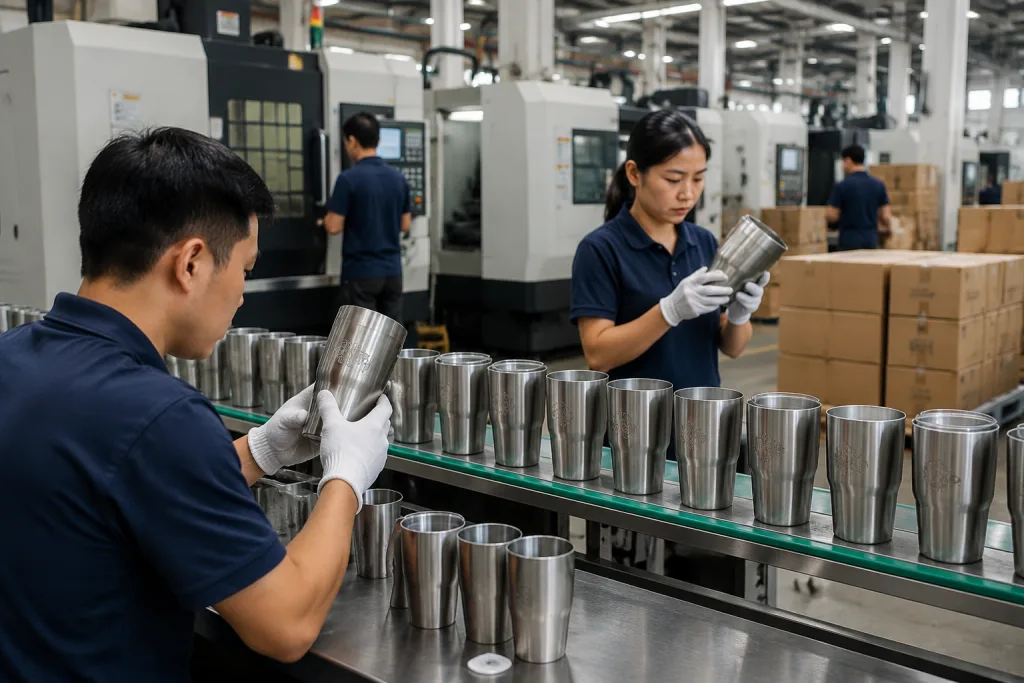
A beer tumbler looks simple because the shape is simple. The line is not. A standard 20 oz stainless beer tumbler runs through deep drawing, trimming, polishing, inner and outer wall forming, vacuuming, leak testing, coating, logo printing, curing, assembly, and final packing. QC pulled one matte sample last month because the vacuum gauge held, but a 0.3 mm rim burr still cut the shrink bag during carton drop testing.
The buyer mistake we see most is generic wording: "good quality," "no leaks," "matte black," "gift box packing." That is not a spec. This is the wrong question to ask if the supplier is a canteen factory or a broader canteen manufacturer in China that also runs tumblers and mugs, with custom growler orders sharing polishing workers in the same week. One PO typo, "matt black" instead of "matte black powder coat, 60 gloss max," can put 5,000 pcs into the wrong finish queue. Your order needs hard limits.
- Material: 304 stainless steel inside and outside, or 304 inner / 201 outer only if the cost sheet and PI both say so.
- Thickness: 0.4 mm body is common; 0.5 mm feels stiffer in hand and cuts dent complaints after transit.
- Capacity tolerance: state usable fill and brimful fill, not just "20 oz"; our QC checks this with a 1,000 ml measuring cylinder.
- Finish: powder coat, spray paint, electroplating, or raw brushed stainless each fail in a different place: adhesion, orange peel, color drift, or polishing lines.
- Inspection: define AQL 2.5, a 24-hour leak test for function, and a 76 cm carton drop test before the first mass run.
At factory level, watch output stability. A line that ships 300,000 units/month is not better by default, but the math usually works because tooling maintenance is logged every 8 hours and QC stations are fixed, not borrowed from another workshop. For a new buyer, that means fewer surprises: 12 days for pre-production samples is normal, while 18 days often means the mold or coating vendor is already tight. Zhejiang factories with stable export programs also understand Amazon FBA labels at carton side, retailer routing guides with pallet height limits, and mixed-SKU pallet rules where the buyer flagged two barcodes on one carton.
Vacuum failures cost more than dents
If insulation performance fails, your beer tumbler is just a metal cup. Vacuum loss is the defect buyers underrate because the carton can look clean and the body can pass a 0.5 m visual check. We have seen QC pull 80 pcs from a 3,000 pcs lot with no dents, then find weak vacuum after the hot-water bench test because the weld bead near the bottom plug leaked.
For double-wall stainless SKUs, ask your canteen supplier or canteen manufacturers to put the control points in writing. Name the vacuum test machine and pass limit. Write the thermal retention target by size, not one loose line for every SKU. State the production sampling frequency by shift, because a night-shift line running 1,200 pcs can drift before final inspection catches it.
Specs worth writing into the PO
- Vacuum leak test: 100% inline vacuum check, not random only. The line should mark failed pcs before polishing, not after packing.
- Thermal performance: for a 20 oz tumbler, hot water at 95°C should remain above 55°C after 6 hours in a 20-25°C room. If you sell cold-use beer tumblers, specify condensation control and cold retention too, including whether ice water is tested at 0-4°C.
- Base temperature check: if the outer base warms quickly after hot fill, vacuum is usually compromised. QC can catch this with an IR thermometer in under 30 seconds.
Do not just ask for “vacuum insulated.” This is the wrong question to ask. Ask where failed units go after detection, who signs the rework tag, and whether the factory keeps segregation records by carton number. Good factories in China run inline vacuum detection, hot water spot checks, and red-bin rework control beside the welding line. If your order is 5,000 pcs and even 2% fail after arrival, that is 100 claim units before labor, reshipment, and customer service cost.
What goes wrong in real life is simple: the pre-production sample was hand-picked, but the mass run had no 100% functional gate.
This matters for related programs too. If the same vendor quotes beer tumblers, a customizable canteen, and a customizable growler, ask whether all vacuum products share the same test standard. We have had buyers flag this after a PO typo listed 20 oz tumblers and 32 oz canteens under one loose “keep hot” clause. A serious canteen manufacturer should already have one internal SOP across categories, whether the order is canteen custom or general customized drinkware.
Lids, threads, and leak paths
Most complaint photos importers send us are not body defects. They come from lids. On beer tumblers, we usually run three lid families: slider, flip, and press-in. Buyers read “spill resistant” as “won’t leak in a bag.” Factories often read it as “won’t splash during normal drinking.” That gap turns into claims, and we’ve seen this go sideways on a 3,000-piece reorder where the buyer flagged wet cartons, not dented cups.
A press-in slider lid usually should not be sold as leakproof. It cuts splash on the desk, but it still leaks when the cup is tipped or laid down. If you want a commuter-safe SKU, write in a threaded lid, silicone gasket, and a clear inversion test standard on the PO. Put the test in black and white: full inversion for 5 minutes, no visible drip. This is the wrong question to leave to sales wording.
- Fit tolerance: define lid insertion force or thread engagement feel. We usually confirm with a push-pull gauge or a go/no-go sample set, not by “feels okay” on the line.
- Material: AS, Tritan, PP, and silicone all behave differently in dishwasher and drop tests. QC pulled one Tritan sample last month with a hinge crack after a 1.2 m drop, while PP passed the same check.
- Odor requirement: no obvious silicone or plastic odor after hot water fill for 30 minutes. Buyers do reject this. One customer wrote “smells like new gasket” on the inspection report.
- Leak test: 90° tilt for 30 minutes and full inversion for 5 minutes, depending on lid type. If the lid is threaded, say whether the test is done at room temperature or after hot fill.
Thread mismatch is another common failure mode on tumbler and customized growler programs. If one workshop makes lids and another makes bodies, thread pitch drift will show up as small but expensive incompatibility rates. We’ve seen 2 out of 100 fail on pilot assembly because the start thread was off by less than 0.3 mm. The fix is simple: freeze the approved sample, record the thread spec, and require first-article signoff before mass assembly. QC should check the first assembled set, not only loose parts.
If you are a distributor drinkware buyer handling mixed categories such as tumblers, bottles, and custom canteen products, standardize your leak-test matrix by lid family. Ask every canteen vendor and canteen vendors quoting the job to answer against the same matrix. We ship cleaner projects that way. One sheet, same test, same pass/fail rule. Then you compare suppliers on something real instead of only FOB price, because the math doesn't work if a cheaper lid creates a 4% claim rate.
Coating, logos, and color drift
Decoration is where margin goes to die. A tumbler body can pass leak test and drop check, then fail on the shelf because black reads like charcoal, the logo edge bleeds 0.3 mm, or powder chips at the bottom radius after carton rubbing. We have seen this go sideways after a buyer approved only a PDF artwork and never fixed coating thickness, Pantone tolerance, or adhesion level.
For beer tumblers, powder coating is the normal commercial choice because it gives a matte finish with hand grip. We run most beer tumbler powder at 60-80 microns. Go below that and 304 stainless can flash through on the rolled lip or corner. Go too heavy and the surface orange-peels, or the lid starts feeling tight when QC checks it with a go/no-go lid gauge.
Controls that prevent decoration claims
- Color reference: give the Pantone code and one signed physical sample. Screens are not enough, and office lighting lies.
- Adhesion: require a cross-hatch adhesion test after curing, with tape pulled clean at the logo and bottom radius.
- Abrasion: set dry rub and wet rub requirements, especially for silk-screen logos that will sit in bar trays.
- Dishwasher note: if not dishwasher safe, print it on packaging. Do not bury it in carton marks where the buyer never sees it.
Laser engraving is stable, but it will not give strong color impact. Silk-screen works for MOQ 1,000 pcs and keeps the unit cost sensible, though 2-color registration can drift 0.5 mm if the jig is loose. Heat transfer can look sharp on canteen promotional programs, but the scratch-resistance math does not beat powder plus laser for retail use. If you need a retail-grade finish, ask for logo placement tolerance in millimeters and keep one golden sample on each side.
Zhejiang factories serving North America handle 1-color and 2-color logo work every day, but retail buyers should still ask for pre-production photo approval under neutral light, not under a yellow packing-room lamp. QC pulled a sample for us last winter where the repeat order looked 1 Pantone shade warmer than the first batch. If the item is sold as customizable drinkware across campaigns, lock the same coating supplier and curing profile on the PO. Color drift between batches makes a shelf display look cheap fast.
Dimensional slop and unstable bases
A wobbly beer tumbler looks minor on the sample table. It becomes a chargeback when 3,000 pcs land with a restaurant chain or a corporate gift buyer and QC pulls photos from a level glass plate. Base instability often comes from uneven trimming, shell deformation during the vacuum process, or a pad pressed off-center by 1 mm on the pad jig. Dimensional drift is the quiet one: cup holders and filling lines are built to a drawing, not to hope.
Write dimensional tolerances for height, max diameter, mouth diameter, and net weight. If your beer tumbler must fit a standard seamer tray, gift box insert, or e-commerce mailer, send those dimensions before tooling or sample adjustment. We had one PO that said “same as last order” while the buyer changed the insert by 2 mm. That is not a spec.
- Height tolerance: for common 20 oz tumbler, keep within ±1.5 mm if custom inserts are used.
- Diameter tolerance: specify top and bottom separately, with caliper readings taken at the mouth bead and base ring.
- Base flatness: no wobble on level glass plate under normal hand pressure.
- Weight tolerance: ±5% is typical unless you need premium feel consistency.
Bottom pads deserve a hard look. A loose anti-slip pad means noise, peeling, and claims after cold-weather warehousing; we have seen pads lift after 12 days in a Ningbo warehouse when the glue cure was rushed. If the product line includes a canteen customized bottle or a customizable canteen with silicone boot, run the same drop-test method across the range. Otherwise one SKU passes and another fails on the same truck route.
This is where a real canteen supplier or canteen distributors partner should think commercially, not just technically. If your master carton packs 24 pcs and the product has a tall narrow profile, one extra millimeter at the rim can turn clean case packing into scrape marks on every adjacent unit. We have seen this go sideways. The math does not work after carton rework starts at 600 cartons.
Compliance files that arrive too late
For EU and North American buyers, compliance trouble often starts as a timing mistake, not a material problem. We have seen goods sit 7 days at forwarder review because the FDA declaration and coating report were still with the lab while the booking was already made. The cup body can be 304 stainless and still miss the vessel. Ask for the compliance scope at quotation stage, before the deposit PI is signed.
For stainless steel drinkware, the document set depends on the market and the build. Typical requests include FDA food-contact declarations for the US, LFGB-related testing or declarations for parts intended for EU contact use, and REACH SVHC statements for powder coating, plastic lids, silicone seals, and printed logos. If children may use the item, ASTM or CPSIA-related checks may also matter depending on the program; QC pulled one sample last year because the buyer changed from adult promo use to school use after artwork approval.
- BSCI: social compliance matters for retail buyers in Europe; 8 of our last 10 supermarket RFQs asked for the audit file before price confirmation.
- ISO 9001: it shows the line has a process, but it does not replace product testing; an auditor will still ask for the actual report tied to the tumbler SKU.
- AQL plan: final random inspection commonly uses AQL 2.5 for major and 4.0 for minor defects, with calipers checking lid fit, rim burrs, and logo position in mm.
- Carton tests: specify drop test and compression requirements for export cartons; weak 5-ply cartons can fail after 2 high stacks in the container.
If you buy from China, ask whether test reports are product-specific or just generic material reports. A generic stainless statement is the wrong file if your lid, seal, coating, or print process changed after sampling. Freeze the BOM first, then test the sellable configuration. We run this sequence because the math does not work when a USD 300 lab test becomes an 18-day shipment delay.
This also matters if you source a family range from one canteen factory: tumbler, custom growler, bottle, and customized canteen. Shared components can cut mold cost and MOQ pressure, but they also spread risk across the line. One non-compliant gasket compound, even a 2.5 mm silicone ring from the same lid supplier, can block 4 SKUs at once. We have seen this go sideways.
Packing failures after good production
We have seen orders pass AQL 2.5 and still fail at the packing table. A good beer tumbler with weak packing arrives with lid scuffs, crushed color boxes, or a barcode that the warehouse scanner rejects. That hurts. For B2B buyers, outer carton design and pallet loading belong in the quality file, right beside coating adhesion and leak testing.
Start with the sales channel. For retail distribution, lock the color box board grade, insert style, barcode scan grade, and drop test requirement before the line starts packing. We usually check this with a 1.2 m drop test and a handheld Zebra scanner. For Amazon FBA, send the FNSKU position, suffocation warning rule, carton weight cap, and label format before carton sealing. Re-labeling after arrival often runs USD 0.20-0.60 per unit, and the math doesn't work on a promo tumbler order.
- Inner packing: use polybag or tissue where powder coat can rub against lids, straws, or box inserts.
- Color box: confirm E-flute or paperboard structure, then test corner crush after a 1.2 m drop.
- Master carton: common export limits are under 18-20 kg, because warehouse teams push back hard above that weight.
- Palletization: define pallet size, no-overhang rule, carton direction, and stretch-wrap turns.
One factory metric works well. For repeat programs, we ask buyers to approve a packaging pre-check 7-10 days before final assembly. QC pulls the sample carton, scans 20 barcodes, weighs the master carton, and checks insert fit with the actual tumbler, not a drawing. On a 30-day lead time, those 7-10 days are enough to fix a wrong FNSKU, tight insert, or weak carton burst strength before the vessel booking is at risk.
If you are a distributor canteen or a buyer working with multiple canteen suppliers, use one carton marking template across all SKUs. Beer tumblers, sports bottles, and customized drinkware gift sets should follow the same routing logic, PO number format, and side-mark position. We once had a buyer flag a PO typo after 286 cartons were sealed. The fewer judgment calls your China team makes at 9 p.m., the fewer shipping mistakes you pay for.
Send your tumbler spec before problems become claims
Share your target capacity, lid type, finish, compliance market, and packing plan. We will review the failure points, MOQ, lead time, and QC checkpoints with you.
Frequently asked questions
What MOQ should I expect for an OEM manufacturer beer tumbler?
For a standard 20 oz stainless beer tumbler with one body color and one logo, MOQ is usually 1,000-3,000 pcs per color. If you want a new lid, special coating, or custom retail box, the practical MOQ often rises to 3,000-5,000 pcs because setup scrap and packaging costs have to be absorbed. Some China factories in Zhejiang will quote 500 pcs, but that is often based on existing stock bodies with limited color choices. If you are also developing a matching custom canteen or customizable growler line, ask for a combined material plan. Shared components can reduce cost, but only if the BOM is frozen early.
How long does production usually take after sample approval?
For repeat models, normal lead time is about 25-35 days after deposit, artwork approval, and sample signoff. A fully new project with custom mold parts, new packaging, or extra testing can take 40-55 days. During peak season, especially before August to October holiday shipping, add 7-10 days buffer. You should also ask when the factory locks raw material: if stainless coil, lids, and cartons are not booked in the first week, the quoted lead time is not secure. In Zhejiang and other China export hubs, factories with stable monthly output usually give more reliable booking windows than small workshops juggling many low-volume jobs.
Which quality tests matter most before I release balance payment?
For beer tumblers, the essentials are vacuum retention, leak testing, coating adhesion, logo abrasion, dimensional checks, and carton drop testing. On the inspection side, many buyers use AQL 2.5 for major defects and 4.0 for minor defects. I would also require a base wobble check on a flat glass plate, a hot-water odor check for lids and seals, and barcode scan verification if retail packed. If the goods are going to Amazon FBA, verify FNSKU placement and carton labels before container loading. A factory can make a nice product and still fail your program because the labels or master cartons are wrong.
Is 304 stainless always necessary for a beer tumbler?
For the inner wall, 304 stainless is the safe commercial standard for most export programs. For the outer wall, some low-cost projects accept 201 stainless to save a small amount, but that should be declared clearly and matched to your market positioning. The savings are often not dramatic enough to justify the risk if you sell in Europe or North America under your own brand. If you want a premium customized drinkware line, ask for 304 inside and outside, with actual material declarations tied to the production BOM. Material claims should not rely on a generic old report from another SKU.
How do I compare a canteen manufacturer and a tumbler-focused supplier fairly?
Use one RFQ sheet and force both suppliers to quote against the same spec. Include body material, wall thickness, capacity, lid type, coating, logo process, packing method, AQL plan, compliance documents, MOQ, and lead time. Also ask for the same sample quantity and the same photo evidence from production. A canteen manufacturer may be stronger on vacuum bottle lines, while a tumbler supplier may be stronger on lid fit and decoration speed. The right choice depends on your program. If you plan to expand into custom canteen, custom growler, and beer tumbler families, the supplier with better component control and repeatability usually wins over the cheapest FOB quote.