Key Takeaways
- A usable growler RFQ should define capacity, steel grade, wall structure, finish, logo method, packaging, test standard, and MOQ; otherwise your sample cycle can stretch from 7 days to 21+ days
- For most OEM growlers, practical MOQ starts at 1,000-3,000 pcs per SKU, with sample lead time around 5-10 days and bulk production 25-40 days after deposit and art approval
- Put leakage testing, coating adhesion, carton drop standard, barcode placement, and AQL level directly on the PO line items; do not leave them to email memory
- FOB Zhejiang, China pricing for insulated stainless growlers often shifts by USD 0.20-0.80 per unit based on steel thickness, lid type, decoration, and gift box requirements
You usually catch growler problems too late: the cap leaks at 2.5 bar after carbonation, the powder coat chips inside the retail carton, or the laser logo lands 3 mm off-center on 5,000 units. Bad timing. By then, your launch date is fixed and your margin is already thinner than planned. Buying from an oem manufacturer beer growler supplier looks simple on paper, but we see first orders go sideways when the RFQ says only “matte black growler,” sample approval gets rushed, and the PO forgets gasket material, carton drop-test rules, or the replacement term for leaking caps.
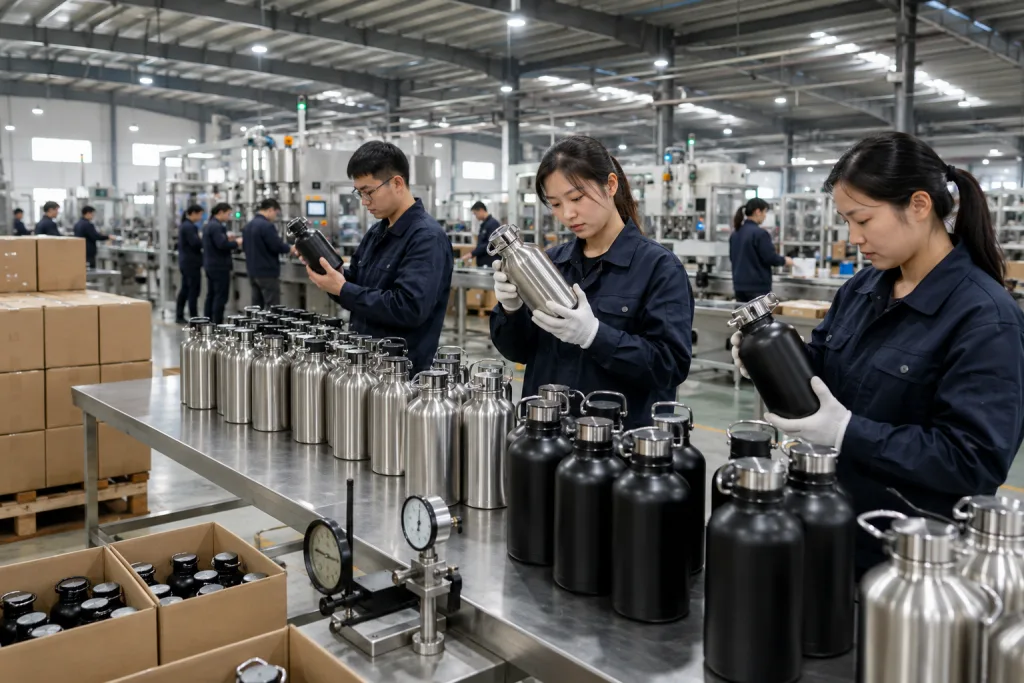
At BottleForge Industrial in Hangzhou, Zhejiang, China, we build custom drinkware for buyers who need clear specs, repeatable quality, and lead times that match the line. We run 304 stainless bodies, check mouth roundness with a caliper, and QC pulled samples from each polishing batch before coating starts. If you are a procurement manager, brand owner, or distributor growler buyer adding a customizable growler line, use the process below from first inquiry to bulk shipment. It will save arguments later.
Start with a real RFQ
If you send “need custom growler price” as the whole RFQ, the quote will be padded by 8-15% or stripped down until it means nothing. We see this weekly. A usable RFQ for an oem manufacturer beer growler must let the factory cost the body, lid, decoration, packaging, and inspection plan without guessing. In Zhejiang, China, a fast reply does not mean the merchandiser understood the neck size or the carton spec. Last month QC pulled a sample where the buyer asked for a “wide mouth,” and the PO later showed 58 mm while the drawing was 62 mm. That mismatch stopped the line for 2 days. Make it hard to misunderstand.
Your RFQ should state capacity, such as 64 oz, 1.9 L, or 2.0 L. Then give body construction, such as single-wall or double-wall vacuum; material, usually 18/8 stainless steel inside and outside; target wall thickness, for example 0.5 mm outer and 0.4 mm inner; mouth diameter; handle style; lid type; required color Pantone; logo size and placement; retail pack details. If you also source a custom canteen or customized canteen line, keep the growler RFQ separate. Same sales desk, different tooling. The same canteen manufacturer may produce both, but growlers often need separate neck tooling, cap structures, and pressure checks; we run the lid leak test with a torque gauge, and the math does not work if the cap gasket is treated like a normal canteen part.
What to put on the first RFQ sheet
- Product: 64 oz insulated custom growler, 18/8 stainless steel, copper-plated vacuum optional
- MOQ target: 1,000 pcs per color, 3,000 pcs total order
- Decoration: 1-color silkscreen or laser engraving, artwork file in AI, logo height in mm
- Packaging: egg-crate, white box, color box, or PDQ display, with carton drop-test request if your retailer asks for it
- Compliance: REACH, LFGB, FDA contact test if required by your market
- Incoterm: FOB Ningbo or FOB Shanghai
- Timeline: sample in 7 days, bulk in 35 days target
Add the commercial terms you expect on the first round. Say whether you are a canteen distributor, canteen vendors group, or a distributor drinkware importer supplying chains in Europe or North America, and attach the carton mark template if you have one. Factories quote differently when retail-ready labeling, FNSKU application, or distributor carton marks are included; we have seen a missing FNSKU line add 12 days vs 18 days to final dispatch after the buyer flagged it at pre-shipment. A serious canteen supplier or growler factory can protect your timeline only when the RFQ shows the job is real.
Compare factories by process, not claims
Once quotes arrive, do not rank them by unit price alone. Compare the process behind the quote. A capable canteen factory or canteen manufacturer should tell you how the shell is formed, how the neck is welded, how vacuum is pulled, how leak test is done, and how coating thickness is controlled. We usually expect specifics like 0.4 mm or 0.5 mm body thickness, argon welding on the neck, and a vacuum hold check on the line. If the reply is just “high quality, best service,” move on. For growlers, process discipline matters more than a polished sales PDF. That is the wrong question to skip.
Ask for hard operating data. A factory in Zhejiang or elsewhere in China should be able to state monthly output, sample room capability, and normal lead time by product type. At BottleForge Industrial, for example, our practical output is up to 300,000 units per month across drinkware categories, while insulated growlers depend on welding and coating line loading. On one 64 oz growler run, coating line loading pushed lead time to 18 days instead of 12 days, and that is the kind of answer you need. It says more than “large capacity.” Also ask whether the plant runs BSCI or SEDEX audits, what AQL level they inspect to, and whether they handle third-party inspection before shipment. QC pulled the sample should not be the first time they mention inspection.
Good factories give you limits, not just promises. If they cannot tell you when MOQ changes from 1,000 to 3,000 pcs, they probably do not control their costing well.
For an OEM buyer, compare these points side by side: price basis, mold status, sample charges, logo setup fee, estimated defect rate, vacuum retention standard, and packaging assumptions. Put them in one sheet. We have seen buyers miss a small PO typo like “1c print” versus “1c + laser,” then argue about the setup fee after sampling. If you also buy custom drinkware, customizable drinkware, or canteen promotional items from the same vendor, ask which processes are in-house and which are outsourced. A canteen vendor may powder coat in-house but outsource laser engraving. That changes lead time and quality risk. We have seen this go sideways when the buyer flagged logo position drift after the outsourced engraving shop reset the jig. The same applies whether you work with one of many canteen manufacturers, canteen suppliers, or a specialized distributor growler program builder.
Ask for two recent production references by market type, not by brand name: for example, “EU retail insulated bottle” and “North America brewery growler.” You are checking category fit. A factory used to simple custom canteen orders may underestimate the sealing and handling expectations of a customized growler program. We ship both, and the complaint pattern is different. Brewery buyers usually push back on cap thread feel, carry-handle strength, and leak performance after carton drop tests from 76 cm.
Lock the sample before the PO
The sample stage is where a buyer saves USD 150 and then burns USD 15,000 on wrong cartons, crooked logos, or caps that feel rough after filling. We ask for at least two sample steps when the order has custom decoration or packaging: a construction sample and a pre-production sample. The construction sample locks body height, mouth ID, cap threading, handle grip, and the thermal structure. Our QC usually checks the thread with a go/no-go gauge and a caliper before we let the sales team send photos. The pre-production sample confirms coating batch, logo position, barcode placement, carton marks, and the packing method that will run on the line.
For a standard customizable growler project, sample charges might be USD 50-100 for a stock body with logo, or USD 300-800 if custom tooling or a new cap is involved. Lead time is usually 5-10 days for a stock-body customized drinkware sample and 15-25 days if a new neck, base, or accessory must be opened. If you are ordering a customizable canteen or canteen custom line at the same time, approve them separately. We have seen this go sideways when one PO had “black matte” for the growler and “black powder coat” for the canteen, then the buyer flagged the two finishes after shipment. Each SKU needs its own signed sample record.
Sample approval checklist
- Capacity tolerance: within stated fill line range
- Weight tolerance: normally plus/minus 3%-5%
- Vacuum performance: target hot/cold retention by your sales claim
- Leak test: inverted 30 minutes minimum, no seepage
- Coating: cross-hatch adhesion and rub resistance
- Logo: Pantone match and location within 2-3 mm tolerance
- Packaging: drop test standard and barcode scan check
Do not approve from photos alone. Ask for a sample report with measurements, then keep one sealed golden sample with the signed label and date. Simple rule. QC pulled the sample last season on a repeat growler order because the carton barcode scanned as the old 16 oz SKU, not the new 64 oz item. A solid canteen supplier or canteen manufacturers group will accept this check because it cuts arguments during AQL inspection. If you are a canteen distributor or distributor canteen buyer serving 3 retail accounts, this discipline matters more. One approved sample should support repeat orders without rewriting the same basic specs on every PO.
Write PO line items that prevent disputes
The purchase order is not a paperwork step. It is the control sheet we run from. In the last 12 growler dispute files I reviewed, 8 started the same way: the buyer wrote “beer growler, 1,000 pcs, USD price” on the PO, then left coating, lid gasket, logo position, and carton label details buried in email replies. For an oem manufacturer beer growler, each line should be clear enough that the production manager on the vacuum line and the QC inspector with a caliper both read it the same way.
A solid PO line item names the SKU code and capacity first, then locks the material grade, body structure, finish, lid spec, accessories, decoration method, unit pack, carton pack, barcode rule, inspection level, and shipment term. Do not write “keeps cold 24 hours” unless the approved test method or exact claim wording is on the PO. We have seen this go sideways: marketing approved one sentence, the carton factory printed another, and QC pulled the sample only after 600 white boxes were finished.
Example PO line item structure
- SKU: BG-1900DW-BLK
- Description: 1.9 L double-wall vacuum customized growler, 18/8 SS inner/outer, matte black powder coat
- Thickness: outer 0.5 mm, inner 0.4 mm
- Lid: screw lid with food-grade silicone gasket, leakproof, brushed steel top
- Logo: 1-color white silkscreen, front center, 45 x 55 mm
- Packaging: 1 pc/polybag/white box, 12 pcs/export carton
- Inspection: AQL 2.5 major / 4.0 minor, based on ANSI/ASQ Z1.4
- Compliance: REACH and LFGB declaration required before shipment
- Delivery: 30 days after 30% deposit and art approval, FOB Ningbo
Add the details that trigger chargebacks: approved carton dimensions, FNSKU sticker position, shipping marks, and whether one carton may contain mixed colors. For Amazon or 3PL channels, one barcode placed 18 mm too close to the carton edge can create relabeling fees of USD 0.20-0.50 per unit. On 3,000 pcs, the math does not work. Experienced canteen vendors and canteen distributors usually write this into the PO; new buyers often remember it only after the warehouse flags the first pallet.
Control bulk production before goods exist
After you pay the deposit, stay close to the order until ex-factory date. Bulk control starts before the first shell is formed. Ask for a production schedule with hard checkpoints: raw material arrival, body forming, neck welding, vacuuming, polishing, coating, logo application, assembly, packing, and final inspection. On a 25-40 day lead time, we expect 304 stainless coils or sheets to be in-house by day 7, and coating plus printing trial samples signed off by day 15. Miss those two dates and the math starts to fail.
For stainless custom growler production, early defects cause the most expensive trouble: uneven neck welds, vacuum failure, cap thread mismatch, and powder coat contamination. The line should run in-process checks, not just final inspection. We use a thread gauge on caps, a water leak test after assembly, and vacuum readings before coating; QC pulled the sample more than once because a 0.3 mm thread difference made the cap feel loose. Ask for photos or short videos from the line, especially for the first bulk order. If you are buying canteen customized, customizable canteen, and customized canteen programs across several SKUs, request a daily output update by SKU so you can catch a 1,200 pc coating bottleneck before the whole booking slips.
Typical payment terms are 30% deposit and 70% balance before shipment, though some canteen suppliers and canteen vendor groups may accept 20/80 after 3-4 clean orders. For first orders from China, tie the balance to inspection pass and document completion. This is where buyers get too casual. If your order is for Europe, check carton labels, outer markings, and compliance paperwork before the containers are sealed; we have seen a PO typo on the EAN code stop a shipment after packing, even though the growlers themselves passed.
Third-party inspection is cheap insurance. In Zhejiang, China, a pre-shipment inspection on a 5,000-10,000 pc order usually costs less than one partial return, especially after repacking labor and inland trucking are counted. Use AQL 2.5/4.0 unless your channel requires tighter. Set critical defects at zero tolerance: leakage, sharp edge, wrong barcode, wrong artwork, broken handle weld, or missing gasket. The inspector should open cartons from different pallets, check gasket seating by hand, and run a simple fill-and-invert leak test. That applies whether the product is a customized growler, custom canteen, or broader customizable drinkware range.
Price the order like a buyer
You do not need the cheapest quote. You need a quote that still works after the PO turns into production. For OEM growlers, price moves usually come from steel weight, lid parts, decoration steps, and pack-out. We run the caliper on the body wall, check the lid BOM, then quote the print by pass. A double-wall 64 oz bottle with a simple screw cap may price at one level, then rise USD 0.35-0.90 if you switch to a heavier lid, custom handle, gift box, and two-pass print. Normal enough. The key is whether the factory shows where the extra cost sits.
As a rough China FOB reference, a stock-body single-wall stainless growler at moderate volume might land around USD 3.50-5.50, while an insulated double-wall custom growler with powder coating is usually higher, based on decoration and pack-out. Custom tooling, low-volume Pantone coating, or full retail packaging can add real cost. On a 1,000 pcs trial order below a 3,000 pcs MOQ, 7 out of 10 canteen suppliers will quote a surcharge instead of refusing the job. That is often the better deal. Forcing the line to run a small batch at a thin price is how coating shade and logo position go sideways.
Ask for a price breakdown by body, lid, logo, and packaging. Serious canteen manufacturers and canteen supplier partners can usually give a simple structure, even if it is not a full cost sheet. This lets you hit a target cost by changing one variable instead of arguing over the whole quote. We had one buyer keep the insulated body but move from color box to plain white box and save USD 0.28 per unit. Another removed one laser engraving step and saved 3-5 days after QC pulled the sample for logo depth variation.
If you are a canteen distributor, distributor drinkware importer, or distributor growler buyer managing several SKUs, negotiate annual buying terms instead of squeezing one PO. Stable forecasts often get better steel purchasing, earlier slots on coating lines, and lower sample charges. The buyer may ask, "Can you just match last year's price?" Sometimes the math doesn't work after 304 stainless or carton cost moves. Buyers in Europe and North America sometimes miss this because they treat each order as isolated. In Zhejiang and broader China supply chains, repeat volume usually beats hard haggling on a single shipment.
Ship with documents that match reality
The last mistakes usually show up after production ends. People relax because the goods are packed. That is where orders get stuck. Before balance payment, match the final inspection report, packing list, commercial invoice, carton dimensions, gross and net weights, and loading photos against the actual goods on the line. We usually spot problems at this stage with a tape measure and floor scale: carton height off by 8 mm, gross weight over the courier limit, or a PO typo that slipped from artwork into the export carton mark. If the order goes to Amazon or a major retailer, verify FNSKU, carton labels, and pallet rules again. QC pulled the sample; do not sign off from memory.
For bulk drinkware from China, shipping details belong in the packing spec before production starts, but the final document check still matters. One carton size change can cut loading from 1,620 pcs to 1,440 pcs in a 40HQ, and the math doesn't work if ocean cost per unit jumps at the end. One missing “Made in China” mark can hold customs. We have seen this go sideways over a 2 mm label shift that covered the country-of-origin line. For Europe, ask for declarations tied to the exact SKU and material. For North America, align carton marks to your warehouse receiving rules, not what the factory used on the last order for another buyer.
Keep a repeat-order file after the first shipment: approved artwork, final spec sheet, approved sample photos, carton die-line, barcode list, inspection criteria, and final FOB price history. This file saves time. It also cuts mistakes. We run these files by SKU and lid code because one wrong barcode list can ruin a full 3,000 pcs run before anyone on the line catches it. The buyer flagged this once on a reorder where the old 64 oz growler insert was used for a new 32 oz body. Whether you are buying a custom canteen line, canteen promotional gift run, or a mature customized drinkware assortment from a canteen factory in Zhejiang, repeatability is where margin improves.
Good sourcing is not mysterious. It is disciplined detail. If your supplier quotes clearly, samples accurately, produces on time, and ships with documents that match the goods, keep talking to that factory. This is the right test. We ship plenty of orders where the product is fine, but the invoice description or carton mark is wrong, and that alone delays release.
Send your growler RFQ and get a workable quote
Share capacity, target MOQ, logo file, and packaging plan. We will reply with practical pricing, sample timing, and production notes from Zhejiang, China.
Frequently asked questions
What is a normal MOQ for an OEM beer growler order?
For a stock-body stainless growler with custom logo, a normal MOQ is usually 1,000 pcs per SKU or color. If you want a new lid, custom handle, or unique body shape, MOQ often moves to 3,000-5,000 pcs because tooling and setup cost must be spread over more units. Some factories in China will accept 500 pcs for a trial order, but expect a higher FOB price, fewer color options, or simplified packaging. If you are combining a custom growler with a custom canteen or other custom drinkware in one container, ask whether the factory can share material purchases across SKUs to keep MOQ practical without adding a small-order surcharge.
How long do samples and bulk production usually take?
A stock sample with logo normally takes 5-10 days after artwork approval. If the growler needs a new cap, new neck tooling, or special accessory fit, sample lead time is more often 15-25 days. Bulk production for a repeatable insulated growler order is commonly 25-40 days after deposit, sample approval, and packaging confirmation. Peak season can push that to 45 days, especially before major retail deadlines. If your order also includes customizable canteen or canteen promotional SKUs, ask for a split schedule by item because coating and printing lines often become the bottleneck, not stainless forming.
Which tests matter most for stainless growlers?
Start with the basics: leakage test, vacuum retention test for insulated models, coating adhesion, odor check, and carton drop test. For compliance, many buyers request REACH or LFGB for Europe and FDA-contact related documentation for North America. If the growler is sold into family or outdoor channels, sharp-edge and handle-strength checks are also important. On the quality plan, set zero tolerance for leakage, missing gasket, and wrong barcode. AQL 2.5 for major defects and 4.0 for minor defects is common for B2B drinkware. If your product claim includes insulation hours, require the factory to state the test condition so the claim is consistent from sample to bulk.
Should I buy from a general canteen manufacturer or a specialist growler factory?
Either can work if the process control is strong. A general canteen manufacturer may already have the stainless forming, vacuum, coating, and logo capabilities needed for growlers, especially if it produces wider custom drinkware lines. The key question is whether it has proven experience with larger necks, gasket sealing, and handle construction. Ask for production records, not broad claims. If the supplier mainly makes lightweight canteen customized items and cannot explain cap torque, leakage testing, or neck-thread tolerance, it may struggle with growlers. A specialist is useful when you need custom lids, pressure-aware closures, or retail-ready brewery programs at 3,000-10,000 pcs.
What should be on the PO to avoid problems after shipment?
At minimum, put SKU, capacity, steel grade, wall structure, finish, lid type, gasket material, logo method, logo position, packaging, carton pack, barcode placement, inspection standard, compliance requirement, lead time, and Incoterm on the PO. Add approved artwork revision number and approved sample date. If your warehouse or Amazon partner has specific carton limits, include those dimensions and weight caps too. For many buyers, one missing line about barcode placement or color box insert causes more trouble than a small price difference. A strong PO turns email promises into measurable obligations and gives both you and the China factory the same operating reference.