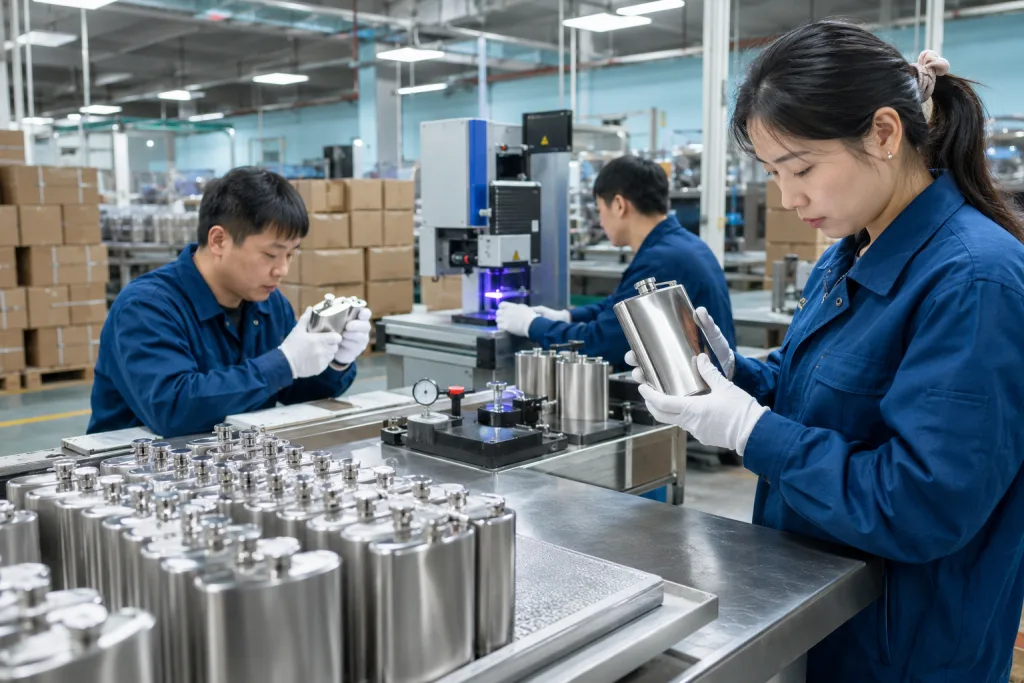
Key Takeaways
- Typical OEM alcohol flask MOQ starts at 3,000 pcs per color for logo orders and 5,000 pcs for custom shape tooling
- 304 stainless steel is the safer default for EU and North American retail programs
- Laser engraving gives cleaner durability, while silkscreen lowers unit cost on large promotional runs
- AQL 2.5 for major defects and AQL 4.0 for minor defects is a practical inspection baseline
An oem manufacturer alcohol flask order looks simple until you price the parts that fail in real shipments: 304 stainless body thickness at 0.4 mm or 0.5 mm, cap leak rate after the 24-hour inverted test, laser logo versus pad print, 5-layer carton drop test, and the sales channel behind it. A USD 1.20 flask and a USD 2.10 flask can look close in a photo. After 90 days in a warehouse, QC may pull a sample with rust dots near the weld or a cap gasket that smells like cheap rubber.
If you buy custom drinkware from China, “who is cheapest?” is the wrong question to ask. The better question is which choices will control cost, compliance, and claims before the PO is signed. From our Zhejiang production base, we usually ask buyers to lock four items first: use case, material gauge, branding process, and inspection standard. We run this check because we have seen 3,000-piece promo orders go sideways over one missed logo color code on the PO, even when the flask itself passed inspection.
Start With The Sales Channel
Start with where the flask will be sold or handed out. A canteen giveaway for 3,000 staff, a liquor gift set with a molded tray, and a distributor program that reorders every quarter all need different specs. Treat them the same and the math does not work: you either overbuild the cheap order or invite cap leakage claims after QC pulls the sample.
For a canteen promotional order, price pressure is usually sharp and the flask may sit in a desk drawer most of the year. A 6 oz or 8 oz stainless flask with 0.4 mm wall thickness, silkscreen logo, and individual white box may be enough. We run this type on a simple gauge check: mouth opening, cap thread, and logo position in mm before packing. For retail, especially in Europe or North America, budget for cleaner polishing, tighter cap fitting, stronger packaging, and food-contact documentation. That can add USD 0.20 to USD 0.55 per unit before freight.
If you are a canteen distributor or distributor drinkware buyer, repeatability beats a clever one-off shape. Your sales team needs stable dimensions, reliable carton quantities, and replacement caps that fit the next batch; we have seen a 1.5 mm thread change turn into a reorder complaint. A custom canteen shape may look attractive, but if it needs new tooling and a 35-day longer lead time, seasonal delivery gets squeezed. The buyer flagged it too late once. Not fun.
For alcohol flasks, we usually split buyers into three working groups: promotional importers buying 3,000 to 10,000 pcs who care about unit cost and print pass rate, brand owners buying 5,000 to 30,000 pcs with packaging control and barcode accuracy, and distributors buying mixed custom drinkware across flasks, growlers, tumblers, and bottles who need carton logic across SKUs. Each group should ask different questions before approving a quotation. On our line, the PO typo we catch most often is “6 oz” in the item description and “8 oz” in the packing mark.
Choose Material Before Shape
About 7 out of 10 buyers send us a shape photo first. Material should come first. For an oem manufacturer alcohol flask, 304 stainless steel is still the normal choice because it holds up against liquor, forms cleanly in the hydraulic press, and passes food-contact review without a long argument. 201 stainless steel can reduce cost, sometimes by USD 0.08 to USD 0.18 per unit on a small flask, but for a serious retail program the math does not work after complaints and returns.
Wall thickness changes the whole feel. A flask body at 0.35 mm may pass a basic visual inspection, but QC pulled samples from a 24-piece carton last year and found corner dents after the inland truck from Yiwu to Ningbo. At 0.4 mm to 0.5 mm, the flask feels more solid and handles mirror polishing with fewer wave marks. If you want a premium customized drinkware line, write the gauge in the purchase order instead of accepting “standard thickness.”
The cap assembly is where cheap flasks usually fail. A low-cost screw cap may look fine on the desk, but thread tolerance and gasket material decide whether the flask leaks after 3 turns on the torque meter. For export, we run food-grade silicone gasket material and a torque check during production. For buyers selling in the EU, ask for LFGB or REACH-related material declarations where relevant. For the US, FDA food-contact expectations and California Proposition 65 risk need to be checked before artwork approval, not after the buyer flagged it.
The same rule applies when your range includes canteen customized bottles or a customized growler. A larger vessel puts more load on welding, polishing, and leak testing; our line uses a water pressure test before packing because one pinhole can ruin a full carton. A custom growler or customizable growler is not just a bigger flask. It needs separate decisions on insulation, cap seal, handle strength, and carton protection, especially when the gross weight passes 12 kg per master carton.
Branding Is A Cost Decision
Logo method is a cost decision, not decoration. It changes MOQ, defect rate, lead time, and how the flask looks after 6 months in a buyer’s hand. For alcohol flasks, we usually run laser engraving, silkscreen printing, pad printing, embossing, or full custom tooling. On the line, QC checks logo position with a 0.5 mm tolerance gauge before packing, because a crooked mark on a curved hip flask gets flagged fast.
Laser engraving looks clean and lasts. It works on brushed or polished stainless steel, so we use it for corporate gifts, retail flasks, and premium distributor canteen lines. The unit cost is usually higher than single-color printing, but there is no ink adhesion problem after a 3M tape test. If your design has small text under 1.2 mm or a thin crest, laser is worth the extra USD 0.05 to USD 0.15 per unit. The math works when returns are counted.
Silkscreen printing fits simple logos and large canteen promotional runs. It keeps unit cost low, but curved flask bodies need a fixed jig and steady alignment. We have seen a buyer approve flat artwork, then reject the sample because the logo stretched across the rounded flask shoulder. If you need 2-color or 3-color printing, request pre-production samples and rub testing. QC pulled one sample last month after 50 dry rubs because the second color shifted 0.8 mm.
Embossing or debossing needs tooling and normally pushes MOQ to 5,000 pcs or more. For a one-time event, this is the wrong question to ask; the tooling cost eats the budget before the flask leaves Hangzhou. It makes sense for a brand owner building a long-term customizable drinkware range. If your program includes a custom canteen, customizable canteen, and alcohol flask under one brand, keep logo size and placement rules consistent. We ship fewer revised samples when the PO shows one placement drawing instead of three different logo rules.
Do not approve mass production from a digital mockup alone. Approve a physical sample with the real finish, logo method, cap, and box.
Packaging Drives Claim Rates
Alcohol flasks are small, but packaging still drives claims. We have seen buyers spend 40 minutes pushing back on USD 0.03 per flask, then approve a thin 250 gsm box that leaves hairline scratches, crushed corners, and retailer chargebacks after the first pallet lands.
For basic wholesale, an individual white box and export carton may be enough. For retail, we run a color box with insert, barcode position, warning text, and carton marking signed off before the line starts. If the product is going to Amazon FBA or a North American distributor drinkware warehouse, carton weight, FNSKU label placement, and master carton dimensions should be locked before the purchase order. A 12 kg to 15 kg master carton is easier for warehouse handling than an overloaded carton that fails a 76 cm drop test. The math does not work if one saved carton spec creates 3% repack claims.
Gift sets need more discipline. A flask packed with cups, funnel, or a custom growler accessory can shift during transit if the insert gap is 3 mm too wide. QC pulled the sample, shook it by hand, and the funnel left a ring mark on the flask cap. EVA, paper pulp, and folded cardboard inserts each need a real quote with thickness, tooling cost, and lead time. Paper pulp fits some sustainable programs, but tooling and drying consistency need checking before mass packing.
If you are working with canteen suppliers or canteen vendors in China, ask whether packaging is handled in-house or subcontracted. A factory in Zhejiang may produce the flask body and outsource color box printing nearby, which is normal. The key is whether one supplier controls final packing inspection, including barcode scan, carton mark, and PO spelling. We once had a buyer flag one wrong letter on a side mark after 86 cartons were packed. At BottleForge Industrial, our practical threshold is simple: if packaging affects the customer’s first impression, it belongs in the approved sample set, not only in an email attachment.
MOQ, Tooling, And Lead Time
MOQ is where buyer talks get fuzzy. For a standard alcohol flask using our existing mold and one logo, we usually quote 3,000 pcs per color. If the buyer asks for custom powder coating, a new body curve, or a molded cap change, the MOQ normally moves to 5,000 to 10,000 pcs because the line has to set coating racks, color panels, and cap gauges separately. For a full customized canteen or customized growler with new tooling, the number goes higher. The forming tools, welding fixtures, and leak-test jigs have to earn their place on the floor.
Tooling cost has a wide spread. A simple logo fixture may be under USD 100, and we run that on a small positioning jig beside the laser machine. A new flask body mold can run from USD 800 to USD 3,000 depending on the shoulder shape, radius, and whether the sample fails the first 24-hour leak check. A larger canteen factory project with custom cap, custom body, and a handle that needs its own welding fixture can move beyond that. Tooling ownership should be written clearly on the PI: who pays, who stores it, how many years it is kept, and whether it can be used for other customers. We have seen this go sideways when a PO only says "mold fee paid" and nothing else.
Lead time needs plain numbers. For existing flask models, sample time is usually 7 to 12 days after artwork confirmation. Bulk production is commonly 25 to 40 days after deposit and sample approval. Before Q4 promotions, add 7 to 15 days because polishing, coating, and carton packing all get crowded. Our Zhejiang facility can handle about 450,000 stainless drinkware units per month across flask lines plus bottle, tumbler, and growler lines, but capacity still needs reservation when several distributor growler and canteen manufacturer orders land together. QC pulled one flask sample last season because the logo sat 1.5 mm off center; that kind of fix can turn 12 days into 18 days.
FOB Ningbo or FOB Shanghai are typical for buyers shipping from East China. If your freight forwarder wants one port, put it in the RFQ, not after carton marks are printed. Zhejiang to Ningbo is a short inland move for us, but carton CBM, pallet height, and the HS code on the customs documents still change the landed cost. The buyer often asks only for the unit price; this is the wrong question to ask if the flask gift set has bulky foam inserts.
Quality Checks Worth Paying For
A flask inspection is simple work, but the wording has to be tight. Visual check alone is the wrong question to ask. Before mass production, define scratch length, dent depth, weld discoloration, and polish marks in writing; on one 304 stainless flask order, QC pulled the sample because a 6 mm hairline scratch looked “acceptable” to the line but not to the buyer.
A practical inspection plan covers material confirmation with an XRF gun; capacity check by filling to the neck line, for example 175 ml or 6 oz; leak test; cap torque check with a torque meter; logo position check against the artwork PDF; rub test for printed logos; carton drop test; barcode scan for retail packs. For most B2B orders, AQL 2.5 for major defects and AQL 4.0 for minor defects is a reasonable baseline. Premium retail needs a tighter cosmetic limit and more inspected units, because one visible dent on a shelf pack can trigger a full carton claim.
Leak testing must be physical. Fill the flask with water, close the cap, invert it for 60 seconds, shake it 10 times, then leave it on absorbent paper for 30 minutes. Write the sample size on the inspection sheet; we run different counts for 500 pcs and 10,000 pcs, so “random check” is not enough. For coated or printed flasks, add a 3M tape test or alcohol rub test according to the finish. If you source from two canteen manufacturers, use the same checklist for both vendors, or the comparison gets messy fast.
Compliance sits inside quality, not beside it. Ask for BSCI or Sedex audit status if your retailer requires social compliance, and ask for ISO 9001 when your internal policy needs a quality management reference. For Europe, confirm REACH and food-contact expectations before production; for the US, check ASTM-related packaging or warning language if the flask is packed in a gift set. A serious canteen supplier will not be offended by these questions. We ship these orders often, and we have seen one PO typo on “LFGB” delay carton approval by 12 days.
Build A Supplier Scorecard
Choosing between canteen distributors, canteen suppliers, and a direct canteen manufacturer is a business decision, not a moral one. A trading company works for 300-piece mixed cartons when the buyer accepts stock shapes and stock colors. A direct canteen factory fits better when you need stable pricing, 304 stainless confirmation, tooling changes, and repeat production on the same line. We have seen this go sideways when a buyer asked for a welded alcohol flask body after artwork approval, and the quote was based on a standard drawn shell. Wrong question. The issue is not who sounds cheaper; it is whether the supplier matches your order profile.
Use a scorecard with five plain criteria: product fit based on real flask size and cap style, engineering support with drawings or sample comments, compliance documents tied to the exact material, production capacity by daily output, and communication accuracy on every PO line. Give each supplier a score from 1 to 5. If a canteen vendor sends a fast quote but cannot confirm steel grade, cap gasket material, carton size, and AQL level, the low price is not yet a real price. QC pulled one pre-production sample last month because the gasket was listed as silicone in the email but TPE on the packing spec.
For distributor canteen and distributor growler programs, also measure range depth. You may need an alcohol flask today, then a custom canteen with a shoulder strap next season, a sports bottle with powder coating for summer promo stock, or a customizable growler packed in a 5-layer export carton. Working with one China factory group that understands stainless forming, coating, logo application, and export packing can cut sampling from 18 days to about 12 days across the whole line. The buyer flagged this exact point after paying two mold fees to two suppliers for almost the same cap thread.
The best buying process is direct: approve the use case, lock material, choose branding, define packaging, then write inspection terms into the purchase order. Put the AQL level, carton drop test, logo position tolerance in mm, and spare cap quantity on the PO before we run mass production. That protects both sides. You get a flask that matches your channel, and the factory gets fewer late changes. For an OEM order, that is where most of the margin and delivery reliability are won.
Send Your Flask Specification For A Factory Quote
Share capacity, logo, quantity, packaging, and target market. We will return practical MOQ, lead time, and FOB pricing options.
Frequently asked questions
What MOQ should I expect for an OEM manufacturer alcohol flask order?
For a standard stainless steel alcohol flask using an existing mold, expect about 3,000 pcs per color with one logo. If you need custom coating, embossing, or a non-standard cap, MOQ usually moves to 5,000 pcs. A fully custom body shape may require 5,000 to 10,000 pcs because tooling and production setup costs have to be spread across the order. For mixed custom drinkware programs, some China suppliers can combine flasks with bottles or tumblers, but each SKU still needs its own production minimum.
Is 201 stainless steel acceptable for alcohol flasks?
201 stainless steel can be used for low-cost promotional flasks, but 304 stainless steel is the better default for retail and repeat distributor programs. The price gap may be around USD 0.08 to USD 0.18 per unit on a small flask, depending on steel market conditions and thickness. For EU and North American buyers, 304 gives stronger corrosion resistance and fewer concerns in food-contact review. If a supplier quotes unusually low, ask them to state the steel grade, wall thickness, and test document availability in writing.
Which logo method is best for a customized canteen or flask?
Laser engraving is best when durability and a premium look matter. It works well on stainless steel and avoids ink adhesion problems. Silkscreen printing is cheaper for high-volume promotional orders and simple one-color logos. Pad printing can help with small curved areas, but fixture accuracy is important. Embossing or debossing gives a more permanent branded feel, but it requires tooling and usually a higher MOQ of 5,000 pcs or more. For any customized canteen or flask, approve a physical pre-production sample before mass production.
How long does production take after sample approval?
For an existing flask model, sample production usually takes 7 to 12 days after artwork confirmation. Bulk production is commonly 25 to 40 days after deposit and approved sample. Custom tooling, special coating, gift box printing, or peak season capacity can add 7 to 20 days. If you ship FOB Ningbo or FOB Shanghai from Zhejiang or nearby China production areas, also allow time for inland trucking, export documents, and vessel booking. Buyers with fixed retail launch dates should reserve capacity before final artwork is perfect.
What should I include in the purchase order?
Include model number, capacity, steel grade, wall thickness, finish, logo method, logo size, packaging, carton quantity, barcode or FNSKU requirements, inspection standard, payment terms, and Incoterms such as FOB Ningbo. Add AQL levels, usually AQL 2.5 for major defects and AQL 4.0 for minor defects, unless your retailer requires stricter limits. For custom drinkware, attach the approved sample photos and artwork files to the PO. This reduces arguments later because the factory, inspector, and buyer are working from the same written standard.