Key Takeaways
- For military canteen wholesale bulk, MOQ usually starts at 1,000-3,000 units per color depending on coating and accessories
- 304 stainless steel at 0.5-0.6 mm wall thickness costs more than aluminum but reduces corrosion claims in humid storage
- Powder coating adds about USD 0.25-0.70 per unit and needs cross-hatch adhesion and 48-hour salt spray checks
- Normal production lead time is 30-45 days after artwork approval, with 5-7 days for pre-production samples
A military-style canteen looks simple until we quote it: 0.6 mm steel or 1.0 mm aluminum, single wall or vacuum insulated, powder coat or bare finish, cup set or bottle only, retail carton or field-kit packaging. One loose spec can move your landed cost by USD 0.40 to USD 1.80 per unit. The math gets ugly fast.
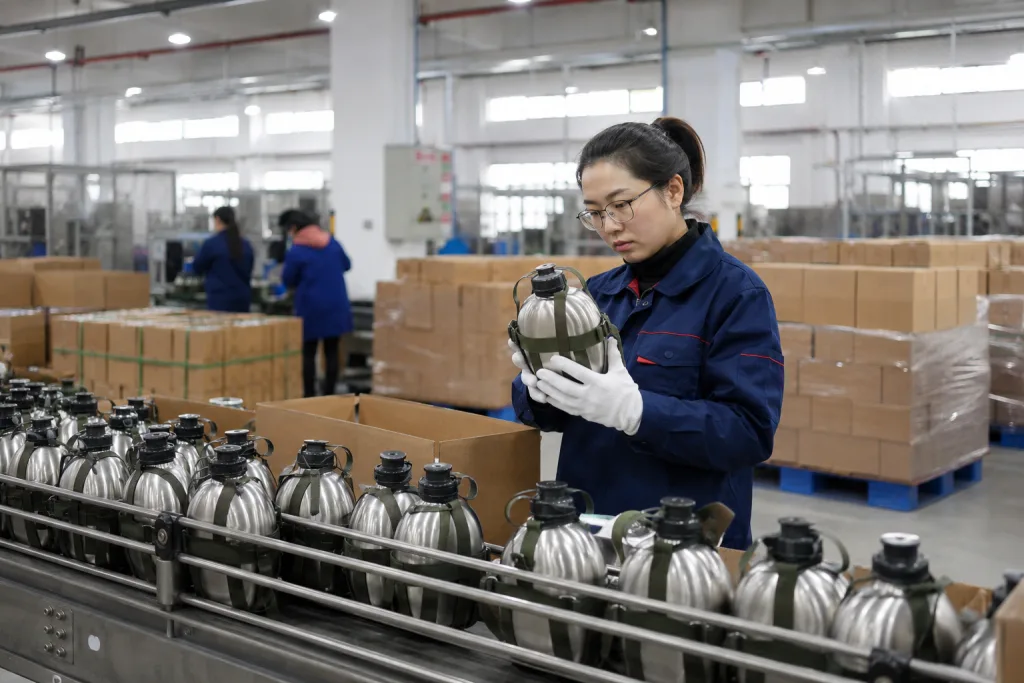
If you are buying military canteen wholesale bulk from China, lock the spec sheet before the factory opens tooling or books material. It should control function, compliance, and retail presentation. Our Hangzhou, Zhejiang team sees this on the line: one buyer asked for canteen wholesale prices from 6 factories, but 3 quotes used thinner gauge, 2 skipped coating thickness, and 1 cap seal failed after QC pulled the sample for a 24-hour leak test. The wrong question is “who is cheapest?” Match gauge, coating thickness, cap seal, carton drop test, and AQL level first.
Material Grade Controls Real Risk
The first line on your spec sheet should not say only military canteen. It should state material grade, wall thickness, and food-contact standard. For stainless models, 304 is the normal export choice for Europe and North America. We run PMI spot checks with an XRF gun before mass production because one mixed coil can ruin a 3,000 pcs order. Some buyers ask for 201 stainless to cut about USD 0.25-0.45 per unit, but the math does not work if the canteen is stored damp, washed with strong detergent, or sold as outdoor gear. Rust claims cost more than the saving.
For a classic bulk canteen, 0.5-0.6 mm wall thickness is the range we quote most often. Below 0.45 mm, dents show up fast during carton drop tests and warehouse handling; QC pulled one 0.42 mm sample last season with a shoulder dent after only a 76 cm drop. Above 0.7 mm, the bottle feels solid, but weight and FOB cost climb quickly. Aluminum canteen bulk orders still make sense for lightweight promotional sets, usually 5,000 pcs MOQ and up, but they need an internal food-safe coating and strict coating inspection. Bare aluminum against acidic drinks is a bad export spec.
If your assortment includes alcohol flask bulk, alcohol flask wholesale, or alcohol flask wholesale bulk SKUs, keep those files separate from military-style water canteens. Different buyer. Different use case. Different label risk. A 6 oz or 8 oz flask may use 304 stainless at 0.4-0.5 mm, while a 1 qt canteen needs better dent resistance and a cap tether that survives repeated outdoor use. We have seen this go sideways when a PO says "canteen flask" and the packing artwork shows a camping water bottle, so confirm the SKU name before tooling or barcode work starts.
Buyer impact: material grade is not a cosmetic choice. It decides corrosion risk, claim rate, weight, tariff description, and the lowest responsible FOB price.
Capacity, Shape, and Fit Tolerances
Capacity looks simple. It is not. Wholesale canteen buyers often mix nominal volume, usable volume, and overflow volume on the same PO, and QC will catch the mismatch with a graduated cylinder at final inspection. A 1 qt canteen is usually expected to hold about 946 ml, but the working fill line often sits lower so the cap gasket can seal without water pushing into the threads. If you sell to outdoor, surplus, or uniform-program channels, write the capacity method on the spec sheet: brimful, rated, or usable.
The body shape matters because military-style canteens are usually bought as part of a kit. A +/-2 mm change at the shoulder can stop the bottle from sliding into a cover, belt pouch, cup, or nested cook set. We run these checks with the buyer's pouch and cup on the line, not just with calipers on a bare bottle. For bulk drinkware programs, we normally recommend a 2D drawing with height, width, depth, neck diameter, thread size, and maximum body bulge. A tolerance of +/-1.5 mm is realistic for formed stainless bodies; tighter is possible, but the math does not work unless you accept extra sorting and more rejected shells.
If you are also sourcing bulk growler, growler bulk, growler wholesale, beer growler bulk, or beer growler wholesale products, do not copy those tolerances into a canteen sheet. We have seen this go sideways. Growlers are normally 32 oz or 64 oz, often cylindrical or insulated, and the cap may need pressure caution when the buyer fills carbonated drinks. A military canteen is flatter, rides against the body, and gets judged on fit, dent resistance, and whether the cap stays attached after a drop test. Beer growler wholesale bulk and beer growler in bulk projects also need different cap lining and a larger branding panel.
For a first order from Zhejiang, set one master sample and one signed dimension drawing before mass production. Our factory capacity for formed stainless outdoor drinkware is about 180,000 units per month, but dimensional drift still has to be controlled at tool setup and first-piece inspection. QC pulled one sample last year where the neck was 0.8 mm off after polishing; it passed capacity, but the buyer's cap would not start cleanly on the thread.
Cap, Gasket, and Leak Test Details
The cap is where cheap canteen wholesale orders fail first. We have seen 8,000 pcs pass body inspection, then QC pulled the sample because the gasket smelled after a 70°C hot-water soak. A bottle body can look clean, but a soft gasket, shallow thread, or loose tether turns into wet cartons and returns. Your spec sheet should name the cap material, gasket material, thread type, tether style, and leak test method, with drawings showing thread depth in mm. For export programs, silicone gaskets beat low-grade rubber on odor and compression set.
For military canteen wholesale bulk production, we run a 100% water-fill inversion test for 3-5 minutes on the line, then add random pressure or shake testing during final QC. Simple test. It catches bad caps. If the canteen is single-wall and not pressure-rated, do not sell it for carbonated beer or fermentation. The math does not work, and we have seen this go sideways when a buyer asked us to print “beer safe” on a PO for a basic army-style flask. That claim belongs to another product family, such as beer growler wholesale or wholesale growler with the correct cap structure.
Cap tether choices change both cost and field use. A simple PP strap keeps the unit price down and works for promotional canteen bulk orders with 3,000 pcs MOQ. A metal chain or reinforced hinge feels tougher, but the buyer may flag coating scratches if the chain sits against the painted shoulder during carton vibration. For wholesale drinkware sold through outdoor retailers, ask the factory to assemble 20 samples and run a 500-cycle open-close test with the same cap tooling. This is not overengineering; it is cheaper than finding after shipment that the cap pops off the retaining loop.
- Gasket: food-grade silicone, odor checked after 70°C hot-water soak.
- Thread: smooth engagement within 1.5 turns before tightening, no cross-thread feel on the gauge sample.
- Leak check: 100% line test plus AQL sampling at final inspection, with failed pieces held in a red bin for review.
- Tether: pull test target of 3-5 kg for basic outdoor use, checked with a handheld force gauge.
Coating, Printing, and Field Wear
Military styling usually means matte green, black, sand, gray, or bare stainless. Finish is not just appearance. It controls scratch resistance, hand feel, laser contrast, carton rub marks, and whether the sample still looks sellable after 7 days on a distributor's retail shelf. For bulk drinkware, we run powder coating more often than wet paint because coverage is steadier around the shoulder radius and bottom weld, and a controlled line can hit a 48-hour salt spray target when the base metal and phosphate pretreatment are right. QC checks film thickness with a coating gauge; 60-80 microns is a normal target on our canteen jobs.
For brand owners, the artwork method has to match the selling channel. Laser engraving stays clean on stainless, but on some matte coatings the mark looks weak unless we test contrast first. Silkscreen works for one-color logos, often USD 0.08-0.18 per position, but the ink needs adhesion testing and full curing; we have seen orders fail because the oven was set 10 degrees low on the first shift. Heat transfer handles detailed graphics, but abrasion damages it faster. For military-inspired products, oversized decoration is the wrong question to ask. Small chest-mark style branding usually sells better in outdoor and tactical channels because buyers do not want the bottle to look like a costume prop.
If your catalog also carries beer tumbler bulk, beer tumbler wholesale, beer tumbler wholesale bulk, beer tumbler in bulk, or best wholesale drink bottle lines, keep brand standards consistent but do not force the same finish across every SKU. Tumblers sit on desks, in cars, and on bar counters. Canteens rub against pouch fabric, belt clips, and metal gear; the math does not work if you copy a desktop tumbler coating onto a field canteen. We test canteen coating with cross-hatch adhesion, alcohol rub, and carton vibration rub, and QC pulled one 2024 sample after the bottom edge showed gray base metal through the carton paper. For REACH-sensitive markets in Europe, ask for coating and ink documentation before production, not when the container is already waiting at Ningbo or Shanghai.
Packaging Lines That Prevent Claims
Packaging is a spec line, not an afterthought. A military canteen dents first at the shoulder and base edge, and we see it faster when the buyer pushes thinner gauge metal to hit a promotional price. For wholesale canteen orders, our floor usually sets the minimum export pack as a polybag or tissue wrap, a divider or fitted inner carton for coated units, and a 5-ply master carton when the pallet will be stacked above 1.6 m or pass through 2-3 warehouses. QC checks the base edge with a 0.02 mm feeler gauge after packing trials. Small detail, big claim risk.
Retail packaging depends on the sales route. Amazon-style fulfillment needs FNSKU labeling, suffocation warning on polybags, carton weight control under 15 kg, and barcode scan checks with a handheld scanner before sealing. Distributor orders usually work better in plain brown inner boxes showing model number, color, capacity, and country of origin. Club or surplus channels often ask for bulk cartons with no retail box to cut cost and waste. That can save USD 0.15-0.45 per unit, but the math does not work if black powder coating rubs in transit and the buyer flags 8 cartons at receiving.
For drinkware wholesale and wholesale drinkware programs, specify carton drop testing. A practical test is ISTA-style drop from 76 cm for cartons under 10 kg, adjusted by carton weight and customer requirement. You do not need a laboratory for every order. You do need a repeatable factory-side test, corner photos, and the failed-sample notes kept in the QC file. In Zhejiang, 7 out of 10 canteen shipments we run move through Ningbo port, so cartons take inland trucking, port handling, sea freight, and final DC receiving before anyone opens the first box.
Marking should be controlled on the carton artwork: SKU, PO number, gross weight, net weight, carton size, quantity, and made in China text where required. Bad carton marks do not change product quality, but they create receiving delays and chargebacks. We have seen a PO typo put 750 ml on the carton while the item was 1 qt, and the buyer held the shipment for 12 days vs the normal 3-day receiving window.
MOQ, Price, and Lead Time
For military canteen wholesale bulk, real pricing starts with MOQ and the exact build. A plain stainless single-wall canteen may start around 1,000 units if we run existing tooling and a standard color. Custom powder coating normally pushes MOQ to 2,000-3,000 units per color because the coating line loses parts during setup and color change; on a 3,000 pcs run, we usually budget 60-90 pcs for spray test, hook marks, and shade adjustment. A new molded cap, special pouch fit, or custom nested cup can raise MOQ to 5,000 units or require tooling charges. The mold room will ask for a 2D cap drawing before they quote. No drawing, no clean price.
As a rough FOB China range, a basic stainless canteen can land around USD 2.20-4.80 depending on size, gauge, finish, cap, and packing. A kit with cup, cover, shoulder strap, and retail carton can move into USD 5.50-9.50. Treat these as check bands, not promises. If one factory is 28% cheaper, ask what changed: 201 instead of 304 stainless, 0.45 mm wall instead of 0.55 mm, cheaper gasket, thinner powder coat, lower carton strength, or no AQL 2.5 inspection. We have seen buyers flag this after QC pulled the sample and found the cup edge too sharp. At that point, the math doesn't work.
Normal lead time is 30-45 days after deposit and approved pre-production sample. Sample time is usually 5-7 days for available shapes with logo, or 15-25 days if tooling or new accessories are involved. Peak season before summer outdoor campaigns can add 7-14 days because the polishing and coating line gets booked by bottle orders. For China export orders, plan inspection at least 3 days before the booked vessel date. Rushing QC after cartons are sealed turns a 2 mm logo shift or loose cap gasket into a rework bill, missed sailing, and 12 days vs 18 days on the buyer's receiving schedule.
Quote lines to demand
Ask every supplier to quote the same Incoterm, usually FOB Ningbo or FOB Shanghai for Zhejiang production. Require material grade with thickness in mm, capacity in ml or oz, finish with Pantone or texture note, logo method with artwork size, packing with carton dimensions and gross weight, MOQ, sample fee, tooling fee, lead time, AQL level, and payment terms on the quotation. Without those lines, you are comparing guesses. We also ask buyers to check the PO spelling; one typo from "canteen cup" to "canteen cap" once held a 1,200 pcs sample run for two days.
Compliance and Inspection Before Shipment
Military-style drinkware compliance is not as painful as powered goods, but skipping it still gets cartons stuck. For the EU, ask for LFGB or food-contact files where they apply, REACH checks for coatings and inks, and packaging marks if the order goes into regulated retail. For the US, buyers often request FDA food-contact support, California Proposition 65 review, and ASTM-related physical testing when the item category or age grading calls for it. If the canteen is not for children, do not print cartoon bears, “kids outdoor bottle,” or school-camp claims on the artwork; we have seen one 5,000 pcs PO delayed 9 days because the buyer flagged childlike graphics during label review.
Factory audits belong in the sourcing decision. BSCI, Sedex, or ISO 9001 does not prove the canteen is good, but it shows the factory has basic management control. The better question is whether the supplier can show incoming material checks, in-process leak testing, coating inspection, and final AQL records from similar bulk drinkware orders. Ask for the actual sheet. On our line, QC pulled the sample after the 0.6 mm body-thickness check and the vacuum leak tester caught 7 leaking caps in the first 800 pcs, which matters more than a clean audit cover page.
A fair inspection plan for canteen wholesale is general inspection level II with AQL 2.5 for major defects and 4.0 for minor defects, adjusted if your customer contract is stricter. Define critical defects clearly: leaking, sharp edges, wrong material, failed coating adhesion, missing warning label, barcode not scannable, or carton quantity mismatch. For alcohol flask in bulk or alcohol flask wholesale programs, add odor checks and cap-fit checks because small flasks are gift items and buyers notice smell in 3 seconds. We run the 3M tape test on coating adhesion and check 10 caps per carton when the order is gift-boxed, because one loose cap makes the whole set feel cheap.
The last call is 80% packed or 100% packed inspection. For new suppliers or new tooling, choose 80% packed so there is time to fix defects; 12 days before vessel closing is workable, 2 days is just damage control. For repeat wholesale canteen runs with stable history, final random inspection at 100% packed is usually enough. The math does not work if you save USD 0.08 per unit and then repack 300 cartons in Ningbo because the outer carton quantity was wrong or a PO typo changed black lids to army green lids.
Send your canteen spec sheet for a factory quote
We will check material, MOQ, coating, packing, and FOB assumptions before you commit to production.
Frequently asked questions
What MOQ should I expect for military canteen wholesale bulk orders?
For existing shapes, the practical MOQ is usually 1,000 units for plain stainless or standard colors. Custom powder coating normally starts at 2,000-3,000 units per color because the coating line has setup loss. If you need a new cap, pouch fit, nested cup, or private mold body, expect 5,000 units or a tooling charge. For mixed drinkware bulk programs, factories may combine purchase value across canteens, tumblers, and growlers, but color MOQ usually still applies.
Is stainless steel or aluminum better for wholesale canteen programs?
For Europe and North America, 304 stainless steel is the safer default because it resists corrosion and does not need an internal coating for normal water use. Aluminum is lighter and can be cheaper by roughly USD 0.20-0.60 per unit, but it needs a reliable food-safe lining if used for acidic drinks. If your channel is outdoor retail or government-adjacent distribution, stainless at 0.5-0.6 mm wall thickness is usually easier to defend than thin coated aluminum.
Can I combine canteens with growlers and beer tumblers in one order?
Yes, if the supplier makes multiple drinkware categories or coordinates production through one export office. A mixed order can include wholesale canteen, beer growler bulk, beer tumbler wholesale bulk, and travel bottle SKUs under one shipment. The limits are MOQ by color, different production lines, and inspection timing. Growlers and beer tumblers may require different lids, pressure cautions, and retail packaging, so do not use one generic QC checklist for every item.
What tests should I require before shipping canteen bulk orders?
At minimum, require 100% line leak testing, final AQL inspection, coating adhesion test for painted units, barcode scan check, carton drop check, and visual inspection for dents or sharp edges. For EU sales, add REACH-related coating and ink documentation. For US sales, request food-contact support and review any Proposition 65 exposure risk. A useful inspection standard is AQL 2.5 for major defects and 4.0 for minor defects unless your customer contract demands tighter limits.
What is a realistic FOB price for a bulk military-style canteen?
A basic single-wall stainless canteen from China often falls around USD 2.20-4.80 FOB, depending on capacity, steel grade, wall thickness, finish, cap, and packing. A kit with cup, cover, strap, and retail box can be around USD 5.50-9.50. If a quote is much lower, ask whether the factory changed from 304 to 201 stainless, reduced thickness below 0.5 mm, removed inner packing, or quoted without logo and inspection costs.