Key Takeaways
- For custom canteen programs, expect MOQ of 1,000-3,000 units per SKU and 35-50 days production after sample approval
- 304 stainless steel body with 0.5-0.6 mm wall thickness is the practical baseline for most military-style canteens
- Ask for AQL 2.5 inspection, 24-hour leak test, and coating adhesion checks before final payment
- FOB Ningbo or Shanghai pricing for basic customized canteen models often starts around USD 3.20-6.80 depending on size and tooling
You are not buying a lifestyle bottle. A military canteen gets dropped on concrete, packed tight in a 5-layer export carton, left in hot trucks, and washed again and again without leaking, tasting metallic, or failing a compliance check. QC will check the mouth weld, cap thread, silicone gasket fit, and coating adhesion with a cross-cut tester. New buyers often miss the small specs: wall thickness, cap retention force, gasket material, coating durability, and whether the logo survives abrasion after 500 rubs.
If you are screening a military canteen vendor in China or Zhejiang, ask for numbers first. Fast quotes mean little. We have seen this go sideways when a supplier accepted the PO, then missed AQL consistency, REACH paperwork, or carton drop performance at the pre-shipment inspection. A capable canteen manufacturer will state the working range clearly: MOQ from 1,000 to 3,000 units, 35 to 50 day lead time, 100,000 units/month capacity, and test standards that match your market in Europe or North America. If they cannot answer the gasket spec or carton drop height, the math does not work.
What should you ask first?
Start with the use case, not the quote. This is the wrong first question. We get RFQs that say “military canteen, best price” with no capacity, no cap drawing, and no packing target; last month one PO even mixed 750 ml in the header and 1,000 ml in the item line. Then the comparison breaks. One canteen vendor quotes a single-wall 500 ml bottle for a promotion job. Another quotes a military-style body with a wide mouth, tethered cap, webbing-compatible profile, and heavier gauge. Same name. Different product.
Your first checklist should be short and blunt:
- Capacity: 750 ml, 1,000 ml, or 1.5 L
- Material: 304 stainless steel, aluminum, or BPA-free Tritan
- Construction: single-wall or vacuum insulated
- Cap system: screw cap, tethered cap, bite valve, or cup lid
- Use environment: outdoor retail, institutional supply, promotional contract, or tactical resale
- Compliance market: EU REACH, LFGB, FDA, Prop 65 as needed
- Branding method: laser, silkscreen, pad print, heat transfer, or embossed mold detail
If a canteen manufacturer cannot answer these points with examples, 2D drawings, and test records, keep moving. We run this check before quoting because the math does not work when the buyer changes the cap after sampling. A reliable military canteen vendor should be able to say, for example, that a 1.0 L 304 stainless custom canteen uses a 0.5 mm body wall, food-grade silicone gasket, and passes a 1.2 meter drop test in standard export packaging. QC pulled the sample, dropped it on the corner, then checked the gasket seat with a caliper. That tells you they build for repeat orders, not just canteen promotional projects.
A useful rule: if the factory talks only about color and logo, and not sealing structure, material certificate, and carton spec, you are probably talking to a trader with limited engineering control. We have seen this go sideways when carton weight hits 16 kg and the buyer flags crushed corners at AQL 2.5 inspection.
At BottleForge Industrial in Zhejiang, we see this split every week. Buyers who define performance before decoration move faster. For a normal 1,000 ml stainless canteen project, clear specs can cut sample approval from 18 days to 12 days because the line is not guessing on cap thread, gasket hardness, or logo position.
Which material fits your program?
Material choice sets the loaded weight, target FOB, test route, and how many cartons come back with dents or odor complaints. For a military canteen vendor shortlist, we usually run samples through a 1.2 m drop check, caliper the body wall, and compare these material routes before quoting.
304 stainless steel
304 stainless steel is the safest default for customized drinkware sold into Europe and North America. It dents less than aluminum, keeps water taste clean, and takes laser marking, powder coating, and durable print without much drama. For a 750 ml to 1,000 ml custom canteen, FOB China pricing often lands around USD 3.80-6.80 depending on insulation, finish, and cap complexity. On our line, QC pulled a 0.55 mm body sample last week because the shoulder radius showed orange peel after powder coating. For a customized growler-style format used outdoors, stainless is usually the right answer.
Aluminum
Aluminum cuts carry weight and can be cheaper, often USD 2.20-4.20 FOB for simpler shapes. Check the inner coating first: coating adhesion, scratch marks around the mouth, and dent risk after packing. We have seen this go sideways when a buyer pushed for a lighter gauge to save USD 0.18, then flagged 37 dented bodies after transit testing. For canteen distributors serving institutional or uniform channels, aluminum still works when low carry weight matters. For hard-use retail, the math does not work if the body gauge is too light.
Tritan or other BPA-free plastic
For lower-budget canteen custom projects or youth and training use, Tritan can work. It handles impact better than standard AS plastic, but it will not feel like metal in the buyer's hand. Decoration choices are wide, though abrasion around the grip area shows up fast; our pad-print operator usually checks the first 20 pcs with 3M tape before the run continues. If the program needs a premium shelf price, plastic is the wrong place to start.
Your checklist here should include: body material grade with thickness in mm, lid resin with supplier code, gasket material with hardness, coating specification with cure temperature, and migration test report with report date. If a canteen factory says only "food safe," that is not enough. Ask for actual report dates and labs. Buyers sourcing from Zhejiang or wider China should also ask whether the same materials are used across mass production, not just on the sample; we have seen a PO typo change "PP lid" to "PC lid" and stop a shipment for 4 days. A good canteen manufacturer or canteen supplier will confirm batch traceability and incoming inspection standards.
How custom is truly custom?
About 7 out of 10 RFQs we see for a custom canteen are not asking for the same thing. Some need a stock body with a logo, some need a stock body with changed parts, and a few need a new mold. We separate these at quotation stage because the BOM sheet, sample schedule, and tooling risk are different.
Level 1: stock model plus decoration. This is the quickest route for canteen customizable programs. You pick an existing body, choose a standard cap, and add a logo by laser, silk screen, or heat-transfer print. MOQ is often 1,000 units per color, and pre-production samples can be ready in 7 to 10 days. Good for canteen promotional orders and distributor drinkware programs. On the line, QC usually checks logo position with a 0.5 mm tolerance jig before we release the sample photos.
Level 2: modified stock model. You keep the base body but change cap color, strap, cup, texture, or packaging. This is common when a canteen distributor wants channel differentiation without paying for full tooling. MOQ usually rises to 2,000 units, and lead time may move to 40 to 50 days if new components are involved. We have seen this go sideways when a buyer approves the bottle body but forgets the strap color on the PO; the sample room then follows the wrong Pantone code.
Level 3: new mold development. This is what buyers mean by canteen customized or customized canteen in the strict sense: new shape, unique shoulder geometry, proprietary lid, or nestable profile. Tooling for a stainless body plus plastic cap components can range from USD 2,500 to USD 12,000 depending on complexity. Development can take 25 to 45 days before mass production. The mold shop will ask for 2D drawings with wall thickness marked in mm, because a nice rendering does not tell us whether the shoulder can survive deep drawing.
The practical question is whether your sales volume pays back the tooling. If you are buying 3,000 units once, use a stock platform. If you expect 30,000 to 100,000 units annually, a canteen customizable program with selective tooling starts to make sense. The same logic applies to a custom growler or customizable growler line. Distinctive packaging, cup lids, and engraving zones can create margin without forcing a completely new body. We run this math with buyers often; at 3,000 units, the amortized tooling cost usually makes the unit price look worse, not better.
Ask every canteen vendor to separate quote lines for tooling, sample charges, FOB unit price, and packaging cost. If they blend everything together, comparing offers from 4 canteen suppliers or canteen manufacturers becomes messy. Our sales team has had buyers flag this after finance found a USD 0.18 carton cost hidden inside the unit price.
What tests actually matter?
Testing is where 6 out of 10 first-time buyers get caught. The sample looks fine on a WeChat video, then the warehouse finds wet cartons or loose caps after the first pallet is opened. A military canteen vendor should talk about failure points, test pressure, and who signs the inspection sheet, not “good quality.” We run a 0.6 MPa air-leak jig on screw caps before the line packs.
Your minimum checklist should include:
- Leak test: 100% air pressure or inverted water test, plus 24-hour resting test on sample lots
- Drop test: usually 1.0 to 1.2 meters with filled product and retail pack
- Coating adhesion: cross-hatch tape test for painted or powder-coated surfaces
- Salt spray: required when metal hardware or external clips sit outside the bag or carton protection
- Dishwasher statement: only if validated; do not print “dishwasher safe” casually
- Migration and food-contact compliance: FDA, LFGB, REACH depending on market
- Carton drop: critical for Amazon FBA or distributor canteen pallets that spend 18 to 32 days in transit
For ongoing quality control, ask for the AQL level and the inspection plan before you pay the deposit. A common standard is AQL 2.5 for major defects and 4.0 for minor defects, with inline and final inspection. Short answer: a perfect golden sample is the wrong target. If you are buying through a canteen distributor or from 3 canteen vendors, lot-to-lot consistency matters more, and QC should pull samples from sealed cartons, not from the sales desk.
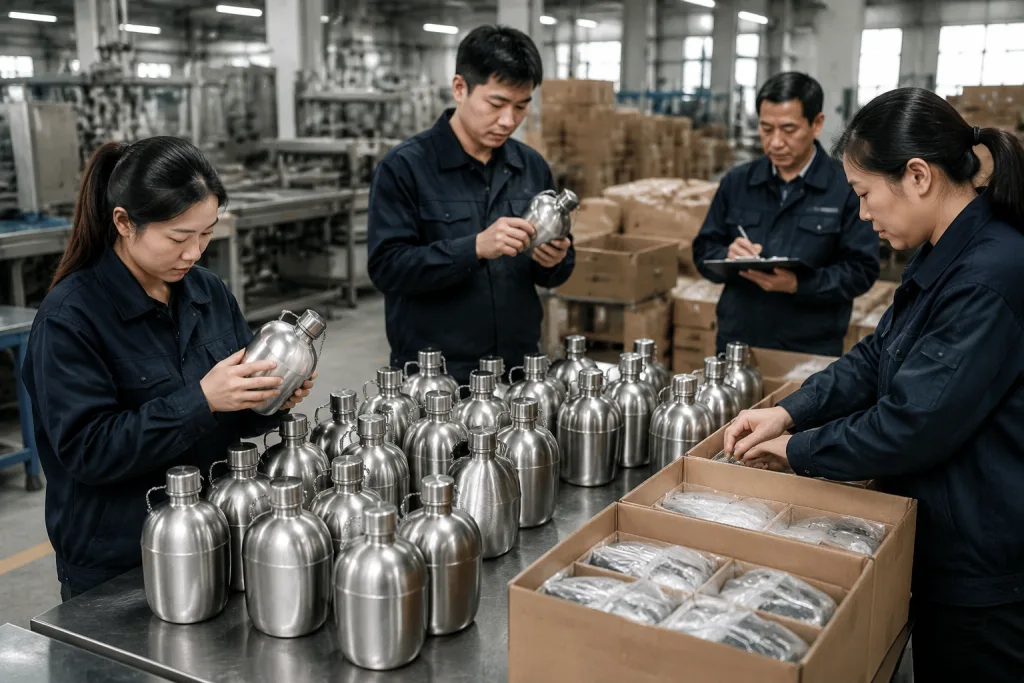
Ask the factory what usually fails. An honest canteen factory will tell you. We have seen cap thread mismatch show up after a 0.2 mm mold wear issue, silicone odor from under-cured rings, off-center printing by 1.5 mm, powder coat scratches from hard PE bags, and vacuum loss on insulated models after the hot-water hold test. A serious canteen manufacturer in China should have corrective actions, not excuses. In our Hangzhou, Zhejiang operations, standard final checks include torque verification with a digital torque meter, visual inspection under defined light conditions, barcode scan confirmation against the PO, and random carton drop validation before booking shipment.
How do price and MOQ move?
If three suppliers quote wildly different numbers, the gap is usually in material weight, packaging, or finish. For B2B custom drinkware, price is not just price. We run into this on canteen RFQs every week: one quote uses 0.5 mm body sheet, another uses 0.6 mm, and the buyer only sees a USD 0.42 difference.
Here is the practical price sheet buyers use:
- Basic single-wall stainless custom canteen, 750-1,000 ml: USD 3.20-4.80 FOB China
- Vacuum insulated military-style canteen: USD 5.50-8.90 FOB
- Aluminum version: USD 2.20-4.20 FOB
- Tritan customizable canteen: USD 1.60-3.50 FOB
- Gift box add-on: USD 0.45-1.20
- Laser marking: typically USD 0.08-0.20 per unit
- Silkscreen: often USD 0.05-0.15 per color position
MOQ usually starts at 1,000 units for stock-body decoration projects, 2,000 to 3,000 units for mixed component customization, and higher if you need exclusive colors with slow-moving caps or straps. Be careful here. If a canteen supplier offers 200-unit MOQ on a fully customized canteen with no surcharge, the math doesn't work. Small runs are possible, but someone pays for the mold setup, first-article scrap, color changeover, and the two extra workers the line needs for sorting.
Lead time is the other side of cost. Typical production in Zhejiang or elsewhere in China runs 35 to 50 days after approved sample and deposit. During peak season, powder coating queues and cap component schedules can add 7 to 15 days; last September we had one matte green batch sit 9 days waiting for coating line space. If you need FNSKU labeling, special carton marks, or retailer-specific packaging, put it into the calendar from day one.
The best purchasing move is to compare landed value, not the lowest FOB. A canteen manufacturer priced USD 0.18 higher may still win if QC pulls fewer leaking samples under AQL 2.5 and the carton packs 24 pcs instead of 18 pcs. We have seen this go sideways when a buyer saved on unit price, then paid it back through rework, air samples, and weak cartons failing the 80 cm drop test.
How should you qualify the factory?
You do not need a perfect supplier. You need a canteen factory that shows its papers, controls the line, and fits your order size. Start practical: if your PO is 30,000 pcs and their polishing room has two workers and one old wheel, the math does not work.
Ask for five things first: business license, factory audit status, recent test reports, production photos or live video, and a sample with your requested decoration. If the factory claims BSCI, ISO 9001, or Sedex-related audit history, ask for document dates and the audited site address; we have seen buyers sent an audit for a trading office 18 km away from the actual workshop. Certifications do not replace product checks, but they show whether the operation is used to outside people walking the floor with a clipboard.
A useful buyer checklist:
- Can they produce your product type monthly at meaningful volume, such as 100,000 units/month, without pushing welding or spraying to an unknown subcontractor?
- Do they manage tooling and sampling in-house, or does the mold sit at another shop with a 7-day queue?
- Can they provide material traceability for stainless, plastic resin, and silicone, including coil batch, resin lot, and gasket hardness record?
- Do they accept third-party inspection before balance payment, with AQL 2.5 written on the booking sheet?
- Can they handle retailer packaging, pallet specs, and barcode control, including a carton drop test from 76 cm?
- Do they understand Incoterms such as FOB, EXW, and DDP clearly, or are they still mixing up local trucking with export customs?
For canteen distributors and canteen manufacturers alike, communication quality is the early warning sign. If the sales contact cannot explain body gauge, gasket hardness, or print durability, you may still get a nice sample, but scaling will be messy. We have seen this go sideways: QC pulled the sample after 500 cycles of rub testing because the logo looked fine on day one and failed before packing. For a military canteen vendor, that matters because your buyers expect function first.
One more thing: ask who owns the mold, who stores it, and what happens if you stop ordering for 12 months. This matters for canteen customized and customized growler projects, where one cap mold can weigh 80 kg and sit on a rack for years. Good factories in China will put that in writing. Bad ones avoid the topic until the next order, then the buyer flags a surprise mold fee on the PI.
What should your PO specify?
A loose purchase order turns into chargebacks, rework, and arguments at the packing table. We see it on military canteen jobs when the PO says “green lid” but the approved sample file has no Pantone chip, no caliper reading, and no signed photo. Lock the details before the line opens.
Put these points in writing:
- SKU code and capacity, with dimensional tolerance such as height ±1.5 mm and diameter ±1.0 mm
- Body material grade and thickness, for example SUS304 with 0.5 mm wall, confirmed by incoming material report
- Lid material and gasket material, with approved color standard such as Pantone reference from the signed sample card
- Decoration artwork with print size, print position, and test expectation, including tape test or rub test if the logo sits near the grip area
- Packaging specification: polybag, egg-crate divider, white box, gift box, master carton count, and barcode position on the carton mark
- Carton size and gross weight limit, often under 15 kg for easier handling, checked before mass packing
- AQL standard and defect definitions, so QC pulled the sample against the same cosmetic limits the buyer approved
- Required compliance reports and shipment documents, with company name and PO number matching the commercial invoice
- Shipping term: FOB Ningbo, FOB Shanghai, or other agreed Incoterm, plus named forwarder contact if your team controls booking
- Sample approval reference and photo archive, including front, side, bottom stamp, lid fit, and packed carton photos
This is where canteen suppliers and canteen distributors split in practice. A distributor canteen source is fine for stock goods with no badge, no custom cap, and 1 carton pulled from warehouse. For canteen custom work, go straight to the canteen manufacturer. Artwork shifts by 2 mm, cap color gets flagged under the light box, and pack-out changes after a drop test. We have seen this go sideways when the buyer approved only a front-view photo.
For North America, add retailer routing rules or Amazon prep needs if relevant; one missing FNSKU label can stop 600 cartons at the prep warehouse. For Europe, make sure the documentation packet supports customs and customer compliance reviews, including test report holder name and item description. A clean PO protects both sides. It also speeds repeat orders, because the second run should take 12 days of confirmation, not 18 days of reopening old choices.
That is the basic discipline behind reliable custom drinkware sourcing. Whether you are buying a customizable canteen, a customized growler, or a broader distributor growler line, write the details once and inspect against them every time. The math does not work if QC has to guess from WhatsApp photos after production is already packed.
Need a military canteen quote that holds up?
Send your target capacity, material, logo method, and delivery window. We will reply with realistic MOQ, FOB pricing, sample timing, and compliance options.
Frequently asked questions
What MOQ should I expect from a military canteen vendor?
For a stock model with custom logo, 1,000 units per SKU is a realistic MOQ. If you want cap color changes, custom strap parts, or retail packaging, the MOQ usually moves to 2,000-3,000 units. A fully new mold project can start at 3,000 units, but annual volume should ideally be 10,000 units or more to justify tooling. Some canteen vendors in China will quote lower numbers, but that often means fewer color controls, mixed packaging standards, or higher unit pricing. Always ask whether MOQ is per color, per size, or per shipment.
How long does a customized canteen order usually take?
If you are using an existing mold, sample time is often 7-10 days and production is 35-45 days after sample approval and deposit. If you need new components or new tooling, add 25-45 days for development before production starts. During peak export periods in Zhejiang and wider China, powder coating, lid injection, and packaging queues can add another 7-15 days. If you need third-party inspection, barcode labeling, or Amazon FBA prep, build that into the critical path early. Serious delays usually come from artwork changes and packaging revisions, not the metal body itself.
Which compliance documents should I ask a canteen supplier for?
For Europe, ask for REACH-related compliance declarations and, where relevant, LFGB or food-contact migration reports from a recognized lab. For North America, FDA food-contact statements are common, and some buyers also request Prop 65 screening depending on materials and channel. If the product is for children, ASTM-related review may also matter depending on design features and age grading. Beyond compliance, ask for material declarations for stainless steel, plastic resin, and silicone gasket. Reports should be recent, ideally within 12-24 months, and tied to the actual materials used in mass production.
Is it better to buy from a canteen manufacturer or a canteen distributor?
If you need a standard product fast, a canteen distributor can be efficient, especially for smaller trial orders. But for canteen custom, canteen customizable, or canteen customized projects, dealing closer to the canteen manufacturer usually gives you better control over material, decoration, and packaging details. You can confirm wall thickness, gasket spec, AQL plan, and carton design directly. The tradeoff is that you need to manage more technical communication. For annual programs above 5,000-10,000 units, direct factory coordination usually produces fewer surprises and clearer cost structure than buying through multiple canteen distributors.
What defects cause the most problems on custom military canteens?
The most common field problems are leaks, scratched coating, bad logo placement, and odor from poorly cured silicone or inner coating systems. On insulated models, vacuum loss is a major issue if welding or sealing control is weak. In transit, carton collapse and cap scuffing also show up if packaging is underbuilt. That is why you should require at least a 24-hour leak test on sample lots, coating adhesion testing, and AQL 2.5 final inspection. For e-commerce or long-haul distribution, ask for carton drop validation and a master carton gross weight below about 15 kg to reduce damage and handling issues.