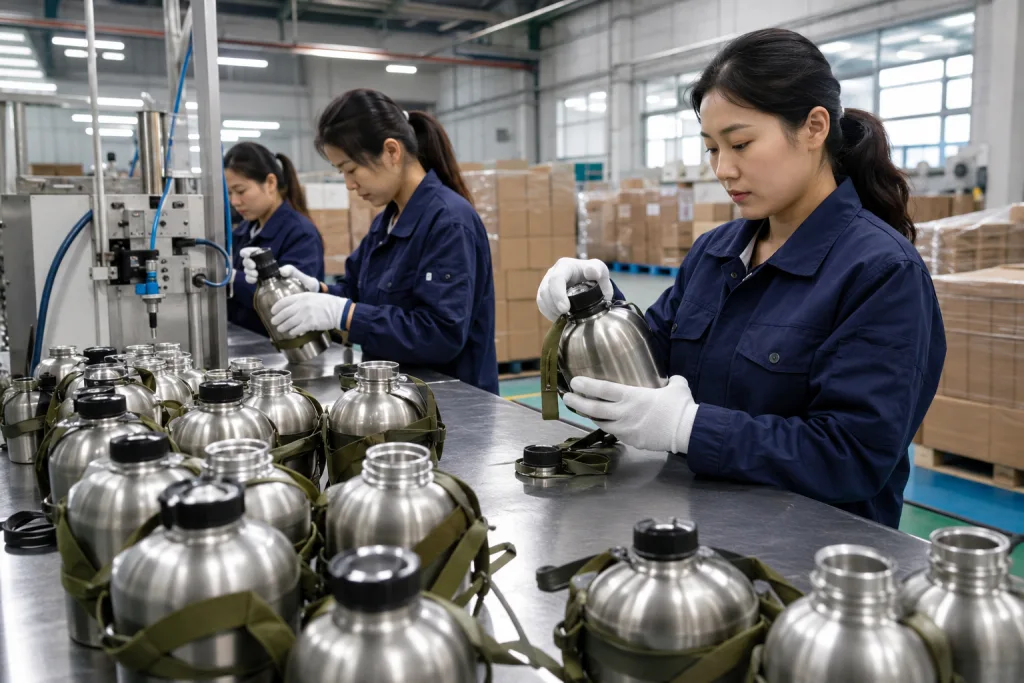
Key Takeaways
- A 304 single-wall stainless canteen typically lands at USD 2.10-3.80 FOB China at 3,000 pcs, while a molded Tritan version is often USD 1.40-2.60 FOB depending on lid and print
- For new custom canteen projects, expect MOQ of 3,000 pcs per color for standard bodies and 5,000-10,000 pcs if you need a new mold or canteen customized cap set
- Normal lead time from Zhejiang, China is 7-12 days for pre-production samples and 30-45 days for mass production after sample approval and deposit
- AQL 2.5, leak testing at 100%, and 24-hour saline or dishwasher tests should be written into the PO, not left as verbal promises
You do not usually lose money on a canteen because of the shape. You lose it on the spec sheet you signed off too fast. A 1 mm wall dents in transit. A cap thread starts leaking after 300 cycles on the torque tester. A coating fails salt spray at inspection. A carton that is 8 mm too tall can bump freight class and break the pallet pattern. The drawing matters, but the cost risk usually sits in material grade, process tolerance, test method, and packing detail. We have seen this go sideways.
At BottleForge Industrial in Hangzhou, Zhejiang, we build custom drinkware for Europe and North America, and we keep seeing the same thing on the line: buyers ask for a sample first, while the real risk is buried in the production spec, line by line. Last quarter, QC pulled the sample on a PO with the lid gasket hardness typed wrong, and that one typo would have pushed leak complaints inside 60 days. If you are buying from a canteen manufacturer or a canteen distributor in China, this is the practical way to read a canteen custom quotation before you commit tooling, deposit, and delivery dates. The sample-first question is often the wrong question to ask.
Start with material and body construction
The first line on any spec sheet should state the material and how the body is made. For military canteen suppliers, the standard options are single-wall 18/8 stainless steel, aluminum, Tritan, or food-contact PP. For rugged outdoor, cadet, emergency, or utility channels, single-wall stainless is usually the safest middle ground. We ship more of this build than any other. It takes dents better than thin aluminum, avoids internal coating complaints, and clears most EU and North American migration testing with less drama if the steel source is controlled. On the line, we still check rim roundness with a go/no-go gauge because good material alone will not save bad forming.
Ask for exact thickness, not just “stainless steel.” This is the wrong question to ask if the answer stops at grade. A body at 0.5 mm feels cheap and dents fast. A practical range for a 500-750 ml military style canteen is 0.6-0.8 mm for the body and 0.8-1.0 mm for the shoulder or base reinforcement, depending on the shape. We have seen buyers push for 0.5 mm to hit a target price, then flag dented samples after a 76 cm drop test. If the canteen manufacturer quotes the same price for 0.5 mm and 0.8 mm, assume something else was cut—often cap weight, polish time, or carton strength.
- 304 stainless: best all-round option for custom drinkware, common for EU and US compliance work.
- 316 stainless: worth the premium only if the canteen will see coastal exposure or repeated chemical cleaning. Otherwise, the math does not work for most tenders.
- Tritan: lighter and lower cost, useful for canteen promotional orders where impact resistance matters more than heat retention. We run a lot of Tritan on MOQ 3,000 promo jobs.
- Aluminum: light, but lining consistency is the real risk line item. QC pulled samples before with uneven internal coating near the shoulder radius.
For a canteen custom program, also check whether the body is deep-drawn in one piece or welded. A one-piece deep-drawn body gives you fewer leak paths and better field durability in most cases. We’ve seen this go sideways on welded bodies with weak seam polish, especially on flatter military shapes. Zhejiang factories with monthly capacity above 300,000 units can often offer both routes, but welded construction needs tighter inspection on seam polish and pressure testing, usually 0.3 MPa on our line. If your canteen vendor cannot state steel source, wall thickness tolerance, and weld inspection method, move on. Last month one buyer’s PO even misspelled “seamless” as “seamles,” and that small typo still mattered because the body route changes the whole QC plan.
Capacity, mouth size, and carry format
Buyers fixate on nominal capacity. That is the wrong question to ask. The real decision is whether the canteen fits the pouch, the crate, and the way troops actually use it. We’ve seen a 600 ml sample look fine on a screen and then fail on the line because it missed a standard utility pouch by 4 mm and would not nest with the cup. Ask military canteen suppliers to show three dimensions on the quote: overall height, max body width, and mouth inner diameter. Then check those against the accessories you already run, not the rendering.
A narrow mouth around 28-32 mm cuts spill risk and suits old-school field use. A wide mouth at 45-55 mm is easier to clean and fill with ice, but it changes cap torque, gasket compression, and leak risk. QC pulled the sample on one 53 mm neck because the buyer flagged seepage after a 1.2 m drop test. A lot of canteen manufacturers quote the body first and treat the cap like a small detail. That goes sideways fast. The cap system drives complaint rate.
What to lock on the drawing
- Nominal fill volume and brimful volume
- Body tolerance, typically plus or minus 2-3 mm on formed stainless parts
- Mouth thread standard or custom thread profile
- Handle, loop, or tether design load
- Compatibility with cup, pouch, or carabiner
If you need a customizable canteen for retail plus institutional channels, one body with two lid options usually makes more sense: a low-cost screw cap and a tethered utility cap. We run this setup often because the math doesn’t work on two full SKUs once you add separate molds, cartons, and spare parts. One recent PO even had the lid code typed wrong, and the shared body saved the shipment. For a canteen distributor or distributor canteen program, this matters because tighter carton packout and fewer SKUs speed reorders. At BottleForge Industrial, private-label buyers in Zhejiang export lanes often pick 750 ml; in a 24-unit master carton, it ships cleaner than 1 liter and still has enough shelf presence.
You are not buying “600 ml.” You are buying a body-and-cap system that must survive transport, user handling, and returns.
Cap, gasket, and leak-proof standards
Most after-sales claims start in the top 30 mm of the bottle. A supplier that only talks about paint, powder coat, or body polishing is dodging the failure point. Ask the cap resin, the gasket Shore hardness, and the validated open-close cycle count. On our line, QC pulled cracked cap samples at 1,200 cycles once because the PP grade was swapped without notice. For a customized canteen, 3,000 open-close cycles without cracking or thread skip is a fair target. For a basic promotional project, 1,000 cycles is usually enough, but put it on the PO. We have seen a one-line typo on a PO turn 3,000 cycles into 300.
“Leak-proof” needs a test method. That is the wrong question to ask if there is no number behind it. Better wording is 100% inline vacuum or air-pressure leak test, plus random finished-goods inversion testing for 2 hours, and hot-water leakage testing at 80°C if the canteen will take warm fill. We run both dry air-pressure checks and inversion checks because the line catches different defects: thread jump, cut gasket, and cap-seat deformation. If a factory only does random checks, you are accepting a higher field failure rate. The math does not work if the shipment is for chain retail.
- Cap material: PP is standard and easy to control in production; Tritan caps look more premium, but buyers usually push back once they see the cost delta on a 5,000 pcs quote.
- Gasket: food-grade silicone is the safer call than unknown TPE blends for repeated use; we normally check gasket cross-section in mm before mass production, not after the first leak claim.
- Tether: if specified, ask for pull-force test, usually 8-12 kg for utility use; the buyer flagged one sample last year because the tether whitened at the hinge before break.
- Torque: set a cap torque window so users can close it securely without over-tightening; we usually confirm it with a torque meter on the line instead of hand feel.
For North American distributor drinkware orders, request ASTM-related material declarations where relevant for consumer products, especially if the project touches youth, scouting, or school channels. For Europe, ask your canteen vendors to support REACH and food-contact declarations from the raw material supplier. A solid project file should include the cap exploded view, gasket dimensions, and torque standard, not only logo artwork. We ship fewer replacement cases when that file is complete. That is what separates a usable custom canteen from a return problem.
Surface finish, branding, and field wear
A military style product gets knocked around. The finish spec needs to be functional, not decorative. Powder coating, wet paint, anodizing, transfer print, silk screen, laser engraving, and embossed marks do not fail the same way under abrasion, UV, DEET, or cleaning chemicals. If you are comparing canteen manufacturers, ask for a finish matrix with test results, not just a color swatch. We’ve seen buyers approve a swatch card, then reject cargo after a 1 kg buckle rub test on the line.
For stainless bodies, powder coating with 60-80 micron thickness is the normal route. We usually check film build with a dry film gauge at 3 points per body. It holds scratches better than basic spray paint and fits matte tactical colors well. For aluminum, anodizing looks sharp, but batch color drift is where buyers get caught. If your order is a canteen customizable range with multiple SKUs, write a Delta E limit into the PO instead of “close match.” That phrase causes arguments. QC pulled the sample on one order last year and the green was 2 shades off batch to batch, even though the factory said it was within visual tolerance.
Branding method should match the channel:
- Laser engraving: durable, low complaint rate, good for distributor growler or distributor canteen programs that need clean branding. No ink to chip. The mark depth is shallow, so confirm artwork line weight before mass production.
- Silk screen: lowest unit cost, but abrasion resistance depends on the ink system and oven cure. We run a tape pull after curing because under-baked prints fail fast.
- Heat transfer: works for complex graphics and small MOQ launches, but it is not the first choice for rough field use. The buyer flagged edge lifting on a camo graphic after carton friction on one 3,000 pc order.
- Emboss/deboss tooling: higher setup cost, strong long-term value on customized drinkware. Tooling math only works if volume is there, usually 5,000 pcs and up.
Ask for cross-hatch adhesion testing, dishwasher testing if relevant, and a basic abrasion rub test. This is the wrong question to ask: “Will it survive 500 dishwasher cycles?” Most military canteens will never see that. Ask what happens in cartons, on racks, and in field handling. A logo rubbing off inside the master carton is a hard fail. China factories in Zhejiang that handle both OEM and canteen promotional jobs often keep two lines: one for low-cost printing, one for higher-durability coating. Make sure your PO names the exact process route approved on the pre-production sample. We’ve seen this go sideways over one typo on a PO: “spray matte black” instead of “powder coat matte black.”
Compliance, audit, and quality control lines
A spec sheet without compliance and QC detail is a sales sheet, not a purchasing document. For Europe and North America, ask military canteen suppliers for food-contact declarations, REACH support where applicable, and packaging compliance statements at the RFQ stage. If the end market includes California or large retail chains, write heavy metal and chemical screening into the first PO draft, not after the line starts. We’ve seen this go sideways: a buyer added testing after mass production, QC pulled the sample, and 2,000 gift boxes had to be reworked because the ink declaration was missing.
Factory audit status matters. BSCI, Sedex, ISO 9001, and relevant social or quality audit reports do not guarantee good product, but they cut process risk. This is the wrong question to ask if you stop at “Do you have the certificate?” Ask for the latest report date, audit grade, and which workshop was covered. We ship to distributor networks that make these files mandatory during onboarding, and one expired audit by 30 days can hold a vendor code longer than a failed lid torque check.
QC items worth writing into the PO
- AQL standard: commonly AQL 2.5 for major defects, 4.0 for minor defects
- 100% leak test before packing
- Drop test standard for packed product, for example 1 corner, 3 edges, 6 faces
- Barcode scan verification if retail packed
- Carton weight limit, often below 15 kg for easier handling
Pre-shipment inspection should not be based only on appearance. Add capacity check, net weight tolerance, logo position tolerance, and cap fit verification. Put the tolerance in writing: logo offset within 1.5 mm, net weight within the agreed range, cap thread engagement checked with the production master sample. For institutional tenders, some buyers also request salt spray testing on exposed metal accessories and odor testing after hot water fill. A canteen vendor that says “our QC is strict” but cannot send a checkpoint list is asking you to trust a process you cannot see. The math doesn’t work. Better to ask for the actual inline QC sheet, final random inspection report, and lab test plan; on our side, the line records leak test results by station and flags repeat failures before packing starts.
MOQ, tooling, and cost structure
Price is never just price. Break the quote into body cost, lid cost, decoration cost, packing cost, tooling cost, and testing cost. That is how we read a canteen RFQ on the factory side, and it shows fast where a supplier is quoting hard and where margin is buried. We’ve seen buyers compare only the FOB total, then find out later the strap, insert card, and drop-test fee were sitting outside the quote. A standard 500-750 ml stainless custom canteen with stock lid usually runs MOQ 3,000 pcs per color per model. A fully canteen customized project with new mold, custom strap, and embossed logo can push MOQ to 5,000-10,000 pcs. On our line, the wrong question to ask is “What’s your best price?” Ask what is included.
Typical FOB China ranges move with steel prices, decoration, and packing, but buyers can use these as a planning frame. Last month one buyer flagged a quote gap that came down to 0.4 mm body thickness versus 0.5 mm, so the detail matters:
- Single-wall 304 stainless: USD 2.10-3.80 at 3,000 pcs
- Tritan canteen: USD 1.40-2.60 at 3,000 pcs
- Custom lid tooling: USD 1,500-4,500
- New body mold: USD 4,000-12,000 depending on complexity
If your project includes custom growler or customizable growler variants in the same family, ask whether the supplier can share finish colors, cap parts, and packing components across sizes. That is where the savings usually sit. Not in a 3-cent gasket fight. We run shared color batches across 32 oz and 64 oz programs all the time, and the math works better if the same Pantone powder, cap insert, and outer carton dieline carry across SKUs. We’ve seen this go sideways when a buyer wanted one cap style for each size and ended up paying for three sets of fit tests.
Lead time from Zhejiang, China for a normal OEM run is usually 7-12 days for sample development, then 30-45 days for production after approval and deposit. During peak season, assume 45-60 days. Sample timing depends on what is new: a logo laser sample can go in 7 days, while a new lid checked with a torque tester and leak jig is closer to 12 days. BottleForge Industrial plans around 500,000 units per month across drinkware lines, but capacity only matters if the factory can reserve the line time. We ship plenty of rush orders, but slot control is what saves them. Ask your canteen factory for a production schedule screenshot or written slot confirmation once the deposit lands. QC pulled the sample too late on one PO last season, and a 30-day plan turned into 48 days.
Packing, freight, and delivery reality
The last lines on the spec sheet decide if your landed cost works or falls apart. Buyers will spend 3 hours fixing a Pantone logo, then sign off on a carton that wastes 18% of cube. For military canteens, nesting is limited by the body shape and cap profile, so carton design matters more than it does on a straight tumbler. Ask for unit box size, master carton size, pcs per carton, gross weight, and loading qty for 20GP, 40GP, and 40HQ. We also ask for carton wall spec, like 5-ply K=A, because QC pulled the sample once and found the factory had quoted with one board grade and packed with another. If a canteen manufacturer cannot give you this before order, they are not planning freight carefully. That is a red flag.
Retail-ready packing adds cost fast. A plain polybag and divider pack may add only USD 0.05-0.12 per piece. A printed color box with insert can add USD 0.18-0.45. For e-commerce or Amazon FBA, you may also need suffocation warnings, FNSKU labeling, drop-tested mailer setup, and barcode position control within 3 mm. We ship this every month to North America, and the buyer flagged it more than once when the barcode sat over a box seam. Small mistake. Expensive rework.
- Ask for carton drop test: especially if shipping LCL or parcel channels. We usually ask for 6-side, 1-corner testing, because we have seen this go sideways on 7 kg mixed-SKU cartons.
- Set pallet rules: EUR pallet and North American pallet specs differ. Confirm 1200×800 mm or 48"×40" before the line starts palletizing.
- Define Incoterms clearly: FOB Ningbo or Shanghai is common from Zhejiang. This is the wrong question to ask if you have not also fixed delivery address, truck type, and who pays port surcharges.
- Reserve spare parts: 1-2% extra caps and gaskets can save a lot of claims work. We run this as a separate inner carton so the warehouse does not mix service parts into saleable stock.
For a canteen distributor program, delivery reliability often matters more than a lower unit price. A canteen supplier with a 2% lower quote and weak carton control will usually cost more after breakage, relabeling, and chargebacks. We have seen buyers save USD 0.06 per piece on product, then lose USD 1,200 on one container because the outer marks on the PO had a typo and Amazon refused part of the shipment. If you are balancing custom canteen, customized growler, and other custom drinkware SKUs in one container, build the load plan before final approval. We run container math early: 40HQ, carton count, pallet or floor-load, max 21 kg per carton if the buyer requires it. That is the export habit experienced China buyers use.
Send your canteen spec sheet for a factory review
We will check material, cap design, MOQ, compliance, and FOB cost line by line before you place a custom drinkware order from China.
Frequently asked questions
What is a realistic MOQ for military canteen suppliers?
For a standard body using existing tooling, 3,000 pcs per model per color is a normal MOQ in China. If you want a custom lid, special strap, embossed logo, or a fully new body shape, expect 5,000-10,000 pcs depending on mold cost and component sourcing. Some canteen manufacturers will quote 1,000 pcs, but often that means using stock parts, limited color choices, or a higher unit price by USD 0.20-0.60. If you are a canteen distributor testing a new market, ask for a mixed-color run on one body rather than pushing the supplier to an unrealistic MOQ that creates quality shortcuts.
How do I compare stainless steel and Tritan for a custom canteen?
Use the channel and complaint profile to decide. Single-wall 304 stainless is stronger for rough handling, has a more premium feel, and usually supports laser branding well. Typical FOB cost is USD 2.10-3.80 at 3,000 pcs. Tritan is lighter and cheaper at roughly USD 1.40-2.60, with good impact resistance and easy color matching, but it can scratch more visibly and may feel less tactical for military-style programs. For Europe and North America, both need proper food-contact paperwork. If your product will be clipped, dropped, and reused heavily, stainless is safer. If freight cost and transparent styling matter more, Tritan can be the better customizable canteen choice.
What quality checks should be mandatory before shipment?
At minimum, require 100% leak testing, AQL final inspection, logo adhesion checks, and carton drop testing. A practical AQL target is 2.5 for major defects and 4.0 for minor defects. Also add capacity verification, net weight tolerance, cap torque checks, and visual standard photos signed off before mass production. If the canteen has coating, ask for cross-hatch adhesion and a simple abrasion test. For retail programs, barcode scan verification should be included. Serious canteen suppliers in Zhejiang or elsewhere in China can send an inline QC report plus final inspection report before balance payment. Verbal statements like “all checked” are not enough.
How long does a customized canteen project usually take?
If you are using a stock body and only changing color and logo, sampling usually takes 7-12 days and production 30-45 days after sample approval and deposit. A project with new tooling often needs 15-25 days for mold work and confirmation samples before the production clock starts. During peak season, add 10-15 days. Sea freight from China to Europe is commonly 30-40 days, and to North America around 20-35 days depending on coast and routing. If you have a hard launch date, work backward from arrival and leave at least 2 weeks for inspection, booking, and any labeling corrections.
Should I buy from a factory directly or from canteen distributors?
If your annual volume is above 20,000-30,000 pcs across related SKUs, buying direct from a canteen factory usually gives you better control over specs, testing, and custom options. You can lock wall thickness, cap structure, and packaging details instead of accepting a standard catalog version. If your volume is lower or you need local stock and faster replenishment, a canteen distributor may be more practical even at a higher unit cost. For many buyers, the best route is to develop with a manufacturer in China, then use regional distributor support for warehousing or service. The right choice depends on volume, forecast stability, and how much customization you actually need.