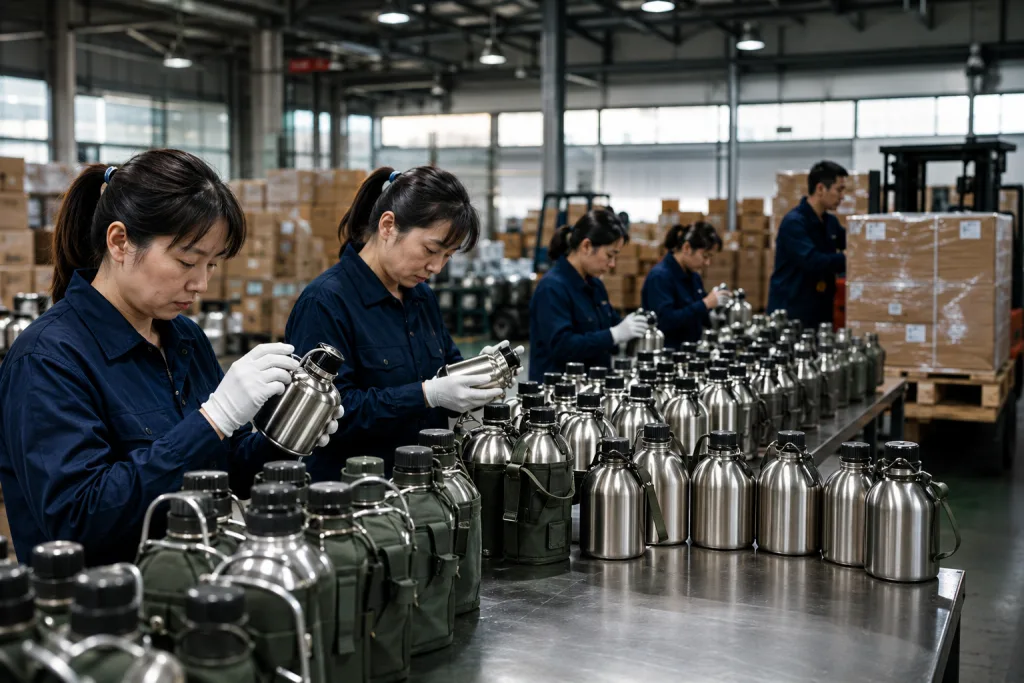
Key Takeaways
- A typical MOQ for a customized canteen is 3,000 to 5,000 pcs, with 35 to 55 days lead time after sample approval.
- 304 stainless steel at 0.6-0.8 mm is the common baseline; 18/8 steel, REACH compliance, and AQL 2.5 sampling matter more than marketing language.
- FOB China pricing for a basic custom canteen often starts around USD 1.20-2.80 per unit, depending on material, coating, and logo method.
- A capable canteen factory in Zhejiang should handle 100,000+ units per month, provide functional leak tests, and support OEM packaging for distributors.
When you buy from a military canteen supplier, the real risk is not the headline price. It is the spec sheet you did not read closely enough. A 0.6 mm wall canteen and a 0.8 mm wall canteen both look fine on a catalog page, but they behave differently in packing, leakage risk, paint wear, and landed cost. On the line, that 0.2 mm gap changes dent rate and carton compression. If you source for retail, outdoor, tactical, or institutional programs, those details decide whether your order moves or sits.
We build and export drinkware from Zhejiang, China, so the pattern is familiar: buyers start with a canteen custom request, then the talk moves to closure type, coating system, test standard, and carton pack-out. The buyer flags a loose cap before QC does. A PO typo on the finish code can hold a whole batch. The right canteen supplier turns those lines into a usable product, not just a sample. If you need a customized canteen, a customizable canteen program, or a distributor drinkware line, read the spec the way an engineer does, line by line.
Start With the Base Material
The first line on the spec sheet is the material, and that is where most buyer mistakes start. For a military canteen supplier, the usual picks are stainless steel, aluminum, and, on lighter programs, Tritan or HDPE. We run into this on the line all the time: a buyer asks for the cheapest body, then QC pulls the sample after a drop test and the denting fails the brief. For B2B buyers, stainless steel is the safest call because it takes repeated use, hot-fill abuse, and rough transport better than soft plastics. If you need custom drinkware that still looks serious on shelf, 304 stainless steel is the standard we quote. In export work, 18/8 stainless is the commercial shorthand for 304, and that keeps retail buyers and canteen distributors from arguing over terms.
Material choice changes more than durability. It moves weight, cost, forming yield, and whether a canteen customized with powder coat will show dents after one bad pallet ride. A 0.6 mm stainless body is lighter and cheaper, but a 0.8 mm body feels stiffer and gives a better hand feel. We had one buyer flag a PO typo on thickness once, and the math did not work when the sample came in 0.5 mm instead of 0.8 mm. For a custom canteen sold through canteen vendors or distributor drinkware channels, that feel often matters more than a small unit-cost gap. If you are building a canteen promotional program, aluminum still has a place, but it scratches faster and needs tighter anodizing or coating control. For a reusable item aimed at Europe and North America, stainless is the cleaner choice.
Practical rule: if the buyer will compare your canteen customized sample against a retail shelf item, use 304 stainless, 0.7 mm or thicker, and treat anything thinner as a price-only line.
Wall Thickness Changes Everything
Wall thickness is not just an engineer’s number. It changes the feel in hand, the way the cans stack in a 600 x 400 mm carton, and how many units survive a drop from 1.2 meters. We have seen buyers focus on the print and ignore the body spec, then the first QC pull shows oil-canning on the side panel. A canteen factory may offer the same shape in 0.5 mm, 0.6 mm, or 0.8 mm steel, but those are different products. At 0.5 mm, the body forms easier and ships lighter, yet it dents faster and can distort after coating. At 0.8 mm, rigidity goes up and the unit feels more solid in the hand, but weight rises and the press load on the line goes up too. That matters when the customer is a canteen distributor serving outdoor retail or an institutional contract with a strict incoming inspection.
For most custom canteen programs, 0.6 mm to 0.7 mm is the working range. It keeps the canteen customizable without forcing the price into premium territory too early. If the program sits next to a custom growler line or other customized drinkware SKUs, the wrong question is only asking the unit price. Freight changes the math. A 10% weight increase becomes a real charge when you move 20,000 units from China to North America or Europe, and the buyer will flag it on the PO after the first shipment lands. A good canteen factory in Zhejiang should quote body weight, carton size, and stacking count in one line. Ask for packed gross weight, not just the sample in your hand. That tells you more.
- 0.5 mm: lower cost, higher dent risk
- 0.6-0.7 mm: balanced for most distributor canteen programs
- 0.8 mm: stiffer body, higher freight and material cost
Closures, Caps, and Leak Risk
The closure is where a lot of canteen suppliers win or lose repeat orders. The body can pass. A weak cap turns the whole order into a service problem. For military-style canteen buyers, the closure has to survive repeated opening, rough handling, and compression in transit. Screw caps with silicone gaskets are standard, but the thread profile, gasket durometer, and cap torque decide whether the customized canteen passes use testing. We run this on the line all the time. If you are buying for a canteen promotional campaign, a simpler lid can work. For retail or institutional resale, that choice is the wrong question to ask.
Ask the canteen vendor for the leak test method, not a yes-or-no answer. A proper spec sheet should show inverted hold time, pressure or vacuum test conditions if relevant, and whether the sample passed after thermal cycling. For most export programs, we recommend a 24-hour inverted leak test at room temperature, then another check after 10 to 20 open-close cycles. QC pulled the sample on a batch last month, and the buyer flagged a tiny seep at the gasket seat after cycle 12. If the cap includes a tether, hinge, or carry loop, inspect the stress points. A canteen customizable with a strap may look better for merchandising, but the attachment still has to survive carton vibration and field use.
When you compare canteen distributors, ask whether the cap is standard stock or private-tooling only. Standard closures keep spare-part risk lower and make future replenishment easier. That matters if you are a distributor canteen buyer managing three or four regional accounts and do not want a service call over a lost cap. It also matters if your line includes related custom drinkware such as a custom growler or insulated bottle family, because shared cap components can cut MOQ pressure and spare-part headaches. We have seen this go sideways when a PO typo changed a cap code by one digit and the buyer received a closure no one could reorder.
Decoration Method Sets Your Margin
Logo method changes price, lead time, and which buyer will sign off. A one-color silk screen still gives the lowest landed cost on a lot of canteen promo work. We run this on the line every week. Laser engraving looks cleaner for premium positioning and holds up better after 500 abrasion cycles. Heat transfer, pad print, and UV print all have a place, but coating compatibility and wear need to be checked before anyone quotes. If the surface is powder coated, your canteen supplier should tell you whether the logo sits under the coating, on top of it, or in a masked zone. That one detail moves scratch resistance and MOQ.
For canteen customized orders, logo area and curvature matter as much as the method. A flat panel with a 50 x 40 mm print area is easier to decorate than a tapered body with a seam running through the brand mark. We had one PO with the logo line typed as 50 x 4 mm, and the buyer flagged it before the file hit QC. For a distributor network, steady logo placement beats a dramatic sample photo. Misaligned decoration reads cheap even when the bottle itself is fine. That is why serious canteen manufacturers in Zhejiang ask for vector files, Pantone references, and a decorated pre-production sample approval before mass production starts. They know the gap between a one-off order and a repeat program.
Buy decoration by failure mode, not showroom shine. If the print chips after 500 abrasion cycles, the sample is not fit for retail. If engraving cuts through a thin coating and leaves bare metal exposed, returns start later and the math does not work. A strong canteen factory will give you the method that survives use, not just the one that looks cheap on paper.
MOQ, Lead Time, and Factory Capacity
MOQ is where buyers find out fast whether a canteen factory is built for export or just good at talking. For a standard custom canteen, 3,000 to 5,000 pieces per color or per logo version is a normal starting point. If you ask for mixed colors, special packaging, or three SKU combinations, the number climbs. That is not a red flag. It comes from mold setup, coating line changeover, and carton allocation. We have seen buyers push for 500 pieces and then complain when the unit price jumps 18% to 25%.
Lead time has two parts: sample lead time and mass production lead time. On our line in Zhejiang, a sample often takes 7 to 15 days, depending on tooling and print method. Mass production usually takes 35 to 55 days after sample approval and deposit, then you still need shipping time. If a supplier claims 10-day mass production for a coated stainless canteen, ask what was left out. QC pulled the sample, the buyer flagged a 1.2 mm coating edge issue, and that is the kind of detail that slows a real order. Speed is not free.
Capacity matters when you are a canteen distributor or brand owner rolling out across several channels. A factory making 100,000 units per month can absorb peak season better than a workshop that outsources coating and packing. Ask who owns forming, welding, polishing, coating, and packing. If those steps sit in different buildings, the schedule will slip. We run into this all the time: the buyer wants a tight ship date, the factory says yes, then the outside polisher misses the carton window. That is the wrong question to ask.
Compliance Is Not Optional
If you sell into Europe or North America, compliance has to be part of the order from day one. For drinkware, that means food-contact declarations, REACH review for coatings and additives, and testing matched to the destination market. On a recent 18,000-piece canteen job, QC pulled the sample because the ink spec on the PO did not match the lab file. Depending on the build and destination, buyers may also ask for LFGB, FDA food-contact support, and migration testing from a third-party lab. A canteen supplier that cannot produce those documents is not ready for export retail, no matter how clean the sample looks.
For institutional or branded programs, write quality control with AQL. We often see AQL 2.5 for major defects and 4.0 for minor defects, but the channel decides the standard, not habit. A retail distributor order and a one-off internal-event shipment are not the same job. Carton drop tests, vacuum or leak testing, print adhesion, and visual inspection need to be on the purchase order if you want something enforceable. Ask what they inspect before packing and what they inspect after packing. That is the right question. The answer tells you whether you are dealing with a real canteen supplier or a trading layer hiding weak process control.
If you plan to sell alongside a custom growler or another customized growler line, keep the compliance file consistent across the family. We have seen this go sideways when one SKU carries LFGB and the other only has an old migration report. One testing logic is easier to manage than rebuilding the file set for every new order.
Read the Price Like a Buyer
FOB price is the start line, not the landed number. A basic stainless custom canteen usually starts around USD 1.20 to 2.80 FOB China, and that moves with 304 stainless, wall thickness, cap style, coating, print count, and packaging. We have seen a buyer flag a PO typo on “gift box” versus “white box” and watch the quote jump. Add a barcode sticker, molded insert, or a second logo position, and the cost class changes fast. The wrong question is “what is your cheapest unit price?”
Ask the canteen manufacturer for the full cost stack: unit price, sample fee, tooling if any, carton spec, inner box count, and estimated freight weight. On the line, we run a 0.35 mm thickness check before release, because that one number changes both feel and shipping weight. A supplier in China that gives a clean breakdown is easier to manage than one that hides behind a single figure. For canteen distributors, margin comes from repeatable cost, not from the lowest quote. A slightly higher unit price can still win if the defect rate stays low and replenishment lead time holds at 12 days instead of 18 days.
For distributor canteen or distributor growler channels, price the repeat order, not the first shipment. The first buy is easy. The second buy tells you whether the factory can keep up without drama. QC pulled the sample, the cap torque missed spec, and that is the kind of detail that decides whether the program scales or stalls.
Send Your Spec Sheet for a Fast Quote
We can review your canteen custom requirements, check MOQ and lead time, and quote a compliant program from Zhejiang, China with export-ready documentation.
Frequently asked questions
What is a realistic MOQ for a custom canteen order?
For most export programs, a realistic MOQ is 3,000 to 5,000 pcs per design or color. If you need multiple logo versions, mixed finishes, or special packaging, the MOQ can rise to 8,000 pcs or more. A canteen factory in Zhejiang that truly supports OEM work should state the MOQ by decoration method, not give one vague number for everything. Low-MOQ samples below 1,000 pcs usually come with higher unit pricing, often 20% to 40% above a normal run.
How much does a customized canteen cost FOB China?
A basic stainless customized canteen often lands around USD 1.20 to 2.80 FOB China. The spread depends on material grade, wall thickness, cap style, decoration, and packaging. A powder-coated body with laser logo and gift box can move above USD 3.00 quickly. If you are comparing canteen suppliers, ask for the same spec line by line. Otherwise one quote may include a simpler cap or thinner wall and look cheaper only on paper.
What compliance documents should I ask for?
For Europe and North America, ask for food-contact declarations, REACH-related material support, and third-party testing aligned to your market. Depending on the build, you may also need migration testing, coating compliance, and FDA-relevant support. For quality control, many buyers specify AQL 2.5 for major defects and document leak testing before packing. A serious canteen supplier should be able to provide test reports for the exact material and decoration method used on your order.
Is stainless steel better than aluminum for a military canteen supplier order?
Usually yes, if your priority is durability, perceived value, and compliance flexibility. Stainless steel is heavier, but it resists dents better and handles repeated use well. Aluminum can work for lighter programs, but the coating and denting risk are higher. For a custom canteen or custom drinkware line sold through distributors, 304 stainless at 0.6 to 0.8 mm is the common practical choice. It gives you a better balance of rigidity and export acceptance.
How long does production take from sample approval?
Typical mass production lead time is 35 to 55 days after sample approval and deposit. Sample making usually takes 7 to 15 days, depending on tooling and decoration. Shipping time is separate. If a canteen manufacturer promises much faster delivery on a coated stainless order, check whether they already have stock, whether the decoration is simplified, or whether they are cutting inspection time. For a distributor canteen program, schedule reliability matters more than a rushed promise.