Key Takeaways
- For a standard 18/8 stainless custom canteen, practical MOQ is usually 1,000-3,000 pcs per color, with 35-45 day lead time after sample approval
- AQL 2.5 major and 4.0 minor is a sensible final inspection level for military-style drinkware orders above 5,000 pcs
- Expect FOB China pricing around USD 2.90-5.80 per unit depending on 500ml vs 1L size, single wall vs vacuum, and print method
- The biggest failure points are odor from silicone parts, paint adhesion, leak risk after drop test, and barcode/carton mismatches
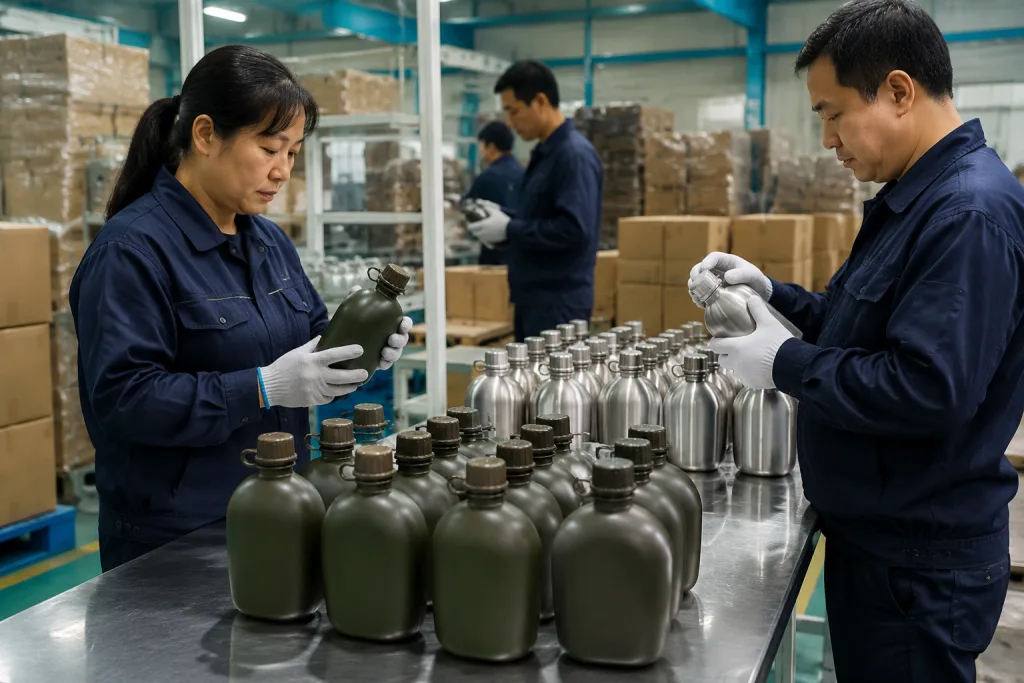
You are not buying a bottle. You are buying 8,000 units that match the approved sample, cartons that pass a 1.2 m drop test, FDA or LFGB paperwork that customs will accept, and a factory that does not change the cap gasket after the deposit lands. That is why a military canteen supplier list beats a random search result. We see Europe and North America buyers come to Zhejiang with a clean one-page brief, then the buyer flagged the hard parts: 304 stainless grade, cap torque, powder coating adhesion, EAN barcode position, and whether 20 cartons can survive the forwarder’s warehouse handling.
Here is one real order pattern we run: 8,000 custom canteen units for a tactical retail program, with a second SKU planned if sell-through is good. Simple on paper. The work is in shortlisting the canteen manufacturer, locking the spec sheet, pushing sampling through without three rounds of guesswork, and holding QC to AQL 2.5 before the container leaves Ningbo. Losing 45 days over a loose lid fit or a PO typo on “matte black” versus “semi-matte black” is the wrong kind of expensive; we have seen this go sideways after a 30% deposit.
Start with the order brief
A buyer sends us a shortlist request built around the keyword military canteen supplier list, but the real buying work sits in the brief behind that search. Here the item is an 850ml custom canteen with captive cap, olive drab powder coat, one-color logo, and a retail-ready hangtag. Europe is the target market, so REACH cannot be treated as a later paperwork item. This is not a direct military contract product, but it still has to pass the hand test: no tinny body, no loose cap strap, no paint edge that chips after 30 rubs on the coating test jig.
Your first job is to lock the product so the factory cannot fill in the blanks. The spec sheet should call out body material, wall construction, neck finish, cap material, gasket material, print area, color reference, carton packout, and compliance requirements. If you only ask for a “canteen custom” quote, 6 canteen suppliers in China may send back 6 different builds, and the math doesn't work. We have seen this go sideways when a buyer approved a low quote, then QC pulled the sample and found a 0.32mm wall where the PO never stated thickness.
- Body: 304 stainless steel, 0.5mm outer wall for single-wall or 0.4/0.4mm for vacuum version
- Cap: PP cap with food-grade silicone seal, Pantone matched strap
- Capacity: 850ml ±3%
- Finish: powder coat, 60-80 micron thickness
- Logo: silk screen 1 color or laser mark
- Packaging: 1 pc/polybag/white box, 24 pcs/master carton
- Standards: REACH, LFGB or FDA, carton drop test, leak test 100%
At BottleForge Industrial in Hangzhou, Zhejiang, we ask buyers to decide one commercial point before tooling and sampling: is this a price-led canteen promotional project or a durability-led retail SKU? That choice changes the build. A promotional custom drinkware order can often accept a thinner wall and a basic white box. A retail customized canteen for outdoor stores needs stronger coating, better strap assembly, and a cleaner neck bead, because the buyer will flag scratches, cap wobble, and uneven powder at the first counter sample review. On our line, that difference is usually visible before packing, right at the neck polishing station.
Build a usable supplier shortlist
A usable military canteen supplier list is not a 40-line Excel file. It is 5 to 8 canteen manufacturers you can qualify in 7 working days. We see buyers lose 3 days asking for catalogs, then still have no welding sample, no carton spec, and no clear FOB Ningbo price.
For this order, your shortlist criteria should be blunt:
- They make metal drinkware in Zhejiang or nearby China production clusters, with a stamping line or assembly line you can see on video
- They can show recent canteen customized orders or outdoor bottle production photos, plus packing records with carton size and gross weight
- MOQ fits your launch: ideally 1,000 pcs per color, not 10,000 pcs, unless the coating color needs a full powder batch
- They have in-house or partner capability for powder coating, logo printing, and leak testing, with QC using a pressure tester or inverted water test
- They understand export documents: HS code, FOB quote, REACH declaration, carton marks, FNSKU if needed, and they do not mix up consignee and notify party on the PI
Ask each canteen factory for six items on day one: business license, factory audit status such as BSCI or ISO 9001, standard lead time, MOQ by size, sample cost, and 3 recent shipment references by market. No customer names needed. You need proof they ship to Europe or North America on a normal schedule, such as a packing list showing 24 pcs per carton and a recent vessel date.
Compare like an engineer, not a shopper. A canteen supplier quoting USD 3.10 FOB Ningbo may be using 201 stainless, a 0.45 mm body wall, thinner silicone, or outsourced coating. Another canteen manufacturer at USD 3.85 may include 304 stainless, individual box, and 100% leak test. Those are not equal offers, and the cheaper one often becomes expensive after QC pulls the sample.
Our factory in Zhejiang runs around 600,000 units per month across tumblers, sports bottles, and thermos lines, but for canteen projects the better metric is control on mixed operations. Ask where the cap comes from, how many hours the powder coat cures, and what AQL they accept. If they cannot answer, remove them from your canteen distributor sourcing list. A short honest list beats a long uncertain one.
Quoting the canteen the right way
The shortlisted canteen suppliers should quote one drawing and one pack spec. Same file, same revision number. In this example, you receive five FOB China quotes for an 850ml single-wall custom canteen, and our merchandiser writes the quote codes on the RFQ sheet before we compare:
- USD 2.92: no retail box, standard green paint, silk screen logo
- USD 3.18: white box included, Pantone powder coat, strap added
- USD 3.44: better cap mold, laser logo, stronger export carton
- USD 4.60: vacuum insulated version
- USD 5.80: vacuum version plus gift box
Asking every supplier to “match lowest price” is the wrong question to ask. Force line-by-line clarity. Ask the body gauge in mm, paint process, box size, carton gross weight, and whether cap gaskets or straps can ship as replacement parts. A solid canteen vendor answers in one email with a spec table. A weak one gives “same quality” and dodges the 0.5mm wall thickness question.
For a distributor drinkware program, check the commercial details that change landed cost after the unit price looks settled. We run these items through the cost sheet before PI because buyers have flagged USD 0.18 hidden carton cost after artwork approval:
- Tooling: new cap mold or strap mold can run USD 800-3,500
- Sample timing: 7-10 days for logo sample, 15-20 days for new mold sample
- Payment: usually 30% deposit, 70% against inspection or B/L copy
- Lead time: 35-45 days for 8,000 pcs after pre-production sample approval
- Spare rate: ask for 0.5%-1% extra parts or complete units
Buyers often ask if the same source can handle a custom growler or customizable growler later. Fair question. It matters when you want one distributor growler and one custom canteen under one vendor base, but the math does not work if you assume shared parts. We have seen a canteen cap drawing approved at 48.5mm, then the buyer sent a growler PO with “same cap” typed in the remarks; QC pulled the sample because the thread pitch was different. Some canteen manufacturers make adjacent customizable drinkware SKUs, but coating line settings, carton sizes, and leak-test fixtures may not carry over. Quote the follow-up product separately.
During negotiation, stay on risk points with real money behind them. Saving USD 0.12 per piece means little if 4% of cartons crush in transit or the logo rubs off after 30 alcohol-wipe passes on shelf. Price matters. Spec discipline matters more. We ship fewer claims when the buyer locks carton 5-ply strength and logo test standard before deposit.
Sampling before money gets trapped
Sampling is where a custom canteen idea turns into a factory file the line can actually run. For this order, ask for three sample stages. One sample is how money gets trapped.
1. Stock body reference
This comes first and should arrive in 3-5 days. Check hand feel, capacity, cap thread, and the basic body shape with a caliper, not just your eyes. We once had a buyer flag a 6 mm neck difference after artwork was already printed. If the stock body feels wrong, stop before color matching starts.
2. Pre-production logo and color sample
This is the sample that matters. Confirm Pantone match, powder texture, logo position, strap assembly, packaging layout, and barcode scan quality under a normal warehouse scanner. Cost is usually USD 50-150 per piece plus courier. If you need a customized drinkware mailer or PDQ display, ask for a mockup photo now, including carton marks and the PO number. Typos on outer cartons happen.
3. Golden sample signed against mass production
This is the sample your QC team and the canteen factory use as the production reference. Sign it physically, or approve it by dated email with annotated photos. Simple rule. No golden sample, no clear argument when QC pulled the sample and the logo sits 4 mm too low.
What should you check? Start with size and function. Measure height, diameter, fill capacity, and empty weight. Run a 30-minute upside-down leak check. Close it with warm water for 24 hours, then smell the inside; bad silicone odor shows up often when the seal supplier rushes material. Scratch the coating lightly with a coin edge. It should not peel. For canteen promotional use, a small cosmetic variance may pass. For retail, the math does not work after returns and chargebacks.
You do not need a perfect handmade sample. You need a truthful sample that shows what mass production will look like.
From China, especially Zhejiang factories working on tight schedules, we have seen samples polished by hand while bulk production gets less control. Ask for process photos: blank body, coating line, logo print, assembly, and packing station. The request is small, but it tells you whether the canteen supplier runs a controlled line or just fixes problems after final inspection.
Production controls that actually matter
Once deposit is paid, the buyer risk shifts. The order is now an operations job, not a sourcing job. For our 8,000-unit custom canteen order, we lock control at four checkpoints: incoming material with grade and batch records, first-off approval from the actual line, in-line checks during mass production, and final random inspection before loading. We run these checks on the same traveler sheet the workshop supervisor signs, because one missed line setting can turn into 8,000 bad pieces.
Incoming material control means checking stainless grade, cap resin, silicone seal, and carton board before the line starts. If your project uses 304 stainless, request a mill cert or at least supplier declaration. For powder coat, ask the canteen manufacturer to log color batch numbers; we mark them on the coating room board next to the Pantone card. Carton quality should support a 1A drop expectation for export handling. Weak corrugate looks harmless in the sample room, then collapses after a 23 kg master carton sits under three pallets.
First-off approval should happen within the first production day. Review one fully assembled unit from actual line settings, not a hand-polished sample from the sales office. Check logo position tolerance, cap torque, seam appearance, and carton marks. This is where QC pulled the sample last March and found the strap mounted backward after 420 pcs, not after 6,000 pcs. Wrong Pantone, wrong strap, wrong PO spelling. Catch it here.
In-line control is where the factory earns trust. For single-wall canteens, look at weld smoothness, thread consistency, and coating adhesion under normal workshop light plus a 600-lux inspection lamp. For vacuum units, add insulation performance and base vacuum integrity; a 2-hour hot water check tells more than a clean-looking outer shell. A practical in-line checklist includes:
- 100% leak test with air pressure or inverted water test
- Coating adhesion by cross-hatch or tape method per internal standard
- Logo abrasion rub test, 20-50 cycles depending on decoration
- Cap fit and strap pull check every 1-2 hours
- Net weight spot check to catch wall-thickness drift
Final inspection should use an agreed AQL, normally 2.5 major and 4.0 minor for consumer drinkware. On 8,000 pcs, your inspector samples per ANSI/ASQ Z1.4. Carton count, assortment, labels, and barcode scan rate must be included. If this is for Amazon or a large canteen distributor, confirm FNSKU, suffocation warning, country of origin, and master carton dimensions before loading. We have seen a shipment held because the master carton read 52 x 38 x 31 cm on the PO but measured 54 x 39 x 32 cm at packing.
About 7 out of 10 canteen distributors ask only “did it pass?” This is the wrong question to ask. Ask for defect photos by category and percentage. You want to know if failures are random or systemic; one scratched logo in 315 sampled pcs is noise, but 18 caps with rough threads means the line needs adjustment before we ship.
Shipping, paperwork, and next reorder
The last stage is where a decent order becomes a repeatable supply line. For this custom drinkware project, assume final inspection passes on day 39 and booking is made ex Ningbo. Your canteen supplier should send the commercial invoice, packing list, test declarations, and shipping marks approval the same day, not three days later. Check every field. We have seen a PO with “334 cartons” on the packing list and “343 cartons” on the invoice; Ningbo warehouse stopped the truck until the clerk corrected it. Wrong carton quantity or net weight can delay customs or warehouse receiving.
If you sell through canteen distributors in Europe, ask for the REACH statement and food-contact declaration matched to the destination market. For North America, FDA-related declarations and California labeling review can matter by sales channel. If the order is routed to Amazon, send carton dimensions, pallet rules, and FNSKU placement before packing starts. Not after. QC should tape one printed FNSKU on a trial carton and scan it with the warehouse PDA before the line seals 334 cartons.
For this 8,000-piece lot, a typical load plan might be 24 pcs per carton, around 334 cartons total. Gross weight may land near 14-16 kg per carton depending on wall construction and box style. If the supplier packs 18 kg cartons to save cardboard, your warehouse team will not thank you. The math does not work. We set carton weight ceilings on the carton spec sheet, usually 16 kg max for hand-loaded drinkware, and QC pulls one packed carton onto the 30 kg bench scale before mass packing.
Once goods ship, do a simple post-mortem with the canteen manufacturer:
- Actual lead time vs promised lead time, for example 39 days planned vs 42 days shipped after logo rework
- Final defect rate by category, including scratches, lid leakage, dented bodies, and weak carton corners
- Carton damage on arrival, counted by warehouse photos and outer carton crush depth in mm
- Consumer complaints in first 60 days, especially odor, cap fit, coating chips, and missing spare parts
- Which parts can be standardized for the next custom canteen or customized growler project, such as lid thread, silicone ring size, carton size, and insert tray
This is also when you decide whether the factory belongs on your permanent military canteen supplier list. A supplier is not “approved” because they sampled well. They earn that status after one full order with stable quality, clear replies, and clean paperwork. We have seen this go sideways when a factory passed AQL 2.5 but changed the carton board from 5-ply to thin 3-ply without telling the buyer. That standard matters whether you are buying a customizable canteen, a custom growler, or a broader customized drinkware range from China.
Good sourcing in Zhejiang, China is not about finding the cheapest canteen vendors. It is about building one supply route you can trust enough to reorder with fewer surprises and better margins. In Hangzhou, we run the reorder file from the signed golden sample, the carton drop-test record, and the last shipment’s packing list, because memory is a poor production control tool.
Need a reliable canteen supplier shortlist fast?
Send your target spec, quantity, market, and packaging needs. We will review feasibility, MOQ, and likely risk points before you commit deposit.
Frequently asked questions
What MOQ should I expect from a military-style canteen supplier?
For a stock-body stainless custom canteen, practical MOQ is usually 1,000 pcs per color and 3,000 pcs per model if you want efficient pricing. Some canteen suppliers in China will quote 500 pcs, but unit cost can jump by USD 0.30-0.80 and color consistency gets harder. If you need a fully new mold, MOQ often starts at 3,000-5,000 pcs plus tooling of roughly USD 800-3,500. For accessories like custom straps or special caps, confirm whether MOQ applies per part, not just per finished bottle. Always ask if your MOQ includes individual box, logo print, and spare parts.
How long does a customized canteen order usually take?
If the body shape already exists, allow 7-10 days for a logo or color sample, then 35-45 days for mass production after approval and deposit. During peak season in Zhejiang, China, that can stretch to 50-60 days, especially if the canteen factory is sharing powder coating or packaging resources across multiple projects. A fully new customized canteen with new cap tooling can take 15-20 days for development samples and another 40-55 days for production. Add sea freight transit separately. Buyers often lose time by delaying packaging approval, barcode confirmation, or Pantone sign-off.
What tests should I require before shipment?
At minimum, require 100% leak test, visual inspection, barcode scan check, and carton drop check. For coated stainless canteens, add paint adhesion and logo abrasion testing. For food-contact compliance, ask for relevant declarations or lab testing tied to your market, such as REACH-related documentation for Europe or FDA-related declarations for the US. If the product has insulation, verify heat retention or vacuum performance on production samples, not just on the prototype. For final inspection, AQL 2.5 major and 4.0 minor is a practical standard on orders above 5,000 pcs. Make sure your golden sample is part of the inspection file.
Should I buy from a factory or a trading company?
Either can work, but you need to know which one you are dealing with. A true canteen factory usually gives better process visibility, faster corrective action, and cleaner cost breakdown. A capable trading company can still be useful if your program combines a custom canteen, custom growler, and other custom drinkware from different plants. The risk is hidden subcontracting with no clear QC owner. Ask directly who makes the body, who makes the cap, where coating happens, and who signs off final inspection. If answers are vague, expect problems later. For repeat B2B orders, transparency matters more than labels.
What price range is normal for a custom canteen?
For FOB China pricing, a single-wall 750-850ml stainless custom canteen often lands around USD 2.90-3.80 with standard packaging and one-color print. Add a captive strap, Pantone powder coat, or retail box and the price may move to USD 3.20-4.20. A vacuum insulated version typically starts around USD 4.60 and can exceed USD 6.00 with premium packaging or complex decoration. Very low quotes usually mean thinner walls, simpler coating, outsourced assembly, or fewer QC steps. Ask for wall thickness, packaging detail, and test scope before comparing offers from different canteen manufacturers.