Key Takeaways
- A 0.6 mm wall canteen with a thin cap seal usually leaks after 3-5 drop cycles; spec 0.8 mm or better for promo use.
- For printed canteen promotional orders, ask for adhesion testing after 50 rub cycles and a salt-spray note if metal parts are involved.
- Typical factory MOQ in China is 1,000-3,000 units; custom molded parts and special lids can push lead time to 35-45 days.
- REACH, LFGB, FDA food-contact, and AQL 2.5/4.0 should be written into the PO, not left as a verbal promise.
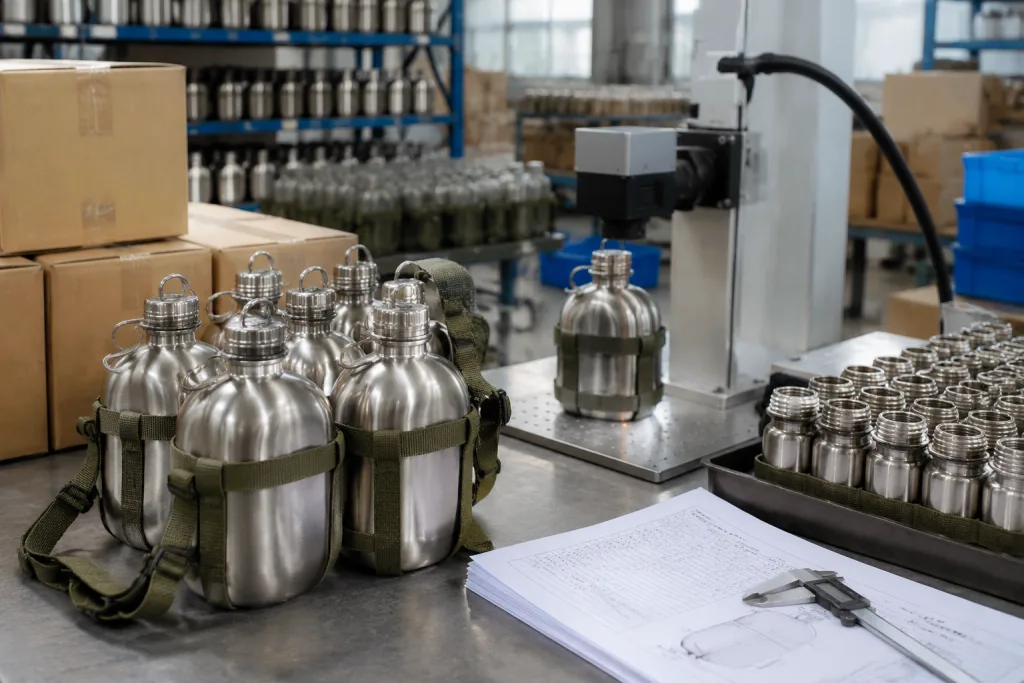
Military canteen promotional orders fail in the same places every season. The idea is fine. The buying brief is not. Buyers treat a canteen like generic custom drinkware and skip the parts that decide whether the shipment holds up: wall thickness, lid seal geometry, coating adhesion, drop performance, and pack-out. We run this every year in Zhejiang and the pattern is familiar. The art proof looks clean, then the first carton lands with leaks, odor, weak engraving contrast, or crushed master cases.
If you are buying from a canteen factory, the job is not to chase the lowest quote from a canteen manufacturer. The job is to spec a product that survives molding, printing, packing, and distribution. A serious canteen supplier will talk in numbers: 500 ml or 750 ml capacity, 0.6 mm to 0.8 mm wall, 24-48 hour sample turnaround, 20-35 day lead time, and MOQ around 1,000 to 3,000 pieces depending on decoration. We have seen buyers push for a cheaper seal and then ask why the lid fails after a drop test. That is the wrong question to ask if you are buying military canteen promotional stock for Europe or North America.
Where military specs usually fail
Most military canteen promotional jobs do not fail at the design stage. They fail when the buyer treats a canteen custom job like a basic tumbler. It is not the same job. The body is where the trouble starts. If the wall is under 1.0 mm, the shell dents in transit or flexes at the shoulder, and the cap seal starts losing pressure. On plastic bodies, poor mold cooling leaves sink marks around the handle or the neck thread. On metal bodies, a rough drawing line or uneven weld seam can print through the coating after the first heat cycle. We have seen the buyer flag this after QC pulled the sample at AQL 2.5.
The closure is the next weak point. A canteen customizable lid can look fine in photos and still leak if gasket compression is low, the thread pitch is off, or the cap comes out too soft after molding. Ask for torque data, leak testing at 30-50 kPa, and a temperature cycle check from 0 C to 60 C. That is the right question. If the canteen distributor cannot talk in those numbers, you are buying packaging, not product. We once caught a PO typo on the cap spec, and the whole lot would have shipped with the wrong liner.
User handling is where field claims show up. Military-themed promotional drinkware gets tossed into kits, trunks, and field bags. It sees abrasion, vibration, and a lot of opening and closing. A custom canteen with a loose carabiner or weak hinge will arrive looking fine and leave looking cheap. We run into this on the line all the time. A canteen manufacturer in Zhejiang that ships at scale will usually push a molded retention feature, a thicker shoulder, or a captive cap if you want the claim rate down.
Build the body around abuse
If you want a military canteen promotional order to survive distribution, start with the shell. On aluminum and stainless builds, we ask for 0.6 mm wall thickness at the floor and 0.8 mm on deep draw sections or a wider body. For HDPE or PP bodies, thickness alone does not save you; shrink control and gate placement decide whether the neck stays round. We saw one neck come in 0.7 mm oval on the bench. The buyer flagged it before packing.
Think like the line. A canteen factory in China will push cycle time, so you have to pin down the numbers that matter: no visible orange peel on the coating, neck ovality under 0.3 mm, and no cap wobble outside the fit band. On one PO, the lid code was typed as 58 mm instead of 56 mm, and QC pulled the sample before it went to assembly. For distributor drinkware programs, that stack-up matters more than the render. The math does not work any other way.
For a military canteen promotional SKU, I would insist on a sample drop test from 1.2 m onto plywood over concrete, six faces, with no leakage and no crack at the weld or seam. That is not overkill. It is a cheap filter for weak construction. We run this test before we open mass production. The extra shell cost is usually USD 0.15 to 0.40 per unit, and it pays back the first time you avoid a chargeback.
Decoration can ruin the order
Decoration is where a lot of canteen suppliers overpromise. We have seen a logo look clean on a 1-piece pre-production sample and then slide on a 5,000-piece run because the surface energy was wrong or the jig let the cup move during curing. Screen print on curved drinkware is unforgiving. On a tight-radius panel, the edge line distorts fast. If you need a canteen custom logo with sharp text, ask straight: does laser engraving, pad print, UV print, or powder coat with knock-down mark fit the material and the line setup?
For metal bodies, laser engraving holds up, but the look is restrained. That is fine when the brief calls for a tactical finish. We run a lot of these at 0.15 mm depth, and the buyer flagged it before because the mark read too gray under warehouse light. For stronger branding, a filled laser mark or two-color print usually wins. On plastic or coated surfaces, ask for a tape test, a 50-rub alcohol test, and a dishwasher note if the channel expects repeat washing. A vague “logo OK” note is not enough. You need the method, ink system, curing temperature, and the measured adhesion result.
Packaging can break the order too. A customized drinkware run loses value in transit if the print rubs against inserts. Separate each canteen with a sleeve or tray when the finish is sensitive. QC pulled the sample on one 3,000-unit order and found scuffing after a 12-hour shake test; the buyer had pushed back on tray cost, and the math did not work in his favor. For distributor canteen programs, decoration choice should follow shipment risk, not the prettiest photo. That answer is plain. It saves claims.
Lids, seals, and leak claims
Leaks are the expensive defect. They trigger returns, freight claims, and a batch of buyer emails nobody wants. A canteen customizable lid needs more than a cap that looks clean in photos. We check the seal geometry, the thread lead, and whether the material stays stable after hot-fill and cold storage. Silicone gaskets usually hold up better than low-grade TPE on long runs, but silicone still fails if the groove is 0.3 mm too shallow or the cap flange comes out warped on the line.
Ask the canteen manufacturer for a pressure test or inversion test on every lot, then write your own pass/fail line into the PO. We use simple numbers: no visible leakage after 10 minutes of inversion at room temperature, and no seepage after 24 hours with water at 50 C. A buyer once flagged a PO typo where the test time was written as 1 minute, and that tiny mistake changed the whole acceptance call. For canteen distributors shipping outdoor retail, that screen is practical. For a military canteen promotional bundle, I would tighten it further, because one leak can stain the pouch, the carton, and the buyer’s confidence in the program.
Hinges, tether points, and spouts need the same treatment. A custom growler or customizable growler shows the same pattern: the cap is where the warranty starts. If the closure uses a snap hook or strap, call out pull strength in kg. If the strap is stitched, ask for stitch count and thread type, and have QC pull the sample before packing. We’ve seen this go sideways when the spec stayed vague and the supplier substituted a lighter thread without saying a word.
Food contact and compliance paperwork
For Europe and North America, compliance is not optional and it is not a PDF sitting in a folder. Your canteen supplier should tie the exact material stack to the target market. For food-contact drinkware, that usually means REACH screening, LFGB support where required, and FDA food-contact declarations for the relevant materials. If there are coatings, inks, or adhesives, they go into the file too. We have seen buyers accept a paper promise and regret it later.
You also need to lock the inspection method. AQL 2.5 is common for major appearance defects, while 4.0 is often used on minor cosmetic issues, but the table has to match your channel. A retail chain may ask for tighter carton checks and cleaner outer boxes. On one run, QC pulled the sample at 1000 pcs because the PO had a carton count typo. If you are buying from canteen manufacturers in Zhejiang or elsewhere in China, ask for incoming material traceability, batch numbers on cartons, and retained samples for at least 12 months.
Do not skip the shipping side. Cartons should meet a drop or compression requirement that fits export, not just domestic trucking. We ship through humid ports, and I have seen good customized canteen stock rejected because the master cartons failed stack compression after 18 days in transit. Ask for the carton burst strength or the board grade. If the supplier cannot state either one, the math does not work.
MOQ, lead time, and price traps
Pricing is where buyers get trapped by partial quotes. A canteen promotional unit price that looks low at USD 1.20 can land at USD 1.65 once you add one-color print, individual bagging, carton labeling, and export master cartons. We run this check on the line every week. A proper quote should split product cost, decoration, inner packing, outer packing, and any compliance test cost. If the canteen distributor gives you one number only, the math does not work.
Factory reality in China is plain. Stock-like customized drinkware can start at 1,000 pieces. A fully canteen customizable build with new mold details, special lid, and custom packaging can push MOQ to 3,000 or 5,000 pieces. Lead time is usually 20-35 days after sample approval for standard builds, and 35-45 days if a new closure or custom insert is involved. In Zhejiang, some canteen factory operations can turn faster, but only if you do not change artwork after approval. QC pulled the sample once and found the logo 2 mm off-center; that delay cost four days.
For distributor canteen programs, the right question is not “What is your best price?” Ask, “What price still holds if I fix my spec, my artwork, and my carton requirement today?” That is the number that matters to a canteen supplier. The cheapest quote usually hides rework, and we have seen that go sideways fast. One PO typo on carton qty turned a clean order into a 12-day delay.
How to brief the factory clearly
A tight brief gets the canteen factory talking in specs, not in sales talk. Put the hard numbers first: 500 ml or 750 ml, 304 stainless, 0.6 mm wall thickness, matte or brushed finish, screw cap or flip cap, logo method, carton spec, and the compliance target. Then spell out the failure you do not want. No leakage at inversion. No coating peel after a tape test. No odor after 24 hours in 60 C water. No print drift beyond approved artwork tolerance. That is how we turn a loose military canteen idea into a job the line can actually run and QC can inspect.
For China suppliers, send one page for commerce and one page for tech. Give the target market, BSCI or factory audit needs, and whether the goods go to retail, corporate gifting, or distributor channels. We ship a lot of requests like this, and the buyer who says "just make it nice" usually gets the slowest quote. If you are buying other lines too, use the same format for custom drinkware, customized drinkware, distributor drinkware, and custom growler work. The math does not work any other way. Strong factories ask for measurements and test limits. Weak ones hide behind a glossy sample.
One practical point. Ask for a golden sample, a pre-production sample, and a packed sample. They are different jobs. The packed sample shows what the customer gets after the cap, pouch, label, and carton are all closed up, and we have seen this go sideways when the PO had a typo on the carton mark. If you are sourcing military canteen promotional stock from China or Zhejiang, that packed version is the one that counts.
Spec the canteen before you place the PO
Send your target capacity, decoration method, and compliance needs. We will quote the build, not a guess, from our Zhejiang production line.
Frequently asked questions
What MOQ should I expect for military canteen promotional orders?
For a standard canteen promotional run, expect MOQ around 1,000 to 3,000 pieces. If you change the lid, add a new mold detail, or want custom packaging, the floor can move to 3,000 to 5,000 units. Stock-body with custom print is usually cheaper to start. A canteen supplier in China will often price the first tier aggressively, but the real number appears once you lock material, decoration, and carton spec. Ask for MOQ by process, not one blended number.
How do I reduce leak risk on a customized canteen?
Lock the closure spec before artwork. Use a gasket material with proven compression set, ask for inversion testing, and require a 0 to 60 C cycle check if the product will ship globally. For a customized canteen, also control thread tolerance and cap torque. A small cap wobble often becomes a leak after repeated use. If the sample passes but the packed unit feels loose, reject it before mass production.
What tests should I require from a canteen manufacturer?
At minimum, ask for dimensional checks, leak test, decoration adhesion, and carton compression or drop evidence. For metal bodies, request a tape test and a 50-rub abrasion check. For food-contact markets, ask for REACH or LFGB support as applicable and FDA food-contact declarations for the relevant materials. AQL 2.5 for major defects is a normal starting point, but tighten it if the order is retail-facing. Put the test list in the PO.
Can I use the same factory for canteen and custom growler projects?
Often yes, if the canteen factory has both forming and decoration capability for insulated or rigid drinkware. The material and closure requirements differ, so do not assume the same tooling or seal design will work. A custom growler usually needs stronger leak control and better thermal performance. A capable canteen manufacturer in Zhejiang will tell you quickly whether the line is suitable or whether you need a separate mold and packing method.
What is a realistic landed cost for canteen customized product?
For a basic canteen customized run, FOB China pricing often sits around USD 1.20 to 2.80 depending on material, decoration, and closure. Add freight, duty, and inland costs separately; do not mix them into the product price. If you need gift box packing or individual polybags, budget another USD 0.08 to 0.35. The lowest quote from a canteen vendor is usually not the lowest landed cost once defects and rework are counted.