Key Takeaways
- A practical first order usually starts at 1,000-3,000 units with 25-35 day lead time after sample approval.
- Aluminum canteens often run 0.8-1.0 mm wall thickness; stainless versions are commonly 0.5-0.7 mm gauge.
- For logo work, expect screen print, laser engraving, or pad print; setup fees often start at USD 40-120 per color.
- A proper QC file should cover capacity, leak test, coating adhesion, carton drop test, and AQL 2.5 for critical defects.
You are not buying a souvenir. You are buying a working item that has to survive drops, heat, freight damage, logo sign-off, and the buyer who checks a cap for leaks the moment the carton opens. That is the reality behind military canteen promotional products. One PO typo on capacity or lid color can throw off the whole run. The job is not print-first; it is to lock material, capacity, mouth style, packaging, and compliance before anyone starts talking FOB or freight.
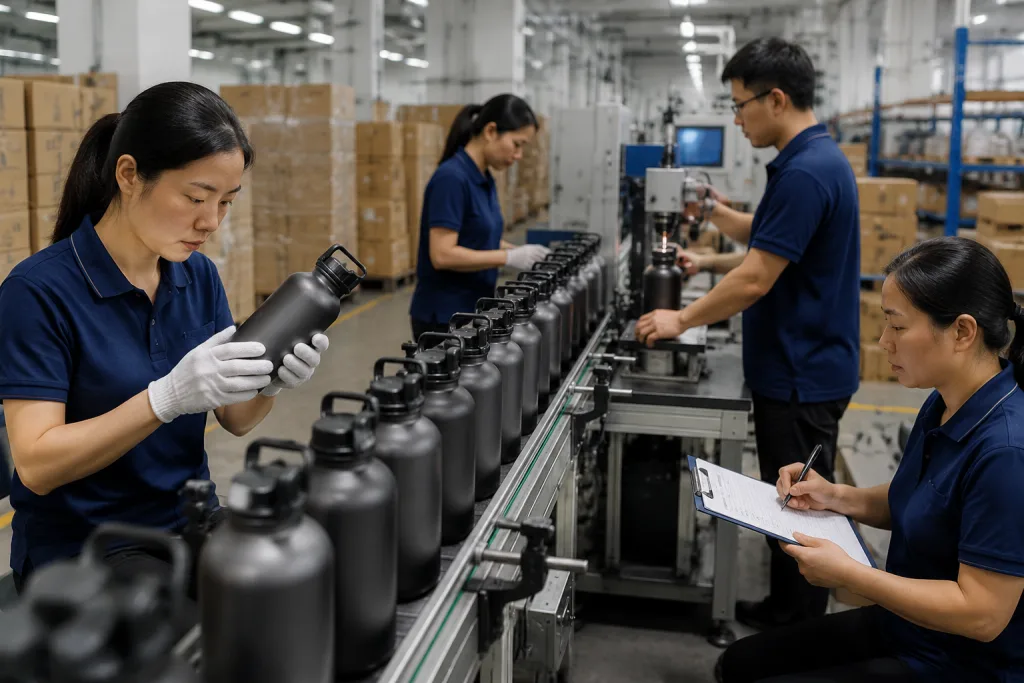
In Zhejiang and across China, a better canteen manufacturer treats your order like a production file, not a decoration job. We run 80,000 to 150,000 units a month on a line with cap torque checks and a 1.5 mm tolerance callout, and the wrong spec still slips through if the buyer leaves room for guesswork. For a first order, the clean path is simple: define the use case, build the spec, confirm samples, then QC the shipment against AQL and your label rules.
Start with the buyer scenario
Picture a distributor placing a canteen order for an outdoor retailer, a veteran group, or a defense-themed corporate giveaway. The client wants military canteen promotional products that read rugged on day one, but the end buyer still expects clean threads, a cap that holds, and color that matches carton to carton. We have seen this go sideways fast. People pick decoration first and only then ask what they are actually buying.
Start with the buyer scenario and use it as the filter. Ask three things up front: who carries it, where it gets used, and whether the job is retail resale or campaign giveaway. A field-use piece needs tighter leakage control than a desk giveaway. If the order will sit next to tents, tools, and cold packs, we run a custom canteen with a secure lid, a matte finish, and shipping cartons that can survive a rough 12-day lane instead of an 18-day one. If it is purely promotional, the spec can stay lean and the unit price stays in line.
That first call should end with a working brief: capacity, material, logo method, color, carton count, and target budget. Add one more line for the PO, because the typo usually shows up there. Without that sheet, a canteen supplier is guessing, and guessing does not make a manufacturable product.
Choose the right canteen build
The build choice sets the whole order. We run the line by body type first, because once the shell is fixed, lid, seal, and print method all follow. A classic aluminum canteen is light and low-cost. Stainless steel gives better dent resistance and a more premium hand feel. A polymer body works when the buyer wants a customizable canteen with unusual colors, but we still check odor, heat tolerance, and food-contact paperwork before we quote. For military-themed promos, buyers usually want an industrial look, not a glossy retail finish. That request comes up a lot.
For aluminum, 0.8-1.0 mm wall thickness is the range we see most often. That holds up for promotional use without turning the piece into dead weight. For stainless, 304 material at 0.5-0.7 mm gauge is a common customized drinkware spec when the buyer wants long life and a cleaner surface for engraving. If the job is closer to a custom growler style product, the same rule applies: thicker walls improve the feel, but freight and unit cost rise fast. The math does not lie. QC pulled one sample at 0.45 mm and the buyer flagged the dent test in the first round.
- Aluminum: lower cost, lighter weight, good for high-volume canteen promotional runs.
- Stainless steel: stronger perceived value, better for premium distributor drinkware programs.
- Polymer: flexible color matching, but needs resin verification and odor checks on every lot.
Ask the canteen manufacturer for the drawing dimensions, not just the capacity. A 1,000 ml body with a shallow shoulder packs very differently from another 1,000 ml model, and carton efficiency changes landed cost. We saw a PO typo once where “1,000 ml” was entered as “1000mls,” and the buyer caught it before tooling started. That saved a week.
Lock the logo and artwork method
Once the body style is fixed, lock the logo method. This is where buyers lose time and money. A logo that looks clean on a PDF can warp on a curved canteen shell. For canteen custom work, the print method has to match the material and the claim behind the piece. If the brand wants a field kit look, laser engraving or a one-color pad print usually fits. If the order needs bright campaign art, screen printing works on a mild curve, as long as the ink system is matched to the coating and the buyer accepts the extra setup.
Keep the art file tight. Most canteen manufacturers in China will ask for vector art, Pantone numbers, and exact placement in mm. We run into the same problem on the line: the buyer sends a logo in JPG, then asks why the edge came out soft at 48 mm wide. For a customizable drinkware program with several SKUs, set one master logo rule first, then adjust placement by model. That cuts reproofing. It also stops the typo-on-PO problem, where one item gets a 30 mm mark and another gets 33 mm by mistake. For dark bodies, ask for a white underbase on multi-color prints. Without it, the logo sinks into the coating.
Check the print like a buyer who has been burned before. Rub resistance, wash resistance, and edge alignment are the basics. If the vendor says the logo is permanent, ask which test they use and what counts as a pass. QC pulled the sample, and the scratch mark was gone after one pass on one order; on another, the edge lifted after a 24-hour soak. Same claim, different result. A serious canteen vendor answers that plainly, not with sales talk.
Approve samples like a production buyer
Do not approve a sample because it looks close enough in a photo. Hold it. Weigh it. Open it, close it, fill it. On the line, we check lid torque, print drift, and leak marks before anyone signs off. A sample approval on promotional drinkware should cover body finish, lid fit, thread smoothness, print position, and leak performance. This is the step that separates a real canteen distributor from a casual middleman.
Request at least two samples: one blank and one branded. The blank unit shows what the factory actually makes; the branded unit shows how the logo behaves on the real surface. If the project is a customized canteen order with a special coating, ask for a cross-section or finish photo so the gloss target is fixed at the 60-70 GU level, not left to memory. If the client wants a customized growler variant later, keep the sample record; the same finish standard can carry over. We once had a buyer flag a PO typo on the color code, and QC pulled the sample against the wrong card. That sort of slip costs a week.
Do not accept a sample unless the factory can repeat it with the same coating batch, same artwork file, and same accessory pack.
On first orders, 1,000 units is the floor if you need a custom color or a special lid, and 3,000 units is where the unit price starts to make sense. The math does not work below that for most setups. A 24 mm cap mold, a separate spray run, and a new print jig all add cost fast, and we have seen small orders go sideways when the buyer wanted factory pricing on a trial run.
QC the order before it leaves China
QC is not optional here, especially when the cartons are headed to Europe or North America. We run a written QC plan on the line: incoming materials, in-line checks, final inspection. A clean canteen order still gets checked against AQL 2.5 for major defects and 4.0 for minor defects unless the buyer contract says tighter. Leakage, wrong capacity, and missing parts are zero tolerance. No debate.
The final inspection needs real tests, not a glance from three feet away. We pull a fill-and-invert leak test, cap torque check, logo placement review, scratch check on the body, and a carton drop test. For painted or powder-coated items, ask for adhesion testing and a basic abrasion rub; on one 500 ml canteen run, QC caught a coating lift at the rim after the first rub, and that saved a claim. For food-contact programs, ask for REACH compliance for Europe and the FDA food-contact statement for the U.S. market when the material calls for it. A serious factory knows which papers it can issue and which it cannot.
- Leak test: test 100 percent of sampled units, not a loose visual scan.
- Pack-out: check the inner polybag, instructions, and master carton count against the PO.
- Labeling: confirm barcode, FNSKU, carton marks, and country of origin if needed.
For a distributor canteen program, ask for pre-shipment photos and a packing list that matches the purchase order line by line. We’ve seen shipments slip because someone typed 1,200 as 1,020 on the PO; the math does not work, and the line stops while the buyer flags it. Clean paperwork keeps freight moving out of China. Bad carton counts do the opposite.
Price it as landed cost
People ask for a unit price first, but landed cost is the number that matters. A basic aluminum promotional canteen usually lands at USD 1.20-2.40 FOB China, depending on volume, decoration, and caps or straps. A stainless model with engraving runs USD 2.80-5.50. Add packaging, test fees, and freight, and the final number can move 20-35 percent. We see that on the line all the time. It is normal.
The clean way to compare canteen suppliers is one table: unit price, decoration charge, mold or setup fee, lead time, carton load, and shipment term. FOB Ningbo or FOB Shanghai is standard for Zhejiang export work, and the local trucking network helps when a buyer wants goods out fast. QC pulled the sample and the buyer flagged a 2 mm cap gap once; that kind of issue is cheaper to catch before booking. If the order is large enough, some buyers ask for a spare parts pack with caps or straps. That adds cost, but it cuts service trouble later.
Watch MOQ language carefully. A canteen distributor may quote 500 units, but the real break at the factory can be 2,000 or 5,000 units. We had a PO once with “5000pcs” typed as “500pcs,” and the math fell apart fast. A supplier worth working with will tell you the breakpoints plainly instead of burying them in freight assumptions.
Plan the shipment and after-sales file
Shipping is where a decent order turns into a clean program. Before production starts, confirm whether the buyer needs master cartons built for palletization, Amazon prep, or mixed-SKU distribution. We had one PO with a wrong carton count typo, 24 pcs versus 20 pcs, and QC pulled the sample before the line ran. For U.S. retail programs, barcode labels and FNSKU placement need to be locked early. For Europe, carton marks, language inserts, and compliance declarations matter more than brochure copy.
Set a simple after-sales file with four items: approved sample photo, final artwork, QC report, and packing list. That makes repeat orders easier and protects both sides when the next batch starts. If the product line later expands into distributor growler or custom drinkware variants, you already have a production baseline. We keep the same file structure on every run, so nobody is digging through emails when the next 5,000 pcs lands.
In Zhejiang and across China, the factories that do this well are not the ones with the prettiest catalogs. They are the ones that can repeat a job with the same coating, same print, and same carton count after 60 or 90 days. We ship against that standard every week, and the buyer will flag it fast if a 0.2 mm print shift shows up on the second run. That is what a real canteen factory should deliver: repeatability, not excuses.
Request a spec quote for your next canteen order
Send capacity, logo art, target quantity, and market. We will quote the build, decoration, lead time, and QC plan without wasting your week.
Frequently asked questions
What MOQ should I expect for military canteen promotional products?
For a standard promotional run, 1,000 units is a practical starting point, especially if you need a custom logo or special color. If you want custom tooling, a new lid, or a unique coating, 3,000 units is more realistic. Some canteen manufacturers will quote 500 units, but the unit price is usually higher and setup cost is spread poorly. For repeat orders, larger volumes can drop the FOB price by 10-20 percent if the spec stays unchanged.
How long does production usually take in China?
After sample approval, most orders need 25-35 days for production. If the canteen custom work includes special packaging, extra testing, or a busy season schedule, plan on 35-45 days. Shipping time is separate. From Zhejiang to Europe or North America, ocean freight can add 18-35 days depending on port and route. A canteen factory with 80,000 units per month capacity can still slip if artwork approvals come late, so the timeline depends on your speed too.
Which decoration method is best for a canteen customized order?
For a rugged look, laser engraving is usually the cleanest choice on stainless steel. For aluminum or coated bodies, one-color screen print is common and economical. Pad print works well for curved areas and smaller logos. If you want a premium presentation, combine engraving with a simple one-color mark. Setup fees are often USD 40-120 per color, so keep the artwork disciplined if you want a better landed cost.
What quality checks should I require before shipment?
At minimum, ask for leak testing, logo position checks, surface inspection, and carton drop testing. For a commercial order, use AQL 2.5 for major defects and zero tolerance for leakage or wrong capacity. If the finish is painted or powder coated, include adhesion and abrasion checks. For Europe, request REACH-related material declarations where applicable. For North America, ask the canteen supplier for food-contact documentation that matches the exact material used.
Can I source other promotional drinkware from the same factory?
Yes, if the canteen manufacturer also runs lines for stainless bottles, tumblers, or growlers. That is useful when you want one vendor handling multiple SKUs for a campaign. A good canteen supplier can often bundle a custom canteen, custom growler, and other customized drinkware into one shipment, which simplifies paperwork and freight. Just do not assume every product uses the same material or QC standard; each SKU needs its own approved sample and inspection record.