Key Takeaways
- MOQ for a custom canteen program is often 1,000-3,000 pcs, with 30-45 day lead time after sample approval
- FOB China pricing can start around USD 1.20-2.80 per unit for basic metal canteens, before printing and packaging
- For EU and North America, ask for REACH, FDA food contact, and BSCI documentation before you place the order
- AQL 2.5 major / 4.0 minor is a common inspection baseline for customized drinkware shipments
Military canteen private labeling looks simple until you line up the material sheet, lid structure, coating spec, and compliance files. This is not a hiking souvenir. It has to survive freight, daily handling, and still carry your logo without scuffing off after the first carton test. In Zhejiang and across China, a decent factory will ask for the missing details before you even ask for a price. We do that every week on the line.
If you are a procurement manager, distributor, or brand owner, the real work is setting the spec before the quotation lands. A canteen factory can run a 500 ml aluminum canteen, a 750 ml stainless unit, or a custom set with boxed retail packing, but the math changes fast. We had one buyer send a PO with the logo file in the wrong spot by 8 mm, and QC pulled the sample before print. The gap between a workable private-label program and a mess is usually 3 things: material, decoration method, and the inspection standard you lock before production starts.
What are you really buying?
Q: What is the product scope when buyers say military canteen private labeling?
You are usually choosing from three commercial formats: a basic field canteen, a retail-ready custom canteen, or a broader drinkware program with pouches, cups, and add-on caps. A military canteen is not just a bottle with a logo. The geometry, wall thickness, lid seal, and coating decide whether it feels like a utility item or a giveaway piece. On our line, a 1.2 mm dent in the shell is enough for QC to flag the sample.
For aluminum, common wall thickness is 0.8 mm to 1.0 mm. For stainless steel, 0.4 mm to 0.6 mm is standard for lightweight canteen custom work, though some buyers ask for heavier gauge when dent resistance matters more than cost. Capacity usually sits at 500 ml, 750 ml, or 1,000 ml. This is the first thing we ask, because the wrong question is often about logo position when the buyer has not fixed the weight target. If you are sourcing for a canteen distributor channel, define the use case first: tactical retail, outdoor promotion, government contract, or army surplus style merchandising.
Checklist:
- Confirm capacity in ml and target empty weight
- Choose aluminum or stainless steel based on corrosion and price
- Specify whether cup, cover, or carrier is included
- Define whether the unit must read as military-inspired or strictly functional
A canteen manufacturer in Zhejiang will quote faster if you send a complete spec sheet. We ship cleaner samples that way. If you leave gaps, the factory fills them with its own assumptions, and that is where rework starts; we have seen a PO typo turn 750 ml into 7,500 ml on paper, and the buyer flagged it before the mold was touched.
Which material makes sense?
Q: Should you choose aluminum, stainless steel, or another substrate for a custom drinkware run?
For military canteen private labeling, aluminum still wins on cost and the field look buyers expect. It is lighter, easier to stamp, and on a 5,000-piece order the FOB number usually stays lower. Stainless steel makes sense when the buyer wants a heavier hand feel, less odor retention, and a shelf-ready retail item. For a promo canteen tied to unit events, aluminum is usually the right call. For outdoor retail, stainless can carry the extra landed cost.
We quote this all the time from the line in Hangzhou: a plain aluminum canteen can sit around USD 1.20-1.80 FOB at moderate volume, while stainless starts closer to USD 1.80-2.80 depending on thickness, finish, and accessory set. One buyer once sent a PO with the cap spec missing, then flagged the price after we added the cup back in. That is the wrong question to ask if the spec is incomplete. Add USD 0.15-0.40 for laser engraving or one-color silk screen, and more if you want a coated surface or printed gift box.
Be precise about performance claims. A canteen built for field use should pass a 24-hour inverted leak check, and if it has a coating, ask for abrasion data or at least our internal rub test with a Scotch-Brite pad. QC pulled a sample last month and found pinholes after the second drop test at 1.2 meters, so we tightened the weld process. A serious canteen vendor will not promise lifetime use without your handling standard.
Do not overpay for a premium material if your channel is price-driven. A distributor drinkware program lives or dies on sell-through, not on metal romance.
How private label decoration works
Q: What decoration method is best for canteen customized branding?
Match the mark to the canteen and the sales channel. Silk screen is still the lowest-cost choice for a flat logo in one or two colors. Laser engraving is cleaner on stainless steel and holds up when the bottle gets tossed around on a 12-day field cycle. Embossing or debossing gives a hard military look, but it needs tooling and usually only makes sense once the MOQ clears 3,000 units. We’ve seen buyers push for embossing on a 500-piece order, and the math does not work.
For small and mid-size programs, we run a simple setup: 1-color print on the body and a single-color logo on the cap or cup. That keeps the line moving and leaves space for a custom packaging insert. A Zhejiang factory will ask for vector art, Pantone numbers, and a placement drawing. Send all three. If you only send a JPEG, QC will spend time guessing the edge line, and that usually shows up in the first sample. One buyer once sent a PO with the logo file named as the product SKU. We had to stop the line and ask again.
- Silk screen: lowest cost, strong color on a flat surface
- Laser engraving: best for stainless steel wear resistance
- Heat transfer or full print: good for retail graphics, less common for military-style canteens
- Embossing: strong branding effect, but higher setup cost
For distributor programs, the right question is not which decoration looks fancy. It is which mark prints the same way on every batch. That is what keeps reorders smooth and complaints low.
What compliance should you demand?
Q: Which documents should a North American or European buyer request before ordering?
Start with material declarations, food-contact compliance, and the factory audit file. For the EU, ask for REACH-related declarations, not a vague promise. For the U.S. market, request food contact paperwork tied to FDA expectations, plus test reports for coating, silicone, or any printed part. If the pack includes insert cards, ink, adhesive, or a gift box, ask for those specs too. We have seen a buyer flag a clean bottle and then reject the carton glue on the PO.
If you are comparing canteen manufacturers, the paperwork shows who runs a tight line and who just collects files. A real export canteen supplier can send a BSCI audit or another social compliance report, product photos from past shipments, and a QC flow that names incoming inspection, in-process checks, and final AQL sampling. For a normal lot, AQL 2.5 major and 4.0 minor is a practical base. For a chain account or a distributor program with strict claims, tighten it before production starts. On one 20,000-piece run, QC pulled the sample at 4.8% defect on print ghosting, and we stopped the line.
Do not treat compliance as a PDF hunt. Ask where the resin comes from, whether the coating is outsourced, and whether labels go on before or after final inspection. That is the right question to ask. In Zhejiang, the better factories answer fast because they know a 2 mm label shift or a late ink change can add 3 days and create a reject pile at packing.
How to price the order correctly
Q: How do you build a real landed cost for custom drinkware?
Start with the FOB unit price, then add decoration, packaging, inland freight, ocean freight or air freight, duty, and local delivery. If a buyer says, “just give me unit price,” that is the wrong question to ask. We run this math every day on the line, and the unit number alone never tells the truth.
Packaging is where the quote gets distorted. A plain polybag is cheap. A printed box, hangtag, barcode label, and retail sleeve can add USD 0.20-0.80 per set, depending on spec. On one 750 ml stainless steel canteen job, the buyer flagged the missing sleeve cost after sample approval; the PO had no carton detail, and the final landed number moved fast.
For example, a 750 ml customized canteen in stainless steel might be quoted at USD 2.10 FOB with laser logo and bulk pack. Add a color box, carton marks, and barcode stickers, and the export-ready price may move to USD 2.55 or higher. If you need a bundled cup, strap, or pouch, the math goes up again. We’ve seen this go sideways when the buyer assumed a strap was “small money” and skipped it in the first round.
Price the program in 3 scenarios: sample unit, pilot lot, and full production. Sample cost is not production cost. Pilot lot often carries a 100-300 pcs setup load, and the full run is where the real unit price settles once QC pulled the sample and the process is locked.
Checklist for pricing:
- Ask for quote at 500, 1,000, and 3,000 pcs
- Separate product price from packaging price
- Confirm whether logo setup is one-time or recurring
- Ask if spare lids or extra cartons are included
A canteen vendor that gives tier pricing is easier to work with than one that hides setup charges until after the sample is approved. We ship better when the PO is clean, the carton spec is written down, and nobody has to chase a typo in the order line at the end.
What a workable QC checklist looks like
Q: How do you protect the order from defects and dispute?
Use a checklist the line can actually run. One sign-off is not enough. We lock the sample, confirm production, pull in-line checks, then do final random inspection before shipment. For a custom drinkware order, the checks stay plain: dent check, logo position, lid fit, leak test, coating adhesion, odor, carton count, barcode read. On a 20,000-piece PO, that is where disputes get cut down.
For a metal canteen, I push leak testing at room temperature, then again after a 30-degree tilt and a full inversion hold. If the lid uses silicone, QC should check compression consistency and look for flash or burrs around the edge. Buyer flagged it once on a PO typo that said "1000 ml" instead of "1000ml"; the spec drift started there. For promo runs, cosmetic tolerance can stay looser. For retail, tighten it. The math does not work any other way.
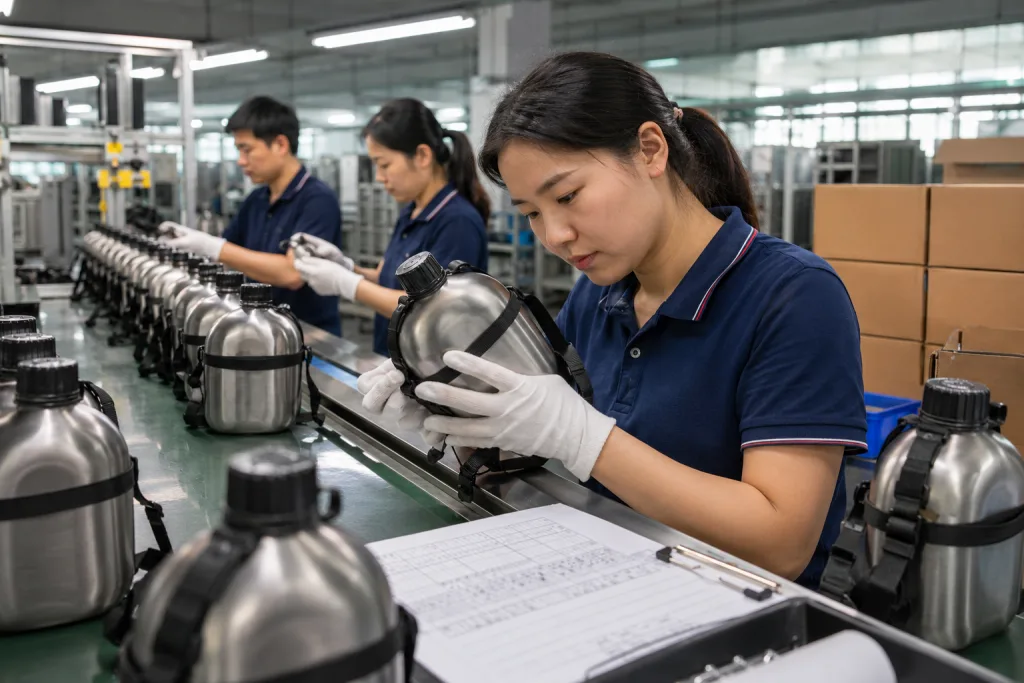
A workable flow in a Zhejiang canteen factory usually runs like this: incoming raw material check, stamping or forming, welding or assembly, surface finishing, logo application, 100% leak spot check, AQL final inspection, then carton sealing. We ship faster when the spec is frozen before the first 3,000 units leave the line. A plant with four lines can reach 300,000 units a month, but only if the drawing, packing mark, and carton label are clean from day one.
If you do not define what counts as a defect, your canteen supplier will define it at shipment time.
What to ask before you place the PO
Q: Which questions separate a real canteen factory from a trading middleman?
Ask where the dies are stored, what the monthly output is, how many production lines handle metal drinkware, and whether they have handled custom growler and custom drinkware exports. A real canteen factory answers with numbers. We run 2 metal lines here, and a buyer once pushed back hard when we quoted capacity without showing the forming press schedule. Ask for MOQ by finish, not just by model. A brushed stainless version may take 1,000 pcs MOQ, while a painted custom version can need 3,000 pcs because the spray booth has more setup loss and scrap.
Also ask who owns the mold if you are doing a fully customized canteen shape. If you pay for tooling, the agreement should say so. We had a PO with the word "mould" misspelled three different ways, and that file still became the reference on reorders until QC pulled the sample and caught the mismatch. If you need repeat orders, ask whether the same color code and logo file will be stored for 6 or 12 months. That sounds minor until you try to rebuild a lost order for a distributor canteen campaign.
- What is the actual monthly capacity in units?
- What is the MOQ by material and decoration method?
- Which tests are done in-house and which are outsourced?
- Can they support repeat orders with the same packaging spec?
In practice, the best canteen manufacturers in China behave like export engineers. They ask for your channel, target price, and claim set before they give you a final offer. That is the right question to ask, because a clean quote on paper means nothing if the line cannot hold the spec at AQL 2.5 and the packing list still drifts on the next PO.
Request a factory quote with your exact spec
Send capacity, material, logo file, packaging, and target MOQ. We will quote the canteen line the way a real export order should be priced.
Frequently asked questions
What is a normal MOQ for military canteen private labeling?
For a basic private-label metal canteen, a normal MOQ is 1,000 to 3,000 pieces depending on material, finish, and decoration. Plain aluminum usually sits lower than coated stainless steel. If you want embossing, a special cap, or retail packaging, the MOQ often rises. Many canteen suppliers will sample at 1 piece, but the production order is a different conversation. For repeat distributor canteen programs, asking for tiered pricing at 1,000, 3,000, and 5,000 pcs gives you a realistic picture.
How long does production usually take in China?
For a standard custom canteen order, expect 30 to 45 days after sample approval and deposit. If the order needs new tooling, special coating, or printed gift boxes, 45 to 60 days is more realistic. A canteen factory in Zhejiang with stable lines may ship faster, but only if the spec is frozen and the artwork is final. Freight time is separate. Ocean transit to Europe or North America can add 20 to 40 days depending on port and season.
What compliance documents should I request?
Ask for material declarations, food-contact test reports, and factory audit documents such as BSCI if you need social compliance. For Europe, REACH-related documentation matters. For North America, ask for FDA-aligned food-contact declarations and any coating test reports. If the product has silicone parts or printed packaging, include those materials in the review. A serious canteen vendor should not push back on this. If they do, treat it as a sourcing risk.
Is laser engraving better than printing for a customized canteen?
Laser engraving is usually better for stainless steel because it is durable and does not rub off. Printing is cheaper and works well for simple logos, especially on aluminum or painted surfaces. If your buyer wants a premium feel, laser is safer. If your priority is price, silk screen wins. On a USD 1.50-2.00 FOB item, decoration can change margin more than the base product does. That is why the right choice depends on channel, not taste.
Can I order other drinkware in the same program?
Yes. Many buyers bundle a customized canteen with a custom growler or other custom drinkware items to spread setup cost across a range. That works best when the same canteen supplier also handles stainless bottles, tumblers, or related accessories. The advantage is consistency in logo placement and packaging. The tradeoff is complexity, so confirm the factory can hold the same color standard and carton labeling across all SKUs before you issue the PO.