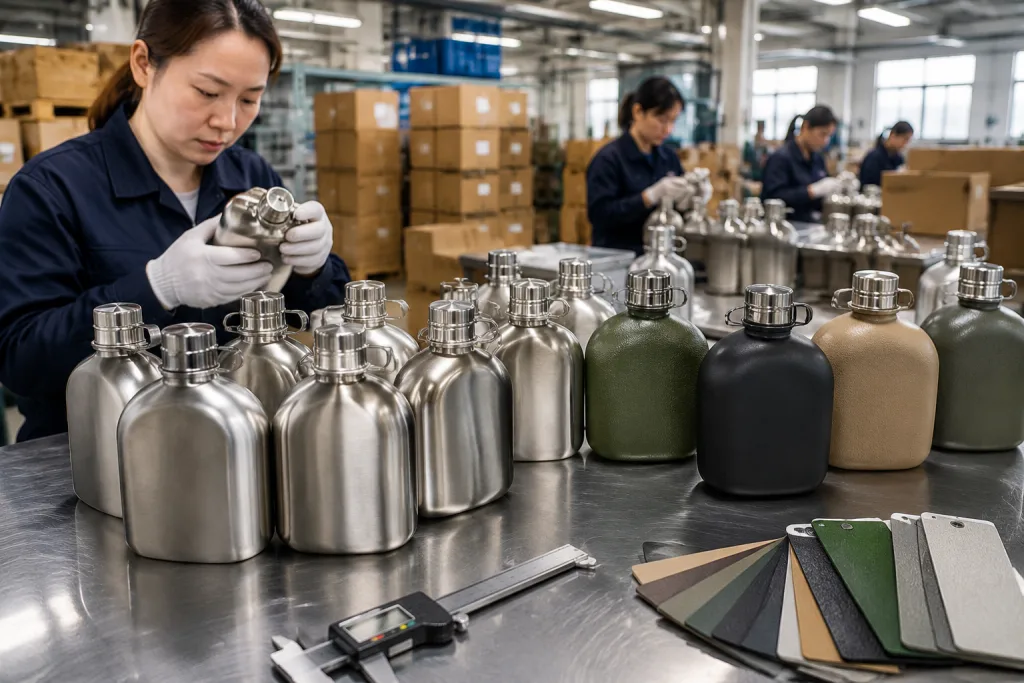
Key Takeaways
- Typical MOQ for a private label canteen is 3,000-5,000 units per SKU, with 25-35 days lead time after sample approval.
- A realistic FOB China price for an aluminum custom canteen is often USD 1.15-2.40 depending on capacity, coating, and print complexity.
- Sample approval should lock material, capacity, cap torque, artwork position, and packaging before you release a bulk PO.
- For Europe and North America, ask for REACH, food contact declarations, and AQL 2.5/4.0 inspection terms in writing.
If you are buying military canteen private label programs, the hard part is not finding a canteen factory in China or Zhejiang. The hard part is locking the spec before the first PO goes out. A 0.6 mm wall on one quote and a 0.8 mm wall on another changes weight, price, and dent resistance enough to blow up a launch or a distributor program. We have seen a buyer flag the PO because the cap thread callout was missing one digit, and that kind of miss gets expensive fast.
Most buyers start with a vague request for custom canteen or customized drinkware, then find out that material grade, coating, cap style, packaging, and compliance all move the landed cost. That is the wrong question to ask first. Run it like a sourcing job: RFQ, sample, bulk, repeat order. QC pulled the sample on the line, checked wall thickness at 0.02 mm tolerance, and the numbers told the story. That is how a serious canteen manufacturer in Zhejiang works, and it is how you avoid paying later for details nobody wrote down.
Start With The Use Case
Do not start with a logo file. Start with the use case. A military canteen private label run for a tactical retailer is one job; a canteen promo order for a field event is another; distributor drinkware for a campus chain is a third. We run into trouble when buyers skip that part. The wrong brief turns into the wrong cap, the wrong coating, and a PO typo that QC has to chase on the line.
Ask four things first: who uses it, where it is carried, how it is cleaned, and what capacity the buyer wants. A 500 ml aluminum canteen with a screw cap fits light retail packaging. A 1,000 ml stainless version gives higher shelf value, but the wall thickness and tooling cost move up fast. If the buyer wants a customizable canteen for government-style merchandising, we also need the finish on day one: matte powder coat, brushed metal, or full-color print. The buyer flagged it late before, and that pushed sampling back 12 days.
Write the brief as a procurement note, not a marketing note. Put material, capacity, lid type, finish, and target market in one line. A good canteen manufacturer or canteen vendor in Zhejiang will tell you fast whether your target FOB works. If the math does not work, we say so. The same applies to custom drinkware, customized drinkware, and a custom growler program: define the use before you ask for decoration.
What belongs in the first RFQ
- Material: aluminum, stainless steel 304, or BPA-free plastic
- Capacity: 500 ml, 750 ml, or 1,000 ml
- Finish: powder coat, anodized, painted, brushed
- Logo method: silk screen, laser engraving, UV print, debossed patch
- Packaging: polybag, gift box, retail carton, master carton count
Build An RFQ Buyers Can Price
A usable RFQ does not ask for “best price.” It gives the canteen manufacturer enough data to quote the same thing twice. Send a half-page inquiry and every canteen supplier will make its own call on wall thickness, print coverage, and packing. Then you are comparing three different products. We see that mistake a lot.
List the item line by line. Example: 500 ml aluminum military canteen private label, 0.7 mm wall, matte olive powder coat, single-color logo, stainless cap chain, individual polybag, 50 pcs per carton, FOB Ningbo or FOB Shanghai. Add target quantity tiers like 3,000, 5,000, and 10,000 units so the factory can show the break on tooling and printing cost. On our line, a logo that grows from 18% to 30% of the body can shift unit price by 8% to 15% because of setup and cure time. That is the math, and it does not care about nice wording.
Be direct on compliance. For Europe, ask for REACH and food contact declarations. For North America, ask for LFGB if it matters for your channel, or at least the exact material declaration and test scope you want. We had a buyer flag a PO last quarter because “aluminum canteen” was typed without the cap material, and the sample passed by luck, not by spec. A serious canteen factory in Zhejiang will price to that level of detail without drama. A vague RFQ is the wrong question to ask.
PO line item example: 500 ml aluminum canteen, olive powder coat, one-color logo on front, stainless cap, individual color box, 3,000 pcs, FOB Ningbo, lead time 30 days after sample approval.
Check Samples Like A Buyer
Samples are not a formality. They are the last gate before the line runs 5,000 units and somebody finds a leak on day 3. For a customized canteen, check the sample against the RFQ before bulk approval. Do not stop at looks. Measure capacity, check coating hardness, test cap alignment, and inspect the body seam. On a metal canteen, a 0.2 mm shift is enough to change fit and show up as leakage later.
Ask for three sample types if the program has any weight: a pre-production blank, a decorated sample, and a packed sample. The blank shows base material quality. The decorated sample shows logo sharpness and color density. The packed sample shows whether the retail box survives actual handling. We ship a lot of this out of Hangzhou, and a 7-12 day sample lead time is normal for standard tooling. If someone offers two days, they are sending a visual mockup, not a production sample.
For canteen customizable programs, put the pass/fail points in writing. Logo registration within 1.5 mm. No cap leak after a 24-hour inversion test. Coating adhesion at the agreed rating. Carton drop test matched to your channel. This is the right question to ask before PO. One buyer once sent a PO with the logo spelled wrong by one letter; QC pulled the sample, flagged it, and we stopped the job before the wrong artwork hit the press. That saved a mess. This matters even more if the item sits beside a custom growler or other customized drinkware in a distributor catalog, because buyers compare finish quality across the range whether you planned for it or not.
- Check engraving depth or print opacity on the sample with a 0.3 mm gauge line
- Test the cap torque by hand and with a simple gauge
- Confirm color against Pantone, not a screen image
- Review barcode and retail label placement before carton approval
Lock The Bulk PO
Once the sample is approved, the bulk PO has to close the gaps. This is where a lot of canteen manufacturers and canteen vendors start asking for “room to adjust.” That is the wrong question to ask. You want repeatability on the line, not surprises at packing. Put every commercial and technical detail into the PO line items so there is no room for interpretation.
A strong PO for military canteen private label should list the product name, spec, artwork file version, decoration position, packaging structure, carton count, inspection standard, and delivery window. State whether the order is FOB, CIF, or DDP. If you need landed control, ask the canteen supplier to quote both FOB and DDP, then pin one term on the PO. For a 5,000-unit run, the usual production cycle in China is 25-35 days after sample sign-off, plus 5-7 days for inland handling and export booking. We run into buyers who leave the freight term blank, then the invoice comes in with a typo on the destination port. That turns into a hold-up fast.
Write the inspection rule in plain terms. AQL 2.5 for critical and major defects is common for consumer drinkware, with AQL 4.0 for minor defects depending on your channel. If the canteen factory in Zhejiang will not accept written inspection terms, do not release the order. We have seen this go sideways on a 3,000-piece PO: QC pulled the sample, found print shift outside the agreed 2 mm tolerance, and the buyer flagged it only after cartons were already labeled. The cheapest quote gets expensive when half the cartons fail your receiving team. That applies whether you are buying a customized canteen, customized drinkware, or a distributor drinkware range for multiple markets.
Suggested PO fields
- Item code and exact product description
- Artwork version and print method
- Unit price by tier and total quantity
- Packaging spec and carton dimensions
- Inspection standard, freight terms, delivery date
Price It Against Real Trade Terms
Buyers often ask for a price without saying whether they need FOB China or landed delivery. That is the wrong question to ask first. FOB gives you a clean factory price; landed cost pulls in freight, duty, and destination handling. On a military canteen private label order, we have seen the margin swing 12% to 20% just from that missing term. One PO even had “CIF” typed in the remarks and “FOB” in the line item, so we stopped the quote and had the buyer confirm it in writing.
In Zhejiang, a basic aluminum canteen with one-color logo and standard cap might quote around USD 1.15-1.60 FOB at 5,000 units. A stainless steel model with a better finish and box packaging can move into USD 1.80-2.40 FOB. Add special coating, multi-color printing, or custom inserts, and the number climbs another 8% to 18%. The math works out that way on the line. QC pulled the sample at 1.2 mm wall thickness once, and the buyer still tried to push for the lower spec price; that does not hold up when the finish gets checked under export inspection.
For distributor canteen or canteen promotional programs, ask the canteen supplier to quote the price break at 3,000, 5,000, and 10,000 pcs. That tells you whether the program belongs in a distributor catalog or should stay as a seasonal offer. If you are comparing canteen suppliers, ask each one to quote the same packaging, the same test standard, and the same shipping term. We ship enough of these to know the comparison breaks fast when one supplier quotes a plain polybag and another includes printed carton inserts. Same order, same term, same spec. Anything else is noise.
China is still the most efficient place for this type of custom drinkware if you need steady decoration and export paperwork. Zhejiang factories are set up for private label work, and the better ones can run 80,000-150,000 units per month across multiple drinkware lines when the schedule is balanced properly. That said, a buyer asking for a 7-day lead time on a 10,000-piece canteen run is asking for trouble; we have seen that go sideways more than once. The line needs room, the cartons need curing, and the paperwork needs to match the packing list before the goods leave the dock.
Control Compliance And Reorders
The first order is not the job. Reorder control is where private label either holds or slips. Keep the approved sample, signed artwork proof, test report, and carton photo set in one file. We had a buyer flag a cap color drift after 8 months because the reference pack was scattered across three inboxes. That is the file you use when you reorder a customized canteen or roll the same spec into related items like customizable growler or custom drinkware programs.
Ask the canteen manufacturer to keep the same cap mold, coating code, and packaging version. If a subcomponent changes, require notice before production. On the line, a 1.5 mm gasket switch looks harmless until the buyer starts logging leaks on arrival. We ship by written approval, not by memory, because a canteen factory in China will sometimes swap a part when a component goes short. That is the wrong question to ask after goods land.
For Europe and North America, rerun the compliance check on each new lot when the market is tight on regulation. Keep the REACH file, food contact declarations, and any third-party test reports you use for resale. If you work through canteen distributors, give them the same file set. QC pulled the sample on one 5,000-piece lot because the carton mark had a typo in the SKU, and that sort of miss burns time fast. Your distributor drinkware program should run on documented specs, approved samples, and a supplier who can repeat the same build without improvising.
Send your RFQ and lock the spec now
We can quote military canteen private label programs with clear MOQ, sample timing, and bulk terms for China and Zhejiang export orders.
Frequently asked questions
What MOQ should I expect for military canteen private label orders?
For a standard aluminum or stainless canteen, expect 3,000-5,000 pieces per SKU as a practical MOQ. Some canteen manufacturers in China may accept 1,000-2,000 pcs if the decoration is simple and the packaging is standard, but unit price will rise 12% to 25%. If you need multiple colors, special caps, or retail boxes, MOQ usually moves higher because of setup and packing labor. Ask the canteen factory to quote both the MOQ and the next price break so you can see whether the program makes sense for your channel.
How long does sample and bulk production take?
A true sample usually takes 7-12 days for a standard canteen, longer if new tooling or complex decoration is involved. After sample approval, bulk production for a normal 5,000-unit order is often 25-35 days in Zhejiang or other parts of China. Add 5-7 days for export booking, carton consolidation, and inland transport if you are shipping FOB. If a canteen supplier promises both sample and bulk in a few days, confirm whether they mean a mockup, not a production sample. That distinction matters when you are buying customized drinkware for resale.
What price should I budget per unit?
For FOB China, a basic aluminum custom canteen with one-color print may land around USD 1.15-1.60 at 5,000 pcs. A stainless steel customized canteen with better finish and retail packaging often sits around USD 1.80-2.40. If you add multiple print colors, coating upgrades, or inserts, budget an extra 8% to 18%. Freight, duty, and destination charges are separate. For a distributor canteen program, always compare FOB and landed cost, because the final margin can shift by double digits depending on carton count and shipment mode.
What inspection standard should I put in the PO?
For consumer drinkware, AQL 2.5 for critical and major defects is a common starting point, with AQL 4.0 for minor defects if your market allows it. Put the exact test points in the PO: leak check, coating adhesion, logo clarity, cap fit, carton integrity, and quantity tolerance. If you want tighter control, specify a pre-shipment inspection and require photo approval before balance payment. A good canteen manufacturer will accept written standards without friction, especially if they regularly export from China to Europe and North America.
Can I combine canteen custom work with other drinkware in one order?
Yes, but only if the production method and packaging plan are compatible. A canteen supplier may bundle a custom canteen with a custom growler or other customizable drinkware, but each item still needs its own spec sheet, sample approval, and PO line item. Bundling can help on freight and paperwork, yet it can also create confusion if one product uses laser engraving and another uses silk screen. Keep the commercial documents separate even when the shipment is combined. That makes reorders and distributor drinkware planning much cleaner.