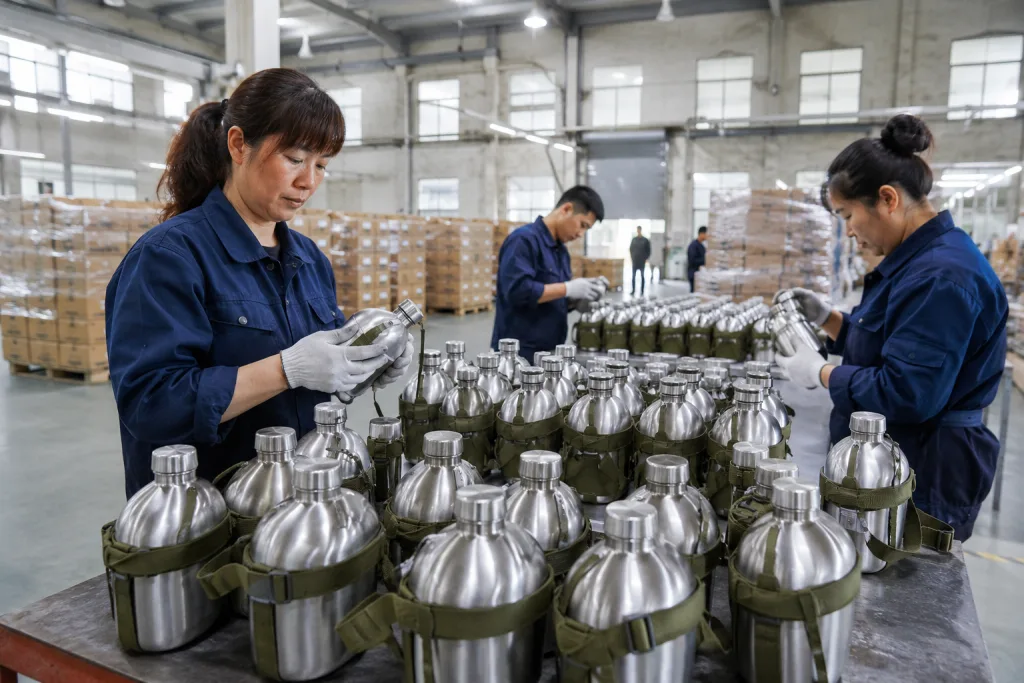
Key Takeaways
- A real military canteen OEM manufacturer should quote MOQ, lead time, and monthly capacity up front, such as 1,000 pcs, 30-35 days, and 60,000 units/month.
- For export orders, ask for REACH, LFGB, FDA, and a documented AQL 2.5/4.0 inspection plan before you approve sampling.
- A customized canteen order should lock material grade, wall thickness, closure torque, and decoration method before mass production starts.
- If you sell as a canteen distributor or distributor drinkware buyer, build one master spec sheet for every canteen customizable variant to prevent SKU drift.
You are not buying a bottle. You are buying a repeatable order that has to pass procurement review, sample sign-off, decoration checks, export paperwork, and field use. That is why a military canteen OEM manufacturer matters more than a generic canteen supplier. The gap shows up fast on the line: wall thickness, cap sealing, drop resistance, and whether the factory can hold the same spec across 5,000 or 50,000 units.
In Zhejiang and across China, a real canteen factory talks in numbers. 30-day lead time. 1,000-piece MOQ. 60,000 units per month. REACH-compliant materials. An AQL plan for incoming and final inspection. If you are a canteen distributor, brand owner, or procurement manager, ask for the order flow from drawing approval to carton drop test. The math does not work any other way, and we have seen buyers get burned when a PO typo changes the cap code by one digit.
Start With the Real Use Case
Do not start with color. Start with use. A military canteen order for a ministry tender, training program, outdoor retail line, or canteen promotional campaign has different requirements. A field-use canteen for tactical kits usually needs impact resistance, a secure lid, and a shape that fits a pouch. A retail canteen customized for a brand launch may care more about decoration, pack-out, and shelf appeal. A distributor canteen program may need two cap options so one base item can serve several channels.
When a buyer comes to us in Zhejiang, the first question is plain: who uses it, how often, and where does it fail? We had one PO with a 750 ml spec written as "75 ml" and QC pulled the sample before the line moved. If the answer is daily field carry, I push for a tougher body spec and a closure that survives repeated hot-and-cold cycling. If it is a custom drinkware program for an institutional buyer, you may need an easier-fill mouth, a safer edge radius, and a carton pack count built for warehouse picking. This is where a military canteen OEM manufacturer earns the fee. You are not buying a catalog item; you are defining a use case the canteen manufacturer can repeat without guesswork.
For a real buyer scenario, write the brief like this: 1) capacity, such as 750 ml or 1 liter, 2) material, 3) color system, 4) decoration, 5) test standard, and 6) shipment target. A buyer once tried to split one request into three color codes without changing MOQ, and the math did not work. Once that brief exists, every canteen supplier and canteen vendor should be judged against it, not against vague samples.
Lock the Spec Before Samples
The sample stage is where bad orders hide. A canteen custom sample can look fine in hand and still miss production if the spec is loose. We need a drawing with dimensions, resin or metal grade, wall thickness, cap structure, and decoration method. For a plastic canteen customizable line, lock thickness to 0.1 mm. For an aluminum or stainless custom canteen, state the gauge or wall thickness and name the seal compound, whether it is silicone, TPE, or another material. On the line, QC pulled a sample cap that was 0.4 mm loose at the neck. That one detail turned into a leak test fail.
A serious canteen factory sends a sample with a datasheet, not a photo. That sheet should list capacity tolerance, weight, temperature range, and packaging method. If you are building a customized drinkware line with several models, write one master spec for the body and separate addenda for caps, straps, and printing. Otherwise the factory starts guessing, and the math does not work. We have seen a buyer flag a PO with one typo on the strap length, then the whole batch came in 12 mm short. A canteen distributor needs the same reorder every season, so this is not the place for loose wording.
Do not approve tooling until the sample matches the drawing within agreed tolerances. If the neck finish is off by 0.3 mm, a cap that looks fine on a desk can start leaking after shipment vibration. That is how claims start in custom drinkware. If the factory cannot confirm the tolerance stack, walk away and find another military canteen OEM manufacturer in China or Zhejiang that can. We run into this when the buyer asks for a fast yes before QC has checked the thread gauge. Wrong question.
Price Is Only Useful In Context
Cheap unit price is not low landed cost. We have seen a canteen promo order save $0.12 per piece on paper, then eat that back in rework, extra cartons, and a second booking. Ask for tiered pricing at 1,000 pcs, 3,000 pcs, 10,000 pcs, and 50,000 pcs. On a real quote sheet, that is where the mold charge drops out and where a special cap or extra color starts adding money. Ask for FOB Ningbo or FOB Shanghai too. A buyer in Germany or the US needs one clean baseline before freight, duty, and local handling get piled on.
Most quote drift in China comes from decoration and packing, not the canteen body. One-color silk print may add only a small charge; a three-position print, laser mark, or gift box can move the price by 8% to 20%. We run into this on the line all the time. QC pulled a sample last month where the buyer flagged a carton typo, and that single mistake changed the pack plan more than the bottle did. Split product cost, decoration, packing, and testing in the quote. That is the right question to ask. Otherwise you are not comparing the same order.
A normal OEM run from a Zhejiang canteen factory often sits at 30 to 35 days after sample approval, with 1,000 to 3,000 pcs MOQ depending on material and print method. We ship orders like this every week. If the buyer pushes back on tooling, sample, or carton cost and the supplier still will not break it out, the math does not work. You are not seeing the real number.
QC the Order Like a Buyer, Not a Tourist
QC starts before the first press run, not after the carton is sealed. The way we run it in the plant is straightforward: first article approval, in-process check, final inspection, then container loading check. For export, lock the AQL before the line starts. AQL 2.5 for major defects and 4.0 for minor defects is common, but the buyer must get the canteen manufacturer to sign off in writing. If they dodge that, the factory is asking you to find the mess in your own warehouse. That is the wrong question to ask.
For a military canteen OEM manufacturer, the checks have to match how the product is used. Does the cap seal under pressure? Does the strap anchor survive repeated pulls on a 15 kg test rig? Does the print hold after abrasion? Does the body stay flat after heat exposure? On a stainless or aluminum custom growler body in a wider drinkware program, we also watch seam integrity, odor, and surface finish. On a customized growler or customizable growler for mixed-channel sales, carton compression and label accuracy matter just as much. QC pulled the sample once and found a 2 mm offset on the neck print; the buyer flagged it before shipment.
- Check 100% of print alignment on first-run pieces.
- Verify closure torque on one sample from each carton stack.
- Drop-test filled samples from 1 meter on three faces.
- Inspect 2% to 5% of units during pack-out, based on order size.
Good canteen manufacturers do not argue about QC steps. They document them, assign responsibility, and keep the records. We’ve seen this go sideways when a PO typo changed the carton count from 3,000 to 30,000; the factory caught it because the checklist matched the packing line. That is a real canteen factory, not a trading desk in a clean shirt.
Packaging, Cartons, and Export Docs
Packaging is where a lot of B2B drinkware orders go sideways. A custom drinkware buyer often spends all the time on the bottle and then forgets the carton spec that the warehouse has to live with. Carton dimensions, pallet count, barcode placement, and master pack logic decide whether the line ships cleanly or gets reworked. For Amazon or retail replenishment, we usually run individual polybags, printed inserts, and FNSKU labels. For direct institutional orders, bulk pack cuts cost and waste fast.
Ask the canteen supplier to confirm outer carton test standards and stacking load before the PO goes in. We have seen a 5 mm carton change blow up pallet math, and the buyer flagged it only after the booking was already set. For export, you want the HS code, commercial invoice wording, packing list, and origin papers aligned line by line. A Zhejiang canteen manufacturer shipping to Europe or North America should know how customs brokers read those documents. If they do not, you end up fixing delays at the last minute.
Material compliance needs the same treatment. For food-contact custom drinkware, REACH is standard for Europe, and FDA or ASTM-linked testing may be expected in North America depending on the item and buyer requirements. QC pulled the sample on a batch where the report was six months old, and that order stopped cold. If a canteen vendor cannot show current test reports, that is a procurement risk, not a paperwork detail.
Plan the Order Around Reorders
The real value of a military canteen OEM manufacturer shows up on the second order. Sample one is the easy part. Reorder two is where the trouble starts. If you sell as a canteen distributor or distributor canteen buyer, your margin lives or dies on getting the same customized canteen back six months later with no color drift, no print shift, and the same strap fit. We run that check off a locked master sample, a stored color chip, a signed drawing, and a revision log. QC pulled one sample against the chip and found a 1.5 mm print offset once; that order went back to the line before it left Hangzhou.
Build the program so the factory can scale with you. A capable canteen manufacturer should give you monthly output, changeover limits, and the decoration methods that match your volume. On our line, a Zhejiang canteen factory with 60,000 units per month can handle a 10,000-piece custom canteen run cleanly, but five colors, three strap styles, and separate retail cartons change the math fast. The buyer flagged it on a PO typo once—one strap code was off by a single letter—and we caught it before tooling was touched. Better to hear that on day one than on day twenty-three.
For a canteen promotional project, a modular setup usually wins: one body, two lids, one strap, two print positions. That keeps the custom canteen program tight and stops inventory from splintering into ten dead SKUs. If you are also sourcing a broader custom drinkware range, keep the same carton spec across the line so the warehouse team is not rechecking every box code. This is the wrong question to ask: not “how many options can we add,” but “which two options actually move the order.”
What Good OEM Support Looks Like
Not every canteen vendor can support an OEM program. A real partner answers the boring questions fast: resin grade, wall thickness in mm, mold cavity count, first-pass yield, and the defect rate before rework starts. We run those checks on the line for a reason. They tell you whether you are talking to a disciplined canteen manufacturer or a middleman collecting quotes.
From the buyer side, ask for a factory tour video, tool room photos, and live production images with date stamps. That is normal due diligence if the factory is in China, especially Zhejiang. Ask for references by market type, not just by country. A canteen supplier serving distributors may pack cartons well and still miss retail presentation. A supplier built around custom growlers may not understand military-style closures or field-use wear, and that is the wrong question to ignore.
“The right partner is the one who can explain why a 0.2 mm change in wall thickness changes drop performance and cycle time. That is the level you want from a military canteen OEM manufacturer.”
Once the factory can talk at that level, you can buy on facts. Sample approval is the easy part. PO execution is where the buyer flags a typo, QC pulls the sample, and the order either holds or slips.
Request a real OEM quote today
Send your capacity, material, print, and carton needs. We will return a spec-based quote with MOQ, lead time, and export-ready documentation.
Frequently asked questions
What MOQ should I expect from a military canteen OEM manufacturer?
For most export programs, a realistic MOQ is 1,000 to 3,000 pieces per SKU. Simple plastic bodies with one-color print can be lower, while special caps, custom molds, or multi-color decoration can push MOQ to 5,000 pieces. A serious canteen factory in Zhejiang or elsewhere in China should give you the MOQ by structure, not one blanket number. If they offer 300 pcs for everything, check whether they are reselling stock rather than running true OEM production.
How long does a custom canteen order usually take?
After sample approval, common lead time is 30 to 35 days for a straightforward order and 40 to 50 days if tooling, special colors, or complex decoration are involved. If you need a customized canteen with new mold work, add 15 to 25 days for tooling and sample correction. A dependable canteen manufacturer should map the timeline from drawing approval to packing list issue, not just quote a production number.
What inspection standard should I use for export orders?
Most B2B buyers use AQL 2.5 for major defects and 4.0 for minor defects, with a defined critical defect rule for leaks, contamination, or wrong materials. For food-contact custom drinkware, ask for REACH for Europe and the relevant FDA or market-specific compliance documents for North America. The best canteen suppliers will confirm the inspection plan before mass production, not after shipment.
Can I order a canteen customized with my logo and packaging?
Yes. A canteen customized program can include logo printing, laser engraving, color matching, hang tags, inserts, and retail cartons. The common mistake is approving artwork before fixing the body spec. Lock the size, closure, and material first, then set decoration. For canteen promotional programs, the packaging often drives shelf success as much as the product itself, especially when you are selling through a canteen distributor or distributor drinkware channel.
How do I compare canteen suppliers without getting confused by quotes?
Break every quote into the same parts: product unit price, tooling, decoration, packaging, sample charge, and FOB port. Then compare the same capacity, same material, same print method, and same carton count. A lower price from one canteen vendor means nothing if it uses thinner walls, weaker caps, or a cheaper box. Ask for a written spec sheet and compare that first, not the headline price.