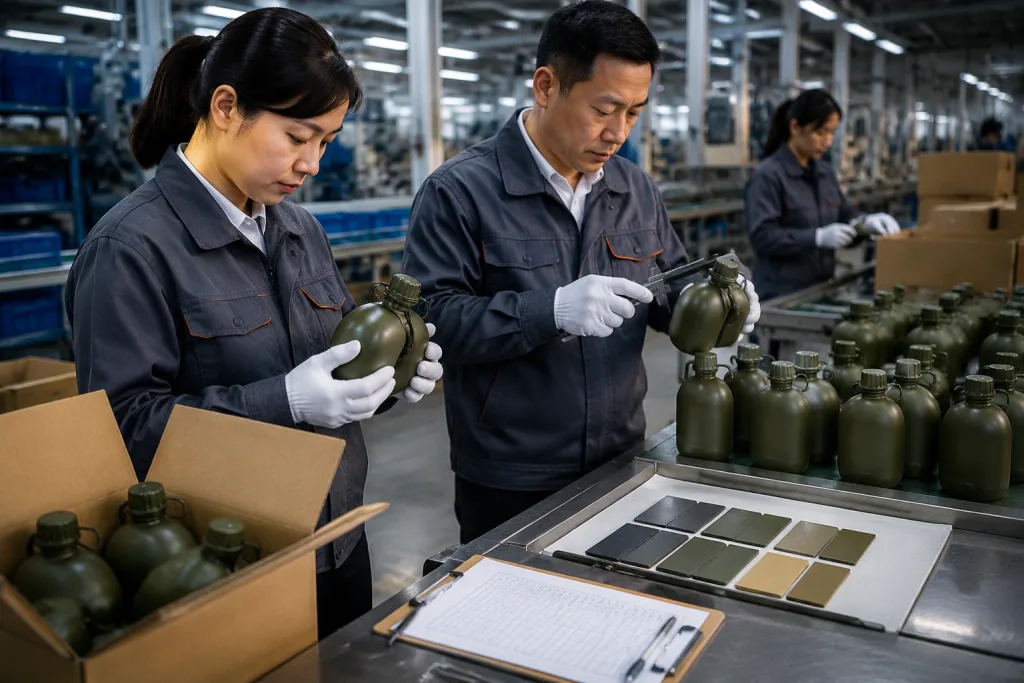
Key Takeaways
- For military canteen manufacturers, 304 stainless steel at 0.8-1.0 mm usually gives the best durability-to-cost balance for 3,000+ unit orders.
- A serious canteen factory should quote MOQ, tooling cost, lead time, and AQL 2.5/4.0 inspection levels up front, not after sampling.
- For Europe, ask for REACH documentation and migration test support; for North America, confirm FDA food-contact expectations and packaging standards.
- If you need canteen customizable options, focus on cap style, coating, logo method, and carton packout before asking for more shapes.
If you are buying for retail, government contracts, or outdoor channels, the word canteen hides a lot of bad purchasing decisions. We have seen two products that both look like a military canteen behave in opposite ways on the line: one dents at 0.5 mm wall thickness, another ships with a 1.0 mm body and takes rough handling without trouble; one passes REACH, another needs extra testing before it can enter Europe. That is the wrong question to ask if you only judge by photos. Serious buyers compare military canteen manufacturers on spec, not on the brochure shot.
In China, especially Zhejiang, a decent canteen factory talks in numbers. MOQ 3,000 to 5,000 units. Lead time 25 to 35 days after sample approval. Monthly output above 300,000 units. Decoration methods tied to exact surface prep, and QC pulled the sample before we signed off. That is the level you want if you are sourcing custom drinkware for a distributor line, a promotional campaign, or a custom canteen program that has to hold color, finish, and margin.
Steel, Aluminum, or Tritan
The first decision is not branding. It is body material. Get that wrong, and logo work will not save the item. For a military-style bottle, the real comparison is stainless steel versus aluminum versus Tritan. Stainless steel is the safer choice when the buyer wants a rugged custom canteen that survives repeat use, dishwashing, and a higher shelf impression. 304 stainless is the normal starting point; 316 adds cost and only earns its keep when the spec calls for stronger corrosion resistance. On one recent line check, QC pulled the sample at 0.78 mm because the spec card said 0.8 mm minimum. That kind of miss shows up fast.
Aluminum is lighter and cheaper, but coating quality and the inner lining matter a lot more. A bare aluminum canteen is not a serious option for most export orders. Tritan or other copolyesters work when the program needs lightweight customized drinkware, yet they do not carry the same military-style feel and can read like a standard sports bottle. We ship a lot of samples through this decision point, and the buyer often flags the same thing: the wrong body material makes the product look off, even before pricing comes up. For distributor drinkware programs, stainless wins unless the target price is tight and the channel wants low-weight packaging.
| Material | Typical wall thickness | Best use case | Risk |
|---|---|---|---|
| 304 stainless | 0.8-1.0 mm | Premium custom canteen, retail, outdoor | Higher unit cost |
| Aluminum | 0.9-1.2 mm | Promotional canteen promotional runs | Coating and dent risk |
| Tritan | 2.5-3.0 mm | Lightweight customized drinkware | Lower ruggedness perception |
If you are sourcing from China or Zhejiang, ask the canteen supplier to quote each material with the same packout and the same artwork method. A PO typo on print area or carton count will distort the comparison. Otherwise you are not comparing products. You are comparing presentations.
Read the Spec Table
Most buying mistakes start with a polished sample and no controlled spec sheet. We see it on the line all the time. If you are comparing military canteen manufacturers, make them lock to the same table before anyone talks price. You need dimensions, capacity tolerance, mouth opening, cap torque, coating thickness, and test standards. A canteen manufacturer that cannot quote those numbers cleanly is not ready for export.
Here is the split between a usable buying sheet and a vague one. One buyer once sent a PO with “750ml” and no tolerance; QC pulled the sample and found a 36 ml swing. That math does not work.
- Capacity: 600 ml, 750 ml, or 1,000 ml, with +/- 5% tolerance
- Body thickness: 0.8 mm, 1.0 mm, or 1.2 mm on stainless
- Coating: 30-50 microns for powder coat, depending on finish
- Artwork: screen print, laser, or UV print, with exact location in mm
- Inspection: AQL 2.5 major, 4.0 minor is common for export carton checks
Head-to-head comparison matters here. A canteen vendor with a 60-day lead time and 1,000-unit MOQ may sound flexible, but if your distribution program needs 10,000 units by a fixed ship date, that pitch falls apart fast. We ship from Zhejiang every week; the buyer flagged the wrong question when they asked for “the cheapest sample” instead of monthly output and repeatability. A larger canteen factory may offer a 25-day production cycle and stable monthly output above 300,000 units, which is what keeps purchase orders predictable.
Do not approve samples until the supplier confirms the same material grade, finish, and logo process that will be used in mass production.
That one step cuts out the sample-versus-bulk mismatch that eats margin and pushes shipment dates. We have seen it go sideways on a 304 stainless run with a 2 mm logo shift.
Customization That Sells
There is a gap between a canteen built for use and one built to catch a buyer’s eye. Buyers in Europe and North America usually want both. The right custom package is not five extras; it is the three choices that move sell-through. Cap design, coating color, and logo method usually beat a new silhouette. We run this every week on the line.
For a canteen customizable program, ask the supplier what changes force new tooling. A logo change should not. A cap color change should not. A new body mold, new embossing, or an irregular shoulder profile can add USD 1,500 to USD 5,000 in tooling and push sampling back by 10 to 15 days. QC pulled the sample on a 0.3 mm cap gap last month, and the buyer flagged it before packing. This is the wrong question to ask: not “what else can we add,” but “what will move without extra steel?” If the project is a canteen promotional run, keep the structure standard and spend the budget on decoration. If the project is a distributor canteen line, lock the fit and finish first.
Practical custom drinkware options that usually make sense:
- Laser logo on stainless for a durable premium look
- Single-color powder coat for lower defect risk than complex graphics
- Silkscreen printing for canteen promotional campaigns with controlled cost
- Custom packaging insert for retail shelf presentation
For a custom growler or customizable growler line, the same logic applies. Buyers often fixate on shape and miss closure torque and coating resistance. The math does not work the other way around. We have seen 24-hour salt spray test failures turn into returns because someone approved a nice outline and skipped closure checks. A typo on the PO for cap finish once cost us a week. That is where returns start.
Compliance Changes the Bid
Price is not the real price until compliance is on the line. If you ship into the EU, a canteen maker should hand over REACH-related documents and material declarations without a stall. For North America food-contact programs, the supplier has to know how to set the material and ink system up correctly. We have seen buyers book a container, then find the coating chemistry cannot clear the destination market. That bill hurts.
For stainless steel canteens, ask for the base material certificate, coating system details, and migration test support where it applies. On our line, QC pulled the sample and checked the coating thickness at 18 um against the spec; that kind of detail matters when customs asks questions later. If the vendor has done this before, they will package the files for customs, marketplaces, and retail compliance teams. If they have not, they will say the factory can arrange it later. Later means delay.
Some buyers also need social compliance. If your brand or retailer asks for BSCI or a similar factory audit, raise it early. A canteen factory in Zhejiang with a clean audit trail is easier to scale than a cheaper supplier who cannot keep the paperwork straight. The wrong question is “who is cheapest?” We run into the real issue in missing test scope, a carton spec that misses the drop test, or a PO typo on the destination code.
Common export checks to lock down before PO:
- REACH and food-contact documentation for Europe
- Carton drop and transit packing expectations
- Barcode or FNSKU placement for Amazon-style fulfillment
- Country-of-origin marking and HS code confirmation
MOQ and Lead Time Reality
Most buyers ask for a low MOQ first. Fine. The next question matters more: what happens to unit price, color consistency, and delivery time when the order is small? A canteen distributor buying 1,000 units and a brand owner buying 20,000 units are not taking the same slot on the line. We have seen the math break on this point. The setup on a 2-cavity molding line is different, and the quote follows that reality.
As a baseline, many competitive military canteen manufacturers in China will quote MOQ from 3,000 units for standard models, with 25 to 35 days lead time after sample sign-off. That is for a clean order. Laser logo only is usually faster. If you need a new color, printed box, and custom insert, add 7 to 12 days. Need a new mold? Put tooling time in front of that. QC pulled the sample at 18:00 once because the cap thread missed the drawing by 0.3 mm.
One useful way to compare canteen suppliers is to ask for three quotations on the same drawing: 3,000 units, 10,000 units, and 30,000 units. You will see fast whether the factory understands scale. A serious canteen manufacturer should explain the price break, the packing ratio, and the shipment plan without guessing. We had a buyer flag a PO typo once, 3000 written as 300, and the whole freight plan had to be redone. In Zhejiang, that kind of operational clarity is common among export-ready factories; in China more broadly, it is what separates a real canteen supplier from a trading desk.
Check spare-part support too. Caps, gaskets, and straws matter. For a customized canteen program, one missing gasket can turn a clean shipment into a pile of complaints. We ship replacement gaskets by the 10,000-piece bag for a reason, and the buyer usually notices only after the first field issue.
Best Fit by Channel
The right product depends on the channel. A military-style canteen that sells in retail can miss the mark in outdoor distribution, and the same spec can still fail when a buyer is chasing promo volume. We run this split every week. Retail buyers want a clean finish, steady branding, and packaging that photographs well at 300 dpi. Outdoor distributors care about dent resistance, cap retention, and refill speed. Promo buyers look first at unit cost and imprint area.
Use-case fit is easier to judge if you compare it directly. One buyer asked for a "premium" cap, then rejected the quote when the cap added $0.18 and pushed the carton over 12 kg. That is the wrong question to ask.
| Channel | Best spec | Typical buyer priority | What not to overpay for |
|---|---|---|---|
| Retail | 304 stainless, powder coat, laser logo | Perceived quality | Complex mold changes |
| Outdoor distributor | Thicker wall, matte finish, tethered cap | Durability | Fancy packaging |
| Promotional | Standard shape, silkscreen print | Price per impression | Premium metal upgrades |
| Amazon-style ecommerce | Barcode-ready carton, FNSKU label, consistent photo sample | Listing accuracy | Bulk accessories you cannot sell |
If you also sell a custom growler or distributor growler line, keep the buying logic the same: standard structure, controlled decoration, and packaging that survives distribution. QC pulled the sample on a 2 mm print shift once, and the buyer flagged it before launch. The product family changes, but the procurement rule stays the same.
Send your spec sheet for a direct quote
We can match material, logo method, MOQ, and packing to your channel, whether you need a custom canteen line or broader custom drinkware sourcing.
Frequently asked questions
What MOQ should I expect from military canteen manufacturers?
For standard models, a practical MOQ is usually 3,000 to 5,000 units. Some canteen suppliers will quote 1,000 units, but the unit price often rises 15% to 30% and the packing options get narrower. If you need a custom logo only, MOQ may stay near 3,000. If you need new tooling, expect higher commitment and longer sampling. A canteen factory in Zhejiang with stable export lines should tell you the price break at 3,000, 10,000, and 30,000 units so you can see where the economics improve.
Is 304 stainless enough for a custom canteen?
Yes, for most B2B drinkware programs, 304 stainless is the standard choice. Pair it with 0.8 to 1.0 mm wall thickness for a solid balance of durability and cost. If the buyer is in a harsh corrosion environment or has a very specific compliance requirement, 316 can be considered, but it usually adds cost without changing sales performance much. The important part is to confirm the real steel grade, not just the marketing description, and to match the coating or finish to the intended use.
How long does production usually take in China?
For a standard customized canteen order, 25 to 35 days after sample approval is a normal production window. If the order needs new packaging, extra printing, or a new color, add about 7 to 12 days. Tooling for a new mold can add another 10 to 20 days depending on complexity. A serious canteen manufacturer or canteen vendor should give you the production schedule in writing, including sample lead time, bulk lead time, and ship date estimate. In Zhejiang, export-focused plants often run at more predictable cycles because they handle repeat orders constantly.
What compliance documents should I request?
Ask for material declarations, relevant food-contact support, and test documentation aligned to your destination market. For Europe, REACH-related support is commonly needed. For North America, make sure the supplier understands food-contact expectations and the packaging standard you need. If your buyer requires it, ask about BSCI or similar audit status. Also confirm carton marking, country of origin, and barcode placement. A canteen distributor selling into retail or ecommerce should treat documentation as part of the product, not as an afterthought.
How do I compare two canteen suppliers fairly?
Use the same spec sheet for both and request quotes on identical terms: material grade, wall thickness, logo method, coating, carton pack, inspection standard, and destination port. Then compare FOB price, MOQ, lead time, and sample policy. If one canteen supplier offers a cheaper quote but changes cap material, print method, or carton quantity, the comparison is not valid. For export buying, ask for AQL 2.5/4.0 inspection terms and a mass-production sample before shipment. That is the cleanest way to judge a canteen factory.