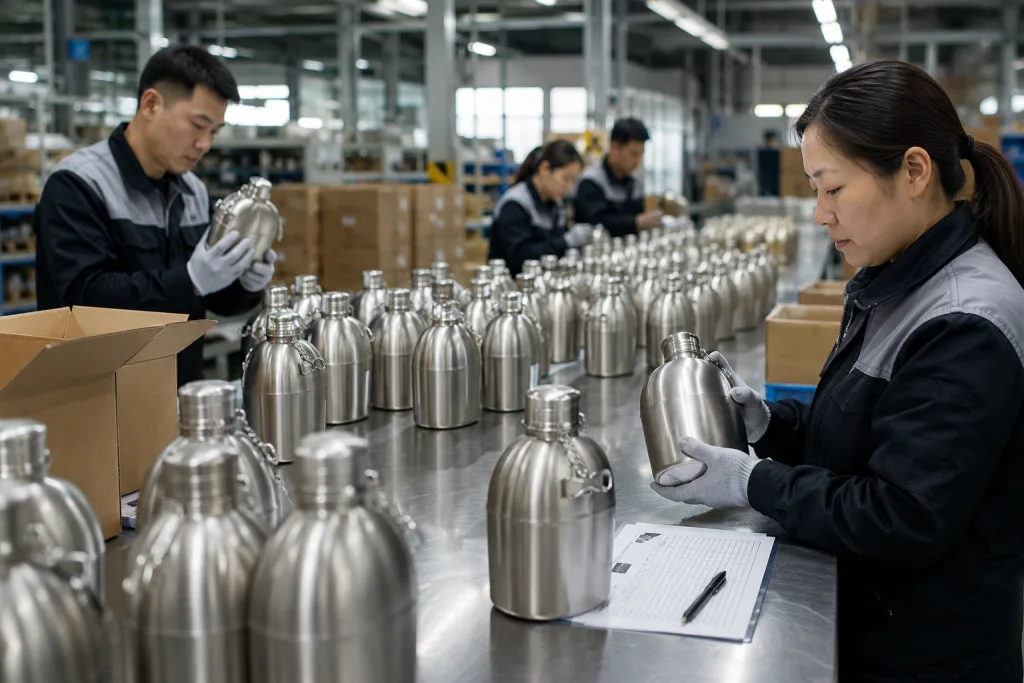
Key Takeaways
- 316L stainless steel is safer for long-cycle use; 0.5-0.6 mm wall thickness is common for export canteens
- A practical MOQ is often 1,000-3,000 pcs per SKU; custom logo samples usually take 7-15 days
- Expect 30-45 days lead time for a stable canteen customized order after sample approval
- Look for REACH, LFGB, FDA-style migration, and AQL 2.5 inspection on finished canteen orders
Buying from a military canteen manufacturer is not about grabbing the lowest-priced bottle with a loop cap. You are choosing a field-use container that has to survive drops, heat, alkaline wash, and a rough carton ride without turning into a claims file. We have seen a 0.8 mm wall pass a quick visual check and still fail after a 1.2 m drop test. That is the wrong question to ask if you sell to ministries, outdoor chains, tactical brands, or emergency-prep channels. The real failure mode is simple: the sample looks fine on paper, then comes back with odor, a leaking lid, weak coating, or decoration that peels after one wash cycle.
The decision path is direct. Start with material and use case, then check the closure, then compliance and QC, then the factory’s real output. On one PO, a buyer flagged a typo on the lid spec and the whole job stalled for 12 days while the line waited for a corrected drawing. In Zhejiang and across China, the gap between a canteen factory that ships exports and one that just assembles parts shows up in the numbers: MOQ, lead time, monthly output, and test files. A serious canteen manufacturer should quote those without digging through notes.
Start With the Use Case
Do not start with a quotation. Start with the job. A military canteen for training, field logistics, or promo supply does not share the same spec as a hiking bottle or a custom growler. If the buyer wants a canteen promotional item, we talk print coverage and landed unit cost first. If the buyer wants issue-style gear, the math shifts to wall thickness, cap retention, and drop behavior. On our line, we ask those questions before we quote, because a blind price on the wrong spec burns time fast.
The first split is stainless steel, aluminum, or Tritan-style plastic. For a customized canteen that needs a premium feel, stainless steel is the clean call. 304 works for a lot of programs; 316L is the better choice when corrosion resistance matters or the product will see aggressive washing. For low-price distributor drinkware, aluminum can work, but the buyer needs to lock down the internal lining and coating test result. For tactical or outdoor retail, a custom canteen in 0.6 mm stainless steel usually gives the right balance of weight and toughness. We have seen a PO call out the wrong alloy code and the whole sample round had to restart.
- Training and field use: prioritize dent resistance, leak performance, and removable cap parts.
- Retail or promotional use: prioritize print area, color finish, and pack-out cost.
- Distribution programs: prioritize repeatability, carton efficiency, and stable supply from canteen distributors.
That first decision removes a lot of bad options. A canteen manufacturer that only talks decoration is selling packaging around a container, not engineering. QC pulled a sample with a loose cap ring once, and the buyer flagged it on the spot; that is the kind of failure this step is meant to catch.
Material Beats Marketing
Most buyer disputes start with material confusion. A custom drinkware spec sheet that only says “stainless steel” is thin paperwork. You need alloy grade, wall thickness, finish, and any coating or lining. For a military canteen manufacturer, the export spec we run most often is 304 or 316L stainless steel with a body thickness around 0.5-0.6 mm. Go thinner and QC pulled the sample and found a soft shell that dents too easily. Go much thicker and the unit cost jumps fast, which breaks the math on a volume order.
Ask for actual material declarations and test support. If the supplier says the canteen customized finish is powder coated, ask for adhesion data, salt-spray hours, and cure consistency from the oven line. If the surface is brushed or polished, ask whether the polishing compound is fully removed before packing. If it is a canteen customizable with interior coating, ask which coating and whether migration testing was done. We’ve seen buyers accept “food grade” on a PO and then find no test report behind it. Good canteen manufacturers in China answer these points in compliance terms, not with vague quality talk.
Practical material rules
- 304 stainless works for broad commercial use and keeps the BOM under control.
- 316L gives better corrosion resistance for humid storage, coastal routes, or aggressive cleaning.
- Aluminum needs tighter control on liner quality and surface wear, or the line will show it fast.
- Plastic fits lightweight promotional SKUs, but it is not the first pick for a true military canteen manufacturer brief.
You are not buying a name. You are buying a material system that has to leave a canteen factory in Zhejiang, clear inspection, and land in Europe or North America without a dent claim or a coating complaint.
Closure Design Decides Returns
The cap is where a lot of custom canteen programs go wrong. A closure looks fine in a photo, then it leaks after five drops or backs off when a buyer tests it with gloves on. For a military-style canteen, the cap has to grip well, resist cross-threading, and swap out fast. We run this on the line every week: one bad cap can turn into 200 returns, and that math does not work for a distributor serving retail, gifting, and field supply at the same time.
We usually see three closure setups. A basic screw cap is the lowest-cost option, and it works if the thread pitch is clean and the mold is stable. A tethered cap keeps the lid attached, which saves loss claims, but it adds assembly steps and one more part to track. A folding or integrated lid gives better handling, especially for a 62 mm mouth, but it pushes up tooling cost and slows lead time. The buyer flagged it on one PO where the cap drawing missed a 0.2 mm thread note; that kind of typo turns into a slow inspection fight. For retail canteens, a neater cap sells better on shelf. For field issue, simple wins. Ask for torque data, leak results, and thread wear counts.
For export drinkware, a good cap is not a feature. It is a warranty control.
Use a hard test sequence before you approve mass production: fill, invert, shake, drop from 1 meter, then run it again after thermal cycling. QC pulled the sample on one lot and found a slow seep only after the second hot-cold round, which is why we do not trust a single bench check. If the closure survives that abuse, you have a base product that can hold up in distributor canteen programs and promotional campaigns.
Compliance Is Not Optional
If you sell into Europe or North America, compliance sits in the buying decision. It is not a side note. We ask the buyer for the target market before we talk artwork, because the paper trail changes with the market and the material. A proper export canteen factory should hand over material declarations, food-contact support, and inspection records without a long chase. For some jobs, that means REACH support, LFGB testing, FDA migration support, ASTM checks for coating or mechanical performance, and an ISO 9001 quality file. We run a 0.5 mm gauge check on the line, and the paperwork needs the same discipline.
For branded and distributor drinkware programs, documents protect the buyer as much as the factory. We have seen a retailer ask for proof on a Friday and the shipment sit because nobody could show what was tested, on which date, and against which PO. If a customs broker asks for classification details, you need clean technical data, not a guess from sales. If your compliance team wants a traceable batch, the canteen manufacturer should have lot coding and incoming material records ready. That is basic export work in China. The math does not work any other way.
- Ask for: REACH, LFGB, FDA-style migration support where relevant, and material declarations.
- Check: traceability, lot numbering, and carton labeling consistency.
- Require: pre-production samples and golden sample approval before mass run.
In Zhejiang, the stronger canteen manufacturers treat paperwork as part of production. QC pulled the sample, measured the lid fit at 0.3 mm, and the batch record matched the carton mark. The weaker ones say they will “arrange later.” We have seen that go sideways more than once, and the buyer ends up paying for the delay.
MOQ, Lead Time, and Output
Numbers beat promises. A capable canteen manufacturer should state the MOQ, sample lead time, mass production lead time, and monthly capacity up front. For a standard custom drinkware or custom canteen program, MOQ usually sits at 1,000 to 3,000 pieces per SKU, depending on logo method, cap type, and color finish. For a laser logo or one-color print, sample lead time is often 7 to 15 days. After approval, production usually takes 30 to 45 days on stable orders, and special coating or packaging will push that out. We ran a 2,000-piece aluminum canteen order last quarter; the buyer flagged a PO typo on the cap color code, and that one line item saved a week of rework.
Ask for capacity in units per month, not “big factory” talk. A solid canteen factory in China should give you a monthly output range and name the bottleneck by line. If they cannot tell you whether polishing, coating, or packing is the constraint, the shop is not tight enough on production control. For a distributor canteen order, this matters because replenishment often lands in 2 or 3 warehouse drops. A 10-day slip can wipe out margin fast. QC pulled the sample on a 304 stainless run and found a 0.3 mm seam gap; that is the kind of issue that shows whether the line is under control.
Ask how they handle split shipments. If the first 5,000 pieces pass, can they hold raw material for the next 20,000? A disciplined canteen supplier will reserve stock for aluminum blanks, cartons, and insert bags against your forecast. That is the part buyers miss. The math does not work if a factory treats every drop as a fresh start. We have seen it go sideways on a 12-day delay when carton stock ran out after the first shipment. A real partner plans the second run before the first truck leaves.
Quality Control You Can Verify
Do not accept “QC checked” as an answer. Ask who checked it, which gauge or fixture they used, and which standard sits on the desk. A proper canteen manufacturer should run incoming material inspection, in-process checks, and final AQL inspection before loading. For finished goods, AQL 2.5 is a normal starting point for major defects, with tighter controls if the customer is retail or public-sector. We have seen a buyer sign off on a PO with the wrong thickness callout, 0.6 mm instead of 0.8 mm, and the whole lot had to be reworked.
The checks should cover dimensions, lid fit, weld or seam integrity, leak resistance, coating adhesion, print durability, and carton drop performance. For a custom growler or customizable growler style product, pressure and seal integrity matter more than the brochure copy admits. For a customized drinkware program with decoration, rub tests and dishwasher exposure may also matter. If the factory offers only visual inspection, that is the wrong question to ask, because you are still blind to the failures that hit after packing. On our line, QC pulled the sample after a 1.5 m drop test cracked a carton corner, not the canteen, and that told us the shipper spec was weak.
One practical point: ask for pre-shipment photos and a lot-coded sample from the finished batch. That lets you compare the approved sample against bulk production. It is a simple habit, but it saves time when a canteen vendor is juggling 6 orders and the buyer flagged a logo position typo on one carton. In China, the factories that ship consistently are the ones that document consistently, right down to the batch card and the carton label.
If you are building a branded line for canteen distributors or a private-label military canteen manufacturer program, insist on a written QC plan. It should name the test, the tolerance, the sample size, and the acceptance threshold. If it does not, you are relying on goodwill, and the math does not work. We ship better when the plan says 32 samples, 2.5% AQL, and a 24-hour hold on any leak claim.
Branding That Survives Use
Decoration has to match the use case. A canteen promotional order usually runs one-color silk screen. It is cheap, reads fast, and the line can print 5,000 units without drama. A premium custom canteen line often needs laser engraving, which holds up better when the bottle rides in a pack, rubs on metal, or gets washed daily. Powder coating can look solid on shelf, but if the coat is too thick or the cure is off by a few minutes, the edges chip first. That is the wrong question to ask if the buyer only talks about appearance.
For canteen customizable SKUs, ask for decoration samples on the actual substrate, not a close substitute. Stainless steel and aluminum do not take ink the same way. We have seen a logo look sharp on a flat plaque and go soft on a curved body at the shoulder. QC pulled the sample at 300 mm because the edge registration wandered. If you sell through a canteen distributor network, placement has to stay consistent from unit to unit, because buyers line them up and spot the drift. On online orders, one bad photo and the complaint shows up fast.
- Laser engraving: durable, clean, no added color layer.
- Silk screen: economical for large runs, good for one- to two-color logos.
- Heat transfer or UV print: better for graphic-heavy commercial drinkware, but check abrasion resistance with a rub test.
A custom drinkware program does not need fancy decoration. It needs a finish that survives the same abuse as the bottle. If the print fails after 20 washes and the container is still fine, the buyer flagged it for the wrong reason, but the math still does not work.
Send your spec, and we will price it fast
Share your target material, logo method, MOQ, and destination market. We will respond with a practical quote, not a brochure.
Frequently asked questions
What MOQ should I expect from a military canteen manufacturer?
For a standard custom canteen, a practical MOQ is usually 1,000-3,000 pcs per SKU. If you want special coating, two-color printing, or custom packaging, expect the MOQ to move upward. A canteen factory in Zhejiang will often hold a lower MOQ for repeat clients because tooling and material risk are already proven. For sample development, 1-3 pcs is normal, but do not confuse sample approval with production readiness. You still need carton allocation, raw material lock-in, and a written lead time before PO release.
Which material is better: 304 or 316L stainless steel?
For many canteen suppliers, 304 is the default because it balances cost and corrosion resistance. 316L is better when the product will face humid storage, heavy cleaning, or stricter end-customer expectations. If your customer is a defense channel, outdoor retail chain, or premium distributor drinkware buyer, 316L can reduce complaint risk. In practice, the right answer depends on the target price. A 316L custom canteen usually costs more, but the increase is often justified when you need a stronger compliance story and longer service life.
How long does a canteen customized order take?
Typical timing is 7-15 days for samples and 30-45 days for mass production after sample approval. If you add tooling, special coating, or complex packaging, lead time can stretch to 50-60 days. A dependable canteen manufacturer should tell you where the time is spent: artwork confirmation, pre-production sample, bulk manufacture, QC, and loading. If they cannot break it down, they probably do not control the schedule tightly. For a canteen distributor planning seasonal replenishment, that level of detail is not optional.
What QC documents should I request?
Ask for material declarations, test reports for food-contact or migration support where applicable, AQL inspection records, and pre-shipment photos. For Europe, REACH and LFGB-related support often matters; for North America, buyers usually want clear food-contact and traceability records. A good canteen supplier will also keep lot numbers and carton labels aligned to the PO. If you are buying a customized drinkware program, ask to retain the golden sample signed off before production. That gives you a clear reference if there is a dispute later.
Can I order mixed models from one canteen factory?
Yes, but only if the factory is organized for it. Many canteen manufacturers in China will accept mixed models if the decoration, lid system, and packing format are similar. The risk is complexity: too many SKUs can slow line changeovers and increase mistakes. For a distributor canteen program, it is smarter to split orders into families rather than random one-off shapes. If you also need a custom growler or customizable growler line, keep that project separate unless the factory can prove the same line can handle both without quality drift.