Key Takeaways
- A military canteen factory quote is only useful after you fix use case, material, closure, and compliance; otherwise the price can vary by 20% or more.
- For most B2B buyers, 304 stainless and food-grade PP or Tritan options cover the bulk of custom canteen programs; wall thickness and lid seal matter more than glossy samples.
- Ask for AQL 2.5 on critical defects, REACH or FDA documentation where relevant, and proof of leak tests before you place a canteen customized order.
- A Zhejiang canteen factory with 300,000 units/month output can usually support 1,000-3,000 MOQ, but decoration method and tooling decide your real lead time.
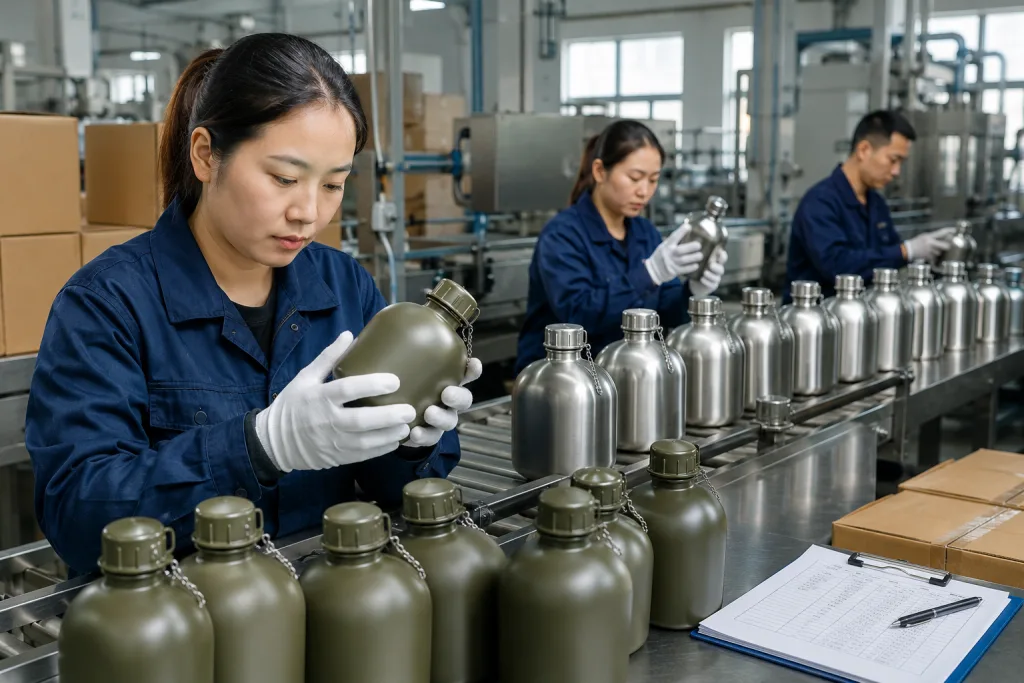
If you are buying from a military canteen factory, do not treat it like a generic drinkware order. A canteen for field use, a promo program, retail, or institutional supply is judged on different things: drop resistance, leak performance, coating durability, packing efficiency, and whether the print still holds up after rough handling. We run this comparison every week in Zhejiang. The line can make a clean sample and still fail after 1.5 m drop tests if the cap torque is off by 2 mm.
You need a decision framework before you ask for price. Start with use case, then material, then closure system, then compliance. Get those four wrong and the unit price means nothing. Get them right and you can compare a canteen manufacturer, a canteen supplier, or a canteen vendor on the numbers that matter: MOQ, lead time, AQL, and landed cost. We ship projects at 300,000 units per month in some factories here, with MOQs from 1,000 to 3,000 pieces and a 25 to 35 day lead time after sample approval. QC pulled the sample last week because the buyer flagged a PO typo on the finish code. That happens.
Start With the Use Case
Before you compare unit prices, lock the use case. A field canteen for military-style carry is a different build from a promotional canteen for an event, and both are different from a retail custom drinkware SKU sold through Amazon or distributor channels. If the buyer team cannot define the job, the factory will quote the cheapest structure that still looks right in photos. We have seen that go sideways fast: the sample clears approval, then the warehouse finds cracked lids or a cap that loosens after transit.
Ask three blunt questions. Is the unit for actual field carry, institutional resale, or branding? Will it see impact, high heat, freezing weather, or repeated dishwashing? Do you need a custom canteen with long service life, or a lighter customizable canteen for a short campaign? The answer changes material, body shape, cap design, and decoration. A distributor program usually cares about packaging and margin. A procurement order for defense-adjacent supply cares about traceability, test reports, and steady output from a canteen factory in China or Zhejiang. We had one buyer flag a PO typo on the carton spec, and the line caught it only because the printed outer box no longer matched the packing list.
One practical rule: if the canteen has to survive drops and still seal, spend your time on structure, not just surface finish. A 2 mm wall in stainless behaves differently from a thin plastic body, and the math does not work the same. A stronger neck finish and gasket spec often matter more than another paint pass. That is the kind of call a serious canteen manufacturers quote should help you make, not hide. QC pulled the sample after a 1.5 m drop test and found the cap stayed shut, but the body scuffed hard, so we changed the finish before mass production.
Choose the Right Material
Material drives cost and field performance. For military-style canteens, 304 stainless steel is the default when you need odor resistance, dent resistance, and stable repeat orders. On the line, we see buyers accept 304 fast once QC pulls a sample after 3 drop tests; it survives the second question better than the first price sheet. If weight is the main target, aluminum can work, but the coating adhesion and internal lining need a hard check. For lighter promo or retail programs, PP, Tritan, or other food-contact polymers fit better, especially when you are building a customizable drinkware line with 6 or 8 color options and lower freight cost.
Do not let a canteen supplier steer you into one material because it is what they already stock. Ask for the actual grade, thickness, and process route. A buyer once sent a PO with “stainless” and nothing else; the shipment matched the wording and failed the use case. For stainless, 0.5 mm to 0.8 mm is common depending on target weight and price point. A thicker body improves dent resistance, but it also changes cost, forming yield, and shipping weight. For plastic, ask whether the resin is Tritan, PETG, PP, or a lower-cost blend. A canteen custom project should state food-contact compliance and the test basis, not just the marketing name.
- 304 stainless: the best fit for a customized canteen that needs durability and repeat orders.
- Aluminum: lighter, but coating and lining checks matter more on every lot.
- PP or Tritan: useful for custom drinkware programs that need color range and lower MOQs.
In China, the cheapest quote usually hides the exact material and wall thickness. Put both into the spec sheet. We run into this all the time. If the factory pushes back, that is useful data. A canteen manufacturer that cannot state thickness in millimeters is not quoting a project, it is guessing at one.
Lock Down Closure and Leak Control
Most buyers check the body and skip the lid. That is a mistake. A canteen built for field use lives or dies on the closure: screw cap, tethered cap, flip top, or an integrated cup lid. Each one changes seal reliability, wash-down effort, and spare-part risk. We have seen a buyer approve a nice-looking shell, then flag the caps after the first 300-unit pilot because the thread pitch was loose by 0.3 mm. If the order moves through a canteen distributor or a distributor drinkware program, the lid also drives return rates and after-sales noise, and that hits margin faster than a small factory price increase.
Leak testing should be defined, not left at “no leakage.” Ask for the exact method. A working factory standard is an inverted leak test at room temperature for 2 minutes, then a hot-fill test if the canteen will hold hot liquid. For a military canteen factory order, I would also ask for drop testing after closure cycling; QC pulled the sample after 500 open-close cycles and that is where weak threads show up. A lid that seals on day one and fails after 500 cycles is not a serious B2B spec.
Pay attention to the gasket material. Silicone is common because it stays stable and is easy to source, but hardness and compression set still decide whether the seal holds. If the canteen custom design uses a narrow mouth, ask how the gasket seats and whether the assembly line uses torque control on the cap driver. Small details like a 28 mm mouth finish or a missed PO note on gasket color separate a solid canteen supplier from a weak one. For high-volume custom growler or customizable growler projects, the same rule holds: closure performance is the product.
Practical buying rule: if the factory cannot state the leak test method, cycle count, and gasket material in one sentence, do not approve production.
Price Depends on Decoration
Decoration is where a lot of buyers burn money. They compare a clean sample on a desk and miss the real production cost. A canteen promo order with one-color silkscreen is a different job from a custom drinkware run using laser engraving, UV print, or full-wrap heat transfer. Each process has its own setup charge, wear profile, and reject rate. Cheap per piece means nothing if QC pulls the sample and the logo flakes after freight, handling, and pallet stacking.
For stainless steel, laser engraving is the toughest option for logos and text, and it holds up on a premium custom canteen without paint loss. Silkscreen costs less for one or two colors, but abrasion testing matters. Powder coating and painted finishes look clean, yet chip risk goes up fast when the line is rough or the buyer wants tight carton packing. On plastic, pad print and UV print are standard, but adhesion is not a guess. A canteen vendor quote should state whether the decoration lands on raw metal, coated metal, or a primed surface. We had a buyer flag a PO typo once because the surface spec was missing; that order went back for rework.
Factory math is plain. Setup can add USD 80 to USD 300 per color or process, and unit price can move 8% to 25% depending on decoration complexity. If you are comparing canteen suppliers, ask for the same print method, the same carton count, and the same insert. Otherwise the quote sheet is noise. On one 5,000-piece run, a 2 mm print shift changed the scrap rate enough to wipe out the low price. If you also source custom drinkware or a custom growler line, keep the decoration spec locked across SKUs. That is the clean way to run replenishment from China or Zhejiang.
Compliance Is Not Optional
Compliance is dull until customs stops the cartons or a retail buyer rejects the file. A serious canteen factory should hand over test reports for food-contact materials and the finish system used on your SKU. In Europe, ask for REACH, LFGB where it applies, and traceability back to the resin lot. For North America, FDA food-contact declarations are the starting point, not the finish line. If the item is sold as customized drinkware, packaging and label copy need the same review.
Do not take a generic certificate and call it done. The report has to match the exact canteen, coating, or ink set you are buying. We have seen buyers accept a nice-looking PDF, then discover the product code on the report was 3042 instead of 3043. That is the wrong question to ask. Ask whether the factory runs under ISO 9001, whether BSCI is current, and whether incoming inspection and final AQL checks are written down. AQL 2.5 is common for major defects, and we can tighten it when the program is sensitive.
If the route to market includes Amazon or retail distribution, packaging compliance matters too. Barcode position, master carton labels, and carton drop tests can decide whether the order sails through or comes back as a chargeback. On one run, QC pulled the sample because the outer carton label was 3 mm off the spec line. A distributor canteen order that ignores those points gets expensive after freight and repacking. The better factories in Zhejiang and the rest of China know this, and they send the paperwork before you ask twice.
What to Ask in the RFQ
Most RFQs are too thin to get a quote you can compare. If you send “please quote canteen” to a supplier, the number back means little. We see this on the line all the time. A proper RFQ should state the use case, material, capacity in ml or oz, wall thickness, lid type, decoration method, packaging, carton quantity, test standard, destination port, and whether you need FOB, EXW, or DDP pricing. Leave that out, and the factory is forced to guess your target cost.
Send the request line by line. Example: 750 ml 304 stainless, 0.6 mm wall, screw cap with silicone gasket, one-color laser engraving, individual polybag, 50 pcs per carton, AQL 2.5, FOB Ningbo. That is enough for a canteen supplier to quote something real. If you need canteen customizable color options, ask for Pantone matching and the minimum order by color. If you need a custom canteen with private mold changes, ask whether the tooling fee is refundable after a certain quantity, and whether sample lead time is 7 days or 14 days. QC pulled a sample once and found the lid torque was off by 1.5 N·m because the PO left out the gasket spec.
For buyers building a broader custom drinkware program, keep the RFQ format the same across SKUs. Then you can compare a canteen distributor, a canteen manufacturer, and a canteen factory on the same terms. That is the right question to ask. We have seen buyers pick the nicest sample, then discover the carton count and freight math do not work.
- Capacity: 500 ml, 750 ml, 1 L, or your exact market size.
- Commercial terms: FOB, EXW, or DDP.
- Packaging: bulk pack, gift box, or retail-ready carton.
How to Judge the Factory
Factory selection is not about who replies first. It is about who still holds the spec after the PO lands. A real military canteen factory should show process control, not a polished sales deck. Look for in-house forming, assembly, decoration, and packing where the line actually covers those steps. The more work the factory owns, the fewer surprises show up in defect rate and lead time. In Zhejiang, we see plants running both stainless and plastic lines under one roof, which matters if you want a canteen custom program now and a customized growler extension next quarter.
Ask for production capacity, sample policy, and whether the factory can support repeat orders without resetting color or print. One plant may quote 300,000 units per month across its drinkware lines, but that number means little until you know how much is tied up by your product type. Ask how they track raw material lots, where they store components, and whether final inspection records stay by batch. QC pulled the sample, found a mismatched cap on a 2,000-piece run, and the buyer flagged it before shipment. If the answer stays vague, the facility often looks bigger on paper than it is.
I also watch how the sales team handles exceptions. A good canteen manufacturer will tell you when a custom logo will not print cleanly, when a 0.8 mm wall will hurt dent resistance, or when a color target is off on recycled resin. That honesty saves money. A weak canteen supplier says yes to everything and leaves you to eat the failure later. We have seen this go sideways on a PO typo alone: one missing slash in the print code, one wrong carton mark, and the whole batch turns into rework. This is the wrong question to ask if you only want the lowest quote. In B2B drinkware, that gap usually decides whether you get one reorder or none.
Plan Margin From the Start
Buyers approve a canteen promo sample and only later find the landed cost kills the margin. Start from the channel. Distributor drinkware and distributor growler programs need room for freight, warehousing, breakage, and 6% to 12% sales commission. Retail runs need cash for returns and markdowns. Institutional supply can run on a tighter margin, but the delivery window has to hold. That is the real question, not whether the sample looks good on a desk.
We model every order by line item: product cost, decoration, packaging, freight, duty, and compliance. On a 2,000-piece custom canteen order, a 12% move in freight or packing can wipe out the savings from a cheaper canteen vendor. QC pulled a sample last month and found a 3 mm cap mismatch, which added rework and pushed the carton count off plan. Ask the factory for two quotes, one with premium packaging and one without, so you can see the margin gap in black and white. If the PO has a typo on artwork or carton size, the math gets worse fast.
For buyers moving beyond canteens into custom drinkware, custom growler, or customized growler programs, keep the same commercial rule. The SKU changes; the cash math does not. We run the same check on every batch at the Hangzhou line before we release production. In China or Zhejiang, you need landed cost in hand before you place the order, not after the freight invoice lands.
Send your spec, not a vague idea
We can quote a real military canteen factory program with material, lid, print, MOQ, and lead time locked before sampling starts.
Frequently asked questions
What MOQ should I expect from a military canteen factory?
For a standard custom canteen, MOQs are commonly 1,000 to 3,000 pieces per SKU and per color. If you need private tooling, mixed colors, or a special lid, expect the floor to rise. A Zhejiang canteen factory with 300,000 units per month may still set a higher MOQ for laser engraving because setup is cheap but line changeovers are not. For multi-SKU programs, some canteen manufacturers will combine variants to reach one total, but only if body, lid, and decoration stay the same.
What is a realistic lead time for canteen customized orders?
Typical lead time is 25 to 35 days after sample approval for a standard stainless or plastic canteen. Add 7 to 15 days if you need new tooling, special coating, or a new box structure. If the order is large, or if you need third-party inspection and carton labeling for a distributor canteen program, build in another week. A canteen supplier in China should confirm both sample lead time and mass production lead time separately, because those are not the same clock.
Which material is best for a custom drinkware canteen?
For durability, 304 stainless is usually the best default. It handles dents better than thin plastic and holds up better in repeated use. If weight or color variety matters more, Tritan or PP may fit better for customizable drinkware programs. Aluminum can work, but coating and lining control must be tighter. For a military canteen factory order, I would not choose based on price alone; I would choose based on wall thickness, closure design, and the expected abuse in use.
How do I check quality before production?
Ask for a pre-production sample, a written spec sheet, and the exact leak test method. Then request production controls such as incoming inspection, in-process checks, and final AQL 2.5 if the order is standard consumer grade. For a more sensitive program, tighten the acceptance criteria. You should also ask for material certificates, REACH or FDA-related documentation where applicable, and packaging confirmation. A serious canteen factory or canteen manufacturer will be able to show batch traceability and photos from the line.
Can I order a canteen promotional product and a premium retail version from the same factory?
Yes, if the factory has both decoration and assembly control. A canteen promotional model may use simpler silkscreen and bulk packaging, while a retail version may use laser engraving, premium cartons, and stricter carton drop requirements. The key is to keep the base body compatible so tooling does not multiply. Many canteen suppliers in Zhejiang and China handle both levels. Just make sure the factory can separate the specs, because mixing promotional and retail assumptions is where margin leaks start.