Key Takeaways
- A real military canteen factory direct quote should include MOQ, FOB price, lead time, and AQL terms in the first response.
- Most custom canteen orders land at MOQ 3,000 to 5,000 units with 25 to 35 days after sample approval.
- For aluminum canteens, 0.6 mm to 0.8 mm wall thickness is common; for stainless, expect 0.5 mm to 0.7 mm gauge.
- A disciplined RFQ-to-bulk process cuts artwork mistakes, leak claims, and rework that often add 5% to 12% to landed cost.
If you are buying a military canteen factory direct, finding a supplier is easy. Sorting a real canteen factory from a trading layer is where buyers get burned. We see this on the line: a low FOB quote comes in, then the coating is off-spec, the leak test fails at 0.03 MPa, or the pack-out does not match the PO because one carton note was typed wrong. That is where margin disappears. One wrong wall thickness, one weak lid gasket, or one unclear artwork proof can push your schedule back 20 to 30 days. We have seen QC pull a sample at pre-production and find the bottle body 0.2 mm under spec; that small miss turned into an 18-day rework cycle.
In Zhejiang and across China, a solid canteen manufacturer will ask the use case first: field issue, promotional set, retail bundle, or distributor drinkware program. That order is correct. This is the wrong question to skip. Your canteen custom decisions should be fixed at RFQ stage, then checked in a sample, then written into the bulk PO with clean line items, gasket material, drop test standard, and carton mark. We run factories at this level every day, and a serious canteen factory should quote MOQ, lead time, coating system, and AQL terms without hand-waving. If the buyer flags a 5,000 pcs MOQ and the factory cannot explain why the spray line needs that volume, the math does not work.
Start With the Use Case
Do not open with color or logo. Start with the use case. A military canteen factory direct buyer needs to tell the canteen factory whether the product is for field training, outdoor retail, promotional resale, or a distributor canteen program. Those uses drive material, lid style, finish, and the test method we run on the line. A canteen promotional order for an event kit is not the same product as a customized canteen built for rough handling and repeat washing.
Write the RFQ like a spec sheet. Include target volume, requested Incoterm, destination port, packaging format, artwork count, and whether you need a custom drinkware set or a single item. If you are comparing canteen suppliers in China, the quote that answers fast is not always the best one. The better quote states the material, thickness, capacity, closure type, and sample charge in plain terms. We get pushback on this all the time: a buyer wants a price before capacity or wall thickness, and the math does not work. In Zhejiang, a competent canteen manufacturer will usually ask for intended temperature range, coating color code, and whether the bottle must pass REACH or FDA-style food contact expectations for your market.
At this stage, the PO does not exist yet. Still, the buyer should draft the future line items now: product name, SKU, capacity, finish, logo method, packaging, and inspection standard. QC pulled the sample and found a PO typo on the carton mark more than once; fixing it early saved a 12-day delay. That discipline keeps a custom canteen program from turning into a chain of email clarifications.
Write the RFQ Like a Buyer
A good RFQ is short, specific, and ugly in the right way. It should read like a purchasing document, not a marketing brief. We see this on the line all the time: vague RFQs turn into 6 back-and-forth emails before QC can even pull a sample. A canteen vendor can work with loose language for a prototype, but not for a production run. Ask for unit price at 3,000, 5,000, and 10,000 pieces. Ask for sample cost, mold cost if any, tooling lead time, bulk lead time, and carton spec. If you want a customizable canteen, say exactly which parts change: body shape, cap color, strap length, engraving area, or packaging insert.
For military canteen factory direct sourcing, the RFQ should also include compliance and test expectations. Common checks include leak testing, drop testing, dishwasher resistance, and coating adhesion. If the item is stainless steel, ask the canteen manufacturer to state whether the material is 18/8 or 304 and whether the surface treatment is brushed, powder coated, or painted. For aluminum, ask for thickness in mm and whether the interior coating is BPA-free and suitable for repeated contact with water. A weak RFQ leads to a weak comparison. Two canteen manufacturers may both say FOB Ningbo, but one may be quoting a 0.5 mm shell and the other 0.8 mm. We had a buyer flag that exact gap last month, and the math did not work. That difference matters more than a 3% price gap.
Use a simple PO-style structure in the RFQ itself: Item, Qty, Spec, Logo, Packing, Lead time, Target price. That format is easy for a canteen supplier to answer and easy for your finance team to review later. We run it that way because the line needs clean inputs, not guesswork, and one typo on a PO can delay a shipment by 12 days while the carton spec gets rechecked.
Check Factory Reality Fast
Before sample approval, check whether the seller is a canteen factory or a controlled factory-account setup. A real line can show press photos, QA checkpoints, and a monthly output number. In Zhejiang and other export-heavy parts of China, a factory that actually runs production will quote capacity in units per month, not say they can “do big volume.” If they cannot state a number, they are not close to the metal.
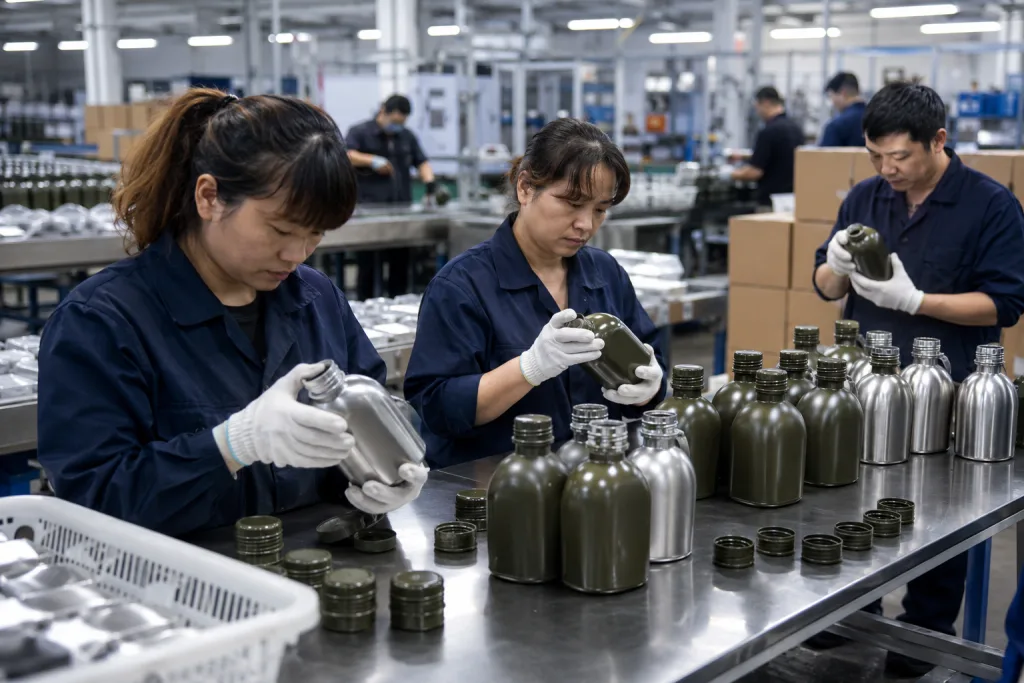
You want concrete proof: press or forming equipment, coating line, printing or laser area, assembly station, and final inspection area. On our line, QC pulled the sample at the packing table and checked it against the work order, which is the kind of detail buyers should ask for. A solid canteen supplier will also tell you how they handle incoming material inspection, in-process checks, and final AQL sampling. For bulk drinkware, AQL 2.5 major and 4.0 minor is common, though some buyers specify tighter limits. That is the right question to ask. If you are buying distributor drinkware or distributor growler programs at scale, the factory should also explain how cartons are coded, how lot numbers are tracked, and how they prevent mixed artwork.
Ask for three numbers up front: MOQ, monthly capacity, and standard lead time. A practical factory metric might be MOQ 3,000 pieces, 80,000 units/month, and 25 to 35 days for repeat production after sample sign-off. We have seen the math go sideways when a buyer accepts “fast” without a number, then the PO lands with a 12-day promise that cannot survive coating and packing. Give me the figures, not the pitch. Anything much vaguer belongs in a follow-up, not in a PO.
Approve the Sample the Right Way
Sampling is where custom drinkware projects stay on track or start burning calendar days. Treat the sample as a technical sign-off, not a keepsake. We run two steps: an initial pre-production sample, then a gold sample after corrections. For a custom growler, customizable growler, or customized growler program tied to the canteen order, keep the acceptance rule separate. Growlers carry heavier closures and different finish tolerances than flat-sided field canteens, and the line will not behave the same.
When the sample lands, check dimensions, surface finish, logo sharpness, lid fit, gasket seating, and odor. We use a caliper on the neck and wall, then fill it with room-temperature water, shake it, and leave it inverted for 24 hours. QC pulled the sample on a 1-meter drop test for both carton and unpacked unit; that is where claims usually start, not with the bottle body. The buyer flagged it in writing, with photos, not a verbal yes.
Your sample approval note should list the exact final version: canteen customized artwork file name, Pantone or RAL references if used, packaging dieline, and any tolerance exceptions. A typo on the PO can turn into a bad week, so we match the approval sheet line by line before release. If a canteen distributor skips this step, the math does not work later when repacks and chargebacks hit. For a canteen promotional run, even a 2 mm logo shift can get a lot rejected when the retailer compares the first carton to the approved sample.
Lock Bulk PO Line Items
Once the sample is signed off, the bulk PO has to be plain and complete. That is the job. If you leave out a finish code, carton spec, or print reference, the line will fill in the blanks for you, and that is where disputes start. A military canteen factory direct PO should spell out item description, artwork reference, material, finish, capacity, unit price, total quantity, shipping mark, incoterm, deposit terms, and inspection requirement. If there are three SKUs, split them into three lines. We have seen one PO say “same as sample” and the buyer flagged it later because the strap color was never locked.
A working PO for custom drinkware usually carries these terms: 30% deposit, balance against copy of bill of lading, sample-approved spec sheet attached, packing 50 units per carton, master carton with desiccant if needed, and carton drop test standard. For China shipments, FOB is clean when you already have a freight forwarder on your side. If the factory is moving goods to the port, state that too. A canteen supplier in Zhejiang should quote EXW and FOB without drama, and if they cannot, the math does not work. QC pulled the sample on one batch and found the PO still listed 48 units per carton, while the approved packout was 50.
Check the cost stack before release. Simple aluminum custom canteen programs often sit around USD 1.20 to 2.80 per unit, while stainless variants run about USD 2.50 to 5.50 depending on finish, printing, and packaging. Add a strap, insert card, or color box, and plan another USD 0.20 to 0.80. These numbers move with volume, but they keep fantasy pricing off the table. On the line, a 0.3 mm wall spec or a 304 stainless callout can change the quote fast, so do not hand-wave it.
Use this line-item logic before release:
- Product and SKU
- Exact quantity
- Unit FOB price
- Sample approval reference
- Packing spec
- Inspection standard
- Delivery window
Inspect Before You Ship
Bulk inspection is where a canteen maker proves it can ship, not just quote. For export drinkware, the buyer has to decide on factory pre-shipment inspection or a third-party check. Make that call before the line clears. Do not wait for the cartons to hit the dock. A canteen manufacturer that ships 8,000 units a month should already know AQL terms, photo reports, and lot traceability; if they do not, that is a warning.
Focus on the failures that hit margin. On canteen customizable jobs, we see leakage, logo shift, dented bodies, coating drift, and carton count mistakes. The math does not work any other way. If you buy through a canteen distributor channel or build your own distributor drinkware catalog, ask for carton photos, outer label checks, and random unit measurements from the top, middle, and bottom of the lot. We once had a PO typo on a 500 ml model turn into mixed packing, and QC pulled the sample only after the buyer flagged it. For a long run, keep retained samples for 12 months.
Some buyers push for easy replacements after shipment. That sounds flexible. It is the wrong question to ask. Real control starts with tighter acceptance at origin. A disciplined canteen suppliers relationship in China should only allow 2% to 3% holdback for field issues when there is a documented defect trend and the gauge data backs it up. Otherwise you are importing uncertainty. That hits hardest in a military canteen factory direct program, where receiving windows are tight and there is no spare day for relabeling at destination.
Hold the factory to the sample and the sample to the PO. If either one is vague, the shipment will be vague too.
Plan Repeat Orders Early
The cleanest way to make military canteen factory direct sourcing pay is to plan the second PO before the first carton leaves the line. A solid canteen factory will tell you what changes on a reorder: 304 stainless supply, print setup, carton material, and whether the mold stays assigned. For a customized drinkware line sold through a distributor, the second and third run are where margins settle and lead times stop bouncing around.
Before the first run ships, ask the canteen supplier what they need to lock a repeat order. We see buyers hold a 60 to 90 day forecast. That keeps the factory from rushing and keeps you off air freight. If demand is seasonal, especially for canteen promotional programs, ask whether the factory can reserve coating or silk screen slots. On one 5,000-piece job, the buyer flagged a 2 mm logo shift on the proof; QC pulled the sample, and the reorder spec was fixed the same day.
Repeat business also lets you lock packaging and paperwork. After lot one, you should have fixed artwork, fixed carton marks, and one QC sheet with the same AQL 2.5 callouts. That makes the next canteen custom order easier to release and easier for finance to compare against the last shipment. The best canteen vendors are not just shipping one run. They cut the noise on run two and run three.
Send the RFQ and get factory-direct pricing
We can quote canteen custom, customized drinkware, and repeat distributor drinkware programs with clear MOQ, lead time, and QC terms.
Frequently asked questions
What MOQ should I expect from a military canteen factory direct order?
For most custom canteen programs, MOQ usually starts around 3,000 to 5,000 units per SKU. Some canteen manufacturers in Zhejiang will go lower for a simple repeat body with stock lid parts, but printed or customized canteen jobs often need setup coverage. If you add special packaging or a unique closure, expect MOQ to move up. Ask the factory to quote MOQ separately for body, logo, and carton so you know which part is driving the number.
How long does sample-to-bulk usually take?
A realistic timeline is 7 to 12 days for sample preparation, then 25 to 35 days for bulk after sample approval. If the order needs new tooling, extra coating passes, or custom packaging, the lead time can reach 40 to 50 days. A canteen factory with stable output should be able to state monthly capacity and whether your order sits in standard production or special handling. For repeat orders, the cycle is often 5 to 10 days faster.
What material is better for a field canteen: aluminum or stainless steel?
Aluminum is lighter and often cheaper, so it works well for promotional and basic field-use programs. Stainless steel gives you better durability and a more premium feel, but unit cost is higher. For aluminum, ask for 0.6 mm to 0.8 mm wall thickness and food-contact coating details. For stainless, 0.5 mm to 0.7 mm gauge is common. The right choice depends on weight target, price ceiling, and whether you want a canteen customizable finish or a more rugged industrial look.
What should be in the PO for custom drinkware from China?
Your PO should include item name, quantity, unit FOB price, material, capacity, logo method, packaging spec, sample approval reference, inspection standard, and delivery date. If the supplier is in China, also specify port, incoterm, payment terms, and carton marks. For canteen distributor programs, break out each SKU separately. Clear PO line items reduce disputes later, especially when the order includes canteen promotional packaging or mixed colorways.
How do I check if a canteen supplier is real and not just trading?
Ask for factory photos, production capacity in units/month, QA flow, and past export markets. A real canteen manufacturer should answer with process details, not just marketing language. Look for evidence of forming, coating, printing, assembly, and inspection on-site. Ask whether they can work to AQL 2.5 or your own standard, and request a sample report with lot traceability. In Zhejiang and other export centers in China, the strongest factories are usually precise on these points and quick to name their MOQ, lead time, and test method.