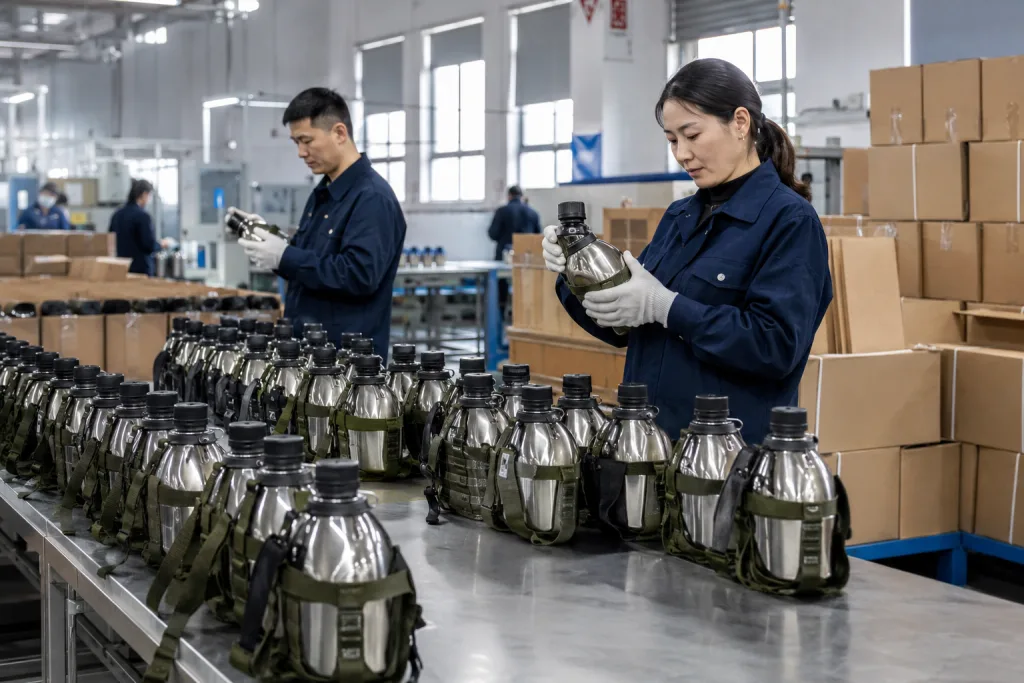
Key Takeaways
- Lock the first 4 decisions early: body material, capacity, cap system, and decoration; changing any of them after sample approval can add 7-18 days
- For B2B orders, a realistic starting MOQ for a custom canteen is 3,000 units, with FOB unit cost often around USD 2.10-4.80 depending on material and print method
- AQL 2.5 for major defects and 4.0 for minor defects is a practical inspection baseline for military-style customized drinkware programs
- If you need EU and North America coverage, confirm REACH, LFGB or FDA-contact scope, and coating adhesion testing before paying the 30% deposit
You do not lose margin on a canteen because the silhouette looks off. You lose it when one early call stays fuzzy: material grade, cap thread standard, decoration method, or compliance scope. A military canteen customizable project sounds clean on paper. Then the buyer asks for logo placement, accessory packs, retail packaging, and destination-market testing, and the quote jumps 20% while lead time stretches 15 to 25 days.
If you are buying from a canteen manufacturer in China or building a line with canteen distributors in Europe or North America, you need a working decision sheet, not a catalog walk-through. Zhejiang factories can move fast when the spec is tight; when it is not, the line waits. At BottleForge Industrial in Zhejiang, China, typical MOQ starts at 3,000 units, and mass production lead time is usually 30 to 45 days after sample approval.
Start with the four fixed decisions
Most sourcing errors start the same way: buyers talk decoration before they lock the four decisions that set cost and line setup. For a military canteen customizable program, those four are body material, capacity, closure system, and branding method. Freeze those first. Everything downstream gets easier.
Body material drives weight, drop performance, compliance, and unit price. A single-wall 18/8 stainless custom canteen feels more solid and holds up well on rough use, but it costs more than aluminum or BPA-free Tritan. Aluminum cuts weight and price, yet it dents faster and usually needs an internal coating you should confirm for food contact. On one 304 stainless run, QC pulled the sample after a coating spec typo on the PO, and the buyer flagged it before we shipped 20,000 units. Tritan or PP often wins on canteen promotional orders above 10,000 units, but some European buyers still push back on anything that does not look like steel.
Capacity is not a marketing label. A 500 ml body and a 750 ml body can need different draw ratios, wall thickness, carton fit, and cap torque settings. We run those checks on the line because the math does not work any other way. Common military-style sizes are 500 ml, 750 ml, and 1,000 ml. For distributor drinkware programs, 750 ml is usually the practical call: enough water for outdoor use, not so large that the pack-out gets clumsy.
Closure system is where first-time buyers get sloppy. Thread pitch, gasket material, leak standard, tether strap design, and mouth diameter all drive complaints later. If your canteen customized order includes nesting cups, carabiners, or fabric covers, the cap geometry changes accessory fit too. Specify the leak test in plain numbers, such as no leakage after 30 minutes inverted and no leakage after a 1.0 meter drop test when filled to 90% capacity. We have seen this go sideways when a buyer accepted a vague “tight seal” note and then asked why the cap failed in transit.
Branding method is the fourth fixed decision because a canteen customizable surface looks simple until the shoulder radius and coating texture start shrinking your artwork. Silkscreen works well for 1-2 spot colors. Laser engraving gives a cleaner premium look on powder-coated steel. Heat transfer wraps can handle complex graphics, but the reject rate rises fast when the body curve is aggressive. Pick these four points first, then ask your canteen supplier for a quote that matches real production, not brochure logic.
Choose material by use case
If you are buying for field use, tactical retail, reserve programs, museums, outdoor brands, or canteen distributors handling institutional orders, material choice has to track real abuse, not shelf appeal. We have seen a PO call for “military style” and then the buyer flagged the first drop test at 1.2 m, so the spec had to move fast.
Single-wall stainless steel
18/8 stainless steel is the most balanced option for a customizable canteen when you want durability and a clean brand story. Standard body thickness usually sits at 0.4 mm to 0.5 mm in production. At 0.4 mm, you hold cost and weight down; at 0.5 mm, dent resistance improves, but FOB pricing can rise by USD 0.12 to 0.25 per unit depending on size. We run a lot of these on the line, and a 304 sample with a brushed finish usually clears the premium retail brief better than aluminum. For North American buyers, that matters.
Aluminum
Aluminum stays common for canteen custom programs when low weight is the main target. A typical gauge equivalent gives you a lighter unit, and the unit cost can work at scale. The trade-off is denting and the internal coating. Ask the canteen factory which lacquer system they use and whether they can show migration paperwork for your market. “Food safe” is the wrong question to ask. QC pulled a sample with a pinhole at the rim once, and that kind of defect turns into a claim after shipping, not before.
Tritan, PP, or other plastics
Plastic works when the order is price-sensitive, the colors need to stay bright, and drop resistance matters more than scratch resistance. A customized canteen in Tritan can fit youth programs, events, and promotional runs with a MOQ of 1,000 or 3,000 pieces. But if your end customer wants a military look, plastic reads lighter and less authentic. We’ve seen that go sideways on museum gift shop orders, where the buyer wanted “field issue” styling and the artwork looked fine, but the material did not.
- Best for retail premium: single-wall 18/8 stainless
- Best for low-weight bulk supply: aluminum
- Best for budget and event volume: Tritan or PP
In Zhejiang, China, the stronger canteen manufacturers tell you where each material fails, not just where it sells. A good sign is a factory that can point to a 0.5 mm dent test, a coating report, or a typo on a PO they caught before shipment. That beats a low first quote every time.
Decoration affects margin more than buyers expect
Most buyers treat decoration as the last art step. That is the wrong read. On a military canteen program, the print method decides scrap, lead time, and whether the vendor looks sloppy when the real problem is artwork-process mismatch.
For a custom canteen, the usual choices are silkscreen, laser engraving, heat transfer, water transfer, and embossed or debossed branding on sleeves or pouches. We run 750 ml steel bodies a lot, and a 1-color silkscreen print usually adds about USD 0.08 to 0.18 per unit at volume. Two colors add another USD 0.05 to 0.10, and registration gets touchy fast when the logo has fine text.
Laser engraving usually lands around USD 0.15 to 0.35 per unit. It cuts the risk of rub-off and holds up better on powder-coated surfaces. A tactical retailer once flagged a bright printed logo as “too retail”; they wanted a mark that looked built for field use, and the line was right to push back. Heat transfer works for camouflage, map-style, or commemorative artwork, but steep body taper can raise reject rates during production.
You are not buying a logo service. You are buying a repeatable production method that survives handling, carton friction, and border inspections.
Ask your canteen manufacturer for coating adhesion and print durability test methods. Cross-hatch adhesion is the basic check, and we also run dry and wet rub tests; if the spec matters, add dishwasher simulation. QC pulled one sample last month with ink lift at the edge after 50 rub cycles, which is the kind of miss that turns into a claim later. If the program is canteen customized for Amazon FBA or club retail, confirm barcode placement, FNSKU responsibility, and master carton labeling before artwork approval.
For distributor growler or customizable growler lines sold alongside canteens, standardizing decoration methods across SKUs cuts approval work. The same logic holds if you run customized drinkware collections with tumblers, bottles, and a military-style canteen. The math does not work if you chase the lowest print price on one SKU and pay for three extra approvals on the next.
Compliance and quality checkpoints first, not later
A buyer new to China sourcing often asks for a sample, checks the logo, then worries about testing. That order causes trouble. For a military canteen customizable order shipping to Europe or North America, lock compliance and quality checkpoints before you pay the deposit.
Start with material declarations and destination scope. If the shipment goes to the EU, ask for REACH-related substance declarations and, where the market expects it, LFGB suitability. For North America, confirm FDA food-contact relevance for the exact product build. If the canteen customized set includes straps, pouches, cups, or coatings, the scope widens beyond the bottle body. We had one buyer flag a PO typo that listed only the canteen shell; QC pulled the sample and found the PU pouch was outside the declared material list. That question saves money.
Then define inspection criteria. AQL is not glamorous, but it stops arguments on the line. A workable standard is AQL 2.5 major / 4.0 minor for drinkware. Major defects usually include leakage, wrong capacity outside tolerance, sharp edges, severe coating defects, missing accessories, or logo errors. Minor defects may include small dust points, slight print position deviation within agreed tolerance, or light surface marks not visible at 50 cm.
Also specify the tests that matter to this product type:
- Leak test: inverted 30 minutes, no leakage
- Drop test: 1.0 meter, filled to 90%, no functional failure
- Salt spray test for metal accessories if exposed finish matters
- Cap torque range, for example 12-16 kgf.cm depending on cap design
- Coating adhesion and logo abrasion checks
If you source from a canteen supplier in Zhejiang or elsewhere in China, ask whether the factory runs under ISO-managed procedures and whether social compliance such as BSCI fits your customer base. Procurement managers in Europe ask for this on simple custom drinkware too. A canteen factory producing 600,000 units per month should show process control records, not just certificates in a PDF folder. We ship that kind of volume only when the incoming check, in-process check, and final check line up. The math does not work any other way.
MOQ, tooling, and realistic FOB math
Buyers often ask for a target price before they decide what they are buying. That is the wrong order. A canteen customizable quote moves with the spec sheet: material, coating, lid structure, accessory set, print method, and packaging. On the line, a 2 mm wall change or a switch from silk screen to laser can change the number before lunch.
For a standard 500 ml to 750 ml military-style canteen with a simple cap and 1-color logo, a typical MOQ from a canteen manufacturer in China is 3,000 units per color. If you need a custom mold body or a new cap design, MOQ usually moves to 5,000-10,000 units, and tooling comes on top. We have seen buyers push back on a USD 2,000 mold fee, then ask for a split cap thread after QC pulled the sample; the math does not work. For a custom cap or body detail, USD 2,000 to 8,000 is a realistic start.
FOB pricing examples for planning only:
- 500 ml aluminum customized canteen, 1-color print, polybag + white box: about USD 2.10-2.90
- 750 ml single-wall 18/8 custom canteen, powder coat, laser logo, color box: about USD 3.20-4.80
- 1,000 ml steel canteen customized set with pouch or cup accessory: about USD 4.60-6.90
Packaging can shift unit cost more than first-time buyers expect. A plain white box may add USD 0.12 to 0.25. A full-color retail box with insert can add USD 0.28 to 0.65. If your canteen vendor needs barcode stickers, instruction leaflets, or multilingual labels, budget that separately; we have seen a PO typo on carton marks turn into a reprint charge. For canteen distributors and canteen vendors supplying chain stores, outer carton drop performance and pallet efficiency matter as much as unit price.
Ask for a full cost breakdown: body, cap, decoration, packaging, testing, and inland charges. That is the clean way to negotiate. Good canteen suppliers prefer it too, because it shows where a cost-down can be made without quietly downgrading the product.
Lead time depends on approval discipline
Most delays do not come from the line. They come from approvals. If you want a military canteen customizable launch to hit a promotion date, your team’s sign-off pace matters as much as the factory schedule.
A normal Zhejiang, China schedule looks like this: 3 to 7 days for quotation and technical confirmation, 7 to 12 days for the pre-production sample, 30 to 45 days for mass production after sample approval and deposit, and 2 to 5 days for final inspection and booking readiness. Add third-party lab work if you need it. That usually adds 5 to 10 working days, depending on the test panel. We run into this on the shop floor all the time; QC pulled the sample, the buyer flagged a missing lid dimension, and the calendar moved.
Revision loops are where the clock slips. If your team changes olive drab after coating approval, or switches from silkscreen to laser after sample review, part of the process resets. A small cap tether change can force new tooling inserts and another leak check. This is the wrong question to ask: “Can you still ship on the old date?” The real issue is whether the spec is frozen before the line starts. That is why we ask for a final spec sheet, Pantone reference, logo size, packaging dieline, and carton marks before production starts.
If you are a distributor handling multiple SKUs, put all approvals in one batch. Approve logo positions and carton marks in one round. If you are also buying a custom growler or customized growler range from the same supplier, keep artwork standards and shipping marks aligned across the full order. We have seen it go sideways when one PO says “carton” and another says “outer box”; the buyer spends a day fixing paperwork while we wait on the press proof.
For urgent programs, ask whether partial shipment is possible once inspection clears the first lot. On a 10,000-unit order, the factory may stage output in batches, but only if packaging materials and the booking plan were locked in early. The math does not work if cartons arrive late. Better to hold approval for 24 hours than pay air freight for 2 tons later.
How to shortlist the right supplier
If you are comparing canteen suppliers, canteen vendors, or canteen manufacturers, stop looking only at the opening quote. Shortlisting should be based on whether the supplier cuts execution risk on your order.
Use five filters. First, check whether the supplier knows the product beyond catalog language. Ask about wall thickness, cap gasket material, coating line, and leak test method. A real canteen supplier answers in detail, not with “we can do it.” Second, ask for sample consistency. We have seen sample one and sample two drift on color, logo position, and cap feel; once that starts, the line follows. Third, check document discipline: can they issue a proper specification sheet, packing list format, and carton mark template without back-and-forth? On one PO, the buyer flagged a 6 mm logo height typo, and that single line delayed approval two days.
Fourth, evaluate capacity with hard numbers. A canteen factory claiming huge volume should still explain how your order fits its schedule. At BottleForge Industrial, monthly output across drinkware programs is up to 600,000 units, but the better question is whether your 3,000 to 20,000-unit order can move through sampling, coating, printing, assembly, and QC without getting shoved behind a bigger run. We run into this issue often: the math does not work when the supplier says yes to every PO and has one spray booth for the whole plant.
Fifth, ask how they handle claims. Every real canteen manufacturer has had leakage claims, print defects, or packaging compression problems at some point. The question is how they handle the mess: root cause, rework threshold, debit note process, and preventive action. QC pulled the sample on one 304 stainless order after a 1.2 mm gasket cut was off-center, and the supplier who fixed it fast kept the account. That matters more than a polished sales pitch.
If you are a canteen distributor, distributor growler buyer, or broader customizable drinkware importer, choose a partner in Zhejiang or elsewhere in China that can support adjacent categories too. Shared engineering standards across customized canteen, custom growler, and other customized drinkware lines usually keep sourcing steadier over time. We have seen this go sideways when the factory only knows one item and treats every new PO like a fresh experiment.
Get a canteen quote with real factory numbers
Send your target capacity, material, logo method, and packaging brief. We will reply with MOQ, FOB pricing, and lead time options from our Zhejiang, China team.
Frequently asked questions
What is a realistic MOQ for a military canteen customizable order?
For a standard existing model, 3,000 units per color is a realistic starting MOQ from a China canteen manufacturer. If you need a new body mold, unique cap structure, or custom accessory set, MOQ often rises to 5,000-10,000 units. For mixed-color orders using the same body and print method, some factories can split quantities, but usually not below 1,000 units per color without a unit-price increase. If your project is canteen promotional rather than retail, ask whether a standard body with custom packaging can keep MOQ lower. The key is to distinguish between true custom tooling and simple decoration customization.
How much should I budget per unit for a customized canteen?
Budget depends on material and packaging more than most buyers expect. For planning, a 500 ml aluminum custom canteen can land around USD 2.10-2.90 FOB China with basic print and simple box. A 750 ml single-wall stainless model with powder coating and laser logo is more commonly USD 3.20-4.80 FOB. If you add a pouch, nesting cup, hangtag, or retail gift box, total cost can move above USD 5.50 quickly. Ask your canteen vendor for a separated quote showing body, cap, logo, and packaging. That makes cost-down decisions easier later.
Which material is best for institutional and outdoor military-style use?
For most B2B buyers, single-wall 18/8 stainless steel is the safest all-round choice. It gives better dent resistance than aluminum, a stronger premium feel than plastic, and supports powder coating or laser engraving well. Typical wall thickness is 0.4-0.5 mm. Aluminum is useful when low weight matters and budget is tighter, but it dents more easily and relies heavily on internal coating quality. Tritan or PP can work for high-volume customizable drinkware programs, but they usually fit event or youth positioning better than military-style retail. Match material to actual use conditions, not just the visual concept.
What quality standard should I put into the PO for custom canteens?
Put the inspection standard directly into the purchase order and specification sheet. A practical baseline is AQL 2.5 for major defects and 4.0 for minor defects. Define major defects clearly: leakage, wrong material, missing accessory, severe coating defect, sharp burrs, wrong logo, or failed cap fit. Add functional tests such as 30-minute inverted leak test and 1.0 meter drop test at 90% fill. Also state allowable logo position tolerance, color tolerance, and carton requirements. If your canteen supplier agrees in writing before mass production, claim handling becomes much easier if problems show up later.
How long does a canteen customized project usually take from sample to shipment?
For an existing model from a canteen factory in Zhejiang, expect roughly 7-12 days for sample preparation after artwork and specification confirmation. Once you approve the sample and pay deposit, mass production is usually 30-45 days. Add 2-5 days for final inspection and shipment readiness. If your order needs third-party testing, custom retail packaging, or new tooling, total time can extend by 10-20 working days. The biggest avoidable delay is internal revision after sample approval. If you lock color, logo, packaging, and cap details before production starts, the schedule is much more predictable.