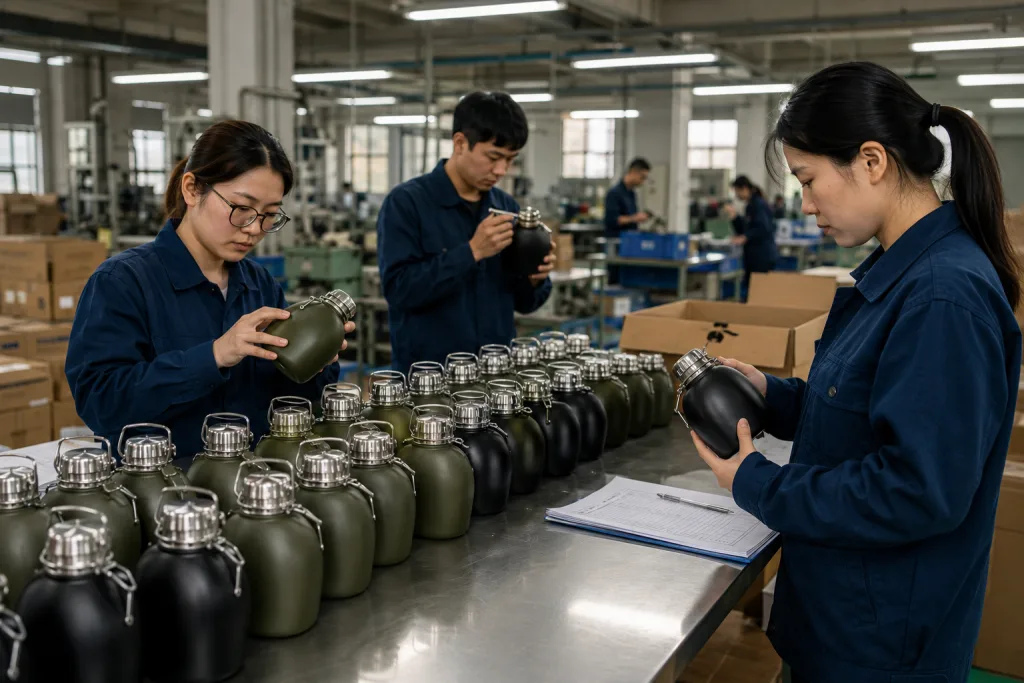
Key Takeaways
- Typical MOQ for a custom canteen is 3,000-5,000 units, with 35-45 day lead time after sample approval.
- A 1.0 mm 304 stainless body or 0.8 mm 5052 aluminum shell is a realistic starting spec for military canteen custom.
- Ask for AQL 2.5/4.0 inspection, REACH paperwork, and carton drop-test details before you approve a PO.
- A Zhejiang canteen factory with 300,000 units/month capacity can support distributor drinkware orders without constant line changes.
If you are sourcing military canteen custom programs, do not treat it like a logo print order. A field canteen has to survive dents, cap failures, odor complaints, and rough transit, while the buyer still needs carton counts, stable lead time, and paperwork that holds up in procurement. We have seen a 2 mm wall spec save a shipment, and we have seen a typo on a PO hold a line for three days. That is where programs in China and Zhejiang either run clean or get messy.
The right answer depends on your route to market. A distributor wants fast turnaround and low risk. A brand owner wants tighter decoration control. A factory buyer wants drawings, a clear MOQ, and a finish spec that does not change every week. QC pulled the sample on a 500-piece run last month because the cap thread was off by 0.5 mm, and the buyer flagged it before it reached packing. If you want custom drinkware that ships without rework, start with the commercial questions first and artwork second. That is the practical way to buy from a canteen manufacturer in China.
What buyers actually mean
When a procurement manager asks for military canteen custom, the real brief is usually wider than the phrase. We have seen buyers want a field-style bottle for an outdoor brand, a training item for a defense supplier, or a canteen promotional piece for a roadshow. Same container. Different job. That changes the spec. A custom canteen for retail needs cleaner surface work and better packout than a bulk-issued unit for internal use, and the line will price it that way.
Start with the market position. Is this a customizable canteen with a removable cup and strap, or a plain one-piece body? Do you need a customized canteen with laser logo, or printed art that has to hold up after abrasion testing on the abrasion wheel? A canteen supplier in Zhejiang quotes faster when you give use case, target price, and pack configuration in one message. Leave those open, and the sample loop slips. The landed cost does too.
Ask these questions early. A buyer once sent a PO with the logo file named wrong, and QC pulled the sample before packing.
- Is the product for outdoor retail, institutional procurement, or promotional distribution?
- Will the buyer accept 5% cosmetic variance, or do you need tighter visual control?
- Do you need a strap, cup, carabiner, or secondary accessory?
- Is the main selling point durability, brand image, or price?
That is the line between a commodity bid and a controlled custom drinkware program. The math does not work any other way.
Choose the body material first
Approve the artwork too early and you burn money. Simple as that. A military-style canteen usually runs in stainless steel, aluminum, or Tritan-style polymer, and the first job is to match the body material to the price target, odor control, and compliance list. For a custom growler buyer, this is the same call in a different shell; for a custom drinkware program, 304 stainless is the safest default when the buyer wants a premium feel and fewer odor complaints.
On stainless, we usually spec 1.0 mm wall thickness on the shell and 0.5-0.6 mm on smaller caps or cups, depending on shape. That number is not decoration; QC pulled a sample at 0.82 mm once, and the panel flex showed up in the drop test before packing. For aluminum, ask for the alloy grade, coating type, and adhesion test result. Color alone is not a spec. A good canteen manufacturer in China will also tell you if the body is deep-drawn or spun, and whether the weld seam needs extra polishing on the line.
Do not skip the cap seal. A 0.8 mm misfit at the closure becomes a warehouse complaint, not a design issue. We have seen buyers flag a PO typo on the cap ring size and lose two weeks while the sample room reworked the mold insert. Ask for leak testing at room temperature and after thermal cycling. If your canteen distributors want mixed cartons or retail shelf display, insist on a packed sample, not just a bare body.
Practical rule: lock the material, wall thickness, and closure system before you approve decoration. That is the order that holds up in production.
MOQ, price, and lead time
Most buyers ask price first. That’s the wrong question. For military canteen custom projects, the number that drives the quote is MOQ. A standard run is usually 3,000 units for one print or embossing setup, and 5,000 units once the order splits into two colors or two carton marks. On our Hangzhou line, we can usually hold 35-45 days after sample sign-off. The first order is slower. New tooling, a 1.2 mm wall spec, or a special coating can push it to 50-60 days.
Price follows the build sheet. Body material, finish, strap, cup, and packaging all change the math. A plain custom canteen in basic stainless often lands around USD 2.10-3.20 EXW at mid-volume, while a set with strap, cup, and printed box can move into the USD 3.80-6.50 range. That is the range we ship in. If a quote comes in under raw material logic, QC pulled the sample and we’ve seen the finish rub off after one carton shake test. The buyer flagged it for a reason.
Break the quote into tooling, sampling, decoration, and carton cost. One PO typo on a carton size can throw the freight math off by 12%. This is the easiest way for your distributor drinkware team to compare two canteen suppliers line by line. It also keeps a second canteen manufacturer in China from hiding a cheap unit price behind expensive packing or a slow ship date.
Decoration that survives handling
Decoration on a field-style bottle is not the place to get clever. The logo has to take rub marks, drops, and repeated washing. On our line, the buyer always asks about the same thing first: how many cycles before the mark fails. Screen print works when the art is simple and the panel is flat. Laser engraving suits a metal body when you need a mark that will not peel. UV printing can look sharp, but we test the abrasion limit before we quote it. A canteen customizable program should be judged by durability first and appearance second.
For most B2B use cases, keep the art to one or two colors unless the margin can pay for the extra setup. A customized drinkware order with multi-color art and tight registration tolerances adds inspection time and lifts scrap. We saw this on a 5,000 pcs PO last quarter: one logo had a 1.2 mm shift, and QC pulled half the batch for recheck. If your channel is a canteen distributor or canteen vendors supplying mixed customer accounts, simple decoration is easier to reorder and easier to stock.
Use these checks on the sample:
- Logo edge does not chip after 50 rub cycles with a dry cloth.
- Ink or engraving remains legible after detergent wash.
- Finish does not discolor around welds or seams.
- Artwork placement is consistent across 10 random samples.
If your buyer wants a custom drinkware line with several SKU variants, limit decoration methods to two. That keeps replenishment sane for a canteen supplier and cuts line setup loss. The math does not work any other way, and we have seen mixed decoration programs go sideways when the PO says one thing and the artwork file says another.
Quality checks worth paying for
Quality inspection is where experienced buyers stop bleeding margin. We run canteen lots with a hard QC plan, because a clean sample can still turn into a weak production run if the line is loose. For an institutional or promo order, write AQL 2.5 for major defects and AQL 4.0 for minor defects straight into the PO. Put the defect list in black and white. Major defects should cover leaks, cap failure, sharp edges, coating peel, and wrong capacity. Minor defects cover print shift, small scuffs, and carton artwork mistakes.
Ask for paperwork, not promises. For Europe and North America, we ship with REACH statements, food-contact declarations, and lot traceability. If the buyer flagged retail, add barcode verification and carton count checks. QC pulled the sample at the packing table, and that is the level you want: in-process photos, final inspection photos, plus a packing list with gross/net weight. Standard export discipline. Not a favor.
Ask these questions:
- What is the verified capacity tolerance, in ml?
- How do you test leaks, and what pressure or dwell time do you use?
- What pass/fail rule do you use for coating adhesion?
- Can you hold one golden sample against the production lot?
When a canteen supplier in Zhejiang knows this playbook, they lock production faster than a generic factory. We’ve seen this go sideways when the PO says “good quality” and nothing else. That is the wrong question to ask. Good QC costs less than chargebacks, rework, and one angry distributor.
Packaging and logistics details
Buyers often miss packaging because they stare at the bottle. On distributor drinkware programs, the carton spec, inner box count, and pallet pattern matter just as much as the shell. A customized canteen in a retail-ready box usually adds production cost, yet it cuts receiving labor on the dock. We had one buyer flag a PO because the carton length was 62 cm, not 58 cm, and the warehouse rack did not fit. If you are building a distributor canteen program, ask for the master carton dimensions before you release the PO. That tells you whether the cube works and whether freight will eat margin.
For ocean freight from China, weight and carton density set the bill. A 2-piece canteen with cup and strap often ships heavier than buyers expect, and the math does not work if you guess. If your target is Amazon or a similar marketplace, pack labels, carton marks, and FNSKU placement need to be fixed before mass production. On our line, QC pulled the sample after a PO typo missed the FNSKU field, and that one mistake would have forced a full rework. A factory in Zhejiang that ships 300,000 units per month can handle this, but only if you tell them early. Otherwise the team treats it as a late change, and you pay for repacking.
Ask for:
- Carton drop-test standard and results
- Inner pack count and separator material
- Gross weight per carton
- FOB port, estimated transit time, and loading plan
That is how a canteen vendor becomes a repeat supplier instead of a one-off quote. We ship on numbers, not hope.
Build a sourcing checklist
Put the checklist on paper before you sign off on samples. Once the supplier starts pushing “upgraded” caps or nicer cartons, the discussion drifts fast. We run the line with a written spec sheet for a reason: a customizable drinkware order is a controlled build, not a mood board. Whether you buy from canteen distributors, a direct canteen supplier, or a China-based canteen manufacturer, the same rules hold.
Use this working checklist:
- Confirm material: 304 stainless, aluminum, or polymer.
- Lock wall thickness and capacity tolerance.
- Approve closure, gasket, and leak test method.
- Define logo method, color count, and abrasion expectation.
- Set MOQ, target EXW or FOB price, and delivery window.
- Request REACH, food-contact, and inspection records.
- Confirm carton spec, barcode, and pallet pattern.
If you are also sourcing a custom growler or customizable growler, use the same checklist. The SKU changes; the buying discipline does not. QC pulled the sample on a 0.5 mm wall-thickness miss once, and the buyer flagged it before we cut production. That is the right question to ask. A serious canteen vendor will use a detailed checklist to quote cleanly, and that is usually the quickest sign you are dealing with a competent exporter in China.
Send your spec, get a real quote
We can review your material, MOQ, decoration, and packing requirements, then quote a canteen custom program that fits your market and schedule.
Frequently asked questions
What MOQ should I expect for military canteen custom orders?
For a standard single-SKU order, expect 3,000 units as a workable MOQ and 5,000 units if you want multiple colors, special packaging, or mixed decoration. A canteen factory in Zhejiang may go lower for repeat buyers, but the unit price usually rises fast below 2,000 pieces. If you need a promotional run, ask whether the canteen supplier can combine colors on one base tool. That can keep tooling unchanged and reduce startup cost.
What is a realistic lead time from sample approval to shipment?
A stable production run is usually 35-45 days after sample approval. If you need new tooling, a complex cup set, or a coating test round, plan 50-60 days. For export shipments from China, add 7-35 days depending on whether you go air, LCL, or FCL. A canteen manufacturer should confirm not only production days but also packaging and inspection days, because those are often where schedules slip.
Which material is better for a custom canteen, stainless or aluminum?
304 stainless is the safer default for odor control, corrosion resistance, and premium feel. Aluminum can be lighter and cheaper, but you need to pay closer attention to coating, denting, and finish durability. For field-style use, stainless is usually easier to defend in warranty discussions. If your target is a canteen promotional order with a lower price point, aluminum can still work if the coating spec and closure design are properly controlled.
What quality standards should I ask the supplier to document?
Ask for AQL 2.5 for major defects and AQL 4.0 for minor defects, plus REACH or food-contact declarations for Europe and North America. You should also request leak testing, capacity tolerance, and carton drop-test evidence. A good canteen supplier in Zhejiang will provide lot traceability, final inspection photos, and a golden sample reference. If they cannot show those documents, treat the offer as unfinished.
Can I order custom drinkware with logo and retail packaging for distribution?
Yes. That is a normal request for a canteen distributor or distributor drinkware program. Build the order around the final pack, not just the bottle. Give the canteen vendor your barcode format, carton marks, inner pack count, and any FNSKU or retail label requirements before sample sign-off. That keeps the line from repacking later and avoids costly delays once the goods are already on the water.