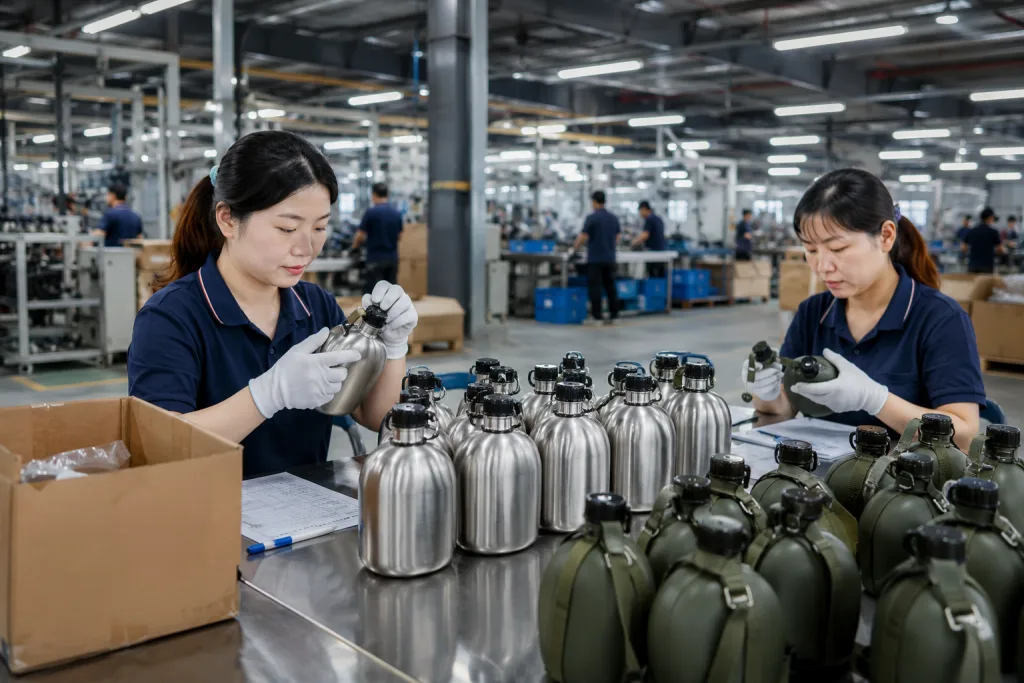
Key Takeaways
- Typical MOQ for a military canteen custom made order is 1,000-3,000 pcs per SKU, with 35-55 days lead time after sample approval
- Single-wall stainless canteens usually land at USD 2.80-4.90 FOB China, while double-wall insulated models are often USD 4.80-8.50 depending on capacity and finish
- Ask for AQL 2.5/4.0 inspection, 24-hour leak testing, coating adhesion checks, and REACH or LFGB material declarations before mass production
- A practical custom logo setup is 1-2 colors silkscreen or laser marking; complex wrap graphics raise reject risk and can add 7-10 days
You are not buying a souvenir flask. For a military canteen custom made program, a 2 mm wall spec, cap retention, coating adhesion, odor control, and carton drop results decide whether the order ships clean or comes back as a claim. One wrong call on capacity or finish turns into rework, then the buyer flags it, then everyone loses two weeks. If you are buying for Europe or North America, you still need clean papers for REACH, LFGB, FDA-contact materials, and factory inspection standards.
At BottleForge Industrial in Zhejiang, China, we see the same pattern on the line: a buyer asks for a custom canteen, then the PO arrives with a logo size typo, a missing carton count, and no note on packaging rules. A canteen customizable for retail is not the same unit we ship for promotional campaigns, tactical use, or private label outdoor kits. The math does not work if MOQ, print method, and inspection level are set after sampling, and that mistake usually costs 30 to 60 days.
What exactly are you buying?
Start with use case, not shape. Buyers often say they need a military canteen custom made item, but that can mean four different products: a classic single-wall canteen for hydration, an insulated field bottle for temperature control, a compact tactical bottle for outdoor retail, or a canteen promotional item built around price and logo space. Each path changes tooling, material choice, and carton math. We run this split every week on the line.
For most B2B programs, the first checklist should look like this:
- Capacity: 500 ml, 750 ml, or 1,000 ml are the common export sizes.
- Material: 18/8 stainless steel, aluminum, Tritan, or food-grade PE.
- Wall construction: single-wall for lower cost, double-wall vacuum for insulation.
- Cap system: screw cap, tethered cap, loop cap, or cup cap.
- Carry method: webbing sleeve, carabiner, or molded handle.
- Compliance market: EU, UK, US, Canada.
If you are working with a canteen distributor or an outdoor retail chain, standardization matters. They usually want one body shape that can carry several SKUs: plain stainless, powder-coated, laser logo, and gift-box versions. If you are buying as a distributor drinkware program for promotions, ask for the opposite setup: lower MOQ, broad color options, and fast repeat orders. The buyer flagged it on a 1,200-piece PO once, and the typo was simple: they wanted one mold, not four mold sets.
A practical point from Zhejiang, China: a lot of buyers over-spec a canteen customized for “military style” but do not need heavy-gauge steel or costly accessory packs. A 0.5 mm single-wall stainless body with a secure PP cap is enough for many commercial projects. QC pulled the sample at 18 hours in salt spray and the math still held. Save the heavier build for retail lines where perceived durability supports margin.
Which specs affect price fastest?
If a canteen manufacturer hands you a quote with a wide range, the spec sheet is still loose. That is the whole game. Material, capacity, finish, and packaging move the number first. On FOB China terms, a 750 ml single-wall stainless custom canteen usually lands around USD 2.80-4.20 at 3,000 pcs. Switch to double-wall vacuum construction, add powder coat, then put it in a custom box, and the same-looking bottle can jump to USD 5.60-8.20. We run this every week on the line, and the buyer usually flags the packaging last, which is backward.
Use this pricing checklist before asking for quotes
- Body material: 18/8 stainless costs more than aluminum or PE, and the sales side sees fewer returns in Europe and North America.
- Steel thickness: 0.4 mm vs 0.5 mm changes dent resistance and cost. QC pulled a sample at 0.38 mm once, and that PO came back for rework.
- Finish: brushed, spray paint, powder coating, rubber paint, and camouflage print all price differently, and the spray booth setup time shows up on the quote.
- Decoration: one-color silkscreen is cheaper than full-wrap heat transfer. Laser holds up, but it is not the right call on every coating.
- Accessories: pouch, strap, nesting cup, retail tag, and color box can add USD 0.35-1.50 per unit. One buyer tried to remove the cup after approval; the math did not work.
- Master carton plan: 24 pcs vs 36 pcs changes freight efficiency and drop performance, and a 2 mm carton spec gap is enough to change the pallet count.
For buyers comparing canteen suppliers in China, ask for separate line items. Do not accept one total price without body, lid, decoration, packaging, and tooling broken out. That is how you see whether a canteen vendor is actually sharp or just hiding thinner steel and weak cartons. We have seen a PO typo on the carton count turn a decent quote into a mess at loading.
When pricing looks unusually low, the hidden cuts are usually steel grade, paint system, gasket quality, or packaging strength.
The same logic applies if you also source adjacent products such as a custom growler or customizable growler. The body can look simple. The lid system and packaging decide whether the goods survive transit, and that is the wrong question to ignore.
How low can MOQ realistically go?
MOQ is where a lot of projects stop being practical. A buyer will ask a canteen factory for 300 pcs in six colors, private label packaging, and mass-production pricing. The math does not work. On a stocked mold with a standard lid, plain carton, and one-color logo, 1,000 pcs per SKU is a workable floor. Once you add custom color matching, hangtag, retail box, and barcode labels, 2,000-3,000 pcs is the number we usually quote. We ran that case last month; QC pulled the sample and the buyer flagged the box artwork before the line started.
At our Zhejiang, China facility, we ship about 300,000 units a month across drinkware categories, but SKU complexity decides the pace. A basic customized canteen moves fast. A canteen custom program with sleeve sewing, mixed finishes, and multilingual packaging slows the line. A 12 mm print shift on one cap insert can force rework, and that is the sort of detail buyers miss when they compare only unit price.
MOQ checklist buyers should confirm
- Per color MOQ: usually 500-1,000 pcs, depending on resin batch and Pantone match.
- Per logo method MOQ: laser is flexible; heat transfer usually needs higher volume and a cleaner artwork file.
- Per packaging style MOQ: custom color box often starts at 1,000 pcs, and the carton spec needs to be fixed early.
- Accessory MOQ: straps, pouches, and custom caps may require 2,000-5,000 pcs, especially if the mold is not shared.
- Mixed container policy: confirm whether the canteen supplier can combine canteen, tumbler, and sports bottle in one shipment without breaking the carton plan.
If you are a canteen distributor testing a market, ask for a staged order. Start with 1,000 pcs in two standard body colors and one retail package. After sell-through, move to the full customizable canteen line. We have seen this go sideways when a buyer tries six SKUs at once and later finds one cap color is running a 4% reject rate. That is a warehouse problem, not a buying win.
This also applies to broader customized drinkware programs. Add too many variants early, and dead stock starts showing up in caps, boxes, and decals. A typo on the PO can lock in the wrong barcode, and then you are paying to relabel cartons by hand.
What testing should you demand?
A good-looking sample means little if the test basis is vague. A military-style bottle gets dragged, stacked, and left outdoors, so we ask canteen manufacturers for material compliance papers and line-level test records before we talk price. One audit we ran found a 0.3 mm gasket mismatch only after the cap torque test.
For EU and North American buyers, the usual file set includes REACH SVHC screening relevance, a food-contact declaration, and, by market, LFGB or FDA-related material statements. Retail programs often ask for BSCI or an equivalent social compliance file, plus ISO-style process control documents. The buyer flagged a missing batch code on one PO; that kind of typo turns a clean file into a delay.
Core test checklist
- Leak test: 100% air pressure or inverted water test, plus a 24-hour sample retention check.
- Coating adhesion: cross-hatch test after curing; a weak powder coat chips fast in the field.
- Salt spray: use this for painted carbon steel accessories or buckles.
- Odor test: cap and gasket materials should not hold a strong plastic smell.
- Drop test: packed-carton drop on edges and corners; 76 cm is standard for export carton evaluation.
- Vacuum retention: for insulated models only, usually measured over 6-12 hours.
For incoming and final inspection, specify AQL 2.5/4.0 unless your channel asks for tighter limits. Separate critical defects from cosmetic ones. Leakage, missing gasket, sharp edge, wrong barcode, and logo shift do not belong in the same bucket as a small paint speck. QC pulled the sample, and that split saved a shipment once when the line had a barcode drift.
If your program includes a customizable drinkware range beyond canteens, the test method has to match the product. A customized growler with a carry handle and wide mouth needs different closure and torque checks than a narrow-neck canteen. This is the wrong question to ask if the only target is the sample photo. We ship on specs, not guesses, and we ask the canteen vendor for the QC plan before deposit.
How should logos and packaging be handled?
Most logo complaints start with decoration mismatch, not a bad file. For a canteen customized for tactical retail, we usually push laser marking on powder coat or brushed stainless. It holds up. On the line, a 0.15 mm offset can be enough for the buyer to flag it. For a canteen promotional run that needs color, one- or two-color silkscreen is easier to read and usually lands around USD 0.08-0.25 per print, depending on size and ink count.
Heat transfer works for full-wrap art, but curved bodies and textured finishes raise scrap. For a 1,000 pcs order, this is the wrong question to ask if you are trying to add three decoration methods at once. Keep the spec tight. We have seen that go sideways. Ask the canteen factory for a decoration position drawing with base and seam-line measurements, and check it against the actual sample, not the PO typo that says 12 mm when the bottle needs 15 mm.
Packaging questions worth asking upfront
- Do you need brown box, white box, or a full-color retail box?
- Will Amazon FNSKU, suffocation warning, or country-of-origin labels be applied at the factory?
- Is barcode scanning checked before carton sealing?
- Will inner partitions stop cap rubbing and paint damage?
- What is the master carton gross weight target, ideally below 18 kg for easier handling?
If you are selling through a distributor canteen model, a plain outer carton with item stickers is often enough. On a chain-store program, the buyer will ask for dieline sign-off, transit tests, and pallet height limits. We run those checks before packing, because one carton at 18.6 kg turns into a loading complaint fast. A reliable canteen manufacturer should give carton dimensions, units per carton, and loading estimates for 20GP, 40GP, and 40HQ without guessing.
The same discipline applies if your line also covers customizable growler or customized drinkware. Good branding closes the first order. Packaging and print that survive transport close the repeat order.
How do you choose the right supplier?
You are not choosing a factory only. You are choosing who answers the phone at 9 p.m., who catches a PO typo before the line starts, and how fast a problem gets fixed. Buyers search for canteen suppliers, canteen vendors, or canteen manufacturers like those labels mean the same thing. They do not. Some are trading companies, some are assembly shops, and some run real production with welding, coating, and QC under one roof.
Ask direct questions. What runs in-house? How many units a month? What share of orders is export OEM? What was the average lead time last quarter? A serious canteen supplier answers straight. On one Zhejiang line, we ship 300,000 units a month, but powder coating is outsourced. That is not a deal-breaker. It just means your timeline and inspection points need to match the actual process, not the brochure.
Short supplier checklist
- Sample speed: 5-10 days for a logo sample on an existing mold is normal.
- Mass production lead time: 35-55 days after deposit and artwork approval.
- Inspection support: accepts third-party QC and provides AQL reports.
- Compliance readiness: can share material declarations and test history.
- Commercial clarity: tooling, sample charges, and mold ownership are written down.
If you are a distributor growler or distributor drinkware buyer moving into canteens, pick a partner that can cover more than one category. One approved supply base for canteens, tumblers, sports bottles, and the occasional custom growler is easier to run than five small vendors in China. The math does not work the other way around. We have seen that go sideways on a 2,000-piece reorder because each supplier blamed the next one.
The best canteen distributors and importers do not chase the cheapest unit. They buy the unit that lands on time, passes inspection, and comes back for a second and third order without spec drift. QC pulled the sample, checked the gasket at 0.8 mm, and the buyer flagged the lid torque. That is the right level of boring.
The purchase order details that prevent disputes
Most production disputes disappear when the purchase order leaves no room for guesswork. If the PO says “1,500 pcs custom canteen, green, logo,” the line will fill in the blanks its own way. We see this go sideways on day one. A buyer once typed “green” on the PO, then flagged the first preproduction sample because the Pantone was never stated.
Your PO and spec pack need body material, capacity tolerance, weight tolerance, finish code, logo size and position, Pantone reference, cap material, gasket material, packaging method, carton drop requirement, barcode placement, and inspection level. If the order includes a tethered cap or pouch, add pull-force targets and stitch count. If there is a cup lid, define the fit tolerance in mm. QC pulled the sample, measured the lid gap at 0.8 mm, and the buyer pushed back because the PO had said nothing about accept/reject limits.
- Payment terms: 30% deposit and 70% against inspection or copy documents is still common for OEM export from China. We ship that way every week, and the bank copy lands before the cartons do.
- Incoterms: FOB Ningbo or Shanghai is standard for Zhejiang factories; confirm inland charges if you request EXW. The math changes fast once the truck fee is added.
- Approved sample reference: assign a sample code and date so there is no confusion later. A PO typo on the sample number can burn a full afternoon.
- Spare parts policy: ask for 0.5%-1% extra caps or gaskets on larger orders. On a 20,000-piece run, that is the difference between a clean handover and a missing-box complaint.
- Defect handling: agree whether replacement, credit note, or next-order deduction applies. If you leave that open, the claim lands after the goods are already on the shelf.
If the project includes a customizable canteen plus related SKUs such as a customized growler, keep decoration specs and packaging language identical across the set. Mixed artwork files have caused label swaps on the line more than once. This is the wrong question to ask: not “can the factory sort it out,” but “did the PO force the same answer for every SKU?”
The buyers who run clean canteen programs are not the ones with the biggest budgets. They are the ones who pin down the details before production starts. That is the gap between a one-off canteen custom order and a sourcing program that ships without drama from China.
Get a military canteen quote that matches your real spec
Send your target capacity, material, logo method, packaging, and quantity. We will reply with MOQ, FOB pricing, lead time, and compliance options.
Frequently asked questions
What is the normal MOQ for military canteen custom made orders?
For an existing mold, standard cap, and one-color logo, most factories in China will quote 1,000 pcs per SKU as the practical floor. If you want custom body color, retail box, strap, or special lid, expect 2,000-3,000 pcs. Below 1,000 pcs, the unit price rises fast because setup costs for coating, printing, and packaging are spread over too few units. If you are testing a market, ask whether the supplier can offer 1,000 pcs in 2 colors using a stock carton first, then scale to a fuller canteen customized program on the reorder. That usually protects cash flow better than forcing a very low MOQ with too many custom details.
How long does production take from sample approval to shipment?
A realistic timeline is 5-10 days for a pre-production sample with logo, then 35-55 days for mass production after deposit and artwork approval. Simpler single-wall stainless canteens can finish closer to 35 days if materials are in stock. Double-wall insulated models, sewn pouches, or custom gift boxes push closer to 50-55 days. During peak season before summer retail, add another 7-10 days. If you are shipping FOB from Zhejiang, China, confirm whether powder coating, printing, and packaging are all in-house or partly outsourced, because that changes schedule risk. A serious supplier should provide a production schedule with dates for raw material arrival, coating, assembly, inspection, and booking.
What certifications or compliance documents should I ask for?
For Europe and North America, ask first for food-contact material declarations for all components that touch liquid or the mouth area: body, cap liner, gasket, and any straw or spout parts. For EU programs, REACH-related declarations and, where relevant, LFGB testing are common requests. For US importers, FDA-contact material statements are often requested. If you sell to larger retailers, also ask whether the factory has BSCI or equivalent social compliance records and whether they accept third-party inspections. On the quality side, specify AQL 2.5/4.0 and request leak-test records. If the product is insulated, ask for heat or cold retention data over 6-12 hours, not vague claims like “keeps warm all day.”
Which logo method is best for a custom canteen?
For durability, laser marking is usually the safest choice on brushed stainless or powder-coated bodies. It resists rubbing better than silkscreen and looks cleaner on tactical or outdoor styles. For high-visibility promotional projects, 1-color or 2-color silkscreen is more eye-catching and usually costs about USD 0.08-0.25 per print depending on size and color count. Full-wrap heat transfer works for detailed graphics, but reject rates are higher on curved bottles and textured coatings. If your order is only 1,000-2,000 pcs, keep decoration simple unless the retail concept absolutely requires more. Always approve a position drawing with exact dimensions so the canteen manufacturer is not guessing logo placement during production.
How can I tell if a canteen supplier is actually reliable?
Look for evidence, not polished sales language. Ask how many units per month they produce, what percentage is OEM export, and which processes are in-house. A dependable canteen factory should tell you sample lead time, standard MOQ, typical defect categories, and whether they accept third-party QC. Request a recent inspection format, packaging photos, and carton specs. You should also ask how they handle claims: replacement stock, credit, or deduction on the next order. If answers are vague, expect problems later. Reliable suppliers in Zhejiang or elsewhere in China usually document details well, because repeat B2B buyers care about consistency more than one-time pricing. Fast, precise answers are often a better sign than the lowest quote.