Key Takeaways
- A military canteen bulk RFQ should specify material, capacity, wall thickness, and cap type before price.
- For stainless programs, 0.6 mm body thickness and 18/8 or 304 steel are common starting points.
- A realistic first bulk MOQ is often 3,000 to 5,000 units, with 30 to 45 days lead time after sample approval.
- For export, ask for REACH, LFGB where needed, and AQL 2.5 major / 4.0 minor inspection terms.
If you are buying military canteen bulk for a program, retail line, or private label drop, the hard part is not finding a factory. The hard part is locking the spec before you send money. A canteen that looks fine in a catalog can still fail on cap seal, coating adhesion, BPA paperwork, or carton drop tests once it leaves Zhejiang or lands in a warehouse in North America or Europe.
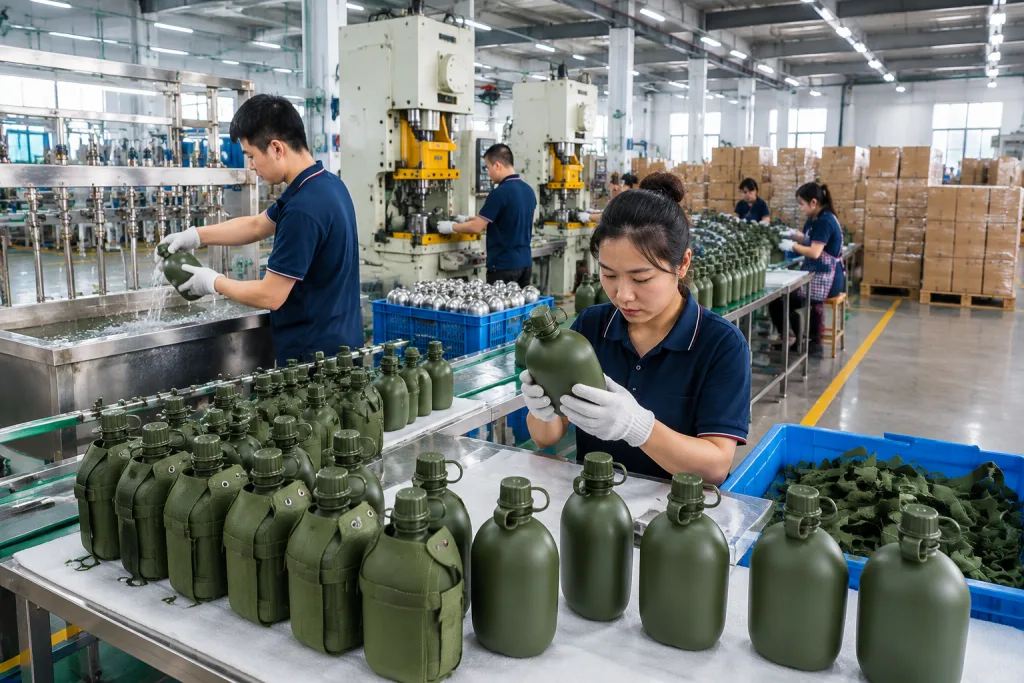
The clean way to buy is to treat it like a controlled sourcing job. Start with a tight RFQ, ask for a sample built to the same material and finish you want in production, then move to bulk only after you have line-item confirmation on material grade, thickness, packaging, and inspection standard. At BottleForge in Zhejiang, we run more than 300,000 units per month across bulk drinkware programs, and the buyers who save time are the ones who ask the boring questions early. We had one PO typo where the buyer wrote 500 ml on the request and 550 ml on the carton, and QC pulled the sample before the line could waste a shift.
Start With the RFQ Package
Your RFQ is where the order gets decided. Send a one-line request for military canteen bulk, and you get a loose quote, then two weeks of back-and-forth on assumptions. We run these jobs every season. A proper RFQ for canteen wholesale should spell out capacity, material, finish, cap style, logo method, carton spec, destination port, and target annual volume. If you want a bulk canteen program to price cleanly, make the factory quote the same packaging and accessory set on every line. QC pulled one sample at 18 oz and the carton math changed by 12 pcs per case.
Use one table and force the supplier to answer in writing:
- Capacity: 18 oz, 25 oz, or 32 oz
- Material: 304 stainless steel, 18/8 stainless, or aluminum with liner
- Body thickness: 0.5 mm, 0.6 mm, or 0.7 mm
- Cap: screw cap, tether cap, or cup-cap combo
- Decoration: silkscreen, laser engraving, or powder coat
- Target price: FOB Ningbo or FOB Shanghai
For procurement teams buying drinkware wholesale or wholesale canteen programs, this is the right place to be strict. We've seen the math go sideways when the buyer leaves carton cost or test fee out of the RFQ. The best suppliers in Zhejiang break out unit price, tooling, sample fee, carton cost, and any third-party test fee. A PO typo on the outer carton size can move the landed cost fast. If the quote rolls everything into one number, you cannot see where margin or risk is hiding.
Set the Spec Before Price
The low quote is usually the one that left out the hard parts. For a serious military canteen bulk order, lock the material spec first. If you want stainless, call out SUS304 or 18/8 and set the wall at 0.6 mm. That is a practical middle ground: light in the field, stiff enough that QC does not flag a flimsy hand feel, and stable in deep drawing on the line. If the design uses an internal lining, put the coating type and cure process in writing. We have seen that detail go sideways on a 5,000-piece order.
Buyers often ask for bulk drinkware, then later the PO grows into matching SKUs for bulk growler, beer tumbler bulk, or alcohol flask bulk. Fine. Do not force those into one spec sheet. A canteen is not a growler, and a growler is not an alcohol flask. The buyer flagged a cap-thread mismatch on one job because someone copied a growler wholesale note into a beer growler wholesale file, and the math did not work. Keep the canteen spec clean and separate.
Typical line items to freeze
- Product name: military canteen bulk
- Capacity: 25 oz
- Steel grade: 304
- Body thickness: 0.6 mm
- Cap gasket: silicone, food-contact grade
- Surface finish: matte powder coat, Pantone match if needed
- Carton: 1 pc polybag, 24 pcs master carton
That is the level of detail that lets a factory in China quote you honestly. It also makes supplier comparison in Zhejiang faster, because one missing gasket spec or a 0.5 mm wall shows up before we ship samples. A PO typo on carton count is cheaper to catch here than after sampling.
Request Samples That Mean Something
A sample only matters if it matches the line. We have seen buyers sign off on a hand-polished piece that the press line cannot repeat. For canteen bulk or canteen wholesale, ask the factory to label the sample as hand-built, pilot-run, or production-standard. Sample charges of USD 40 to USD 120 are normal when tooling or logo work is involved. The real check is simpler: the same wall gauge, the same seal, the same coating. On our side, we once had a PO typo that listed 0.8 mm wall thickness as 0.08 mm; the buyer flagged it before we cut steel, and that saved a mess.
For a military canteen bulk order, we run three checks before approval: leak resistance, dent behavior, and cap feel. Fill the canteen with 80 C water, invert it for 30 minutes, then leave it overnight at room temperature. Drop one sample from 1 meter onto plywood. If the cap loosens or the gasket shifts, reject it. This is normal qualification work for wholesale drinkware buyers. QC pulled the sample on our bench last month and found a closure torque drift of 0.3 N·m after 200 cycles; that is the kind of number that tells you whether the line will hold.
Do not approve a sample just because the logo looks sharp. A clean mark with a weak seal still turns into a return.
If you are comparing bulk drinkware programs across categories, keep the approvals separate. A bulk growler may use a different closure spec and finish line than a field canteen, while alcohol flask in bulk orders usually need a deeper engraving and different inner packing. Mixing them is the wrong question to ask. Separate approvals keep the paper trail clean, and the factory can quote each SKU against the right 316 or 304 stainless spec without guessing.
Quote the Bulk Order Properly
Once the sample is approved, write the bulk quote as a line-item commercial document, not a casual email. We see buyers lose control right there. A proper purchase order for military canteen bulk should spell out the exact SKU, quantity, unit price, printing charge, packaging, test standard, and delivery terms. If you are buying in China, ask for FOB terms first. Need DDP later? Keep that as a separate logistics line so the product price stays clean. On our floor, a typo in the PO like “Nibo” instead of Ningbo has held up booking before.
For a first order, 3,000 units is a normal MOQ for a standard canteen, with 30 to 45 days after sample approval and deposit. Custom tooling adds 10 to 15 days. That is factory math, not a delay story. In Zhejiang, a mature line can ship more than 300,000 units a month across mixed drinkware wholesale SKUs, but this order still depends on coating, cap sourcing, and the carton print slot. QC pulled one sample for a 0.3 mm cap gap last week; the buyer flagged it, and we fixed the mold insert before mass run.
Include these PO line items:
- Product: wholesale canteen, 25 oz, 304 stainless
- Quantity: 5,000 pcs
- Unit price: FOB Ningbo USD 2.15
- Logo: laser engraving, one position
- Packaging: brown box, export carton, 24 pcs/carton
- Inspection: AQL 2.5 major, 4.0 minor
- Documents: commercial invoice, packing list, origin, test reports
That structure also works when you buy adjacent categories like beer growler bulk, beer tumbler wholesale, or alcohol flask wholesale bulk. The product changes. The paper trail does not. We run the same quote sheet for every batch, and the math does not work any other way.
Check Compliance and Testing
If your consignee is in Europe or North America, compliance is not optional. For metallic drinkware, ask for REACH declarations, LFGB if your market requires it, and food-contact declarations for the steel, coating, and gasket. On one line we had a buyer flag a missing gasket declaration after the PO typo said “silcon” instead of “silicone,” and that one word stalled release for 6 days. For imported drinkware bulk programs, some buyers also ask for ASTM impact or thermal performance references, especially when the item is sold through outdoor or tactical channels. Do not assume the supplier knows which standard your retailer or distributor expects.
Quality control should be written into the order, not discussed vaguely after the deposit. We run AQL 2.5 major / 4.0 minor for a normal consumer program, or tighten it when the item goes into a stricter channel. Ask for pre-shipment photos, carton count confirmation, and a final inspection report showing cap torque at 18-22 N·cm, seal test, and print adhesion. QC pulled a sample once and found two lids with a 0.6 mm gap at the gasket seat; that batch never left the line. If the finish is powder coat, ask for a cross-hatch adhesion check on at least 5 samples per lot.
For buyers who also source wholesale growler or beer growler wholesale bulk items, it is common to combine paperwork for shipping efficiency but not for testing. A canteen, a growler, and an alcohol flask each need their own spec and test file. We ship them together when the carton mix makes sense, but the math does not work if you treat one test report as enough for all three. That is how you keep customs, compliance, and customer service manageable once the orders grow.
Manage Packaging and Freight
Packaging is where margin gets killed. A canteen priced at USD 2.15 FOB can turn into a bad buy if the pack is too heavy, too loose, or built for retail when the channel is military supply. For military canteen bulk, we run a practical export carton: 24 units per master carton, 5-layer outer carton, and an inner polybag or molded tray when the cap finish needs protection. Marketplace orders are a different animal. The buyer flagged FNSKU on one PO last month, and that job needed a tougher individual mailer.
Freight planning should start while the sample is still under approval. Ask the factory in China for carton dimensions and gross weight, then work out container load before you confirm the order. A 10 mm change in carton length can move unit freight by several cents. That sounds small until you have three SKUs on the same booking. A mixed container with bulk drinkware, bulk growler, and best wholesale drink bottle items ships cleaner when the carton footprint is standardized. If each SKU runs a different box, you lose cube and pay for air.
We ask for one packed sample carton before bulk production starts. QC pulled the sample, weighed it, and checked the tape seams against the packing list on a 1.2 kg carton. If the factory’s numbers miss, stop there. Fix it before the line runs 20,000 pcs. That is cheaper than paying a forwarder to sort out a truck that was booked off the wrong carton data.
Lock Reorder Terms Early
The first order is not a one-off. If the sample runs clean, the second PO is where the margin shows up. Before the first carton leaves Zhejiang, lock reorder price bands, spare gasket supply, and artwork retention. On a stable military canteen bulk line, we usually see 3% to 8% off the opening price once tooling is paid and the line can buy resin in one shot instead of piecemeal. We saw this on a 5,000 pcs run last quarter; the buyer flagged a loose cap drawing, we fixed the file on press, and the repeat price held. That same logic applies if you are also ordering wholesale drinkware or related items such as beer growler in bulk, beer tumbler wholesale bulk, or alcohol flask wholesale in the same production window.
Put the repeat terms in writing now. Record the approved color, logo file, packaging spec, and test report number. Keep the sample sign-off photos in the PO file. We once caught a typo on a PO where “matte” became “matt”; QC pulled the sample, and the paper trail saved two days of back-and-forth. If you run private label in Europe or North America, this is where your distributor team, compliance team, and warehouse team need the same approved SKU sheet. The math does not work if each group is working from a different version.
With a disciplined process, canteen wholesale stops turning into a guessing game. You are buying a controlled item with a spec, a test trail, and a repeat price you can budget against. That is the right question to ask.
Send the RFQ, get the spec locked
We quote military canteen bulk from Zhejiang with clear MOQs, factory samples, and export-ready line items. Send your target price and packaging needs.
Frequently asked questions
What MOQ should I expect for military canteen bulk?
For a standard stainless military canteen bulk order, a realistic MOQ is usually 3,000 to 5,000 units. If you need custom embossing, special coating, or unique packaging, some factories in Zhejiang will push that to 5,000 to 10,000 units. For a simpler wholesale canteen program with stock tooling, you may get 2,000 units, but the unit price will be higher. Ask the supplier to separate tooling, decoration, and packaging so you can see where the MOQ is coming from.
How long does a bulk canteen order take?
After sample approval and deposit, 30 to 45 days is a normal lead time for a bulk canteen order. Add 10 to 15 days if you need custom tooling or a new color match. If the order is combined with other drinkware wholesale items, the factory may schedule it faster if the materials are already in stock. Shipping time is separate; ocean freight to Europe or North America can add 20 to 40 days depending on port and season.
What material should I specify for wholesale drinkware canteens?
For most military canteen bulk programs, specify SUS304 or 18/8 stainless steel with 0.6 mm wall thickness as a practical baseline. That gives you better stiffness than 0.5 mm without making the bottle too heavy. If your market needs a lighter product, you can discuss 0.5 mm, but ask for dent and seal testing. For coatings, request food-contact documentation and make sure the gasket is silicone or another approved food-grade material.
How should I compare quotes for canteen wholesale?
Compare like for like. Put the same capacity, steel grade, wall thickness, cap type, logo method, and carton spec on every RFQ. A canteen wholesale quote that looks 12% cheaper may simply be using thinner steel, simpler packaging, or no test documentation. Ask for FOB unit price, sample fee, tooling fee, and carton dimensions separately. That makes it much easier to compare suppliers in China or Zhejiang without hidden cost shifts.
Can I combine canteen bulk with growler or flask orders?
Yes, but keep the specs separate. A growler bulk or beer growler wholesale bulk order often uses different neck finish, closure, and packaging than a military canteen bulk order. Alcohol flask wholesale bulk programs usually need different decoration and size control as well. Combining freight can save money, but combining specifications usually creates confusion. The clean approach is one approved spec sheet per SKU, then one consolidated shipment if the production timing works.