Key Takeaways
- A practical MOQ for a custom wine tumbler program is often 3,000 to 5,000 units, with 25 to 35 days for bulk production after approval.
- 304 stainless steel at 0.4 mm to 0.5 mm wall thickness is the common baseline; 18/8 and vacuum insulation matter more than the marketing copy.
- For logo work, laser engraving is more stable for long runs, while silk screen is cheaper but usually adds more color and wear risk.
- Ask for REACH, FDA or LFGB alignment, an AQL 2.5 inspection plan, and carton-drop testing before you approve a canteen supplier.
When you buy from manufacturers wine tumbler suppliers, the real decision is not the cup shape. It is whether the factory can hold finish quality, decoration consistency, and delivery dates at your order volume. A 12 oz stainless wine tumbler can look identical in samples and still fail in production because the coating chips, the lid leaks, or the logo tolerance drifts across a 5,000-unit run. We have seen that break a PO on the line after QC pulled the sample and found a 0.8 mm print shift.
The better move is to treat this as a sourcing decision, not a design purchase. You are choosing a canteen manufacturer, a custom drinkware partner, or a canteen factory that can run your spec under repeatable controls. In Zhejiang and across China, the strong factories are set up for laser engraving, silk screen, powder coat, and OEM packaging, but they still vary on MOQ, lead time, AQL, and revision handling. The buyer flagged a typo on the carton mark once, and the math did not work for a 20-day ship date. Know that before you place the order.
Start With The Three Decisions
If you are buying manufacturers wine tumbler programs for retail, promotion, or private label, start with three decisions: the material system, the decoration method, and the supply model. Those three calls drive most of the landed cost and most of the complaint risk. A polished 12 oz double-wall tumbler with a sliding lid is easy to quote. The real question is whether you want 304 stainless steel, whether the finish is powder coat or bare metal, and whether the order is going to a distributor shelf, an Amazon listing, or a corporate gifting run. On our line, a missing lid code on the PO has caused more delay than the cup body itself.
Material is the first fork. For standard custom drinkware, 304 stainless is the normal choice because it gives solid corrosion resistance and clears certification work without drama. If your buyer wants a heavier hand feel, you can move to wall sections around 0.5 mm, but that changes weight and cost fast. We have seen buyers ask for the same look at 0.4 mm and 0.6 mm, then wonder why the carton count shifts. Decoration comes next. Laser engraving leaves a clean mark that survives shipping and warehouse handling better than printed art. Silk screen works for bright logos and short promotional runs, but it is less forgiving if you expect heavy wash cycles. Then look at the supply model. If you need the same SKU every quarter, choose a factory with stable monthly output and documented repeatability. If the program is seasonal, a supplier with faster sampling may be enough. QC pulled the sample at 2.3 mm on the rim once, and that was the run that exposed a weak spec sheet.
Practical rule: do not approve a quote until the supplier has shown you the exact unit build, the test standard, and the packaging spec. A distributor drinkware buyer cares about the shelf result. A distributor canteen buyer cares about the restock cycle. You need both under control, and the math does not work if you leave one of them vague. We ship cleaner when the buyer flags the carton mark up front.
Judge The Factory, Not The Sample
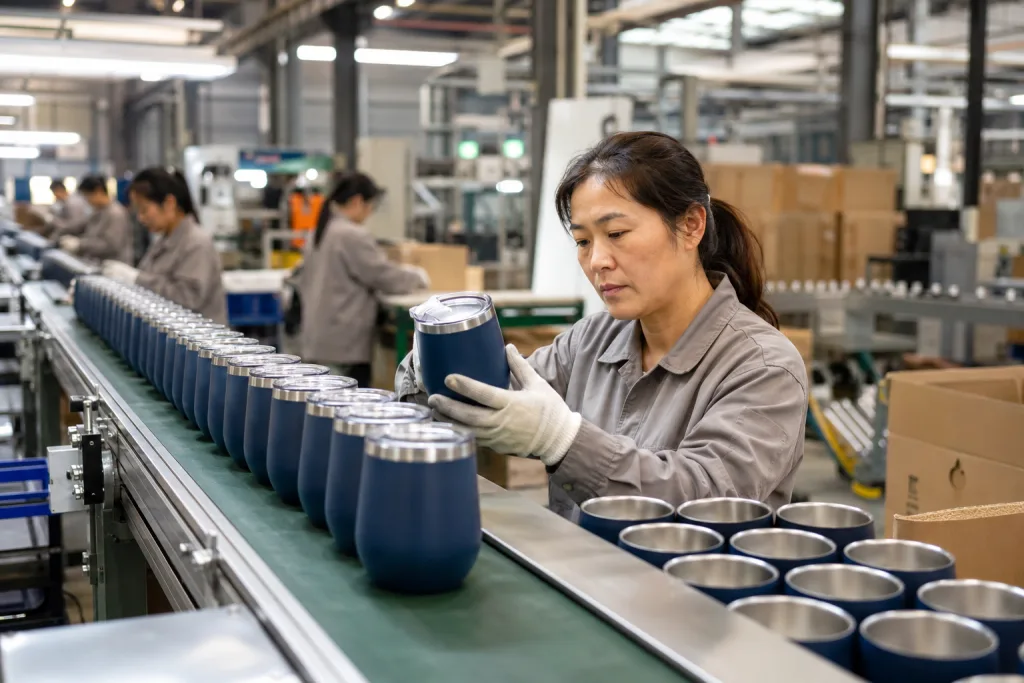
Samples can fool you. A Zhejiang factory can hand-make a clean sample in one day and still miss the target at 10,000 units. Judge the factory by process, not by one polished cup. Ask how many units they ship each month. We run plants that move 300,000 to 500,000 pieces monthly across bottle and tumbler lines, and a wine tumbler line gets its own schedule once the order justifies it. If they cannot state line balance, changeover time, and inspection points, they are selling luck, not manufacturing.
Look for a canteen manufacturer that can show incoming material checks, in-process leak tests, and final inspection under an AQL plan. For B2B buyers, AQL 2.5 is a normal target for appearance defects, while leaks deserve tighter control. Ask for photos of the vacuum welding area, coating line, and packing station. QC pulled the sample here once and found powder dust on the rim after coating; the buyer flagged it, and that same issue showed up again on the third order. That is the kind of thing that tells you the line is weak.
Check what else they make. A plant that handles custom growler, customizable growler, customized growler, and custom canteen lines usually has better control over forming and lid sourcing than a pure trading desk. That does not make them the right fit by itself, and this is the wrong question to ask if you stop there. It tells you they know the gap between a promo item and a retail SKU. We ship with plants like this because they can run customized drinkware and branded packaging without scrambling at the end of the line.
Match Decoration To Use Case
Decoration is where buyers burn margin. The lowest quote often loses money later. If you sell through retail or e-commerce, the finish has to survive carton rub, pallet squeeze, and return handling. For event stock, the bar is lower. A one-day giveaway does not need the same spec as a shelf item.
For a wine tumbler, laser engraving usually gives the cleanest result for wear resistance and tone control. We run 0.2 mm depth checks on the line because a shallow mark vanishes after use. It works well on brushed steel and matte coat. Silk screen still makes sense when the logo needs color or a wider print field, but the ink system and cure temp need to match the cup body. We have seen cheap runs pass photo approval and then fail after 20 dishwasher cycles. UV print can hold on some coated surfaces, yet the buyer has to test the exact finish. A similar coating is not the same thing.
There is a real split here: custom drinkware for retail needs tighter art placement and finish tolerance than custom canteen work for events. A canteen customizable or canteen customized item can tolerate a wider print window because the logo matters more than perfect symmetry. A customizable drinkware program for a premium brand cannot. The buyer flagged one PO where the logo was centered in the spec sheet but off by 4 mm in the sample. That order got held. This is the wrong question to ask if you only compare print price. Experienced canteen distributors and distributor drinkware buyers ask for a decoration proof, a master carton photo, and one packed pilot lot before release.
- Laser engraving: best for permanence and low defect drift.
- Silk screen: best for color branding and lower setup cost.
- Powder coat with logo knock-out: best for premium shelf impact.
- Full-color print: only when the artwork and coating system are proven together.
Set The Commercial Terms First
Price is not just unit cost. On imported drinkware, the real number is landed cost after freight, duty, packaging, and a rework allowance. A FOB China quote for a 12 oz stainless wine tumbler usually sits around USD 2.10 to 4.80, depending on finish, lid, and decoration. We have seen a buyer ignore the export carton spec, then the math blew up by 0.18 USD per set on the first shipment. Ask the supplier for pricing in layers: blank unit, decoration, inner box, master carton, and QC charge if there is one.
MOQ matters as much as price. For a standard custom drinkware SKU, 3,000 units is often the point where the factory treats it as a production run, not a sample batch. For more complex customized drinkware with multiple colors, MOQ can move to 5,000 units or more. QC pulled the sample on a 2,000-piece trial and found the buyer’s PO had the color code wrong by one digit; that kind of mistake is why tiny quantities often come from a wholesale stock channel, not a real line. Fine for testing. Wrong for a branded rollout.
Payment terms matter too. Most China suppliers ask for a 30% deposit and 70% before shipment. That is normal, but repeat buyers with stable volumes can often push for better terms after two clean shipments. We run into this on the line all the time: once the buyer proves they pay on time, the factory has room to talk. Cash flow and schedule control move together.
If your portfolio includes adjacent items like a customizable canteen, customized canteen, or distributor growler program, build the commercial model around shared packaging components and combined shipping. One factory can often consolidate those SKUs better than three separate suppliers can. We ship mixed cartons this way when the carton sizes match within 10 mm, and it saves more than people expect. That is especially true when the canteen manufacturers already own the tooling and carton specs. The wrong question is, "Can each item be cheapest?" The right one is, "What is the total landed cost across the set?"
Test The Things Buyers Ignore
Most failures come from the boring checks people skip. Leak testing is the first one, not the last. We also ask for thermal retention, coating adhesion, drop resistance, and lid cycle life. On a vacuum insulated wine tumbler, a normal retention target is 6 to 8 hours for cold drinks and 4 to 6 hours for warm drinks, depending on wall design and lid seal. QC pulled the sample on the line and the buyer flagged a 10% drop after 4 hours; that is the kind of gap paper specs hide. If the supplier cannot explain the test method, you are buying a number, not a product.
For compliance, ask for the actual reports, not a summary sheet. REACH matters for Europe. LFGB or FDA alignment is often requested for food-contact products in Germany, the United States, and Canada. If the tumbler uses silicone or plastic lid parts, get the material declaration for those parts too. A 304 stainless body with a weak lid still fails in the market. We have seen this go sideways after a carton-drop test from 76 cm and a transit compression check at 2.5 kg; the cups survived, the lids did not. That is the wrong place to save a dollar.
For custom growler and customizable growler orders, wall thickness and neck geometry matter more than buyers expect. A 0.4 mm body can pass, but 0.5 mm or 0.6 mm holds up better when the product moves through bars, breweries, and field sales. The same logic applies to a custom canteen or canteen promotional item that gets packed and repacked. We run these with calipers and a lid-fit gauge because a 1.2 mm neck mismatch will show up fast on the line. Ask the factory for prior production samples, not only fresh prototypes. A polished sample is nice; a real shipment record is worth more.
“If a supplier cannot show you the test method, the pass criteria, and the packing spec, they do not own the risk.”
Use The Right Supplier Type
Not every buyer needs the same supplier model. If you are a brand owner with a retail launch, you want a canteen manufacturer that owns decoration setup, carton consistency, and repeat POs. If you are a trade company or regional wholesaler, a canteen supplier with 24-hour quotes and mixed-SKU flexibility may be enough. If you are a reseller handling seasonal demand, a canteen vendor with 500 pcs MOQ and 7-day sample turnaround cuts your risk. We run into this all the time. The buyer flagged a PO typo on the outer carton mark, and that tiny miss told us the account was not ready for the wrong supplier type.
For Europe and North America, the strongest partners usually behave like an export ops team, not just a factory line. They should understand cartons, SKU labels, and master data for distributor drinkware programs. They should be able to prepare barcodes, FNSKU labels if needed, and private-label packaging without you rewriting the spec three times. A 1 mm carton mismatch can hold up a shipment. A factory in China can be excellent at output and still be weak at documentation, and we've seen that go sideways fast. The better Zhejiang shops usually keep both sides tight.
There is also a practical category split. Canteen suppliers and canteen vendors are fine for commodity blanks. Canteen manufacturers matter when you need repeatable decoration or controlled tooling. Canteen distributor and distributor canteen models work when you need faster assortment coverage, but the margin math is weaker than a direct factory relationship. Decide by your channel and your reorder plan, not by the seller's wording. QC pulled the sample at AQL 2.5 on a 304 stainless run last month, and that kind of check is what separates a real manufacturer from a paper trader.
That is why the best B2B buyers keep one foot in custom drinkware and one foot in supply chain control. A supplier that can handle a customized canteen line, a customized growler line, and a standard wine tumbler run without losing documentation is usually the one that still works when the order jumps from 3,000 units to 12,000. This is the wrong question to ask: "Who says they can do it?" Ask who can ship clean paperwork, correct packing, and the same finish on the next lot.
Get a factory quote built around your channel
Send your target volume, logo method, and market. We will quote the right spec, MOQ, and lead time without padding the answer.
Frequently asked questions
What MOQ should I expect for manufacturers wine tumbler orders?
For a standard stainless wine tumbler, a realistic MOQ is usually 3,000 to 5,000 units per SKU, especially if you want custom decoration or special packaging. If you only need one logo color and simple export cartons, some Zhejiang factories can start lower, but the unit cost will climb. Once you add multiple colors, matte coating, or custom lids, the MOQ often rises because the line setup and QC time increase. For repeat orders, a good factory can often reserve capacity and hold the same spec across reorders, which matters more than chasing the lowest first-order number.
Which decoration method is best for a custom wine tumbler?
Laser engraving is the most durable choice for a custom wine tumbler, especially if you want a premium look on 304 stainless steel. It usually holds up better than silk screen through shipping and washing. Silk screen is useful when you need color and a lower setup cost, but the artwork is more exposed to wear. For coated tumblers, powder coat plus laser knock-out can look stronger on shelf. The right answer depends on your channel: retail and e-commerce usually need better abrasion resistance than event giveaways or canteen promotional programs.
How do I know if a canteen factory is trustworthy?
Ask for more than one sample. A trustworthy canteen factory should show production photos, QC flow, material declarations, and test results for leak, coating adhesion, and packaging. Look for clear answers on monthly output, often 300,000 units or more for a serious export line, and ask whether they work to AQL 2.5 or a tighter standard for functional defects. If they can explain REACH, FDA or LFGB alignment, and carton-drop testing without hesitation, that is a good sign. If they keep changing the spec language, that is a problem.
Can I combine wine tumblers with custom canteen or custom growler orders?
Yes, and buyers do it often to reduce freight and simplify supplier management. A factory that already produces custom canteen, customizable canteen, custom growler, and customized growler items can often share sourcing, printing, packaging, and export documents across the order. That helps if you are a distributor drinkware buyer or a canteen distributor handling mixed assortments. The main caution is that each SKU still needs its own final QC, since lid fit, volume, and decoration tolerances can differ even when the metal body looks similar.
What lead time is normal for China production?
For a confirmed order from a canteen supplier in China, 25 to 35 days is a normal bulk lead time after sample approval and deposit, depending on season and decoration complexity. If you need custom packaging, multiple logo locations, or special coatings, plan on the upper end. Shipping adds more time: ocean freight to Europe or North America can add 20 to 40 days depending on route and customs. In Zhejiang, many factories can move faster on samples, but the real schedule risk is usually in artwork approval and packaging sign-off, not in the steel body itself.