Key Takeaways
- A realistic MOQ for a custom stainless thermos is often 3,000-5,000 pcs, with sample lead time around 7-10 days.
- Double-wall 304 stainless with 0.4-0.5 mm inner and outer shells is a common production baseline for a durable vacuum flask.
- For export buyers, keep REACH, FDA contact-safety, and drop/leak tests in the PO; ask for AQL 2.5 major and 4.0 minor.
- FOB pricing for a basic promotional thermos can start around USD 2.20-4.80 depending on size, lid, finish, and decoration.
You are not buying a logo on a bottle. You are buying a production slot, a 304 stainless body, and a QC run that has to leave China, clear transit, and land at your warehouse without dents, leaks, or a neck ring out of spec. We had a buyer flag a 0.3 mm wall callout on a PO once; the line caught it before tooling, and that saved a bad batch. This is where manufacturers vacuum flask orders go off track: the buyer starts with artwork and skips wall thickness, lid fit, coating cure, and drop-test targets.
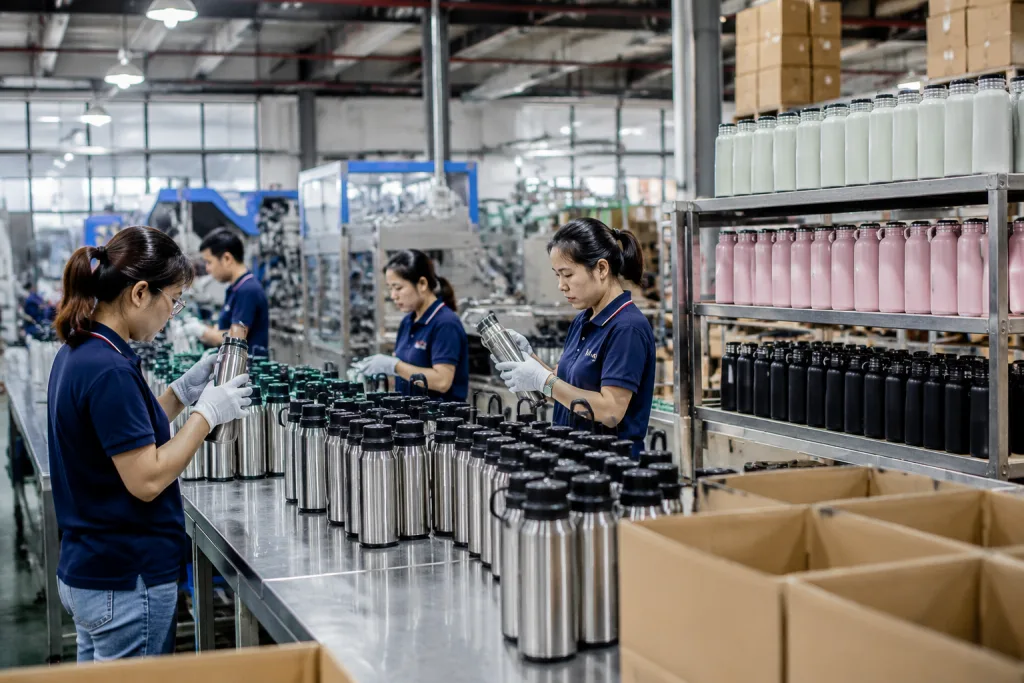
If you are sourcing for outdoor retail or a promo program, treat the first order like a controlled run, not a design exercise. In Zhejiang, a serious thermos factory asks for capacity, use case, finish, and test standard before it talks about print. That order matters. A usable custom thermos order starts with flask construction, then decoration, then the inspection plan. We run it that way because the math does not work any other way.
Start With the Order Use Case
A buyer usually calls this a stainless thermos order, but the factory reads a use case. A 500 ml giveaway for a trade-show booth is not built like a 1 L bottle for retail shelves. The first one can run a PP lid and single-color silk print. The second one needs tighter lid tolerance, stronger powder coating, and cartons that survive cross-border freight without corner crush. On the line, we keep those jobs apart from day one.
For an outdoor retailer, define the order before you ask for a quote: capacity, target retail price, carry style, heat retention target, and whether you need a custom thermos with a screw lid, push-button lid, or tea filter. For a promotional brand, the rules change. You want a promotional thermos that keeps unit cost down, prints fast, and stacks cleanly in cartons. In Zhejiang, a good factory thermos team asks these points early because a lid change after mold approval can add 15-25 days and a tooling bill. We've seen the buyer flag it after the PO went out, and the math does not work.
Do not skip the distribution channel. A thermos distributor selling into outdoor retail needs fewer defects per carton and cleaner packaging than a one-off event order. A thermos supplier running a distributor thermos program should also know barcode placement, master carton marks, and whether you need FNSKU labels or plain retail cartons. That sounds basic, but QC pulled the sample on a 3 mm print shift last week, and that is where the first orders get expensive.
- Retail program: durable coating, retail box, barcode-ready.
- Promotion program: lower unit cost, faster decoration, simpler packout.
- Outdoor program: verified retention, leak resistance, tougher lid.
Lock the Thermos Build
Set the flask spec first. A workable manufacturers vacuum flask order usually starts with 304 stainless for both shells. It keeps cost in line, handles normal corrosion, and passes food-contact checks without drama. For a premium retail line, some buyers switch the inner wall to 316, but the math is plain: cost rises about 8-15 percent, and you only need it if the bottle faces harsher use or the buyer is paying for the badge. We run 0.4 mm to 0.5 mm on the inner wall and 0.4 mm outside. Go thinner, and the line starts showing dents after carton drops and vacuum variation after forming.
The lid is not an afterthought on a bulk thermos program. It drives leakage claims, return rates, and the first hand-feel at the shelf. A PP screw cap works for a thermos bulk promo run. A stainless outer lid with a PP inner contact gives a cleaner retail read. QC pulled one sample last month with a 0.3 mm gasket seat typo on the drawing, and the buyer flagged it before mass production. If you need a tea infuser, write the mesh gauge and seating depth into the print; otherwise the factory will treat it like loose trim, not a controlled part.
Put the spec on one sheet and leave no gaps. Capacity tolerance, mouth diameter, finish, gasket material, and vacuum retention target all need to be fixed before sampling starts. A good thermos factory can hold 12-hour hot retention at around 60-70 C at room temperature, depending on fill conditions, but do not put that into a catalog unless the test method is locked. Ask for a sealed sample report. We’ve seen this go sideways when a buyer approved a casual lab note and then expected the same result on a hot-fill line in winter. Better factories in China will test to internal QC rules plus export buyer requirements like 100 percent leak check and 10-12 samples per lot for thermal validation.
- Material: 304 inner and outer shell, or 316 inner for premium programs.
- Thickness: 0.4-0.5 mm shell, with stable neck forming.
- Lid: PP, stainless, or mixed construction with silicone gasket.
- Tests: leak, vacuum decay, thermal hold, and lid torque.
Ask for the Right Quote
Price checks only mean something after the spec is locked. A 500 ml matte powder-coated flask with laser logo is a different job from a gloss-sprayed bottle with one-color screen print. We’ve seen buyers compare those two and wonder why the math does not work. For a promotional thermos, FOB China pricing usually lands around USD 2.20-4.80 on basic builds. A retail-ready insulated bottle with better packaging and a more complex lid sits closer to USD 4.80-8.50. Those numbers move with stainless cost, vacuum yield, carton format, and decoration method.
The quote has to spell out what is inside the price. Ask whether it covers inner box, master carton, drop-test packaging, spare gasket, and artwork setup. QC pulled the sample on a 0.5 mm carton gap once, and the buyer flagged it only after the PO typo left the carton spec out. A thermos manufacturer in Zhejiang may look cheap on the bottle, then add charges for custom cartons, molded trays, or multi-location printing. That is not a scam. It is a sloppy RFQ. The right move is to force every manufacturers thermos candidate onto the same sheet.
MOQ decides whether the project is real. For a new customized thermos design, tooling plus decoration setup can push MOQ to 3,000 pcs or 5,000 pcs. With existing molds, some suppliers will take 1,000-2,000 pcs if the print stays simple. If a thermos supplier says 300 pcs with full customization, ask what is actually custom; we’ve seen stock bodies passed off as factory thermos runs with label work on top. For distributors thermos programs, that difference decides whether you can reorder the same shelf item without redoing the whole line.
Buy the quote, not the headline price. Ask exactly which parts, tests, cartons, and artwork steps are included.
Proof Before Production
Before mass production, insist on a pre-production sample that matches the real order. Not a hand-picked showpiece. Run it with the same steel, coating, lid, and print method. That is where a thermos customizable concept turns into a usable product. If the buyer wants a laser logo, check brightness, contrast, and whether the mark still holds after 20 dishwasher cycles. If the spec calls for screen print, confirm ink adhesion and curing temperature. We have seen a clean sample fail once the line speed picks up from 18 bottles per minute to 30.
Freeze the sample against a signed reference. Keep one approved sample at the factory and one with your team. Add a measurement sheet with body height, mouth OD, cap torque, gasket hardness, and weight. QC pulled the sample at 500 ml and found a 20 g drift. That looks small on paper. The math does not work in a 40-foot export load, and it usually points to material drift somewhere on the line. The buyer flagged it, and we rechecked the PO before steel was cut.
For export buyers, ask the factory to confirm REACH and food-contact expectations in writing. If your market requires it, add FDA declarations, ISO process references, or market-specific packaging language. A serious thermos factory in China will sign those papers without drama. The weak ones stall on a typo in the PO or dodge the question about the test report. That is the wrong question to avoid. We ship a lot of custom stainless thermos and vacuum flask orders this way, and the paperwork has to match the carton mark before production starts.
- Approve a production-intent sample, not a showroom sample.
- Freeze critical dimensions in a signed spec sheet.
- Match the artwork method to the final line process.
- Keep compliance papers attached to the PO.
Control the Line and Cartons
On a real run, line control decides whether a manufacturers vacuum flask order ships clean or turns into discount stock. The shell can look fine at first glance, then the neck spin drifts 0.3 mm and the vacuum seal slips. We run checks at forming, after welding, after vacuum sealing, and at final assembly. Put the points in writing: appearance, leakage, insulation sample checks, lid fit, carton count.
For QC, AQL 2.5 works for major defects and AQL 4.0 for minor defects on a consumer thermos order. That is the starting point, not the finish line. We have seen buyers accept a small mark on the lid, then reject the same lot when one unit leaks after a drop test. For outdoor retail, tighten the leakage limit and the visual standard. For a promotional thermos, color lot match is the real fight. Pantone control and batch retention beat a shiny vacuum spec every time.
Packaging needs the same discipline as the bottle. A thermos distributor sending product into chain stores should specify carton strength, divider type, and a drop-test target. Export cartons should survive 5-7 layers without crushing the shoulders; we check that with compression samples on the line before we close the master carton. Master cartons need clear SKU, quantity, and batch number marks so receiving can book in without opening every box. If you are buying from a supplier thermos program in Zhejiang, ask for photo proof at packing and carton close-out. Cheap insurance.
- In-process checks at forming, welding, vacuum sealing, and final packout.
- Visual standard with retained master sample.
- Carton drop and compression requirements.
- Batch traceability for each production lot.
Set the Reorder Path
A first order should make the second one faster. Keep the mold number, lid code, print file, carton spec, and approved sample on file with the thermos factory. Once that pack is locked, reorder time can drop from 30-45 days to 18-25 days on a standard repeat run, depending on coating and packing work. We run into this every season with outdoor buyers who miss a restock window by three days and lose the shelf slot.
Ask the factory to mark anything that can break continuity. Powder coat shades can move between batches by 1-2 units on the color card. Laser depth shifts when the substrate finish changes. A customized thermos with a special lid insert may need a spare-part pool, and that is not a nice-to-have. QC pulled the sample and found a 0.3 mm difference on the cap seat; that sort of detail is where a reorder goes sideways. The factories in Zhejiang that handle export well treat documentation as part of the product.
Before you close the PO, confirm the commercial terms: FOB port, payment split, production schedule, and claim window. A common structure is 30 percent deposit, 70 percent before shipment, with 7 days for visual claims after delivery at destination. That is enough to keep the deal clean. Check the paperwork line by line; we have seen a buyer flag a PO typo on the carton count and the whole container had to be reissued. If you buy as a thermos supplier or distributor thermos channel partner, that discipline protects margin on the next container.
One clean data pack now saves a lot of guessing later.
Send your flask spec and get a factory quote
We can quote custom stainless thermos orders with clear MOQ, FOB pricing, lead time, and QC terms from Zhejiang production.
Frequently asked questions
What MOQ should I expect for a custom stainless thermos order?
For a real custom thermos with new artwork or a minor structure change, expect 3,000-5,000 pcs. If you are using an existing mold and only changing print, some manufacturers can work at 1,000-2,000 pcs. Sample lead time is usually 7-10 days, and mass production often takes 25-35 days after approval. In Zhejiang, many factories will quote faster, but check whether that includes decoration and packing, not just shell making.
How do I compare thermos factory quotes properly?
Ask each thermos factory to quote the same spec: capacity, steel grade, lid structure, decoration method, carton format, and test requirements. A USD 2.60 promotional thermos and a USD 4.90 custom thermos are not comparable if one includes a retail box and the other does not. Also confirm whether the price is FOB, whether samples are credited, and whether mold or artwork fees are separate. That is the only clean way to compare suppliers thermos offers.
What tests should I request before shipment?
For export, request 100 percent leak testing, visual inspection under your defect standard, and sampled thermal retention testing. Many buyers also ask for drop tests from 80-100 cm, depending on packaging and channel. Use AQL 2.5 for major defects and 4.0 for minor defects as a baseline. If the product is going to outdoor retail, ask the factory to retain samples from every lot and mark batch numbers on cartons and inner packs.
Which decoration method is best for a promotional thermos?
For cost control, silk screen is usually the cheapest on a promotional thermos. For a cleaner premium look, laser engraving is harder to wear off and works well on stainless surfaces. Powder-coated bodies can also take laser marks cleanly if the coating is set up correctly. The right choice depends on your target retail price and whether the bottle needs to survive repeated washing or rough field use. Your thermos supplier should show at least two finished samples before you approve production.
What should I watch in the first shipment from China?
Check carton count, SKU accuracy, print alignment, lid torque, and leakage on a random sample from every master carton. Also inspect dent resistance, because packing that looks fine at the factory can fail in container transit. For buyers importing from China and Zhejiang, keep the packing list, commercial invoice, and batch photos aligned with the approved sample. If you sell through a distributor thermos channel, make sure barcodes and retail labels match your receiving system before the container leaves port.